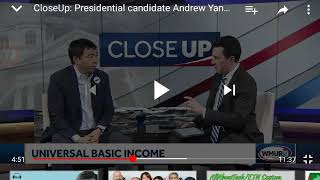
In this YouTube segment, the host introduces presidential candidate Andrew Yang’s universal basic income (UBI) plan, known as the Freedom Dividend, which would provide every adult in the United States $1,000 per month. The video plays a clip from a WMUR News interview where Yang explains that the funding would come from a value‑added tax (VAT) levied primarily on large technology firms that benefit from automation—companies such as Amazon, Google, Facebook, and Uber. Yang argues that the U.S. economy’s $20 trillion size makes a tech‑focused VAT sufficient to cover the program. After the clip, the host discusses the proposal, expressing caution about implementing UBI through traditional government channels and suggesting that blockchain or cryptocurrency‑based experiments (e.g., BitcoinMYK.com) could serve as a decentralized testbed. The host invites viewers to share their opinions on the feasibility and public acceptance of Yang’s funding mechanism, compares Yang’s economic framing to other candidates, and encourages audience participation through comments and a website experiment.
Chapters
Hey you, welcome back to the channel. And guys, today I wanted to revisit presidential candidate Andrew Yang, Taiwanese American who's running on the platform of universal basic income. And we want to target today, we want to look at his plan for paying for universal basic income for all Americans, $1,000 per month to meet their basic needs. So I'm just going to run some of this segment here from WMUR News, Channel 9, that talked to him about this.
Like, it's going to be a pretty big outlay in addition to all of the other major programs you're proposing. But how do you end up paying for this Freedom Dividend? So you have to look at it big picture where all of this money is getting sucked up into the cloud. It's heading off to the coasts. So And the big winners from all of these new technologies and innovations are going to be the trillion-dollar tech companies— Amazon, Google, Facebook, Uber. So what we're going to do is we're going to pass a value-added tax, which is going to get a lot of that money back and bring it right here to the people of New Hampshire so you can rebuild your Main Street economies. But our economy now is so vast, at almost $20 trillion, that a value-added tax that would fall most heavily on the companies that are benefiting from automation would be enough to pay for a $1,000 dividend for every adult. Let's shift some other domestic policy ideas, right?
So I'm going to stop right there because they're going into another area, and I just want to focus on, um, you know, how universal basic income is going to be paid for and how he came up with this, um, the, the idea of how it's done, um, you know, as this new wealth would be created through automation. And the value-added tax. And so there's been some controversy about that, but he, you know, speaks a lot in this interview about how the new oil of the future is technology, driverless cars, information, and things like that. And so, very interesting, but he's very, he seems very well-versed in um, when it deal— when it comes to dealing with the economics of where the money comes from and how much money we spend, uh, per year already, uh, in certain areas. But I'm going to leave a link in the description, uh, so you can watch this full segment as he goes into detail about this. Um, and, uh, you know, my personal thoughts, uh, looking at this, um, you know, I've been very concerned about this being done at the government level. Um, and I, I think with some of the technology we have today, such as blockchain technology, uh, I would much rather run these type experiments in a, uh, a system of choice, uh, using the blockchain technology, which is this trustless system, uh, these deflationary coins. And I believe we could implement a similar idea to this and see how it goes. At the very least, I think it will give us another option on how to explore this further. Um, but, uh, feel free to give me your thoughts about do you think if presidential candidate Andrew Yang's idea is going to work, about, uh, where he gets the money to pay for this, um, and, uh, you know, if it's going to be something that is accepted by the American people. You know, as you know, we have a great fear of these type systems that have come about. And even though Mr. Yang seems a lot more well-versed with the economy than some of people like we've gotten with Bernie Sanders and the Kasia Alexandra, Cortez, you know, his approach seems a great deal more, you know, centered in fundamentals. I think that work, you know, in economics, and I am ongoing trying to study, you know, some of his policies and how to deal with this, but I find them very interesting. Um, I, you know, it's going to be, uh, something to look at to see. I love to see him in a debate with this, running the numbers and see what people, people think. But anyway, guys, tell me what you think. If you're interested in universal basic income personally, I would love for you guys to come over on my website and try out our experiment with BitcoinMYK.com, where we use cryptocurrency to simulate what it would be like, uh, creating a universal basic income, uh, run by the people, uh, for people. Um, guys, if you like content like this, don't forget to like, subscribe, and until next time, take care.