
Andrew Yang - UBI & Presidential Candidate Vs Bitcoin Myk
In this video, the host introduces Andrew Yang, the 2020 presidential candidate known for championing a universal basic income (UBI) of $1,000 per month. He outlines Yang’s background, his business‑centric approach, and the economic case Yang makes: automation could eliminate roughly 49 % of U.S. jobs, so a VAT‑style tax on corporations would fund the UBI, stimulate consumer spending, and offset job loss. The host discusses common criticisms of UBI—potential misuse by addicts, welfare overlap, and the “socialism” label—while arguing that the extra income could improve health, mental well‑being, and entrepreneurial activity. He contrasts Yang’s platform with Bernie Sanders, emphasizing Yang’s market‑friendly stance. The second half of the video pivots to the host’s own cryptocurrency project, Bitcoin MYK, which incorporates a token‑based “social‑capital” or “time‑banking” system that distributes value similarly to a UBI. He highlights similarities (the $1,000 monthly figure, digital delivery, focus on dignity) and differences (funding via blockchain consensus, advertising, and decentralized value generation rather than government VAT taxes). The host also reflects on broader philosophical questions about automation, corporate freedom, antitrust, and what kind of society should be built. He concludes by urging viewers to explore both Yang’s campaign and the Bitcoin MYK token, positioning the latter as a private‑sector alternative to a government‑run UBI.
Chapters
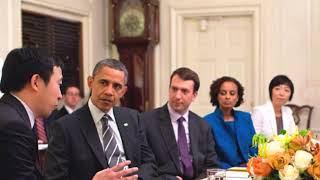
Hey you, welcome back to the channel. And guys, today I want to talk about presidential candidate Andrew Yang, who's running for office in 2020. And what's unique about Mr. Andrew Yang is he's running on the universal basic income platform. Um, and so this is very interesting. Uh, today I want to talk a little bit about Mr. Andrew Yang, uh, his position, uh, how he plans to, uh, incorporate universal basic income into our system, and I want to make a few comparisons between, um, what he's doing and Bitcoin MYK Universal Basic Income, see if there are any similarities there, what are the differences. Um, and so Mr. Andrew Yang is a Chinese American. He's pictured here to the left of President Barack Obama. Um, he had met with the president in several, uh, meetings dealing with Venture America, a company that he launched, or an initiative to give young entrepreneurs in, um, inner cities, places like Detroit and other economically challenged areas to create businesses and jobs. And, um, he was able to create a significant amount of jobs through this program. And, uh, you know, he's also a businessman, CEO, understands the economy well, an author, uh, who's wrote several books. And, uh, listening to him, after listening to him, because I just really found out who he was, but I can see he's starting to get popular. People are starting to really listen to him. Um, but I can tell you right off, um, um, I, I really like his energy. I like this guy. Uh, I like this guy, but I want to do a little bit more research on him before I can say that he has my vote. Now he does. I'm about 90% there of giving him my vote. So that, that just goes to show you the kind of impression he makes. And I'm usually pretty, uh, careful about candidates, uh, you know, when I really want to know their positions. But it's just something about his energy and his research that made a lot of sense to me as I listened to him speak. And I invite you all to, you know, look at his platform and, you know, and make your own decisions about him. But, um, uh, very interesting candidate. Uh, very interesting. I'm glad he's running. Now, you know, where I'm a little bit concerned about Mr. Andrew Yang is, uh, you know, it's not how he's coming off, but it's very easy to start to, uh, compare candidates to one another. And I think what problem could happen with Mr. Andrew Yang is he can get compared to Bernie Sanders. Uh, and Bernie Sanders of course was running on Democrat socialism. Uh, you know, the, the, it's a vast difference though in, in what Mr. Andrew Yang's talking about and what Bernie Sanders was doing. Um, and also, um, which was what was kind of, um, uh, you know, a big difference I find in, in Andrew Yang is that he has a very businesslike approach. So, you know, with Bernie Sanders, it just felt more like a career politician and, you know, him trying to demonize companies and people who make a lot of money just because they make a lot of money. And, and that's not what Andrew Yang is doing. Andrew Yang has come up with a universal basic income of about $1,000 per month to every adult. And he's made— he's arguing the case on his platform about how that can actually improve our economy. That is for everybody. And that, um, you know, basically that it actually creates, uh, it would be funded rather by VAT taxes, something that's pretty much all the world uses. And, um, it would be at a much lower rate, which basically is just a way of saying that, um, Many companies that are going to benefit from what we are predicting to be severe job losses in the future from automation, from robotics, companies laying off and using machines that can not only do the work better, but they don't have to worry about benefits. They don't have to worry about machine getting tired or anything like that. And so, uh, it's estimated that about half the workforce, it's like 49%, could lose their jobs due to this. This is because many of the industries that are going to be targeted is retail, um, the transportation industry, uh, the food industry. And, uh, so that's accounting for about 49% of our jobs. When you walk into department stores there are dozens of self-checkout lines, and the question is raised, then why do we, why do they even, why do we even need cashiers? You know, uh, you know, it's, it's really already signaling that the, the era of the cashier is over. Uh, same thing with fast food restaurants, same thing with transportation. All the truck drivers, it's going to be a lot easier to have, um, uh, trucks that can already do it, drive themselves. That don't get tired, have less accidents, have to worry about being sued less because the machine is probably, is definitely not going to have as many accidents as a human driver with vast amounts of issues. Uh, and so these are real concerns coming forward, and this is Andrew Yang's platform. Um, and you know, and going back to how he plans to pay for the companies that have been benefiting the most from the automation, like You might think of companies like Apple or Amazon, uh, when they're hit with a VAT tax, they might have to pay, their products might increase by 8%. But the argument is that if everybody has the new buying power now for an extra $1,000 per month, that would do very little to cause any kind of economic distress to them. They would be definitely way on the benefit side prospering. And the spending the money back into the economy would create, you know, more opportunity, more jobs. Now, not without issues, you know, of course, you know, ideas arise like, what about people who are drug addicted on opiates? You know, many of us already has the buddy or friend who can't stop smoking marijuana and weed and he, You know, he, he could probably envision a weed paradise, you know, where he would just sit down all day smoking weed. Maybe that's all he wants to do, uh, and then he's getting in there, he's receiving $1,000 per month. You know, what do you, what do you do in those cases? Well, you know, although, uh, you know, part of Mr. Andrew Yang's argument is things like that could happen, you also have to account for Uh, you know, there being, um, increases in, uh, food and nutrition. You know, people can afford to eat better, so then that, uh, also improves their mental health. So we got less people who are maybe even need to do drugs. You know, drugs also are kind of like a byproduct of stresses through life. They're products of, uh, mental illness. A lot of things that this extra $1,000 a month could help improve. And so, it could also be a part of his argument that that frees up time. You probably have people who become entrepreneurs. Maybe them guy who smokes marijuana decides to go to a drug, a state that is where drugs are legal, and maybe he starts a marijuana business. You know, also to keep in mind, part of Mr. Yang's argument is that that, uh, $1,000 per month is only about $12,000 per year. Uh, and the average American probably makes around $24,000 a year, which means probably not going to stop working. In fact, it's going to actually incentivize them in some cases to work more, and then they won't have the stresses of not making enough money, but then have a little extra spending money to, to get over the hump and do some of the things that they want to do in life. So a lot of people like this guy, Mr. Andrew Yang, and I, and I think he's going to be a a big force in this next upcoming election. Uh, I think he's going to be even, uh, even a more, uh, stronger, uh, have more of even a stronger, uh, impact than Bernie Sanders because this guy really understands the economy and he makes sense. Also, the $1,000 per month is also included as part of social programs and welfare systems. So that means that people are already collecting social programs and welfare. If they're already collecting like $1,000 per month, then there would be no need to give them the $1,000 per month. This would go out to everyone else. So, you know, the idea of this is just solve a lot of problems across the board, uh, economically, uh, in the, in the, uh, problems with automation in the workplace with the robots taking jobs and various things like that, you know. Also, something to think about, I think, is what we hear a lot is that, oh, you know, these programs, these ideas, they're nothing but communism. They're nothing but socialism. And what happens is you're taking money from someone else, someone else who has more money. So you're taking it and you're, you're, you're making everybody lazy. You're giving them money. They don't have to work, so they're not going to go to work. And you're taking it away from people who have, through ingenuity, uh, and invention, created this, you know, this wealth, this money. And so what I take from that is that whereas that argument is very true in many ways, I think the problem is you can't have it both ways. Are we going to accept that, uh, uh, automation and robotics is— people are going to be able to create these, um, these robots and companies and, and do all the works from humans, leaving the human state of value in, in perhaps maybe a lower, you know, place. Uh, and if, and if we accept that, and if that's the route we want to take if we want total freedom of people being able to, to earn whatever they wanted and do the things they want within our, uh, society, um, you know, then we can't really complain about jobs then. Because if a company or corporation can go and create robots that can do all the jobs of people, I would look at it as it being their right to do that. And, and create all these robots that do all these jobs, and if, if, if we say that it is, it is only fair that we have the right and freedom to earn and, and we shouldn't have to pay for somebody else, then I kind of look at that too as then we shouldn't have to provide a job for someone else, right? So I think it's a matter of we just have to decide what type of you know, people we want to be. That's just like when companies, um, back pre-1920s, they would create these big companies and they would, um, innovate and, and kind of monopolize, right? Buy up all the businesses and lands. And then we go, oh no, that's, uh, that's not right. You can't buy up all the businesses and companies to keep people from working and control all these enterprises. So we, we, we, um, we implemented antitrust laws. We stopped all these monopolies. But then it's kind of weird where we can have companies create robots that cuts 49% of the entire workforce and we're, we're okay with that. We're still arguing for the freedom to be able to do that. So I think it's just coming down to, we have to really take a step back and look at what type of society do we want to be. Is this the route we'd like to take? So these are, you know, some of Mr. Andrew Yang's arguments. I do have to do a lot more research on his policies and his stance, but I think I got the gist of it. And it's very interesting to see what happens with, with, you know, with him going forward. I'm going to pay close attention to him. And I really like this guy. You know, my— I don't really talk about my political positions a lot, but it's very conservative. And what I mean by conservative, I'm the type, if something costs, you know, you know, more, I think outside my living means I'm not going to purchase it. You know, I want to be in a sustainability situation. So I'm very conservative in those matters. So I understand all the arguments, but then there's a second argument to this, that if you are on that conservative side and you are the type that, uh, you wish to, um, uh, say things like, oh, this is socialism, this is a type of communism, and automation does take these jobs, then I think it becomes more of a situation of, uh, would you rather it be more so the government spending and handling this or the money going back to the people. And Mr. Andrew Yang, he went to talk about how this isn't a new concept, that this was almost passed in Congress, but I believe it was the— was it the Democrats? I believe wanted more income for the program per month. And that's what hung Congress up. I have to check check my history on that, but I, I believe that's happened. But over 1,000 economists were in support of universal basic income because they had been fearing automation, uh, coming in the 1970s, uh, and so big, big, uh, great economists like Milton Friedman was for it, um, civil rights leaders like Dr. Martin Luther King were for it. So there's a lot of people, uh, who saw that this would be a solution, and Congress was about to pass it, but, you know, they just kind of pushed it a little bit too far, and that's what caused the hangup. So these aren't new concepts, you know, they're just kind of repeating. Um, so I think that kind of covers as much as Mr. Andrew Yang's platform as I can at this point. I'm going to leave some links in the description so you can check out his, uh, his presidential campaign and his views. I think they're very interesting. And if you're interested in universal basic income, I think you're really going to like him. Uh, so let's just compare a little bit Bitcoin MYK. You know, many of you who watch the channel, maybe this is your first time watching it, uh, you know that I launched Bitcoin MYK, which is a fork of Bitcoin, but it's also now implemented from, um, certain value we create through the token Universal Basic Income. And it's a little— it's not a Universal Basic Income token. I like to make that point. We are, we are a sustainable token, we believe, based on things that work in economies, that work in value, value-wise. And there's a percentage of this value that is implemented into universal basic income. So a little bit different from just being a universal basic income token. Now, if you're totally new to cryptocurrencies, Bitcoin and these things, There exists in the cryptocurrency space versions of universal basic income tokens that haven't worked well because they're underfunded, and I just don't think they've caught on for whatever reason yet, probably because they aren't sustainable. And so what we're attempting to do is address the parts that make these type situations unsustainable and, uh, correct it there and go forward from there. But interesting enough, uh, if you are familiar with Andrew Yang, you've heard him speak of what would be a, um, a digital social currency, which works a lot like what we're basing our token on, which is this type of social capital slash time banking token. And It's, it's, it's very interesting. The comparisons are so identical here, and I didn't even know about Andrew Yang's platform, but when I set the token up, it's almost identical to many of the things he addresses in his digital, uh, social currency token, which seemingly would be a way to deliver this universal basic income to families, this $1,000 per month, because you're going to need the platform to do that, to reach everybody, to get the funds out. Blockchain technology, what BitcoinNYK uses, makes it very easy for us to do that. We already had a platform set up, but just going over some of the comparisons and some differences so we can find them, uh, you know, of course, the, you know, the, the, the, the idea what he has for the social, uh, aspect of it, you know, uh, time banking, where people actually put the value in the token from what they do and how they exchange their values with one another. We use the blockchain and digital technology in order to make that possible by exchanging value from one person to another over several blockchains, over several value consensus models. And we'll leave links in the description to go deeper into detail if that— if you're new. But we invite you to, if you're interested in universal basic income, this token is for you. So we, we definitely want you to come over, take a look at it. But there are a lot of similarities in what he's saying about that digital social currency token that seemingly he would want to use in order to implement this $1,000 per month to everyone. That is similarity, uh, before we even knew about his platform, we also came up with the idea $1,000 per month is what we would be, uh, given out in value to people. And that would be the hope. And that is because $1,000 per month seemingly seems to, I think, cover most of the average basic living needs for most people across the globe. So many times these programs come up with a number like that. So we're, we're, we're, we're, uh, very similar on that. We're the same on that, actually. Um, what I think is a little bit different is, you know, of course In this program, you know, they would have to tax big companies and big corporations. We use a different approach. Our value of money comes from several consensus models across the blockchain, blockchain social media sites, offers, programs, advertising, things linked across the internet and social media that offer value through our interaction over the internet. So in many ways, you know, and the basic ideas of how money is made across the internet, it goes back into Bitcoin and YK through use of a kind of huge social media platform that's linked like a hub to many others. You know, I think the hardest part, uh, and the big differences is because it's being run on a government platform, it's going to always feel like this type of socialist paradigm where you have to tax someone and move money from one place to another. And I, I think our program is very much so privatized that you don't have to target any direct entity. Um, and, uh, you know, I think that is probably going to be digested a lot, you know, better by a lot of people, especially people who don't like programs like this. Uh, interesting enough though, uh, Mr. Yang's platform speaks about how it costs about $2 trillion, but it can be reduced with the VAT tax to something like $800 billion, uh, uh, $800 billion reduction. So probably a little bit over a trillion $1 trillion a year to come up with, uh, prob, um, you know, to get the additional funding. But, uh, seeing that we're already paying out like $500 billion a year in programs and, um, welfare and various governmental social programs, uh, it wouldn't be that far of a leap to take a go a mile further with the many benefits to the economy he underlines, which I have to go a little bit more in depth about and research about it. But, um, it does sound quite plausible and feasible and it sounds quite interesting. Uh, so definitely something to take a look at. But, uh, those are about the differences between the two platforms. I just thought it'd be interesting, especially a lot of you who are interested in Andrew Yang. That, um, you might want to check us out. Uh, we are testing this model now and I think it's going to be quite interesting. Uh, and, uh, uh, it's something that you can do now while hopefully we will get to see someone like Mr. Andrew Yang in the White House who can solve problems, you know, not just for a few people, but for the overall economy and give people their dignity and value back. You know, something that I think gets lost a lot in our conversations with these systems. We forget about human dignity and we tend to focus on, uh, oh well, you know, oh, I just want all my money to myself. I don't want to give this person anything. But when you look further into the economy and understand how money moves, how value moves, what people do with money, that you have entrepreneurs pop up here and there. They use that money to fund various programs, that they use a little money over here to improve their health so later on down the road you don't have to pay for their disability, you don't have to pay for their medical insurance. It's so much that goes into this that it does take a little research and, and being a little bit more informed. And, uh, you know, I understand that, you know, we live in a world now where that's becoming very harder to do because Uh, you know, people tend to, you know, I mean, who wants the problems? That's why we have leaders. You know, we hire them because we don't want to deal with the issues. We'd rather they deal with them, put on somewhere else, someone else's shoulders. But also, I think the world is getting smaller and we're starting to become a lot more responsible and a lot more involved in our world and the economy and the reality of our situation to say, well, hey, you know, regular Joes, people like you and myself, are going to have to start doing things and stop depending on others to do it for us. And then we see the wreck they cause and then we complain. But sometimes you got to roll up your sleeves and get involved and try to do the things to make the system better as well. But guys, that's all I got today. I hope you liked, enjoyed the content. If you're in a Universal Basic Income and building value, social capital with people where the value comes from us. Uh, feel free to check out our website BitcoinMYK, get involved with that. Check out Andrew Yang's platform. Um, you know, if you, if you, if you're dissatisfied with Donald Trump, if he wasn't your promised president, uh, maybe someone like Andrew Yang is. Um, so we'll leave a link in the description. Guys, that's all I got today. Guys, if you like content like this, don't forget like, subscribe, and until next time, take care.
More from Michael







UBI - CIA Agent Explains Why Americans Will Never Get Universal Basic Income?



