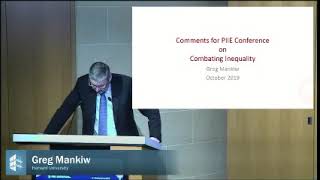
In a clip from a Peterson Institute conference, Harvard economist Greg Mankiw discusses the feasibility of a value-added tax (VAT) to fund a universal basic income (UBI) of $1,000 per month, which Andrew Yang calls the Freedom Dividend. Mankiw expresses skepticism about the political implementation of such taxes but acknowledges that, if successfully enacted, a VAT could raise sufficient revenue without penalizing frugality, unlike other redistribution ideas. He contrasts this approach with wealth taxes and targeted UBI schemes, noting that a universal payout can cost roughly the same as a means‑tested program. The video’s host (Speaker B) then highlights Mankiw’s credentials—Harvard professor, highly cited economist, bestselling textbook author—to argue that his support should temper emotional objections to UBI. The host links Yang’s proposal to Milton Friedman’s negative income tax, cites a 1968 consensus of over 1,000 economists, and points out common misconceptions about the program’s cost (e.g., the inflated $3 trillion figure versus the more realistic $800 billion annual cost). A Harvard student survey is mentioned, showing that 90 % of respondents incorrectly believed a means‑tested UBI would be cheaper than a universal one, illustrating a broader misunderstanding of economic trade‑offs. The commentary concludes by emphasizing the bipartisan appeal of Yang’s plan and urging viewers to consider the data and expert analysis rather than rely on intuition.
Chapters
Now, I'm skeptical that these taxes can be implemented successfully, but I'm not going to actually talk about that today given the limited time. But let's suppose they are implemented successfully. These taxes are going to hit Frank Frugal hard and it'll be much easier on Sam Spendthrift because he doesn't accumulate the large nest egg. They might say, "Okay, well, that's just the cost of redistributing economic resources." And if this is the only possible tax on the table, then I can kind of see the argument in favor, but there are a lot of other ideas that are on the table. I think in particular, there are ways to redistribute economic resources in ways that do not penalize frugality. In particular, I am attracted to something along the lines of the policy now being championed by Andrew Yang, the former tech executive and the entrepreneur who is now running for the Democratic nomination. Mr. Yang proposes enacting a value-added tax and using the revenue to provide every American with a universal basic income of $1,000 a month, which he calls a freedom dividend. It's pretty easy to see how this idea would work. Value-added taxes are essentially sales taxes. They're used in a lot of European nations, and they've proven—
Welcome back to the channel. I hope you all are having a great day. So, very important video today, uh, one I'm happy to see Uh, it's basically the combating inequality, uh, basically a conference that is being held by the Peterson Institute on Economics. It's international. And the speaker you see here goes by the name of Greg Mankiw. Now Greg Mankiw is an American macroeconomist who is currently the Robert M. Baron Professor of Economics at Harvard University. A 2011 survey of economics professors named Mankiw the second favorite living economist under age 60, just after Paul Krugman and just before Daron Acemoglu. Mankiw has written widely on economics and economic policy. As of April 2016, the RPEC Overall ranking based on academic publication citations and related metrics put him as the 23rd most influential economist in the world. Out of nearly 50,000 registered users, or authors rather, he was the 11th most cited economist and the 9th most productive research economist as measured by the H-index. In addition, Mankiw is the author of several bestselling textbooks, writes a popular blog, and since 2007 has written a column approximately monthly for the Sunday business section of the New York Times. Now, so basically what we're getting with Greg Mankiw is we see that Greg Mankiw is not just an economist, but he's one of the best economists in the world. Right. Cited to be number 23. Um, he is also, as we can see, very much in support of Andrew Yang's Freedom Dividend. And so we're going to leave a, um, a link in the description to the full video from the Peterson Institute. But this is very important because what I think has to happen with Andrew Yang's proposal of the Freedom Dividend is I think I first have to ask people to just for a moment suspend emotion, right? Suspend your natural inclination to, at surface level, see that the idea of universal basic income or Freedom Dividend will do things like cause inflation or hurt the economy or something like that, first consider the very high intellect of people like Greg Mankiw that haven't received these honors for nothing. And let's perhaps, you know, if you're not Yang Gang and you're thinking about this subject, just for a moment, just be a little bit humble and then we can kind of, because sometimes that's what it takes, right? Makes, uh, just, you know, that we don't know everything and that's, and that's okay. It's okay that we don't know everything, right? We learn when we, I think we get to that point. And, uh, at surface level, um, if I didn't have any financial background, if I hadn't worked for several investment firms, I'm very sure that I would look at what Andrew Yang is proposing like a lot of people do. Right? I would look at it like it was something that isn't going to work, isn't going to cause inflation, because the economy is actually a lot more complicated than we think. And things happen in the economy that aren't always expected. And if we knew what was going to happen in every way, we better control the economy, but we can't. And that is an indication that, uh, the economy could do things that we don't expect it to do, right? And some of our ideas about the economy and theories about the economy don't always go the way we think they're going to go, right? But this is very interesting, this presentation Great Mankiw gives, because he gives this very interesting— you'll get to see it in, you know, with the link— but he gives this very interesting, uh, example of where Uh, he surveys some Harvard students and, uh, and, and one, uh, idea to combat inequality, they, uh, of course it's a broad topic and way different ways to combat inequality. But of course this conference is about getting to some of the more efficient ways, right? Uh, he talks about people like Elizabeth Warren's wealth tax and Bernie Sanders. He doesn't believe it's going to work, right? Um, and that he's favorable to what Andrew Yang's proposing, right? So there are many ways people are going at it. But what was interesting was that in an example of where people will receive a type of universal basic income, there's one example he gives where it's only going to needy people. And people are thinking that, and then the other one of course is Andrew Yang's version which goes to everybody. Now the Harvard students, I think it's like 90% of them believe that basically the one that only goes to needy people will cost much less than the one that goes to everybody, right? This is another fallacy and misunderstanding of economics, right? But as Professor Mankiw points out that how Andrew Yang's targeting the VAT tax and a variety of other specifications, that these two, uh, uh, ways to combat inequality end up costing about the same thing, right? So there's no difference in the examples, and you'll get to see exactly that example. But I just thought it was so interesting, and I think it speaks to, uh, you know, a lot to the, the idea that we don't quite understand the economy and we don't quite know what's going to happen. And in these particular cases, um, you know, I do think it makes a lot of sense to use the data and information and the credibility of people like Professor Greg Mankiw, who has done so much in economics and understands the complexities of economics much more than I can, and I'm definitely sure, uh, much more than many of you all can now. Also, I want to focus on how Andrew Yang policies crosses party lines, and that's going to be very important, uh, as this, you know, in a political setting of who does this serve. And this is why Andrew Yang can reach so many Republicans, independents, Democrats, because at the very core of some of the policies that Andrew Yang is proposing, Um, some of it is actually quite conservative, right? People like, uh, Nobel Prize winners like Milton Friedman, uh, have, uh, basically, uh, championed ideas like the negative income tax. Now, a lot of us don't really know what the negative income tax is. It works something like UBI. If you don't earn money, then you, uh, you did— the government essentially gives you so much money per year, right? Whether you earn it or not, you know, you're going to make a certain amount of money. So it's kind of like universal basic income, uh, in reverse. And, uh, Professor Greg Mankiw here states that how very close, uh, Andrew Yang's— in fact, he's pretty much saying it's essentially the same thing. Andrew Yang's universal basic income is gonna— is playing out just like Milton Friedman's, uh, negative income tax, right? Now, it is also very important to note that in 1968 these very core ideas and similar, pretty much same ideas, was approved by over 1,000 economists, right? 1968. Now, just like Professor Mankiw says here, uh, what, what are the chances, or, or could it, could it be that 1,000 economists could be wrong? And the answer is, from Professor Matthew, yes, they could be wrong, but he doesn't believe they're wrong, and more than likely they are not wrong. And I believe the same thing, right? And so this is all very important to consider what we're hearing here, right? Because this comes from a lot of research. This comes from a lot of smart people. Very smart, not just smart people, but the most, the most intelligent economists, the best economists, right? Milton Friedman, Nobel Prize winner of economics. Greg Mankiw, 23rd, uh, most influential economist in the world, and all the other accolades and honors that I read off in the beginning. Is there any reason to believe these people are that incorrect on Andrew Yang? Is there any reason for us to believe that they're wrong and that there will be all this inflation, uh, when they've run the numbers and they're finding out that, uh, many of these ideas will, uh, either not cost much more money or not be significant enough to cause any additional problems. Um, in Andrew Yang's policy, he's shown a lot of numbers where the budget's going to come from to pay for this, what the total impact of it's going to be, what it's really going to cost. A lot of people start at $3 trillion, which is incorrect because they forget about the people already on social programs and who will have to opt one or the other. So when it's all— the numbers are all crunched, it comes in, and Andrew Yang's number, something like $800 billion a year. But The bottom line is we know it's going to be lesser than that $3 trillion. We know that $3 trillion is an inaccurate number, right? Um, but why are we so confident? You know, why is the, why is the, uh, you know, the, the, the every everyday guy like many of us who, uh, doesn't study economics, doesn't know, why are they so passionate and why are they so, uh, dead centered on Uh, this is what it's going to be, you know, much like, uh, Professor Mankiw gives the example of how 90% of the Harvard students thought that they were right and that it would cost less money if you only gave the $1,000 per month to needy people, right? Now, as much as I love Marianne Williamson, if you look at her plan, that's basically what it does, right?
It—
she gives— she has a universal basic income, but it's $1,000 only to people who need it. And I, I understand what Marianne's heart is and I love her to death, but, uh, not giving the Freedom Dividend to everybody is a misunderstanding of the policy and the entire economics of how this works, right? And so you have to kind of understand that it's not some type of social welfare program, right? This is something to, uh, basically stimulate the economy and move money through the economy, something we need, right? Uh, every advanced civilization has some social program to keep it going. But this is something else. This is something that can really work across the board for our economy. It's not a handout, it's not giveaway, it's not welfare. It is a dividend that allows us to share in the prosperity of the richest country in the history of the world. And, uh, um, you know, as citizens, this is just something that's went on throughout history. Many civilizations that have been advanced, that have been rich, have ushered some type of universal basic income to their citizens. And that's just how it's been. It happened in Rome, it's happened out through the course of history. So this is something that works, can work. Uh, we have, uh, world-renowned professors saying it can work. And so at this point, I really don't think this needs to be a debate anymore. Interesting enough, if you watch the video, you're also going to find that Professor Greg Mankiw talks about how they even talk about and release data about universal basic income is outright deceptive, right? Do you understand what I'm saying? That the media companies that are putting this out, how they're trying to frame it, how they're trying to knock Andrew Yang down and make him sound ridiculous. And how we're picking up the message and go, oh, it's going to cause inflation, this does work. We're puppeting, uh, information that very educated people who specialize in economics at the top of the area are saying is deceptive, right? That is incorrect information, and we shouldn't puppet that. We should get more educated about it and, uh, uh, and, and study a little bit more upon it, and then we will be able to put out accurate data and understand how good this could be for America. Right? And so something to think about, guys, but check that out. I'm glad to see, uh, the data now backing up Andrew Yang. People really coming forward now and, uh, saying they support Andrew Yang. I believe if Milton Friedman was alive, he would support Andrew Yang. And, uh, again, these are all conservative people on the conservative side, right? These are not Democrats, right? These are not progressives. So this echoes and resonates to all people, right? As what a good policy should do. Real quick guys, our project, BitcoinMYK.com, you need to join that. It's a free project. It's us, our experiment with universal basic income. It's a lot of fun. We give out cryptocurrency, which you can redeem for cash in local communities, or you can keep it in cryptocurrency and do cool cryptocurrency things. And buy things like you buy with cash online and a variety of things. It is created for you. It will benefit you. Don't miss out on that. Try that out today. We'll leave a link in the description. But that's all I wanna say in this video. If you like content like this, don't forget to like and subscribe. And until next time, take care.