
BBD Coin - Withdrawal Fee 8.9% Increase
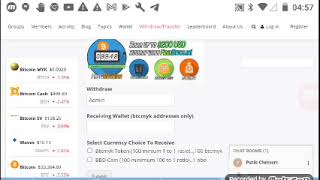
BitcoinMYK charges an 8.9% withdrawal fee to fund a universal basic income program. The presenter argues the fee is necessary to provide a basic living wage and compares the model to free social networks like Facebook that generate value through network effects.
Chapters
Welcome back to the channel. I hope you're having a great day. So today we want to talk about the BBD coin withdrawal fees being at 8.9%, and that seems to be kind of the magic percentage with most of the, um, the fees that are associated with moving the BBD coin, um, whether it be moving it to another blockchain or withdrawing it out to an exchange or or your wallet or something like that. Um, so let's talk about why the fees are so very high. The 8.9% is pretty high, and, uh, we're going to talk to you about why it is that high. So many of you all who understand the BitcoinMYK project, you understand that it might be one of the most ambitious projects in the world. And the reason I'm saying it like that is because, um, it's centered around universal basic income. This is something that the greatest minds in history have been trying to get right for a long time. Economists, great figures in history, um, in modern— in our modern-day history, we know universal basic income, the concept started around 300 years ago. People like Thomas Paine championed it, that everybody should receive this basic living wage in America. So it's a very American idea, but that's in our modern-day history. Ideas like universal basic income sure have existed since the dawn of time. People figured out that, you know, that resources should be distributed amongst communities, and, and that community taking care of that community, make sure that community was healthy, was a priority. And it was great for the survival and the growth and health of that community. So I'm pretty sure that universal basic income didn't originate with Thomas Paine. Later on, of course, people like Dr. Martin Luther King, Milton Friedman, they championed the idea, so on and so forth. But one thing that always comes upon the discussion is the, the cost of universal basic income. If you're gonna provide everybody with a system like this, it's going to cost a lot. So a lot of people ask the question, how do we pay for this? So it's a twofold question. We're gonna take them apart so you can get a basic understanding of it. The basic basis of the first part of the project, uh, how we're able to pay for this is in its core nature of being a Bitcoin fork. So what happens? How does this work? So a lot of people don't know that most of the cryptocurrency that exists gets distributed to Bitcoin holders, right? A lot of people don't know this because they haven't read the white paper yet, and this is a big problem in cryptocurrency. A lot of us are still chasing pump-and-dump coins, Ponzi schemes, pyramid schemes. And because these cryptocurrencies are so small, it's very easy for you to be in one of them and don't even know it. In fact, some of you watching this video right now are in many, might be in one right now. Um, because of that, they don't get a chance oftentimes to do any research, look into the white papers and see that the idea, the very core idea of the BitcoinNYK project is to be a Bitcoin fork. What generally happens is this type of osmosis and, um, you know, being a Bitcoin fork, Bitcoin's, you know, worth, uh, you know, almost trillion dollars, trillions of dollars. That value then comes into— through this osmosis, when a fork happens, some of that value can transfer over to, uh, projects like Bitcoin MYK, right? It is the— Bitcoin is the biggest cryptocurrency out there, it's the most known, it's still the most trusted, it's the most, um, used to buy altcoins for the most part. So there's money being transferred through it, but, um, because of that, it just makes more sense to be involved with the biggest network somehow. Now, of course, the other structure comes down to the transactions, right? Uh, whether you're paying miner fees or some transactional system. The way that the Bitcoin MYK project works is you're paying the transactions to move the cryptocurrency from blockchain to blockchain, and you're paying the transactional fees to withdraw the coin, for the most part, moving it over networks like whether it's Hive or Steam or Waves are going to be almost going to be feeless to very low fees, right? It's going to be done in a way on the back end that you can't really see the fees, so you're not going to really have a problem of, you know, paying fees like many other cryptocurrencies you have to pay ridiculous fees where there's Bitcoin and Ethereum. Because Bitcoin MYK doesn't suffer from that problem, oftentimes it's going to be a lot more appealing to move it, right? And so if you're getting so many Bitcoin MYK because you hold Bitcoin, it's going to probably be appealing to go, okay, I prefer to move Bitcoin MYK. It's easier, it's cheaper, it's faster, it's almost initially free, essentially free. Um, and so that's going to make people want to use it, right? At least in that use, in that capacity, more so. But the 8.9% fee obviously is going to help and aid in paying for universal basic income. And that is because part of this ambition of this project is also weighted in— imagine, uh, a cryptocurrency like Facebook, right? If Facebook had a cryptocurrency with that many people. If you really look at the structure of the BitcoinMYK project, it's almost designed and structured a lot like Facebook to be easy to use, and a lot of governance is conducted by the groups that are formed in the platform. So because of this, um, we expect a lot of value in this project as time goes on. It, as it is a freemium service and it is not centered around buying the cryptocurrency, it is designed to function without purchase of the cryptocurrency, right? Because its design is in that capacity, we expect a lot of users. Like, you can draw a lot more people when your network is free and the people are getting as much value as if they paid for premium service. That's why many of the social media sites get so many users, because they don't have to pay membership fees. If you look at something like Instagram, imagine if Instagram just went, okay, Now it's going to be $9.95 a month. It's going to be $29.95 per month. Would they have as many users? Absolutely not. They wouldn't have as many fans. There wouldn't be as many fans. And the same thing with Facebook. And so that's why we stick to the freemium service model. It's just that ours has a cryptocurrency with it, but the growth of the network is what's really creating the value, right? And one day we'll do a video on that to explain that further in depth. A lot of people are kind of lost. They, don't connect the growth of a network, the size of network with the value of a network. They still just feel like if a whale comes in and puts up some money, that's enough, right? They feel that whale is not the economic engine behind that. But as I said, we'll explain that in future videos. What we need to understand now is that this is a self-generating system value-wise. When accounts are formed, they mint the cryptocurrencies, they receive the cryptocurrency. When, um, the fees, uh, when they try to withdraw the cryptocurrency, so many of 8.9% go back to be recirculated as universal basic income, right? So that's helping to fund these projects. So that's, that's why it's going to 8.9%. Uh, most of the other fee structures work in that, in that, um, on that level again to pay for what's going to be a very ambitious, expensive project. But that I believe is going to be the, uh, the key to cryptocurrency becoming mainstream, being mass adopted. When everybody know all they have to do is sign up to BitcoinMYK.com, they don't need any money, just sign up and participate like they already do on many social media sites and they're tokenized. When they realize that and when they start using BitcoinMYK, that's when we're gonna see this tremendous big network, we believe, grow. And have this tremendous value. And, um, we see no reason why that isn't conceivably possible and likely. But that's the explanation of why the 8.9% fee. And that's all I want to say in this video. If you like content like this, don't forget like, subscribe. Until next time, as always, take care of yourselves and eat cheddar.
More from Michael







UBI - CIA Agent Explains Why Americans Will Never Get Universal Basic Income?



