In this video, the host examines whether Bitcoin MYK (also referred to as Bitcoin NYK) offers greater decentralization than Bitcoin itself. He begins by referencing economist Nouriel Roubini’s claim that crypto decentralization is a myth, highlighting concerns about centralized miners, exchanges, and developers. The speaker explores the practical barriers to mining Bitcoin—expensive hardware, expertise, and concentration of mining power in large data centers, often located in China—arguing that this undermines true decentralization. He also mentions Craig Wright’s Bitcoin Satoshi Vision as an example of a top‑10 coin that relies on large‑scale mining. The discussion then shifts to Bitcoin NYK’s design, where anyone can become a “network supplier” using simple tools like a website or WordPress plugin, and token distribution is governed by an election process. This model is presented as more democratic and accessible, potentially offering greater decentralization in spirit, though the system still depends on proof‑of‑work for security. The host concludes by inviting viewers to share their thoughts on the trade‑offs between decentralization, security, and practicality in both Bitcoin and Bitcoin MYK.
Chapters
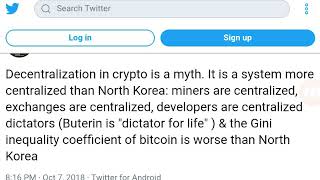
Hey you, welcome back to the channel. And guys, um, by the title of the, um, of the video here, uh, you can see that I'm posing a question: is Bitcoin MYK more decentralized than Bitcoin? And this can be a kind of confusing question because, uh, you know, we tend to think of Bitcoin MYK as an extension of Bitcoin, uh, you know, meaning if As you buy more Bitcoin, you mine more Bitcoin. Uh, you— that transfers to Bitcoin NYK value, which you get from that. The more you mine, the more you buy, the more Bitcoin NYK you, you get. So they're almost joined at the hip. Um, but it, it got me thinking about, uh, the centralization and centralization as compared to these systems, right? And I was reading up on this prominent economist, uh, Roubini, and he spoke about Bitcoin. And then he tweeted this. He tweeted that decentralization in crypto is a myth. It is a system more centralized than North Korea. Miners are centralized, exchanges are centralized, developers are centralized dictators. But I mostly focus on this particular part where it says miners are centralized. And I thought about mining in Bitcoin, and I thought about the, the whole idea of decentralization. And I guess the question I'm trying to ask is, in the idea of decentralization, what are the parameters because I agree that a system itself can be decentralized and have great security, right? Um, but we can also have a centralized system that has great security. And when he says in this tweet that miners are centralized, right, it got me to thinking, what would it take for me to be a miner? And I got on the idea of, I don't think I would want to be a miner. Um, you know, I would— you have to go out and buy heavy equipment. You have to do the, the, uh, this expensive, uh, to mine the Bitcoins. And it's not practical for some people. Some people don't know how to do it right. Some people just don't have the expertise. Uh, some people want to do it but aren't able to do it because they can't afford to do it or what have you. But the, what the problem with all that is it kind of condenses the miners into a, which could potentially be a very small group of people, uh, and the idea, in the broad idea of decentralization, wouldn't that kind of then, uh, reduce decentralization, at least just in that area? Right? If there is an area of centralization in the exchanges themselves that conduct most of the value of the cryptocurrency of Bitcoin, most of the trade volume of Bitcoin is handled on centralized exchange. If the developers are themselves centralized, right? You know, meaning the people who develop this system and then down to the miners, um, Then how do we break this cycle, right? Because then what we, we do end up with a form of decentralized technology, meaning everybody comes in and they have a decentralized use of this technology. I, I guess the, the easiest way to put it is a comment that was made by Dr. Craig Wright, and I'm pretty sure most of you know who he is. 'Cause a lot of people in the cryptocurrency don't tend to like him very much. But whether you like him or not, whether you agree with him or not, what is clear is that when he launched Bitcoin Satoshi Vision, it was a top 10 coin for a long, long time. And it's still somewhere around that mark, worth billions of dollars. And statements that he was making was to the effect of, that Bitcoin was never meant to be mined at home. It was meant to be mined by these large data centers. And if that's true, if Bitcoin is meant to be mined just by large data centers, with most of them being mined probably in China, then that doesn't feel like real decentralization to me, right? That feels like a form of it, but it doesn't seem to touch on all the parameters of decentralization, uh, that are important to me. And so that's kind of concerning to me. I'd like to hear you guys' thoughts about that as well. But it got me thinking, where does BitcoinNYK fit into this? Our project, uh, you know, obviously Bitcoin NYK was meant to be this arm of Bitcoin, right? Um, to be, to make Bitcoin work a little bit better, a little bit more efficient alongside with it offering this, this other solution. Um, you know, however, uh, what I find about Bitcoin NYK that seemingly works a lot better, I think, for us is one is that anybody can basically run BitcoinNYK, be what we call a network supplier, which is kind of similar to mining and block producers and things like that in our ecosystem. And it's basically, they collect and distribute out these tokens along the network. Now they can do this, anybody can do this that can run a traditional website. You can use a WordPress plugin. You can set up pretty much any type of website that ties back to the blockchain, links back to the blockchain. And it's pretty much democratizing that. Then there's an election where people are voted on to how many tokens they receive throughout the course of this system. Now that feels a lot more like democracy decentralization to me. And I say that because anybody can do this. It's very cheap to do it. Anybody can jump in and start doing it. And, uh, I won't go into all the details of it, you know, we do that on other videos. But from the setup of it, just by making it easy for anybody imaginable to be able to pretty much distribute this token and help to create the value of this token in comparison to what we get with the proof-of-work algorithm makes me, you know, want to say that Bitcoin NYK is a great deal more decentralized, if not in technically, definitely in the spirit of it. Now, that said, we need proof-of-work. Right? And so I can't demonize it because it's necessary for Bitcoin NYK to function. It's necessary for every blockchain to function to some degree. Uh, so we need the proof of work algorithm, but it just makes me beg the question, if I'm looking for a more fairer, more decentralized, uh, model and idea, it would have to be something like what Bitcoin MYK does, which allows a great deal more democracy, literally, right? And we just can't get that with Bitcoin, right? We can't get the mine, we can't get rid of miner monopolies that's controlling most of the mining, right? We can't seemingly get rid of centralized exchange. We can't get rid of decentralization of the developers like the economist here, Roubini, speaks about. And these are very, very difficult workarounds, it seems. But it's just a question that came to mind in looking at the connection between Bitcoin and Bitcoin MYK. But guys, that's all I want to say in this video. Would love to hear your opinions. If you like content like this, don't forget to like, subscribe, and until next time, take care.