
Bitcoin Cash - SLP Dex & Btcmyk Free Cefi This Month!
In this video, the presenter discusses the Simple Ledger Protocol (SLP) on the Bitcoin Cash network, noting the imminent launch of an SLP-based decentralized exchange (DEX) that would enable cheap, rapid token creation (over 9,000 tokens at under $0.10 each). He compares SLP to the earlier Waves token platform, arguing that technology alone isn’t enough for adoption. The talk then shifts to CeFi (centralized finance) versus DeFi, introducing BitcoinMYK – a multi‑chain cryptocurrency built on top of Memo.cash, a Bitcoin Cash‑based social‑media platform where users can create and trade tokens. BitcoinMYK aims to provide a universal basic income (UBI) token that is free to claim, deflationary (burned on transactions), and backed by a “free centralized finance” (CeFi) system. The CeFi model involves buying a stable‑coin‑like NFT token with the free UBI coins; the purchase funds are burned back into the BitcoinMYK supply, and the token’s value appreciates modestly (e.g., $1 → $1.30 after 30 days). Redemption is possible at market‑derived value, avoiding promised returns typical of Ponzi or high‑yield DeFi schemes. The presenter highlights arbitrage opportunities across multiple blockchains where BitcoinMYK is listed, the importance of mass participation over whale or institutional dominance, and the need for custodial‑style services that are safe and compliant. He argues that true decentralization requires broad user inclusion and that BitcoinMYK’s model—free UBI, proof‑of‑participation, internal liquidity pools, and a circular token economy—could drive mainstream adoption of cryptocurrency.
Chapters
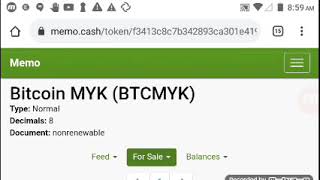
Welcome back to the channel. I hope you're having a great day. So today, interesting video. We want to talk about the SLP Simple Ledger Protocol that runs the tokenized or the tokens in association on the Bitcoin Cash network. We're understanding now that the development of The SLP DEX may be complete this month. So a lot of people have been anticipating with the great ability to tokenize almost anything on the Bitcoin Cash network, with over 9,000 tokens now created. These tokens are created for under 10 cents. This is amazing, very record speed, takes you under a minute. And you're broadcasting over the chain. Um, many have anticipated, uh, some type of trading DEX, and they've been working diligently, as I understand it, on this DEX, and they believe they're going to be done, uh, sometimes this— the month of October, possibly, right? A high possibility of that. So seems to be right around the corner. So this may in fact be a game changer. I The only thing I saw close to this but wasn't as, you know, well-ranked as Bitcoin Cash and had the, you know, the entire history like Bitcoin Cash has was the Waves network, which had a similar thing where there was a lot of people tokenizing. And for some reason, Waves— I was hoping it would have took off— just didn't take off. It just didn't make it. Didn't get the necessary adoption, although it had some great development. And I think Waves just missed the very important need to onboard. The problem with a lot of projects is they believe that if they just build great technology, that's going to be enough and people are going to be satisfied with just that. And that doesn't seem to be the case. It seems to now be a combination of whether centralization, decentralization, boots on the ground. Uh, there's just a lot going into making projects work nowadays, and unfortunately, just building, um, the technology I don't think is any longer enough. And that kind of brings us to our video today. We're going to talk a little bit about CeFi. Now, if you're not familiar with CeFi, it stands for centralized finance, uh, and we generally hear about the other one, DeFi, that many believe is going to be a groundbreaker. But we're going to also discuss a little bit why CeFi may be overlooked and some of the important, uh, things we need to take note of with centralized finance, right? And why, especially in the initial phases of cryptocurrency, why these type platforms may be necessary. So we're looking here on Bitcoin MYK. It's on the Memo. And what Memo Cash is, this is built on top of the Bitcoin Cash network. It's very interesting, and it has basically where people receive tokens from various projects. And it's really cool because it has a Twitter-like social media feel, and we spoke a lot about the importance of social media. So people are able to create their tokens for little or nothing. Anybody can do it, get on here build up a community, send your tokens from tweet to people and so on and so forth on your posts, tweet to tweets broadcast over the blockchain, you know, you know, post to post and so on. And as you can see, even though Memo.cash with all of this integrated into their kind of social media type situation, even though they don't have a standard trading exchange DEX like many of us are accustomed to and like to see, there still exists this ability to sell your tokens and buy them. And it's a very kind of NFT-like feel because, you know, everyone is kind of— you can make it kind of unique to the person who's buying, and you can make it specifically to a buyer, as, you know, unlike what you get in the standard DEX of somebody's putting up a wall of sell orders or buy orders or what have you, you gotta move around that, right? And this is kind of different. In some aspects, I like what can be done with this, this ability, but on the other hand, it doesn't, I think, encourage a lot of traders to get involved and for there to be a lot of volume. So I don't think it's really just set up for that, but it's interesting nevertheless. And I don't know Maybe in the future they may just link off to one of these DEXs, uh, that's coming out. Like, they could probably just link this to a DEX. You can send your tokens right to the DEX and, and something like that, and, and you'll be able to trade there. So I can see that something like that happening. I'm not even sure if the, the people who develop Mimo are, are, um, you know, related to the development going into the DEX that's coming out. But I think that would be awesome if they did that. Now I want to talk about also with that very exciting news, Bitcoin MYK launching its centralized finance and what exactly that means, because this can also be, I think, a game changer for us as well. So let's talk about that. All right, so over here on the Steem blockchain their DEX, where you see our cryptocurrencies, well, Bitcoin and YK again. So this is very important too when we're discussing what's going to be happening with centralized finance that we're going to be coming out here with very shortly. We estimate to be launching sometime this month or early next month, and it's probably going to run on NFT-like uh, token. Now let's talk about that a little bit. Bitcoin MYK, um, is a basically a universal bridge cryptocurrency that provides universal basic income. Now a lot of you in recent times, even though there's a very old concept of heard universal basic income, and in your perspective countries may have been granted it, or in the United States we received, uh, what some believe to be a type of low-level universal basic income with $1,200 going out to everybody, and they want to do more rounds and so on. Um, but it's very important, a very important topic, a very, a topic that a lot of people are considering, specifically with the state of not only where the economy's been but where many believe it's going here in the near future. So This is gonna be something that's gonna be important to everybody, your grandmother, your mailman, your just average everyday people. And I think that's what cryptocurrency misses. What's happening with cryptocurrency is we're creating a space for a specific group of people, right? These are very intelligent, not normal people. Just doing cryptocurrency, right? Um, the average person isn't understanding cryptocurrency or doesn't see the importance of it, right? And so what's happening in this space is it's a very geeky, nerdy-like element that's getting excited about technology that people don't understand and that they don't use. And, uh, this very small group of people, like, in any, um, situation like what you get with DeFi about 400,000 people, which is a lot of people. But this very small group of people, they're, you know, they're just having a ball, you know, trading money back and forth. Some making money, some losing everything. Um, but this isn't really, I think, the best use of this technology, right? So the big moves in cryptocurrency, the really big moves, you know, we're not talking about, uh, you know, your coin that's out of the top 10 or out of the top 20. Ranked over 100 and making a little bit of, you know, money here and there, you're hoping it'll moon. But the real big players in cryptocurrency are something like Bitcoin and Ethereum. And what's happening there, where the major money is coming in, is coming in from institutions. It's not coming in from retail investors like us, coming in from institutions that are going to be more so operating in a custodial capacity like Fidelity, right? So what Fidelity is doing is, right, it's creating a situation now where it can have custodial accounts where the average person who doesn't know anything about cryptocurrency, who doesn't want to get involved and get wrecked as a result of not being knowledgeable about it, they're going to manage this for them. Now, to many of us, this is anti-cryptocurrency, right? And I can agree with you on that, unless there are certain things put in place that maybe through a system is, is more educational people and, and helping people to, to manage through cryptocurrency, but kind of designed in a way for them to still take advantage of the more important aspects of what they're hoping to achieve in cryptocurrency. And so, for example, what I mean by that is that it's just inclusion, right, to have True decentralization, first you got to have a lot of inclusion, you got to have a lot of participants. That doesn't really happen in cryptocurrency because the, the, the learning process is so difficult. The other problem is when you're starting to get hands-on and custodial, and in that sense, um, it can be, uh, you know, very— things could come up like security laws and legal issues and things like that. So You have to be very careful with how that's done. So we want to talk a little bit about BitcoinMYK, how through some natural process we might be able to take advantage of, uh, a certain situation only unique to our cryptocurrency that may make a lot of sense to people. So we have to start at the beginning. The first part is our cryptocurrency is free to everybody, right? It's a universal basic income, so anybody could go in, get it free. They can, uh, get our wallet, download our wallet, and they'll start to get our cryptocurrency, um, due to its deflationary nature, and it burns against transactions. So mostly everybody who's getting the coins are going to hold some value right now. You're able to, in a sense, go in, get these Universal Basic Income, our, our coins free, and you could then sell them on the market and you could buy into our centralized finance, uh, coin that is more likely going to be an NFT coin, right? So how it's going to work is, as you can see, we've just jumped from one exchange to another and we're probably on several exchanges now, probably on 5 or 6 exchanges or something like that. Uh, the thing is, um, because our product is a multi-chain cryptocurrency, it's creating a natural arbitrage. So if you don't know what arbitrage is, when you go from one exchange to another, there are slight price variances right now. A professional trader or somebody who knows cryptocurrency markets or who knows how to trade fairly well they oftentimes will be able to just go, okay, I see this cryptocurrency exists on this exchange, it's at a different value, it's a different price. I can take that and I'm able to then sell it for more over here, buy it cheaper on here. I can repeat the process and I make a profit, right? Some people know how to do that, uh, but there are a great amount of traders who probably either don't understand it, don't want the, uh sitting up there watching and doing this, and, and they're missing moves when maybe they should be taking advantage. Or maybe they're just not knowledgeable about where the market goes. Or maybe it would be great if there was a system that was more, uh, stable, high liquid, and, and, and, and more safe to trade in. It's as safe as it can possibly be. And so that's what our centralized finance system is attempting to do. Now, there are a few things you need to understand why this is going to be so so much different than probably any idea of centralized finance or any element of DeFi in it. Whereas DeFi and centralized finance, many times these are entities totally outside of the investments they're making or the assets they're making, and they're probably going from one to another. They're trying to catch the dagger of Damocles, right? You know, that's the old Greek story about daggers falling from the ceiling and so on and so forth, um, randomly. And so a lot of times they don't know, you know, what's happening. They're just kind of diversifying their portfolio. And, you know, a cryptocurrency entire market can tank on you, right? You just don't know. Um, where this is a little different is this is completely internal to create a liquidity pool for Bitcoin MYK. Now, how it's going to work is going to be quite interesting. Um, you're basically going to be able to, um, uh, basically, um, okay, because it's going to be internal, Bitcoin MYK is basically going to be able to take advantage of the many different chains that we're trading on, right? These are different blockchains. Remember, the is a multi-chain cryptocurrency in different communities, right, in different platforms. So what could happen is not only that the price— there could be price variances, these price differences from one price of a Bitcoin MYK on another blockchain, but the blockchains itself could become either a great deal more valuable or a great deal less valuable, right? And so that means its perspective, uh, base coin that it's being traded against could reduce the value of the Bitcoin MYK on another network. Now here's the cool thing about Bitcoin MYK, because everything is inter, uh, interoperable, right, through the Bitcoin MYK, the supply is the same, right? So there's never a creation of more coins from one blockchain to another. Right? These are the same coins that are being reflected on these other chains, meaning that they are being burnt to represent those other chains, or that they are, uh, basically, uh, going to only be so many sent over there on that chain that could be traded on that chain. And overall, it's still going to be the same supply of coins, right? Um, Keep in mind also that against the growth rate and the scalability, by being on these a variety of chains and being exposed to, uh, their, uh, their projects, their— through their base coins, um, that, uh, through the scalability and growth, uh, the, the cost— the tokens are being constantly burned, right? So it's gonna make it a lot easier for them to hold value through that game theory and tokenomics. The other thing important that I think a lot of people miss is that if we think about something in reference, like if you're looking at something like Euro Finance, you're looking like at, uh, Sushi as it were, and I'm hearing they're having many issues. I'm hearing the founder, uh, has, uh, talked about quitting due to some bug early on. Uh, Sushi, of course, there was a big debacle with them. So what's happening with many of these decentralized, uh, finance projects is, you know, they're trading the value of these, using this arbitrage across the markets. But oftentimes when that happens, you know, you don't really know what projects are going to do what and who's going to perform what. So with us, it's a kind of unique situation because it's the same cryptocurrency, but there are differences between based on the communities they're in and the different platforms they're in. So I think it's more relative to look at BitcoinNYK a lot like Tether. And what I mean by that, you might see Tether pop up on several different blockchains, right? But it's Tether, right? It's backed by the US dollar or might be backed by gold. What is BitcoinNYK? Where's the value from it coming from? Well, here's one thing you need to keep in mind. Universal basic income is a mass adoption vehicle. What's more likely to happen is, through our research, we find that about 80% of the globe is going to opt for universal basic income. And the one thing that we've never come in touch with through all our research is we've never seen a multi-million person platform or network that had a value of zero, right? So there are tremendous value in social media, and that is because communication was one of our most important things throughout history. And all the internet is is a larger network of communication, right? And so that's why expanding and building this project and having a lot of people, uh, is so very important. And without— with very little marketing, we've, we've already got over 6,000 low-level KYC accounts, and there are over 15,000 accounts operating over multiple exchanges. Um, so very, very interesting how big this product can grow. The problem with many cryptocurrencies is that I don't think they quite understand or get that oftentimes it's going to be general, uh, the average Joe who's going to make a platform valuable. It's not going to be a whale, it's not going to be an institution, but it's going to be people who use this every day, who just the average common person. A lot of what drove the stock market's, uh, value were retirement accounts. And where do retirement accounts come from? They came from regular average working Joes who wanted to have a peace of mind and some value when they retired. And so they would get these fund managers, and these fund managers would take their money and put them in the stock market. And hopefully in 20, 30 years they have something to retire off of. This was all done through a custodial capacity. Now again, custodial capacity is a problem in cryptocurrency. How do we get around this? Well, one big problem with any type of custodial capacity is going to be relative to fraud and people who are making promises that they shouldn't be making and breaking the law or skirting around the law. So the first way we approach this is first we say you don't have to buy Bitcoin MYK. It works on a proof of participation model. It is just important as us as you participate, as you spend money in the markets trading with one another who find the cryptocurrencies valuable. Uh, we would rather that there be participation inside the, uh, communities itself and us transferring value between each other. Now, um, because participation and networks create a natural value, money is going to transact through there. So you're going to be able to create money just from joining. Now, in the case you want to create more money, that's probably when centralized finance comes in, but Maybe you want to do it on a maybe safer term. So very briefly, and we're going to do videos in the future about centralized finance. We're not going to really go 100% in it, but we're going to give you a general idea of it. How's it going to work? So first of all, what generally happens and how it's going to be free. So the reason we're calling it free centralized finance is because first you get the universal basic income coins, you can sell them on the market, then you could go buy the centralized finance coins with them, right? Which again are probably going to be like an NFT. Let's say each one is running for a dollar. So when you buy one for a dollar, what's going to happen is we're going to take that money and every dime of it's going back in the BitcoinNYK coin, but every coin that's purchased from the management of the funds will be burned. So none of the money, none of that will go out the window into somebody's hands or something like that. It will go back into the token itself, right? Now, what happens to the person who's bought this? How did they get value from it? So this is a very interesting circular system we're creating. So what will happen is every month we will increase their, um, the, uh, kind of think of it as a stable coin, if you will. Let's say you bought it at $1, come back 30 days later, it's at $1.30, right? So it is moving up, but it's not just like these erratic jumps. It stays okay. What you will be able to do is you'll have two options. You can try to sell it on the market, like you sell stablecoin or something and try to get whatever price you can, or you'll be able to redeem it with us. But here's where we're able to cover the basis with this. Instead of promising returns and saying, hey, you're going to make this or that, what we're— what we will be doing is redeeming these tokens will be redeemable in Bitcoin NYK's market value. right? Um, and the market value would be calculated over a 30-day period. And we should take— we'll be able to take that market value from the BitcoinMYK token and redeem them to equal out to be whatever your dollar was. So in a sense, what's happening is you're, you're doing centralized— you're doing the centralized finance, you're doing it free. And in many cases, you're getting the token itself free just by joining the UBI program or registering with the site, participating, adding value to the network, right? So it's a very circular system. So I think it's going to be very interesting and very fun. We're going to do some upcoming videos on it we think you're going to like, but that's the general idea of it. That's going to keep, uh, repeating this cycle, the cyclical loop. And, uh, people might say, well, yeah, that feels kind of pyramid-ish, kind of Ponzi-ish. Well, first off, The first part is, does it cost a dollar, a dime to do it, right? Uh, we, we, from what we can see since we've launched our UBI, we gave away millions of coins. There's still value in our markets, it's still, uh, a value to the coin, and there's still a growing network and a platform. So it has not diminished any of that, right? So that first part of it doesn't create value, there's no value, we could tell you that that is completely false. The second part is, um, uh, because we're able to redeem in something we have, the BitcoinNYK coin, so it won't be like, um, you're making promises of interest you can't, um, that you're unable to, uh, uh, uh, you know, pay out, right? So that's one problem with Ponzi schemes, pyramid schemes. They're not able to pay out the returns. And so because they're not able to pay out the returns, it all crashes down, right? With DeFi, they're not able to keep up the, uh, the, uh, unobtainable returns— 600% a month, 1,000% a month. And so that's why they have to go from one to another. This is where social media comes from. If you can imagine how Facebook, uh, went all the way up to about nearly a trillion dollars, now $700 billion. Think about— you can grow a network so vast, so important to people, like universal basic income, that you could create a social platform, uh, worth hundreds of billions of dollars, right? You can see how this will be a place for these— this value to come in. Now, we don't promise any returns with centralized finance. We would hope that the social dynamics will, uh, grow, drive people to it, and creating a system that, uh, that we believe has a future, is going somewhere, that is going to help human beings and be important to people who, uh, don't even care about cryptocurrency. Like, our project brings in a lot of people who don't know anything about cryptocurrency, so that's good for our growth and value. And something like centralized finance, I think in the future what we're doing is going to be able to help them to get involved without knowing much about cryptocurrency, right? Much like the fund managers did with retirement accounts and individuals, uh, getting involved in the stock market in the early days of the markets. So this is very important. I think this is what cryptocurrency is missing because I, I think we're trying to tell a narrative that sounds good in theory but just doesn't quite play out, uh, like that. You know, most systems, especially new ones, requires some type of process evolution in which things change gradually, that they don't just land spot at ground zero. So I think we're going to have to, you know, some of our biases and about what decentralization should look like, I think we need to change them. Some people believe it should look like total automation And my problem with that is oftentimes we still end up with a concentration of power and money into the hands of a few. So there's obviously no decentralization of wealth or representation, centralization of mining or anything like that. Whereas we tend to focus more on the decentralization of the wealth and participation. And I think just my personal opinion, in the end, that's what's more important, right? Than some of these other aspects of these false ideas of decentralization. But I'd love to hear you guys' opinions about it. If you have any questions about centralized finance, what we're doing, let us know about it. We, we'll love to go into detail with you about it, but gonna be some explanation videos coming up real soon over the next week or so, uh, maybe, maybe this week, we'll see. But I think you guys are going to really like it. If you haven't joined already, make sure you join our project BitcoinMYK. Get your wallet here. It's free, it's free and easy to get. Get some coins and you're really gonna like this project. But that's all I gotta say in this video. If you like content like this, don't forget to like, subscribe, and until next time, as always, take care.
More from Michael







UBI - CIA Agent Explains Why Americans Will Never Get Universal Basic Income?



