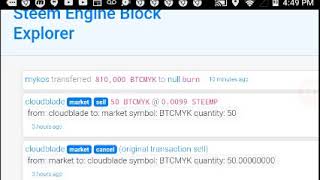
In this December 2019 burn‑report video, the presenter outlines the BitcoinMYK project's core deflationary model, where every transaction triggers a 1‑to‑1 token burn. A record 810,000 tokens were destroyed in December, pushing the total burned supply past 1 % of the original 100 million. The speaker projects the circulating supply could shrink to between 5 million and 1 million tokens, depending on how many Bitcoin holders claim their free allocations. BitcoinMYK tokens are distributed via a proof‑of‑participation system: Bitcoin holders claim unclaimed Bitcoin tokens without purchasing, effectively “minting” BitcoinMYK through participation. Mining is simulated on the Steem blockchain, avoiding physical energy costs; rewards decrease as the token supply contracts, mirroring Bitcoin’s halving but applied continuously. Current mining rigs earn roughly 100 tokens per day, now reduced to about 99 due to the burn. Market data shows the token price fell from $1.04 to around $0.12‑$0.14, occasionally trading at twice the value of Dogecoin, while buy orders have risen tenfold. Community metrics indicate growing interest: over 1,000 daily site visitors, ~800 registered accounts (low‑level KYC), and 1,500 total accounts. The platform also hosts music streaming and social networking services that generate additional token‑earning opportunities. The presenter concludes by emphasizing the project’s bet on deflation over inflation and invites viewers to discuss which monetary model they prefer.
Chapters
Welcome back to the channel, and I hope you all are having a great day. And it's time for our burn report for the month of December 2019. So this is what many of you all have been waiting for. The BitcoinNYK project is what I believe to be one of the most deflationary cryptocurrencies in existence right now. Some of us have identified one big issue with cryptocurrencies is their annual inflation rate, and trying to deal with that in the most effective way, we created a system with our token that burns on a 1-to-1 ratio against every transaction that happens. And so the monthly report today, as you can see as we zoom in here, We have burned a record of 810,000 Bitcoin MYK tokens for the month of December, right? That's quite a bit of tokens, quite a bit of tokens, and that means a great deal of things, right? Um, so to kind of understand this, uh, the Bitcoin MYK tokens, this means on every transaction, every token that is mined through our simulated miners, uh, every, uh, transaction that they whether it's on our, uh, site bitcoinmyk.com, they are burned in the same, uh, same ratio, same amount. So we're talking, uh, a great deal of tokens. There are only, uh, 100 million tokens in existence. We've already burned, uh, well over 1% of the supply, uh, and it's going to continue down to about 5 million to 1 million tokens. At some point it will be on par with Bitcoin. And as many of you all well know, the reason it's called BitcoinMYK is because Bitcoin holders get it absolutely free. But it also uses the proof of participation model that allows you to claim these BitcoinMYK tokens from the unclaimed Bitcoin tokens. So that is how people are able to get them free through our proof of participation model. So you don't buy the tokens, you actually bring the tokens into existence through your participation. But there is a secondary market that trades them where people trade them back and forth. So, um, this is quite interesting, right? The 810,000 burn. At one time, these, uh, these, uh, tokens were trading at about $1.04. Then they dropped about on par with the token of the blockchain, which is STEEM, which is something around 12 to 14 cents. And now it's dropped even further than that and it's trading around, uh, it trades about twice the value of Doge at times, somewhere in that ballpark. But what we do see here and what we are starting to, uh, understand, uh, about the BitcoinNYK token is that as the token starts to basically, um, burn at this rate, at this very, very aggressive rate, that, uh, we believe that just through basic math, we're going to start to see some very interesting dynamics at play there as we go from our starting point of 100 million tokens all the way down to between 5 and 1 million tokens. And that will depend vastly and greatly on how many Bitcoin holders claim right? Um, now, uh, in any event, we factor it's going to probably get down to about 5 million because, uh, the statistics is that generally Bitcoin holders don't claim in large amounts, right? Uh, worst— best case is something like around 3 million, and it can get down much lower than that. So in that case, we could potentially see only 1 million of these BitcoinNYK tokens, making them extremely rare. But This is a very interesting project, very interesting experiment in what deflation can do in a cryptocurrency. So people are starting to get involved with this, uh, starting to like this project, and it has a variety of other things it does. But I think what's important in understanding this is then trying to understand how this is going to affect our simulated miners, right? And we're going to get over to the site and show you some statistics about what you can expect to see with these simulated miners due to this aggressive burn rate. Oh, excuse me. Okay, so we're here on the BitcoinMYK site now. Let's get over to the simulated mining area, uh, and let's see what this means for the burn rate of BitcoinMYK. Um, so, uh, the mining risk, much similar to what we get with the, um, with the Bitcoin halving, right? Uh, what's happening is anytime you got a deflation token, you got a fixed amount, you got this fixed amount of, um, of tokens. Uh, when you got that, you basically have, uh a situation where you're gonna obviously run out of tokens, right? So, so, so what's happening with Bitcoin halving is that it's actually starting to reduce the mining, the miners' rewards, right? Because it's getting ever so closer to mining that last token, right? We're doing the same thing but in reverse, right? Uh, we're not really in reverse, it's almost quite similar. Our simulated mining works on an idea, doesn't use physical mining, right? Excuse me again, guys. Uh, it doesn't use, um, physical miners, right? The data suggests that if everybody were to use Bitcoin, that these rigs would basically expend so much energy it would just become impractical, right? So one way that the BitcoinNYK project gets around that is through a simulated mining process in which we piggyback off the Steam blockchain, right? So everything is simulated. It doesn't really require the tokens to be mined, but the learning experience of what it's like, you actually do earn the BitcoinMYK tokens when you use the miner. So it kind of does all the good stuff in association with mining and cuts out the bad, right? Steam is a pretty solid blockchain security-wise, so it's pretty sound. So we don't have to worry about a lot of security threats or anything like that. Transactions are free and it's fast, so it works fantastic. Now what happened is, much like the Bitcoin halving, as we get closer to, uh, the last of our BitcoinNYK tokens to be mined, the rate decreases, right? So we just came off the burn report. The— it works a little bit different from the Bitcoin halving where they, they kind of wait to the halfway point to start reducing the block rewards. What we do is we reduce the block reward, uh, all the way as we go, right? And, uh, it's in direct correlation to the, uh, to the, uh, tokens being burnt and the tokens being mined. So what you're actually getting then is you're getting, uh, you know, what would be, uh, essentially Um, hmm, uh, you're getting, uh, as over 1% of the BitcoinNYK token supply has now been burned off, then the mining rewards will decrease. And right now the mining rewards are, for us, it's like, uh, with a Series 1 mining rig, you're mining about 100 tokens per day per miner. And so they're now only going to receive about 99 tokens. Now it won't affect the the value of the— of what they're bringing in, it was pretty much still be the same because it's reducing against the overall size of the network, right? So that's very interesting. It's very important to understand how this works. Um, but, um, yeah, in understanding cryptocurrency, our biggest monster has been inflation, hasn't it? Uh, how many times have we looked at a project that has billions upon billions of toke— of cryptocurrency coins, tokens, and we've went, well, that's, that's too many, right? And, uh, you know, we're going to get flooded with sell walls and downward sell pressure, and that's not what we want to see in our cryptocurrency. Now, of course, by reducing the token supply, it doesn't guarantee that the value— it'll be more valuable, but the data does suggest in principle, when you put that scarcity in there, that you're going to have, uh, in many cases, a, a much more attractive project. And so that's what we're, we're doing here. And so far it seems to be working. Uh, we do— we have seen our buy orders increase over the last several weeks. They've actually increased 10 times, right? And although this is trading on the market with very, very low volume, What's interesting about our project is we have a really great outreach. The site Alexa rankings are starting to pick up. We're getting over 1,000 visitors per day, and it's really starting to attract people because we have many, what you might call, attractions on the site, right? That is explained in many of our other videos. You know, besides being this Bitcoin sidechain deflation token, it has music streaming services, social networks. It just has a host of things you could potentially participate in and earn these tokens that Bitcoin holders have not yet claimed. Uh, and, uh, as course goes on, then they're losing a percentage of what they can claim. So it's very interesting, but the deflation is the key to this project and, uh, starting to draw quite a few people. And I think we've broken now, uh, around 1,500 accounts, and I think that number is going to increase. Uh, uh, that is on the, uh, uh, over on the site, uh, on the blockchain rather. On the site, we're getting close to about 1,000 accounts. I think we're around about 800 registered accounts that are doing low-level KYC. Now, we don't do KYC, we don't do anything with the data, but some people did consider collecting emails. The emails are pretty much just used to— you can, uh, get back into your accounts and so on and so forth. But, uh, in many ways, some people still consider that a form of low-level KYC. So in any event, we've had nearly about 800 people registered to the site so far. So, uh, very interesting project, one that we're very interested in seeing the results of. We're betting on deflation over inflation. We'll take that bet any day of the week that we're going to see potentially about only 5 to 1 million Bitcoin MYK tokens left. And we're going to be very interested in seeing what that's going to mean for this project going forward into the future. I think that's about all the details we want to discuss in the Burn Report this week. If you have any questions or comments about the project, be sure to leave a comment. Let us know. Tell us, do you like deflation over inflation, or which one do you think works best? What are the inflation rates of many other cryptocurrency projects, uh, that are out there, uh, and, uh, you know, which one would you rather be in, uh, when it comes to value, and, uh, and, uh, you know, where you'd like to see the value of your project go. But anyway, that's all I think I want to say in this video. If you like content like this, don't forget to like and subscribe and share. And until next time, take care.