
Bitcoin Myk - Decentralized Trustless Secure?
Bitcoin Myk is a Bitcoin fork that issues tokens based on participation rather than mining power or wealth, aiming to reduce centralization. It uses a hybrid verification system checking against both the Bitcoin ledger and Waves blockchain, plus a novel "L. Drake Equation" to flag suspicious wallet activity and prevent double-spending.
Chapters
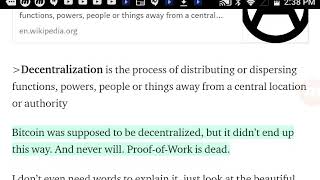
Hey you, welcome back to the channel. And guys, today I want to talk about Bitcoin MYK. Is it decentralized? Is it trustless? Does it have security that is adequate? So we're gonna— it's gonna be quite a little bit of technical video today, guys. And, uh, this is pretty much targeted to a lot of my, uh, developer friends and, uh, very technical and brilliant people across the space. To address questions that come up with our project. And we're going to learn a little bit about the, uh, different algorithms that are used, whether it be proof of work, proof of stake, uh, delegated proof of stake, and then going into our method, um, proof of participation, which is kind of this hybrid. So we want to address all that today in today's video. All right, so first we're going to start here with this article from, uh, a brilliant person by the name of Igor Homakov, and he talks about, uh, how we should look at decentralization. So I'm going to start there. I'll leave a full link to his article in the description. He speaks on decentralization is the process of distributing or dispersing functions, powers, people, or things away from a central location or authority. Bitcoin was supposed to be decentralized, but it didn't end up this way and never will. Proof of work is dead. I don't even need words to explain it. Just look at this, at the beautiful charts below. Let's obviously assume 51% get the power to do something. Centralization is decentralization with one entity being the center, right? So in this example, he shows this circle to illustrate how centralization would look, right? It's one entity in control of everything. So still centralization. And then in this next diagram, is it— oh no, still centralized. The right one controls more than 50% they are being the most important center. And it goes on with this next chart. Let's get back to the Bitcoin hash rate distribution from blockchain.info.pools, right? And he goes on here and he says, technically you need to hijack 3 to 4 entities to control it. Let's pretend Antpool, BTC.com via BTC, FTpool or F2Pool, BTC top are non-colluding businesses and not just one entity pretending to be 5, which I really doubt. So he's talking about the control of the hash rate, right, with these mining, with these mining data centers. GHASH failed because they publicly demonstrated only 51%. Chinese miners are smarter than that. Look how nicely the hash rate is divided with no clear leader. It is still heavily centralized because decentralization equals 3 short of 2%. It's just 2 entities away from a single center. But this is the chart that shows miners. Miners are physically located in countries. Let's get back to real world because countries have full authority over physical entities located in them, including miners. Here's a graph of non-China versus China. Now please look back at the third chart. Anything familiar? Bitcoin, Ethereum, and all proof-of-work coins are centralized. You can quantify it by business entities, 3 and 4, or by countries, 1. These are most obvious ones, but you can also quantify centers by hosting companies. All use AWS, centralized citizenships, physical locations of CEOs, and so on. You get the idea. Either way, it fits into the term centralization. When someone says they are decentralized, point them here. So again, guys, I'm going to leave a link in the description so you can get the full details of this, but I think we're all pretty clear on how he's talking about how these mining pools, uh, in these particular sovereign nations Uh, the control by them of these sovereign nations, as well as the idea they could be colluding with each other so that they're not separate but they could be one. Um, this is not bad, but we can live— I'm sorry, let me go back up here. Either way, it fits into the term centralization. When someone says they are decentralized, point them here. This is not bad, but we live in— we— but we can live with it. This is game over. Bitcoin is 1,000 times slower version of UnionPay. They both work at the mercy of China, and I'm somewhat sure UnionPay has better appeal in their eyes. It's only security through obscurity that keeps it allegedly decentralized in eyes of the public. In case if you're really that stubborn to repeat the mantra, miners don't get to set the rules, look into another article that shows how double spending works. And, uh, We'll check that out in a second. That's very interesting. I read that article, but it just talks about how they can double spend. They can send this off to exchanges, um, and, uh, just keep repeating this double spending over the network, and then they could change it for altcoins, uh, and, and cash out over these exchanges, right? It's true that you can't change the consensus itself. There's no in-protocol on-chain governance, which I think is stupid, and Tezos Definity failsafe will make way more sense and move faster, but it doesn't matter. As long as you can mine empty blocks or rewrite the history by mining on other branch, you keep the blockchain hostage. If you say, but they have no profit in hacking it, you miss the whole point of decentralization. You don't engineer blockchain security on does the center profit from exploiting you. Now PayPal won't ban your bank account today either, but they certainly can do it later when they need to. That's why nothing at stake and cost of attack are nowhere as important as just number of entities you need to compromise. So I think we all kind of picked up on that, guys, that the fact that they can do it, have the ability to do it, uh, even if it might not be practical for them to do it, they are able to do it, right? And no hard fork, two different A proof-of-work algorithm can save you from that because you will start with a much weaker hash rate from square one back to 2009 level of security. Only switch to proof-of-state can possibly help. This is how true decentralization must look like. 51 entities to hijack, both for business entities and for countries where they are located. 100 businesses in 100 different countries have much lower chance of colluding than 3 companies under one government. And it shows this graph of, of, of how it could work. And I just want to read a few of these comments because I thought they were important as well, if I can find them here. Okay, this is what a, uh, a person said about it. He says, I think you missed— I think you meant to say missed concepts here. Decentralized in a computer science meaning is the ability to handle the information from different points. In addition to that, Bitcoin is replicated. So that means all of the information is copied to all of the participants in the blockchain. If you attack one node and cause a DDoS, it's effective. The other nodes can, um, continue working. That's because Bitcoin is better than PayPal. Or any other tech, not just centralized bank. And so Igor Hamakov goes on to write, did you read that? Mining nodes control history. History is all blockchain is about. They can reverse it so they can do double spends. That means no TX is ever final. Number of replicas is irrelevant. You can have billions of nodes, but with 51% of hash rate, you own the whole thing's ass. So I'm going to leave those links in the article. And again, guys, the reason I'm giving out the reading this information from Igor Hamakov is, was to help you get a fairer understanding, a much more clear understanding of the, uh, what some may turn to be the myth of decentralization and how it exists. And so, um, you know, uh, we, I think we have to take all that into consideration. So some may raise the issue after this. Next day might go, well, you know, maybe that's all true. And maybe that's all the case with the mining, the situation in China and the miners and various things like that. But that's why we would use something like proof of stake or delegated proof of stake, right? So you can't see it on this page, but I'm gonna read a passage from another article that talks about some of the issues with delegated proof of stake. And some things we might have to look out for with that as well. So here are some of the flaws of delegated proof of stake. It's easier to organize an attack because fewer people are in charge of keeping the network alive. It's easier to organize a 51% attack. The next flaw in delegated proof of stake is the rich may get richer. People's vote strength is determined by how many tokens they have, which means that people who own more tokens will influence the network more than people who own very few, right? So that, that's the rich gets richer, and, uh, that's not doing a good job pulling away from centralization, right? Next flaw: apathy can kill. Without a large number of engaged users, The system will not function as intended. That's a bit like any democracy or democratic republic, you know, of course, meaning, you know, if you don't have a lot of engagement, usership, or adoption, then you don't have a great functional system. Delegates could inform— or sorry, could form cartels. Delegates can organize into cartels by concentrating the role of validation in a smaller number of hands. This not only makes it less decentralized, but it also makes it less resilient, right? So that's similar to what we've seen happen with on EOS and, and systems similar to that, right? And proof of stake, um, the algorithm— there can be problems in the algorithms. It can be, uh, basically manipulated to rewards to go to certain people, right? So you can manipulate the algorithm to a great degree. So, um, just want to kind of point out, guys, some of the problems with the systems we determined to be decentralized. But considering all this information we just talked about here and keeping that in mind, let's look at our project BitcoinNYK and let's see how it holds up with this proof of participation model. right? So let's get over to the BitcoinMYK site. See if I can find it here. Bear with me. We're gonna try to find it here. Okay. We've made it to BitcoinMYK. So let's see here. First, let's look at BitcoinMYK and understand the model, uh, we term, uh, proof of participation. What is proof of participation? Proof of participation is a system where you technically don't necessarily buy our tokens, but your engagement and activity in a sense creates the token, right? That's the first premise of it. So It doesn't require people buying large amounts of mining equipment or holding large data mining centers exactly, or, um, um, but it doesn't require any of those things and they can gain value in this token. Now it is a Bitcoin fork as well, which means Bitcoin holders are going to be the people who, uh, are able to get their amount of Bitcoin in relation on a ratio, uh, about 4 to 1 to Bitcoin MYK, right? So how do the— how does that allow proof of the proof of participation model? Well, what happens in many Bitcoin forks is that tokens don't get claimed, uh, whether the accounts have been— people of the accounts are— they're no longer active or whatever the case may be. People have lost passwords whatever the case is, this goes back into circulation and those tokens get distributed according to the proof of participation model. So now let's ask the question, is it a trustless system? Because that's one of the most important things I think in these systems, that you don't have to, um, rely on, uh, getting these tokens and rely on the system and trust the system, right? So we believe BitcoinMYK is a trustless system. And the reason that is, is because BitcoinMYK is first verified against the Bitcoin ledger. And then it's next verified against— we use the Waves platform and the Waves blockchain to be able to send our represented value of Bitcoin at a high speed. Right. And so when anybody can go on these blockchains, verify the, the, um, the value and the balance of their Bitcoin tokens as opposed to what's on the Waves blockchain. And in that sense, there is— there isn't needed to be any trust. You can verify who's supposed to get what, who's supposed to hold what. And if you trust the Bitcoin ledger, as most people in crypto currency space at this point, I have to say probably Bitcoin is the most trusted of them all. Then, um, you would be able to have that same degree of trust in our network based on that. Um, is it decentralized? Well, let's look at it this way, or let's consider what we read in the decentralization ideas about Bitcoin delegated proof of stake or proof of work algorithms and proof of stake algorithms. Are they decentralized? Well, our thoughts are like this. These systems are all moving from a point of centralization to decentralization. In our system, if you take away the fact that we're even using a Bitcoin ledger, so whatever occurs on Bitcoin should be representative of what occurs on our system. If you take all that away, um, then, uh, we would, we would be in the same situation, right, of a form of centralization moving to decentralization. Um, Now, whereas with the proof of participation model, things might even work a great deal better. You should, in theory, have a great more degree of distribution and less centralization because number one, you wouldn't have, like in the case of delegated proof of stake, the richer people controlling the network because they bought more tokens. The proof of participation model works less on purchasing tokens and more on moving already, uh, value that has been identified, whether it be on Bitcoin or whether you use the proof of participation algorithm or system in order to get more tokens where you don't have to— it doesn't rely on money. You don't have to have a lot of money to beat the system. It doesn't rely on mining equipment or data centers. Where you can mine more and create these monopolies and even possibly collusion. And so in that sense, I think we move to a better state of decentralization, maybe more so than the other models. Now, with those factors considered, let's look into security. How secure is this? How secure is Bitcoin MYK when all those things are factored? Well, here's what we have to look at, or here's what I say about the security of Bitcoin MYK. Some of the components of Bitcoin MYK is still very much experimental and, and quite ambitious. If we consider that Bitcoin MYK uses the Bitcoin Wave system Which means that all the Bitcoin you hold at any time in your wallet, they stay in their wallet and you're issued Bitcoin MYK tokens against it at any point in time. Those tokens are used to be your representative value to move your Bitcoin value at high speeds in Bitcoin MYK. Now your Bitcoin stays in this wallet, it's never spent, and you're, you're able to do this almost like thinking of a concept of how we spent money and the gold stayed in this vault. The gold backed up the, the money. But of course, the security issue, the great security issue with this would be the double spend problem. But as we recall, going back to the articles we read, even in a Bitcoin system, people are still able to double spend because they can simply attack the network and then they can move those Bitcoins to exchanges, then they can trade those Bitcoins for other altcoins. And so, um, maybe in another video we'll cover in great detail how that's done, but it doesn't stop double spending. Um, in our system, as far as security, we have several verification levels— excuse me— to make sure that double spending doesn't occur. We never make the, uh, point that the security is 100%. Um, I'm— it is possible it can be exploited or manipulated in some way or broken in some way, much like the other networks, right? So we're not impervious to that. However, I think it's important to note that there are several factors that secure our situation. So think about it from the standpoint of if you're moving Bitcoin or if you're not moving your Bitcoin from your wallet to our network, you're only moving the representative value, which means you, you proved you own the wallet and now we've issued you the BitcoinMYK tokens. Much like in a Bitcoin fork, then the security of your Bitcoin itself was never affected, right? So the game theory to that would only be you would only need then to buy Bitcoin or mine more Bitcoin to get more BitcoinNYK tokens. There would be no need security-wise to go into our exchanges and buy BitcoinNYK tokens over third-party exchanges, if that makes sense. Um, now for a person who doesn't own Bitcoin who wishes to acquire our tokens, they could use the proof of participation model, which doesn't require any spending of any money or mining equipment, just your participation. Um, it doesn't require any spending of tokens to try to influence the system. None of that. You can gain, uh, probably just as many tokens as a person who mines Bitcoins, buys Bitcoins, or what have you. So we think it's a brilliant system, and it could be a safe system provided that if you want to acquire more tokens, you purchase Bitcoin first, right? Now, how we protect against the double spend is, it's several layers of verification in which what we call a social media key. The worst case scenario with that is that someone could find a way to break through the verification levels of the system. And if they were to do that, then they can flood the exchanges with our tokens or attempt to similar to the double spend issue with Bitcoin. That gets increasingly harder for them to do every day. but the worst case scenario, it will result in costs against the network, but not against investors, right? So that's a way of saying that people wouldn't lose their Bitcoin. People wouldn't lose any money invested in the network provided they went on the third-party exchanges and purchased the tokens. Now we recognize certain important factors in speculators. Speculators are people who wish to liquidate their tokens in a, um, in a certain way, not use it as a money. They probably want to trade it for something else, and that's fine. Uh, third-party exchanges exist for that, for the community to find value in these tokens to be able to trade them in and out for, for various asset classes and products. However, speculators also gain value through taking risks. And so as far as a security protocol, our game theory would be to buy Bitcoin, to use the proof of participation model, and to mine more Bitcoin to get more BitcoinNYK tokens. But if you're a speculator who's willing to take the risk to make more money and you go to a third-party exchange, yes, some of those risks would move over to you in that particular situation. Third-party exchanges aren't necessarily the only ways to liquidate BitcoinNYK tokens. There are easier ways, there are a little bit more safer ways, and that is because BitcoinNYK tokens also serve as cross-chain tokens against social media networks across blockchains through a series of upvotes. For people who are familiar with these systems, you can gain tokens from other networks by the value you have invested in those networks by uploading content. So if you hold BTM tokens, our network tokens, then you're able to use these tokens to get these values in other systems as well. I think it's important to note that in the concept and idea of us being kind of money to Bitcoin, that we want to be used as a money. We want to be traded for items and various things that third-party exchanges aren't exactly our main priority as far as what we deem to be security issues. Uh, we kind of look at, again, that is speculation and various things like that. The how we see Bitcoin NYK can be used as a money across our networks and other networks, but there's nothing wrong with speculation. We're simply saying that it will present probably the highest security risk to a person who invests in our token directly, which isn't the main idea of what our system is created on and based on. It's more just a, uh, a, uh, something, a byproduct of it, right? But the point is you can get a lot of value out of our tokens in a more safe measure than that. Um, And I think that's pretty much all we want to say in this video because it can go on for hours. But if you'd like to learn more about the Bitcoin Wave Network, uh, you can watch the video or just click on our white paper. And this video will tell you about how it works, how certain aspects of the verification of it works. Um, but, uh, going back to the exchange, I like to add this one last security protocol. If you just want to be a speculator in the token, meaning you just want to take advantage of the price rise or maybe just hold the token on exchanges, maybe you don't have the time time to invest in proof of participation, right? Maybe you'd rather be a miner, but you don't have the mining rig, so you can't mine Bitcoin. Maybe you don't have the money, so you can't, uh, do the something like delegated proof of stake or proof of stake. So maybe you would much rather, uh, just take the money you have and speculate on the value of it going higher. We do have a security measure intact for that to be able to create this, um, this, uh, interesting concept, uh, in its experimental phase so that it'll work for you in a safe manner. And that is something that we call the L. Drake Equation. The L. Drake Equation— and we'll do some videos on that later and some diagrams— but it stands for Ledger Accounting across blockchains. That's what the L stands for, and it's how we verify the value of your Bitcoin and activities on other blockchains to substantiate and issue value in our token over to you. But it is part of the idea of something called the Drake Equation, which has nothing to do with it, has more to do with, uh, finding, uh, life on other planets throughout the cosmos. Created by astrophysicists where he uses a series of equations and habitable planets based on how many civilizations possibly exist. It's a, it's a real scientific equation that people really use and, uh, take serious. But we use something like that to create more security, and it works something like this. Uh, it's based on the average of how many Bitcoins are held on the average wallet. And this is to work against any people with Bitcoin trying to do the double spin. Um, it works on the average of how much the average Bitcoin holder has in their wallet, which I think now is something like under $100. Um, and then it takes into consideration how many Bitcoin wallets there are. So there's a string of As a string of transactions go through, people claiming their Bitcoin NYK tokens, a series of flags go up when that average of what the value of the Bitcoin you hold in your wallet should be. So then those accounts get flagged, uh, and they go into a database, a relational database, to their wallet addresses and other wallet addresses and their transactions. And if these wallets interact with each other, basically what happens is they get knocked out of the system and they get moved to a higher level of verification, right? And so what this does is this limits any type of, um, uh, any kind of dilution of our token by people using double spending. But again, like I said, guys, double spending is not 100% secure to stop by any network, as we've underlined in the earlier parts of the video. But what we can promise you is that we will use some of the, uh, most determinable and, uh, increase the chances— or decrease, right— the chance of that happening greatly. Uh, and, um, and, uh, so, uh, in doing so, we think that this would create a better situation, a more secure situation with people who use this network. But again, if you use our game theory, the losses of you should be little risk to none at all, at all, uh, if you use the game theory of buying and mining Bitcoin first or using our proof of participation model directly. The only slight dangers you face would be trading on third-party exchanges. And so I want to end there, guys. I know it's been kind of technical video. Some of you who— because our main target is people who are new in the cryptocurrency space, so this, I understand, it might fly over some people's heads. Um, um, and we want to make this very user-friendly and easy, so don't worry about it. Uh, it's just a way of saying that, uh, the way our program and platform works we're looking to ensure the most safest approaches to making sure your value is kept. Guys, if you like content like this, don't forget to like, subscribe, and until next time, take care.
More from Michael







UBI - CIA Agent Explains Why Americans Will Never Get Universal Basic Income?



