
Bitcoin MYK Miner & Curator Elections Now Open!
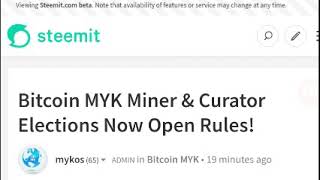
BitcoinMYK is a deflationary cryptocurrency on Steem with fast, free transactions. The project is opening elections for miners and curators, with voting open until January 22. Top miners earn 20,000 tokens, but the presenter warns the voting system could become plutocratic without safeguards.
Chapters
Welcome back to the channel. I hope you're having a great day. So in this video, we're going to talk a little bit about our elections are now open, the rules. Uh, this is for our miner and curators. And if you don't know what the BitcoinNYK project is, it is basically a cryptocurrency that kind of works like a Bitcoin overlay. If you were to think of something like the Lightning Network we use a blockchain that is more efficient. You might think of it as a sidechain, uh, to facilitate Bitcoin. But then it also has features that, uh, do some things that Bitcoin can't. It's a lot more deflationary than Bitcoin. Bitcoin holders can't get it free. Uh, basically it kind of works like BOMB token. Every time a transaction is done, there becomes less and less tokens, and the deflationary rate can go a lot further than Bitcoin. So quite the interesting product. The transactions are free and also fast. So you don't usually hear anything associated with Bitcoin with fast and free, and that is because we use the Steem blockchain. But what this is about is this is something, um, that we've discovered in cryptocurrency that I think many of us haven't allowed ourselves to ask the questions about, and that is understanding more so the true nature of decentralization and what it means. And, uh, can we, uh, in a way really say that that's what's happening with our cryptocurrency project? So let's talk a little bit about that, and let's explain how these elections work, why they're important, and why I'm so proud of this idea of doing what I believe to be the first truest act in democracy on the blockchain. So let's look at the definition of decentralization. Let's kind of get some ideas of what it means that we don't just throw these terms around loosely. So here's one definition I think that could kind of relate to what's going on with the, some of the general idea of it. The transfer of decision-making power and assignment of accountability and responsibility for results that accompanied by delegation of commensurate authority to individuals, or to commensurate authority to individuals or units at all levels. Now, there is also another definition that I think works a lot better that speaks about the— to move away power from a central authority, right? To delegate it away. Power from a, a central authority, um, and to move it to a, uh, a more decentralized group or a bigger group, right? And it— and then when it says to delegate away, right, when you get into delegates and delegation, what does that mean? Who's doing that? Because if you're going to delegate the power away from a central authority, then there has to be someone doing that, right? Some mechanism. But the problem is, who is that group and who selected that group? So the meaning of delegate: a person chosen or elected by a group to represent the group, a smaller group which represents a larger group, right? So that's kind of going back to you have to delegate And we see delegate and delegation time and time again in the idea of decentralization. Every time you look up the definition of decentralization, more than likely you see delegations, delegates, to delegate. But who are the people delegating, and, and how does this work exactly? What does it mean? So it will move some to say, well, if you, you look at something like Bitcoin, right, It's happening with the miners, right? The miners, pretty much anybody could come in, or it used to be that anybody could come in, start mining Bitcoin, right? Become part of a pool. And that decentralizes the network to a great degree. Now the problem is who elects the miners, right? What happens if the miners become too centralized? What happens if they become too corporatized? What happens if big corporations just buy up all the mining data centers? And that's kind of, in a sense, although not directly, what has happened. A lot of the big corporate mining data centers are still thriving, whereas the, basically, these, the smaller data centers, a lot of them had to go out of business, right? They had to stop mining Bitcoin. Also, it's, it's, it's going away from decentralization a lot as the technical aptitude is there for mining Bitcoin. But not only that, the cost of mining, right? These data centers, you have to go in cold regions, so you got to travel, you got to open up facilities, you got to do a lot. I think that kind of pulls a lot away from the idea of decentralization issues and problems. I think that the BitcoinNYK project has done a great job of addressing. So the BitcoinNYK cryptocurrency project, which recognizes the importance of democracy on the blockchain, we have opted to have participatory elections to give our community the right to vote on who should be rewarded and receive tokens for their participation in the growth of our network. Unfortunately, we have recognized that many cryptocurrencies, even Bitcoin, don't allow this important act of democracy to take place. Our miner pools in many cryptocurrencies are controlled by centralized as well as corporatized entities that have in fact thrived while small mining data centers have had to go out of business. It's driven even products like Bitcoin to be heavily controlled by less than 5 miner pools and nobody gets to decide who these miners are. This is not representative of anything to do with any idea of decentralization. It is with heavy hearts this discovery is made real to us. In our proof of participation model, we have discovered that in our simulated mining operation, nothing is more important than democracy. So in ideal, we wish to reward the miners the community sees fit to represent us by rewarding those miners and curators to our projects. And, uh, you know, we go on to discuss where you can find more information about the product, the white paper. A lot of interesting stuff happening with the Bitcoin MYK project. So the rules are simple: community members now have the right to select over the next few weeks the miners and curators they believe should be rewarded for their participation and service to our community. Eligibility to vote is as follows: you have to subscribe to our group And the group is available at BitcoinMYK.com in our group on our Steam group. And it should be, that's an error there. That shouldn't be our white paper. That should be our group. We'll correct it. Comment under this post to vote with the candidate name here is, for example, you would just comment under the thread and say, vote whoever the candidate is. And so here are Qualifying candidates is number 1, Barsky, 2, E. Constant, 3, E. Constats, 3 or 4, Raymond Speaks, uh, 5, uh, Leonardo DeSlade. And I see the numbers are off here. Double Bear should be, let's see here, number 4. Um, Nathan Peters is number 7, 8 is Justin Park, 6 is TMPS. 7 is ITYP. And the curators are as follows: Iron Shield, uh, Welch, uh, David Dickeyall. And top miners and curators rewards as follows: the first, um, the, the most voted of the miners is going to get 20,000 Bitcoin MYK tokens. Place 2, $15,000. 3, $10,000. 4, $5,000. 5, 4,000. Number 6, 3,000. 7, 1,000. 8, 500. 9, 250. 10, 100. 11, 50. 12, 25. 13 is going to get, um, 10 BitcoinNYK tokens. 78 BitcoinNYK side affiliates were not included. They will be part of a new project that will be the first affiliate program that we uh, wish to conduct that pays in both SteemBack Dollars and BitcoinNYK for referring members to the Steem blockchain. So that's going to be pretty interesting. First affiliate program for the Steem blockchain. We're going to enter it on the Steem proposal system, see how it goes. But if it works, it's going to allow both the referrer and the, uh, referee to receive both BitcoinNYK, SteemBack Dollars for for joining the Steam blockchain. New miners and curators may enter any, enter any period until up to January 22nd. Any entries after that won't be counted. Any non-members subscribed to the group votes won't be counted. That just means you have to hit the subscribe button at the top of the group in order to be eligible to vote. Real easy. Make sure you have subscribed. Candidates make sure to post and let the community know you like their vote. So just saying, if you want to campaign for this a little bit, you're a minor curator, you want to win the pot here, let people know that you're participating in this election so they can come over, subscribe, and vote on you. Self-voting is allowed. It means just like many elections, you are allowed to self-vote. You are allowed to cast a vote for yourself. You don't have to. You can vote— cast it for someone else. But if you really want to win and you want to vote for yourself, hey, um, you're allowed to do that. You need at least one vote to claim any rewards, meaning if you have no votes, no participation, you got— you're not going to receive anything. Candidates, make sure you hit the subscribe button to qualify for these elections, right? So, um, if, if you're a candidate, uh, you know, again, make sure you hit the subscribe. Well, it looks like people are already voting. Oh, excuse me. That was quick. I didn't see that before I did the video, so somebody's trying to win here. Excuse me. But this is what I believe to be our first act in democracy on the blockchain. What I've seen is I've seen some similar situations like this where you are able to cast bigger votes based on how much stake you have on the network. Now, what is the problem with that idea? Well, it would basically mean that in any sense of the word democracy, the people with the most money would win the votes, right? Anytime you could control an election with money, we tend to have words for that, ideas like plutocracy, right? Oligarchies and so on and so forth. These no sense of the word democracy or delegation is needed in that way. And so you can't really have, I believe, democracy in the truest form of the word, truest idea of it. But even in saying all that, even with our system here, it's not perfect, right? The biggest problem with account-based voting and trying to have the democratic system has been that, you know, you could have people who have many accounts, right? And they could try to game the system to some degree. It may be difficult for us to detect, uh, some of these fake accounts. Now, you know, of course, going back to no system is perfect, that's why I think in, uh, some situations you have to try several systems. And somewhere along the lines, we find what works best for the community. What we do know is people who have the most money who cast votes don't represent a true democracy. It just means that you have more voice and more control based on how much money you have. And of course, any democracy with that issue has a problem. And we've already went over what problems we could face with count-based voting, right? But at this point in time, we're in the stages of blockchain technology where we're trying a variety of things. And since we've already tried several, why not try this? So we think it's going to be quite interesting to get the activity and participation to go along with the proof of participation model. And it's what I believe to be closest act of democracy we're going to get to on the blockchain. So if you're watching this, if you're a cryptocurrency enthusiast and you want to participate in this historic event, uh, come on over, give it a try, start voting on people. Well, you can look at their polls and kind of get an idea of of what they've been doing with the group. Look in their comment section, see who they've been curating. You can look at their miner reports. We'll try to drop some links for that as well. So pretty interesting stuff. So make sure to participate. If you have any questions about it, feel free to contact us on our website, BitcoinNYK.com, or Steemit blogs, here on our YouTube channel, whichever you prefer. But, uh, glad to bring you all that. Um, as always, if you like content like this, don't forget to like, subscribe, and until next time, take care and good luck in these elections.
More from Michael







UBI - CIA Agent Explains Why Americans Will Never Get Universal Basic Income?



