In this video, the host provides an update on BitcoinNYK (also referred to as BitcoinMYK), noting a brief price surge to $1.04 before retreating to around $1. He contextualizes the movement within a generally dull bear market and explores why some low‑cap tokens can break out while others stagnate. The speaker shares a personal anecdote about using Dogecoin for remittances to illustrate the appeal of low‑price, cash‑like crypto for everyday transactions. He argues that high token prices create psychological barriers and volatility that hinder practical use as money. The core of the discussion is the token’s “proof of participation” model, which ties token value to user attention and activity on the platform, leveraging network effects similar to social media. This model uses cross‑chain interactions—actions on other blockchains are measured to assign value to BitcoinMYK tokens. The host emphasizes that the token is a lightweight, cross‑chain asset built on the Waves network rather than having its own blockchain, positioning this as an energy‑efficient and secure alternative to many newer tokens that waste resources on inferior blockchains. He outlines current market dynamics: limited selling pressure, existing buy orders, support zones between $0.01‑$0.05 and a smaller zone near $0.30, and anticipates future volatility until broader token distribution creates a natural correction. The speaker also highlights the Bitcoin Wave Network, which enables fast Bitcoin transfers without moving the underlying Bitcoin, potentially driving demand for the representative token. Finally, the host frames the token’s sustainability in economic terms, comparing it to fiat systems where widespread holding and daily use create value. He critiques tokens that build their own blockchains as unsustainable due to energy costs and security risks, and asserts that BitcoinMYK’s lightweight, cross‑chain design, combined with its proof‑of‑participation incentives, positions it for long‑term relevance despite the bear market. The video concludes with a call to action for viewers to engage with the network rather than speculate on exchanges, reinforcing the belief that participation will drive lasting value.
Chapters
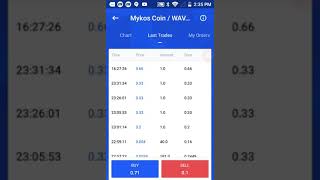
Hey you, welcome back to the channel. And guys, today I wanted to do an update on the price of BitcoinNYK. It has surged to $1.04 and went back to $1, but it did break its peak price today. And I wanted to try to understand a little bit or discuss with you all a little bit about what I think's happening with the price of BitcoinNYK. And let's see if we can get some insight into that and see what the future is going to be like for BitcoinMYK. Is it going to be a coin that is relevant and that is a real player in this market? So first thing I want to say about the bear market in general is that it has been very dull. It has been very boring. I'm about to sleep through the entire bear market. And I want to talk about why some coins are breaking out, why some coins seem to move adversely to others, and maybe what some of those reasons may be. So looking at the price of Electroneum get up to about $1.04, we're looking at it in Waves, in Waves value right now. One Waves token is about, probably about close to $3 now. Price fluctuates. Waves is a good token, but, um, we want to, uh, uh, try to understand what the future holds for BitcoinNYK, uh, and how we should look at this token. So I'll start off by telling this little small story. When I first came to cryptocurrency, I remember befriending some people. I believe they were from Mexico. And they had been using Dogecoin to send home— I think it was, they were using it for basically remittance. They were sending money back to Mexico and they were using Dogecoin to do it. And the thing about it, I can understand they're probably using Doge because of the fees and a variety of things. Things, uh, Doge trading at a fraction of a penny, uh, and Dogecoin has been quite successful trading at a fraction of a penny. So I say all that to say this, that in my mind's eye, what would be a great situation for BitcoinNYK is it trading in those very small cap areas like that so it can be used as cash. It could actually be utilized. When tokens are very high priced like that, they, they break a rule, uh, that we in the markets that we call unattractive pricing. That's to say when the value of something keeps going up and up and it's in big numbers, people generally like to buy when they feel they can get more of a token. It's this psychological thing that happens. So whereas some people say, oh, well, $1.4 for 1, that looks good in theory, what it's actually doing is creating a great deal of volatility in the Bitcoin MYK marketplace, right? And it makes it harder for it to be used as a money. Now in saying that, let me say, let me, let me say this, my insight as to why this might be happening as well. You know, we work on something called a proof of participation model, right? And to really understand BitcoinMYK, you have to understand the dynamic of proof of participation. So how does that work? Well, proof of participation works on the attention value you put to the platform to our token. And within the scope of that, it creates value because of course attention is value and time is value and all these things are valuable. But to probably put it in a more, uh, a more identifiable way, if you look at a social media, right, when people start looking at social media, you ever wonder why do social media sites have value? How is it possible that by you using something like Facebook every day, it can become a trillion-dollar business. And that's due to the network effect, right? Proof of Participation, our, our model is about network effect and network value, right? If you were to evaluate the value of a social media network, some people would say that each account might be worth $100 or $200 per person. And that's, that's a projection based on the value each person could potentially bring to that network, right? And this is the dynamic you have to understand in proof of participation. Now, proof of participation works a little bit different because what it does is it kind of uses other blockchains to determine your value. Do something on our site that has value on another blockchain, and we're able to kind of gauge a value between that blockchain and our token value. And the value being handed over, right, or exchanged rather. So basically what I'm saying, guys, is the reason that we're probably seeing a lot less selling pressure and the price is going up and up like this is the dude that— we have people registering every day now. We have hundreds of wallets already. And, um, I, I thought by now the pressure would be immense to start dumping the tokens and getting us in a, uh, a great, uh, trading range to be used as money, uh, which is probably what I like to see. Unfortunately, I don't control the third-party exchanges, and that's not what we're seeing yet. And, and there are some practical reasons for that. Again, in the proof of participation model, the value of the tokens is not zero. You're doing something to earn it, to put the value in that token. And so by you doing that and receiving one of our tokens in exchange for that, it's probably less likely you're going to want to sell it for pennies, right? And so what the demand to buy these tokens, um, are going to be based on the value that comes into the network and the growth of the network over time. Um, it's also, you know, a cross-chain token, meaning that there are communities that can exchange it for real value on their networks, and that's gonna have some dynamic and impact on what happens with the price. But to be used as a money, to be really used to send money back and forth, the margins do have to decrease in Bitcoin NYK. And I think it's going to happen. I think that we're going to see a lot of selling pressure at some point in time, but it's seeming like the market is saying that Uh, the, the price, the prices that— and even the buy orders, the buy orders are still there, you know, and people would be selling, uh, on under those buy orders, you know. Somebody would be selling someplace, right, if they felt it was enough value in those tokens. Uh, a lot of the support is around, I would say, anywhere from the 1 to 5 cents range. A little support around the 30 cent range. Um, But we do expect a lot of volatility until more tokens are distributed, and we think it will create a natural correction. But another thing with it being part of a Bitcoin fork, I think many Bitcoin coins have been quite successful. You have quite a bit in the top 100, even like Bitcoin Private. I think after its debacle was over $1.50 or something like that. So a lot of Bitcoin token seemingly have that. Not to mention we have the Bitcoin Wave Network, which allows you to move Bitcoin high speeds without touching your tokens. And it could be that some people are speculating on that as well, that what happens if a lot of people start to go, hey, you know what, it makes more sense for me not to touch my Bitcoin but use this representative value Bitcoin and move it at high speeds. And no matter what happens, I'm at no risk because my Bitcoin is still in my wallet. It's probably only a matter of time before people figure that out. Now, how is that useful to us? It's useful to us because our site is basically monetized. The more people who pack on our site, the more valuable it becomes, the more money circulates through the token. And so due to that network effect that we expect is going to happen along with our cross-chain features, our cross-chain token features, Due to all of these things taken into consideration, we believe there is a certain amount of inevitability in, you know, us hitting this great trading range and being highly liquidable at certain rates of exchange. And so, you know, we believe that will probably happen more than not. And we've done a little research into certain economics we've studied in the cryptocurrency markets that seemingly work. The easiest being, can I find liquidity in your token in one form or another? As long as people can exchange our tokens and get value someplace else, they're going to not want to dump that token at certain prices. And so Very interesting stuff. It's been a lot of fun for me as a student of economics to watch these models and to experiment with this and to look psychologically at what works with people and what doesn't work. But I, my personal view on this is this is going to be a lot more exciting token than many of the tokens we're going to see in the bear market. And that is because this is a very lightweight token. Right? And what I mean by it being a very lightweight token, it doesn't have a blockchain. It piggybacks off of tokens that do have, or, you know, token that has its own blockchain. We're part of Waves Network. And some people frown at that and they might go, oh, if you don't have a blockchain, you're not a real token. But that might not be exactly true. In fact, it might make more sense not to have a blockchain. Let's think about it for a second. Thousands of tokens, many do have their own blockchains. Unfortunately, these blockchains aren't good blockchains, and we know they aren't good blockchains. And so they've wasted a lot of resources in order to build an inferior blockchain nobody's going to really use. And if a lot of people do use it, it's a security threat that can easily be hacked and destroyed. So it doesn't make a lot of sense. You're just You're, you're burning resources. You got people mining the network. It's an inferior network, and, and they're mining this network, they're wasting, uh, resources, environment. They're exhausting energy for no reason at all, and nobody's going to use this blockchain because the, the security of it is not good. Um, and we know this, so that's one problem That's more, I think, of a burden on the backs of many tokens, uh, expending these resources. And it gets to the point where they just have to shut down. Nobody's mining the token, and the value of the token has decreased so low that even when they mine the tokens, it's not even enough money for them to pay for their electric bills, right? So that makes like zero sense, guys, uh, in my, in my opinion. And, uh, those tokens will not be able to fare well because you're going to constantly have the miners dumping tokens to pay their electric bills, right? So you— it's going to keep the price down. Why not just forego that and have a token that piggybacks off another network that can put the value back in your hands so you can make money and you can still have the security of a good blockchain, of like a top 20 blockchain? Right? These type of what I call fumbles in the cryptocurrency industry is what causes people to lose a lot of value in their investment. BitcoinMYK, we don't do that, and we're not going to do that. Um, and our connection to Bitcoin, uh, we do feel with the Bitcoin Wave Network, people who use Bitcoin are just going to go, this is a great way for me to move the value of my Bitcoin. without losing my Bitcoin, uh, it being secure in my wallet, so my risk is zero. I'm getting, uh, Bitcoin MYK tokens free, and it's valuable because it builds network effect, which is a value to itself, right? You know, I mean, if I have millions and millions of traffic on the site, that is very valuable. Um, and so all these things considered We think BitcoinMYK is going to be a very sustainable token, a very, as far as value is concerned, we think it's gonna be a lot of value there in the network going forward. And so I think maybe that might speak to some of the price range of BitcoinMYK. We're very comfortable talking about price because this does work on a proof of participation model. We would much rather see you all participate in the network and actually use the tokens and use the networks than go out and speculate on it on a third-party exchange. And the reason that is, the reason we don't worry about people, um, going on exchanges or try to push people to do that, the reason we don't do that is because we understand that those— that only creates a temporary market surge. It does nothing to really create a usable platform where people actually are doing something with the token on a day-to-day basis. And so, uh, we know that, uh, using those principles, that our token will make sense and be of value and be sustainable, uh, in the future. So, uh, the proof of participation model, uh, we think it's one of the best models going forward. Uh, we think it, um, it does— it addresses and it makes sense economically speaking. Like, if you, if you think about how our standard economy works, um, you— we basically just have money all around us and everybody has the currency of their land, right? Like, if anybody you go up to in the world, in your country, in your city, they have that currency. They have those dollars or pesos or whatever it is, those euros. They already have them in their wallet. Doesn't really matter how rich or poor they are. They, they can get access somehow to some, some value of this currency, right? Now, in cryptocurrency, we can't do that. You walk up to people, they don't have your token, they don't have a vendor to accept that. But in the proof of participation model, Everybody who participates, just like in a standard economy, can have our token and move it back and forth. And that's what you need. You need first everybody to hold it, right? The problem is, in order to create these blockchains and distribute these tokens, it takes so much energy that you have to pay for the creation of the token, right? That's why it's important especially in the bear market, for a token to be successful, for it to piggyback off a blockchain and not create one. They're a lot more lightweight and they can afford to move the tokens without the cost of the, of the blockchains or what it costs. Um, and so I think that's all very interesting, what we need to consider in this market and how we need to look at the cryptocurrency space over the course of this bear market. About what tokens are going to give us probably the value we really are looking for and which ones are going to be sustainable. Because a lot of tokens are just about to run out of money, guys, or have already. And, uh, they're, they're like white dwarfs now. They're just dying out, and there's no hope for the future for them because, uh, they weren't sustainable and they don't understand the dynamics of what it takes to be sustainable. I think BitcoinNYK gets it, and I think we'll be around for a long time. But guys, that's all I want to say in this video. If you like content like this, don't forget to like, subscribe, and until next time, take care.