
Bitcoin Myk Vs Manna Token - Rise Of The Free Coins
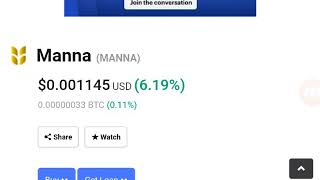
The presenter compares MANA, a universal basic income token with a $500k market cap and 10 billion total supply, to BitcoinNYK's UBI program. MANA's exchange volume of $5 is unreliable and its weak branding limits adoption. BitcoinNYK's approach of forking Bitcoin and funding UBI with unclaimed tokens offers a more sustainable model.
Chapters
Hey you all, welcome back to the channel. And guys, today I want to talk about a very interesting token, Mana token. I want to make some comparisons between, uh, Mana token and make some comparisons between the Bitcoin NYK Universal Basic Income program. So Mana token is one of these tokens that early on gained notoriety on the basis of it being a universal basic income token. And as we take a look here at Mana token, it's up 6% today, but you can see the market volume is, um, only, uh, $5 in the last 24 hours. They have a market cap of over $500,000 USD, and they have all over 500 million tokens now circulating with a supply of well over 10 billion. Um, and so people will look at this volume and they will go, well, this doesn't seem to be working very well. So let's just talk about the history of MANA a little bit. Let's just look at some of these statistics here on MANA and just talk about why possibly this may be the situation. So first of all, the volume is low, but I have an upcoming video that's coming up where we're going to talk about manipulation on exchanges. And, uh, the reason I'm bringing this up is because a lot of the data we see that gets distributed amongst many exchanges on tokens is not accurate data. A lot of, a lot of the trading is, you know, these are propped up trades that are put in and we don't know many times who are behind these trades. So just want to keep that in mind that we will do some upcoming videos showing that a lot of the liquidity that is being reported in the trades that are implemented in over the exchanges that much of this data may not be reliable, except if you're dealing with like the top, very top exchanges. And some predict that it's maybe only 3 of them that's really even close to, you know, what is really going on. But that's another story for another day, guys. Just want to point out that when you see these very— this obviously to me looks like real volume. I'll just put it that way. It's ranked 1,257. So let's talk a little bit about some of the ideas of universal basic income when using a token and some of the problems that come up and some of the issues we've looked at with BitcoinNYK and why we've put in place certain fail-safes to deal with this. So the obvious reason why universal basic income token would probably not do well, or a free token, is because the question comes up is how are you sustaining this token? You're in effect printing, um, you know, more and more money into the markets with these tokens, and what you need is a way to create value, right? And so we're going to talk about sustainability, sustainability, and then we're going to talk about, uh, certain market theories, economic theories that I see working for MANA, uh, and we're going to look at the history of MANA and going to explain why that is. So sustainability, where's the money coming from? That's always the number one question, universal basic income tokens, uh You know, with Mana, you know, it would appear that Mana is maybe going the economic theory route. And that is where it's basically the idea of you have enough users, he who has the most wallets wins. And now you have this viable money that everybody's using. It's the people's money and they're finding value, uh, with it. It's well distributed, which means it's going to be very little manipulation on it. If we go back into history, one of the problems with gold was that it just wasn't enough gold to go around as a money. So what would happen is the poorer classes of people would oftentimes be disadvantaged by the monetary system, much like we get today with unbanked people. Right? And that is because it simply wasn't enough gold to go around to be used as a viable money. Now, obviously with blockchain technology and how this is set up, you can have the entire world using your cryptocurrency and you won't have the issue of, um, of, uh, there not being enough for these people to, uh, to, uh, transfer their value around the markets. right? So that's, that's the one theory, right? The idea that everybody's using your money. If we compare this to currencies in many lands, right? United States, a lot of countries use the United States dollar, right? It's kind of looked at as this reserve currency. Everybody's using it. Everybody has it so they can trade their value back and forth with it, right? Whereas if there is a, me a currency that I don't even have, I don't even have it to transfer to you, is not valuable to me because I don't hold it. And so I'm not going to receive it. This is the state of many cryptocurrencies. You know, the fact that as we try to make them viable monies, people just don't have them. If I, if I go to a marketplace, if I go to the store, they don't accept Bitcoin because they don't have, um, the means to accept it, nor do they want to. And so that's the, the, the issue with if people don't have access to your money. Um, and, and if you, uh, uh, you know, compare that to if they did have access, if everybody had a wallet, everybody had the money, and everybody could move the value, it could become valuable to them and they would have access to it. And I'm gonna show you some history as to why I think it's working for Mana, although The market volume looks low now. Um, so let's go back here. We're going all the way back. I'm trying to get all the way back to, um, way back, way back years ago. Because man has been going on obviously a pretty long time. Now look at this. This is what I want to bring your attention to. If you go back to like in February 2016, MANA is at $0.0001. That's, um, a tenth of a tenth of a penny, right? But if you go back up here, MANA token is at $0.0000001. 0.001, and that's, um, it's up 6%. So I'm trying to look at circulating supply. Well, and the total supply is 10, uh, 10 billion. So what that's indicating to me is that as long as Mana hasn't burned any tokens, which, uh, they still have a lot here The value of the MANA token has increased, right? And their market capitalization has increased. So what that would mean is their dollar over time, as more people use it, it gets more valuable. Does that make sense? And so that's part of economic theory and what we need to understand about cryptocurrency. Now, obviously it will— the price will decline and it will come to use more as viable money. which will make more sense for people to be able to move it. But over time, the value of it is increasing and it's given all this economic power and value back to people. And through mass adoption, which I would imagine the hope was for Mana, that would have happened. Now, here are some problems I'm seeing with Mana. With Mana token, the branding just isn't there, and that's very important to networks and building up people. Now, because Universal Basic Income has always been hot topic. It's always been, um, you know, basically, uh, something that people felt we were going to need at some point in the future. So it's a demand for— it's a priority. Um, I think that's allowed, of course, Mana to, to be valuable to people, you know, obviously. But due to the lack of branding I'm finding with Mana you know, that makes it harder. How you gonna let people know about this? It's just hard to get this information out. We live in a very capitalistic society, which means any form of socialism generally gets frowned upon. So some people are very resistant to it unless you can create a type of hybrid model that exists like most of them exist today in many nations, whereas there are these aspects of a socialist system excuse me, social programs, but then you have a balance of capitalistic ideas that kind of help to create a harmonious balance between the two, which basically means it can make the program more sustainable. So I'm not seeing where Mana has that, although some of the latest data, they don't get a lot of reports these days. I think they're suffering from the market like everyone else, But I don't see a lot of data coming out of the Mana Camp these days. I just checked their Facebook and it looks like it was going on over a month now since any kind of information came out of the camp. Their website's still up, it looks good. But, you know, that's gonna be a very important aspect to getting everybody to hold these coins and hold these tokens. The branding isn't there. You know, where's the value coming from? You know, the cryptocurrency market, when it comes to vendor and people accepting value in the tokens, it's still very hard to get people out of mindset that they're going to accept this MANA token to buy goods and services because their mind's going to always clip back to how valuable is this thing. So these are some of the very interesting things about MANA and many of the other free tokens that are using a similar platform to Mana. And I think the differences with Mana and Bitcoin MYK— and when I make these comparisons, as I say in all videos, I look at universal basic income tokens as— we look at them as brothers in arms because— and I would much rather there be universal basic incomes all across the cryptocurrency space because I believe We will be able to create this mass adoptive use of cryptocurrency through it. Everybody would have stake in it and a reason to hold it. And then some of these economic theories and ideas that work that we just described earlier, everybody holding your token so it has value and using it and seeing the value and being willing to trade that value for it. Those things work. Those are facts in the economy. Uh, but to get to that point, we would need everybody, um, doing this. And that's why I don't look at this as competition at all. The more people doing it, the better. It means we can kind of interchange this value and that everybody's using cryptocurrency. Everybody's now adopted the cryptocurrency so they can use other cryptocurrencies, but everybody's— it's a well-distributed system. It's not a monopoly. Is not a pyramid. The truth of the matter, fact of the matter, guys, is that the way the cryptocurrency markets work, we work in a pyramid-like economy. That's just the facts of it. Uh, and, uh, people don't really want to invest a lot in these platforms because they're small, very pyramid-like. These aren't vast economies where you have very stable price movement like what you would get with currencies like the US dollar. which is the place I think cryptocurrency needs to get, but at the same time release value back to the people, uh, in a deflationary way. And so those are— these are very important factors, guys, um, in that, you know, unfortunately many of us are still looking at this as a casino. They think it's a great idea if they can jump in and they can get rich, but here's the problem with that. A lot of times in a small market, when you can get rich, that means somebody was left holding the bag, right? The people who are left holding the bag, do you expect them to keep playing the game and for how long, right? Does that make sense? They're not going to keep playing the game. If they don't keep playing the game, you're not going to be able to sustain your value. You're not going to be able to keep making money. Sure, a few people would get rich at the top and get out, but you're going to leave the rest of us. And, and this is like 90% of the entire cryptocurrency space till we figure this out. We'll continue to have this problem, but that's why I say that, that this is not competition with us. I would prefer we all interchangeably use each other's tokens until we can reach mass adoption and try to get away from the traditional cryptocurrency coins that work in a pyramid-like form. And unfortunately, that's most of them. Until we create these well-distributed systems, we're going to have that. But some differences with Bitcoin MYK that I think work a lot better than many of these tokens are going to work is branding. You know, we're a Bitcoin fork. Everybody holds Bitcoin. You cannot take value from other people to just pay for programs. It has to be in a sustainable method and model. We don't take any value from Bitcoin holders. We fork Bitcoin. We use unclaimed tokens and value to fund our universal basic income program. So we're more like a hybrid and, and more going on similar to what EOS might, uh, is going on where they're still doing their day-to-day operations, but they have their inflation that they hope to pay for the, um, uh, the program, the what they call the Universal Resource Inheritance Program. Now the problem I have with EOS is I don't like the branding of EOS. I think Bitcoin is better branding. Why? Because everybody in the public understands Bitcoin. And when they would think about universal basic income, they would understand Bitcoin's valuable and as a way to deliver that value, right? Um, you know, and so we also have this interoperability into other social media networks. As more people accept, uh, cryptocurrencies connected to social media, I think it's much easier for them to understand value as they've seen what's happened with the Facebook being worth like a trillion dollars or getting there, and they've seen the value, how it operates in a, in a social media type of environment. And if we can kind of make it digestible to them in that way, that value can more easily be moved. And so I think they understand that, and BitcoinMYK has many of those combinations. If you're a MANA token holder, or if you believe in the rise of the free tokens, and there are many coins out there that believe in the rise and are part of free token rise, and, um, or some form of hybrid. Uh, one coin I talk about a lot, as many of you know the most on my channel, is Electroneum. And Electroneum, uh, gives out free tokens through their mobile simulator miner. People get these free tokens every day. They get, uh, um, hundreds per month free without paying for them. And that makes a lot of sense. They understand that point of view. Every token, every cryptocurrency should be doing this. Uh, I was listening to this business guru one day and he talked about the problem with cryptocurrency is what we do is we actually should move it more like how you get samples in mail, right? Give people the samples free, then they use your products, right? We want people to just take a million percent risk, all the risk, 100% risk, and we want them to just jump in this and start spending the money. And the only way we can get them to do that is by, you know, trying to send out this signal promising them big returns, possibly. Um, and so that's what fuels that. And, uh, if we— if you don't present it that way, people aren't going to join your programs, they're not going to participate in your tokens. So guys, if you use a MANA token, keep using MANA token. From what I can see in the data in it is that MANA token, it may be moving slow. The volume might be very low or any, hardly any at all, and it's probably manipulated. Uh, I'm sorry, not MANA token manipulated, but a lot of exchange data is already manipulated. So people are looking at this going, this is a lot of volume, but the reality is a lot of what's going on over the exchanges is manipulation. So we can't fully trust that data. Uh, and so I wouldn't pay a lot of attention to that. I would keep building my coin and program. Now we have some very— with BitcoinNYK, we have some very practical ways to make money that just work in any business. That would work. So our model is sustainable to create value, and we invite you to watch our channel and information about it and join our free Universal Basic Income program. But, uh, uh, you know, we got some basic business approaches that just would work in any business that's helping to sustain our token. But guys, that's all I want to say today. Guys, if you like content like this, don't forget to like, subscribe, and until next time, take care.
More from Michael







UBI - CIA Agent Explains Why Americans Will Never Get Universal Basic Income?



