
Bitcoin - Shark Tank Kevin O'Leary Slams/BtcMyk Up 52%
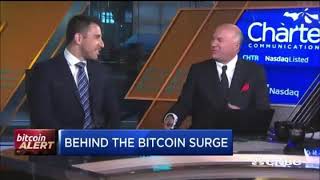
The video opens with the host introducing Kevin O'Leary’s repeated criticism of Bitcoin, labeling it “garbage” and a speculative gamble akin to roulette. O'Leary argues that Bitcoin lacks intrinsic value, cannot generate interest, is unsuitable for large transactions, and is hampered by regulatory and tax issues. The host then plays a series of O'Leary clips and interjects commentary, offering a point‑by‑point rebuttal. The rebuttal emphasizes Bitcoin’s role as a belief‑based money, its superior performance versus traditional assets, institutional interest, traceability for law enforcement, and its function as a safe‑haven during geopolitical tensions such as the US‑China trade war. The discussion also touches on Bitcoin’s volatility, the difficulty of using it for high‑value purchases, and the broader cryptocurrency ecosystem, including ICOs and regulatory scrutiny. After dissecting O'Leary’s points, the host pivots to promote a new token, BitcoinMYK (Bitcoin MYK), describing it as a universal bridge cryptocurrency integrated with a social network, providing universal basic income, and offering free token acquisition for Bitcoin holders. The host claims BitcoinMYK solves Bitcoin’s limitations by enabling cross‑chain transfers, leveraging network effects similar to a hypothetical Facebook coin, and operating without ICOs or direct purchases. Throughout, the host frames the analysis as an unbiased examination, contrasting O'Leary’s traditional‑finance perspective with the emerging crypto narrative, and concludes with a call to action for viewers to subscribe and claim free BitcoinMYK tokens.
Chapters
Hey you, welcome back to the channel. And today we want to talk about the, uh, one of the hosts of Shark Tank, which is this, uh, program that's become quite popular, millions upon millions of viewers, where private equity capital funds, uh, new products on the horizon, new companies, new startups And most people are familiar with this show now. You know, many people watch it. And one of the main hosts here is Kevin O'Leary. So he's been really slamming Bitcoin. And I want to get my thoughts on that. Now, after spending over a decade working for some of the biggest investment firms in the nation, um, working for VCs and private equity firms as well. I could tell you that I work with people like Kevin O'Leary every day, and I'm very— I can pretty much tell you what he's gonna say before he says it on many ideas and many projects. Uh, so I think I got a little experience in, in dealing with people like this. So what I want to do is I want to play some of the, the, uh, the comments he's made about Bitcoin, and I, I want to, you know, try to, you know, be, uh, come from a kind of unbiased view about it and, you know, tell you what parts of it I think, you know, makes sense and what parts probably don't. But let's, let's take a look at it and let's see what we come up with.
Right, so don't look at the highs, look at the lows. And again, it's just supply and demand. If you have a scarce asset and demand increases— Mr. Wonderful thinks it's worthless.
Well, I, I called it garbage. I did say that. I want to explore the idea that there's nothing here except raw speculation, no different than when I go to Las Vegas and put my money on black or red on a roulette wheel. Because where is the intrinsic value inherent in deploying real capital. Let's talk real money here and putting it into Bitcoin as a storage of value. I get gold for 2000 years, including the Romans. They saw value in owning that as an asset class. Tell me why this, which is basically a digital game, that's the way I look at it, has any intrinsic value. When people actually put real money into this, they make no interest. They can't pay their taxes with it. The regulators don't like it, which is always a problem for compliance. And where's the long-term value? Just this, this idea that they're going to cut the number of units in half, that's such a scam. Like, that's just totally BS.
So I would say two things. One is, um, it's disruptive technology. So if you look at it from a technology standpoint, that also has an odor of BS to it. It, it, look, everything that's new seems different, right, in the beginning. And I think what you've got to realize is with Bitcoin specifically, money is a belief system. So the US dollar, the only reason why you and I use it is because we believe it has value. So I give you a dollar, you give me a good or service in exchange. We believe that it has value. Bitcoin has value because two people who exchange it believe it has that value. And what we're seeing is the volume, right? Look at people using it. That, that's the ultimately what matters.
Other crypto crap, there's lots of other coins.
I, I believe Bitcoin is the king and is going to stay the king for a very long time.
So I taught a class at Harvard 18 months ago that, you know, young people in that class challenged me. I put $100 into something called Coinbase which is a wallet thing. And you buy Bitcoin? I bought them all. I bought all the crypto crap. I put $100 in. It's now worth $30.
$30.
That's a 70% loss on my crypto crap. Now, I bought them all. I think that really sucks. And I think people should understand today that the hot digital is Bitcoin. Tomorrow it could be whatever, right?
Again, I think that Bitcoin— the reason why Bitcoin is getting so much attention, it's the best performing asset in the last decade. It's drastically outperformed S&P, every other kind of financial asset that's out there. And the second thing is the institutions are coming in because Bitcoin is actually a better store of value. It's more transparent and more secure. So regulators, they actually like Bitcoin in the sense of law enforcement can track criminal activity. Every single transaction is done on a public ledger. You can see— Law enforcement loves Bitcoin? I've interviewed a DEA agent who came on and they would love for criminals to use Bitcoin over US dollars and cash. Right? It's much more traceable. And so what law enforcement is saying is they want these digital currencies used, Bitcoin specifically, because of the public nature of the transactions. Easier to track the criminal activity after the fact. After the fact, yeah, of course. Well, US dollars, you can't track it before or after.
Last time this had a big run-up to $20,000 and people started talking about assets with it, the SEC was handing out subpoenas like birthday cards.
They were doing it for the ICOs. So ICOs are essentially people who took the concept of a blockchain or a cryptocurrency token and they're using it for fundraising for companies. And so you can imagine if you go out out and solicit funds from investors and you do nefarious things, the SEC cares.
That's actually fraud. I mean, you're talking about fraud. And the fact of the matter is Bitcoin has been acting pretty well in respect to the recent bad news hitting the sector. We had a hack of Binance, and then we also have the New York AG bringing charges against Tether and Bitfinex, and the coin has done Listen, it's a real currency.
Why can't I pay my taxes with it?
You can.
The IRS takes— you can.
In the state of Ohio, they accept Bitcoin for taxes, and there's other states that are working on it now.
Some weird freeze thing seemingly happened, but, um, that was some statements made by Kevin O'Leary. I just want you all to kind of get a full picture of what Kevin O'Leary from Shark Tank was saying. But here's another clip, uh, I want to throw in here real quick, um, about, uh, him making some more comments about Bitcoin.
Conventions in New York this week, a potential safe haven from the US-China trade war and greater institutional support. For example, reports earlier this month that Facebook is building a crypto-based payment system. Traders are also saying that Chinese buyers were using Bitcoin to circumvent the country's capital controls on the yuan. So Chinese investors in China trying to get their money out and using Bitcoin as the vehicle. And that's supposedly one explanation for much more money later.
Bitcoin— once you put your money into Bitcoin, you ever hear people say that they are challenged to sometimes sell?
Really?
Sell in volume.
Oh, in volume.
In volume. Try and do a transaction over $100,000 with Bitcoin. I tried to do some real estate in Switzerland with it once. It is a useless currency. It is a useless currency. That's what I believe. I mean, Look, I'm not like, you know, I realize people have different opinions, but to me it's garbage because you can't— you can't do—
do—
I mean, you can't get in and out of it in large amounts. And it was just— you can. But what happens is the receiver wants some guarantee. Let's say you want to buy a piece of real estate for $10 million in Switzerland. Let's just say— just let's just say— and they don't want to use the traditional transfer system. All right. Which is illegal, by the way, because you have to disclose why you're transferring $10 million into Switzerland. They want to guarantee that the value comes back to US currency at 10. You have to somehow hedge the risk of Bitcoin. That means it's not a real currency. That means the receiver is not willing to take the risk of the volatility it has. It's worthless. I believe that. Okay, speaking truth.
Okay, all right guys, um, so you, you, that way you got to hear a little bit of what Kevin O'Leary had to say about, um, how he felt about Bitcoin, right? So what I want to attempt to do, I'm going to get my thoughts on, I'm going to try to talk about some of the things I thought he made some valid points with, and then I'm going to talk about were some of the things I think that he was off in left field about. So when he spoke about it being a speculative device, like something you get out of Las Vegas, right? He's talking specifically now about the actual use of Bitcoin to what many of us are using it for, right? Which is speculation. And he's making that movement in that point from that to not only then is it really not being used as a money, but then if it is a money, it's a terrible money. Now, in some respects, uh, I would have to say he's correct in that. Um, he gives the example about in this last segment about the problems he, he has is using it as a money, that it, you know, that it would be, uh, illegal to use it as a, as a money, be, you know, to make these big transactions, buy this real estate over in Switzerland. And a variety of things like that. And they also get into the demand of Bitcoin a little bit, or rather, sorry, what's driving the value of Bitcoin, what's driving the price of Bitcoin. And interesting enough, they spoke about the trade wars. People are seeking out a safe haven with their money due to these trade wars coming up. And then over in China, people are trying to get their money out of the yuan, right? And so they're using Bitcoin. These are things that come up quite a bit. Now they're very important because they relate to driving the price of Bitcoin, right? And why Bitcoin's value is going up the way, the reason it's going up. He then goes on to speak about technology, the idea of disruptive technology and that the fact there's so many cryptocurrencies, you just keep creating them over and over again. And, you know, because of that, it's, you know, it's basically anybody could be Bitcoin, right? Anybody could be better than Bitcoin. There's no reason why another cryptocurrency wouldn't take its place, meaning the people who have their value stuck in Bitcoin, they are now losing that value or that cryptocurrency is becoming obsolete as they now have this other one. He speaks of the halving being a scam, feeling like a scam and a variety of things. From a, from a purely business perspective and an investor perspective, Kevin does pose some very important questions that make you think about, uh, what's happening with Bitcoin and why people are buying Bitcoin and will it really work. Um, now where, where Kevin, uh, I believe comes from a place of ignorance on Bitcoin. We can tell by listening to Kevin He's not really that big informed about Bitcoin, but he's speaking about Bitcoin, uh, in ways like he is. So he's jumping, he's jumping to conclusion. He's going, well, if A plus B equals C, then thus D would follow in a variety of things like that. So he's, he's making an assumption with knowledge he doesn't know because he's not well informed like about Bitcoin. It's similar to what Warren Buffett's been doing, right? And I don't know what it is, but it seems like Uh, with a lot of the top investors, when they reach a certain age, you know, we used to hear this old saying about you, you, you can't teach an old dog to do new tricks, right? Sometimes when people get at a certain level and, uh, you know, place in their careers, there's no more compromise for them. They're sticking to what they're familiar with, sticking to gold from thousands of years ago. Warren Buffett, Kevin O'Leary. And I think that's dangerous. That's a huge issue, and that's a big problem because it doesn't allow for fresh new ideas to come in and concepts. And they're kind of using these old paradigms to deal with the future. And that's always, that's always bad. And clearly, you know, Kevin is not well informed about how cryptocurrencies work. He doesn't, he doesn't understand that the values in the blockchain technology, you know, he doesn't he doesn't understand how, uh, he, he didn't take into consideration, rather, uh, the, the concept of money, uh, being this kind of faith-based system, all right? That when money is exchanged, we do have to go, well, I'm gonna believe and I'm going to accept that this, uh, this product, this money, uh, is, you know, is worth what you say it's worth or what we believe is worth. I'm going to exchange my good for that. Now, you know, the reality of the situation is money under sovereign nations is a bit more complicated than that, right? Because you have an army backing it up, and the country may have natural resources as well as what's owned by that country, right? Uh, the lands that are owned by that country, depending on how that country is structured. And that means what's happening then is it's giving that nation much more ability and power as the central authority to redeem those notes as they say they will. So it's kind of like a corporate bond in a way. If a corporation makes a lot of money, it's very likely that that corporation's gonna be able to pay that bond, right? And so when you try to compare that, a currency, in relation to that, you know, then you're gonna, uh, you know, you're gonna leave a lot of important stuff out of that about why that it's gonna be more likely that that currency is gonna be redeemable. Now Bitcoin is another story, and this is kind of a point in Kevin's favor, you know, that, uh, the people aren't really willing to take the risk of, um, the Bitcoin or the volatility, which he's saying then that makes it not a a currency, or at the very least not a very good one, right? And I think in fairness to what Kevin's saying there, I think we've all kind of come to that conclusion in cryptocurrency. And the problem with just saying it's a store of value, we can create more, we can have it, the problem is that that concept is very problematic because you can take that and you could do that with any cryptocurrency. So what makes Bitcoin then the leader and the king would be branding, right? And just the fact we've been using it for the last 10 years, which is not enough time in human history for something else to come along and be better than Bitcoin. And those are the points he's making in that to his favor. But now he's, we could tell he's very green. He's very ignorant to a lot of things. Like how he say he went into Coinbase, he just bought all these cryptos. Uh, he hasn't studied the market to know that, you know, where he was buying at, he shouldn't have been buying at the top of the market. None of that. He just put money— he essentially just put money in and then went back at a certain time and tried to get it out. He didn't even really specify the time frame, right? So, um, you know, his comments are very biased. And in this, you know, in this video, I'm trying to approach from a very unbiased way, right? I'm trying to, you know, and his is clearly quite biased, like Warren Buffett and the rest. And a lot of these people have invested in, in the old structure, and they're well invested in that, and they're fine with how the old structure's working because they're winning from the old structure, right? So they're not really, you know, looking to change it, uh, very much, right? And so that's the problem with, uh, many of the commentary from these guys. But I will point and say that Bitcoin doesn't work good as a currency, and there's a huge problem with that. It not— because being a money, right, being money, working, working well as a money, rather, and being able to be implemented into a store value system, uh, it's, it's kind of like a, a circular thing. They're, they're very important. Being able to transfer as a money adds to the store value. It builds the store value. Right? So they don't really separate from each other as much as people would think they do. Right? Um, so in those ways he makes some, some very interesting points. We don't, you know, another thing is like how Bitcoin is going up in value right now. Um, you know, some of the things we touched, there are specific reasons that are doing that. And then there are other reasons that could reverse that. For instance, let's say the trade wars between China and the United States, are the key reasons that Bitcoin is going up in value. Does that then mean that as soon as the US and China reaches a resolution and those things work out, that the price of Bitcoin will go down? Probably, possibly so, right? So that means it's controlled by that. And that's kind of problematic because then it's geared toward that. And going back to the merchants, for example, not wanting to take the risk of Bitcoin and that making it a bad money. Yes, we know that a lot of people who take Bitcoin, as soon as they exchange Bitcoin for something, what do they do? They take the Bitcoin and they cash out, right? They cash the Bitcoin back into fiat currencies. And that's a problem, means they didn't have a whole lot of faith in Bitcoin. There's been a big thing going around with eBay and the New York consensus for cryptocurrencies happening and where eBay was supposedly going to be taking Bitcoin. They're not taking Bitcoin, uh, really. It's something like a gift card that you can— that you, you use, and you, you can buy Bitcoin with the gift card, but then you got to go through 90 Degrees. They're not directly taking the Bitcoin for, for cash in place of fiat because they're not willing to take the risk on Bitcoin yet. And that's— those are the points that Kevin made to his favor. But I want to kind of connect that to the next segment We're gonna talk about my project Bitcoin MYK up 52% today. Another one of these cryptocurrencies that I think Kevin O'Leary is warning us about that could emerge up. And I just wanna talk about why Bitcoin MYK might make a great deal of sense in the cryptocurrency space. So let's talk about that a little bit. Okay, so here on the Steam Engine marketplace, Bitcoin MYK, uh, is presently up 52%, um, and Bitcoin MYK is a universal bridge cryptocurrency, uh, is integrated into a social network, um, and, um, it also supplies about, um, 80% of the globe with universal basic income. Now Uh, the reason all these factors are very important, even to the point of where BitcoinMYK is trading, um, with the Steam, uh, and then Steam ecosystem. So relative to what you get in the ERC-20 token with Ethereum, the Steam blockchain started its version of its tokens. Uh, what is, what is so important about Steam? Uh, one of their premier applications called Steemit.com, which is the biggest social network in cryptocurrency. And why are these key things and why are they so important? Well, uh, also in those segments that we didn't get to see, they talked a bit about Facebook Coin. And Facebook Coin, uh, is part of one of those factors that's driving the cryptocurrency market value up in Bitcoin, uh, because Facebook is going into cryptocurrency. Now with 2— over 2 billion users, what happens With Facebook, if it becomes a cryptocurrency, it already has an established network. In fact, a system like Facebook would be bigger than probably most countries in the world, several of them combined, the major companies, countries in the world combined. So it would be a money unto itself throughout its network. Now Bitcoin itself doesn't have anything like that. It doesn't have a system integrated like that. To work and move through this ecosystem. BitcoinMYK.com does. It has a, this type of social network and this type of workers economy for universal basic income recipients where they can move that value through this. Yet at the same time, BitcoinMYK solves a major problem in Bitcoin, allowing it to be a universal bridge cryptocurrency that moves through several blockchains, meaning that you can now move your Bitcoin value, represented value across these blockchains easily. And that is because if you are a Bitcoin holder, you don't purchase Bitcoin MYK. You just basically get it through our hub systems. You get it actually free, right? There is a ratio you can— you switch off your Bitcoin, moves to Bitcoin MYK. You keep your Bitcoin in your wallet just like gold. Um, and, uh, this is kind of like more efficient money, right, for Bitcoin, right? It's not Bitcoin, but it's kind of like an ex— you could think of maybe as an extension, or like the Lightning Network, or what have you. Now those are all very, very important key, uh, things to think about with demand and who's using it. Another thing, social networks is much easier to gauge not only use but value. And how Facebook Coin puts that together. Cryptocurrency needs something like that. Of course, the problem with Facebook being, it's more centralized in that idea, right? And that's the problem people have, is this company that's doing it. Whereas something like Bitcoin MYK, we believe will become the most decentralized cryptocurrency in cryptocurrency, in the cryptocurrency arena. Um, and, uh, we got a white paper available, you can check that out. But we believe this is the answer to what somebody like Kevin O'Leary saying. We believe that's why it's up 52% today on the Steam Engine Marketplace. It also trades on the Freedom Exchange, it's on the Waves Exchange, so it's on 3 exchanges right now, um, and it's a new project, but we don't see any reason why it won't be headed to some of the more large exchanges fairly soon here, um, uh, and so that's— I think that's where we're at with that and understanding uh, social network, the network, the network effect, the community, the users, uh, myself being in a community which is quite legal and going to you, we decide that we have a, a currency, a token system where we can trade back and forth. And that's legal in the United States. A lot of people don't know that. Uh, not that we're not talking about counterfeiting the US dollar or anything like that, occurring in a currency, but you can have a local a token where you can exchange with people of your community, and cryptocurrency on a scale is similar to that, right? Um, you know, having a social network feature integrated into all of this, yet having all the strengths of a decentralized platform, is what BitcoinMYK does. And that's why we believe the price is up and why it's becoming valuable. Another factor could be, uh, had this very fun feature we've added to it called Market Predictor. which is something like a prediction market type game. You don't, you know, buy into it or anything like that. Uh, now BitcoinNYK works more traditional, like a standard money in a normal economy, right? If I go out and work, my labor produces the money, right? I don't go buy the money and then use the money to reward the labor. That's kind of what you, what you get in Bitcoin right now, is we got to kind of move that fiat over into Bitcoin. Ours, we, we go in reverse with BitcoinNYK. We believe the value comes out of us and is represented in BitcoinNYK, which is why you do not purchase, you do not have to purchase BitcoinNYK. There are no ICOs. We don't sell it. Now there are exchanges where third parties can move this value of the cryptocurrency around, but you come into the BitcoinNYK network and your contribution to it produces BitcoinNYK. not the other way around where you go in and buy it. So this is all very revolutionary, what we're talking about here, and you really have to take a little bit of time with it. And again, if you're a Bitcoin holder, you can get BitcoinMYK tokens free. There's no reason why you shouldn't be taking advantage of them, getting them, because it's going to solve many, many problems. And like you see, it's up 52% today. We believe things like that are going to continue. But those are my thoughts on it, guys. I love coming from a non-biased point of view, because, you know, we know we got Bitcoin maximalists and we already know where Bitcoin maximalists stand and community loves Bitcoin. I understand that. But people like Kevin O'Leary are very important because they control a lot of capital. People like Warren Buffett are very important. He controls a great deal of capital and would much rather have, and at the end of the day, they're all about making money, right? That's what businesses do. Kevin O'Leary explained some of the problems in transferring large amounts of money to buy real estate in other countries. His points were valid, but I'd much rather have them part of this system and find ways we can all work together than opposed to it. But would love to hear you all's views, guys. That's it for this video. If you like content like this, don't forget to like, subscribe. Don't forget to get your free Bitcoin MYK tokens, contribute value to the ecosystem, and get value out. Until next time, take care, guys.
More from Michael







UBI - CIA Agent Explains Why Americans Will Never Get Universal Basic Income?



