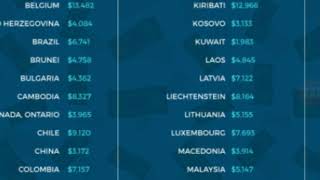
In this video Michael Joseph Presley explains why he has abandoned dollar‑cost averaging and now places buy orders at a fixed $1,800 price level for Bitcoin. He grounds his strategy in a supply‑and‑demand analysis, noting that Bitcoin historically showed price stability around $800‑$1,000 before China’s mining dominance. Presley presents data on regional mining costs, highlighting that China’s average cost is roughly $3,100 per BTC (potentially lower with newer equipment) while other countries range from $500 in Venezuela to $26,000 in Kiribati. He argues that because mining can be profitable at lower prices, the current price floor is not yet reached and a further decline of several thousand dollars is plausible. He also discusses how such a drop could affect altcoins, noting both correlated and inverse relationships. Finally, Presley promotes a Bitcoin fork called BitcoinMYK on the Waves network, offering free token claims with near‑zero transaction fees and the promise of significant upside, positioning it as a low‑risk hedge amid the anticipated crash.
Chapters
Hey you, welcome back to the channel. And guys, today I want to talk about Bitcoin and want to talk about why I've taken on a new strategy of setting my buy orders. I've stopped the dollar cost averaging down and I've set my buy orders at about $1,800 per Bitcoin. And I'm going to tell you why that is. I'm going to get into that a little bit in this video. So if you watch my channel, you've probably heard what some may deem to be quite a pessimistic view of the value of Bitcoin. And I don't want to have that view of Bitcoin. This is based on economics studies done into Bitcoin based on supply and demand. And those are rules in economies that I do not break. Supply and demand rules. And so it's important to understand that, uh, whenever, um, you know, we discuss, uh, the value of cryptocurrencies, that you do your own research and all due due and all due due diligence. Well, I'm getting choked up today, aren't I? Um, and hopefully I'm going to be able to bring some good news before the video is over, uh, with the price of Bitcoin and why I've done this. But let's Let's talk, look a little bit about the supply and demand because we have to, we have to accept supply and demand factors in markets because if we cannot ascertain true value in some form or agree upon a value, then we're going to, you know, continually of course have big market fluctuations that aren't going to be good. To many investors. And so let's try to understand a little bit about what we've been able to find on the history of the supply and demand factors of Bitcoin. So when we, when we speak of demand and we, and we talk about demand in earlier videos, many Bitcoin experts have been able to kind of come to the conclusion that Bitcoin was at its most stable price around the $800 to $1,000 mark. Due to it being— this was pre-China's intervention into Bitcoin and the dominance it has in Bitcoin and control it has over Bitcoin today with the mining operations. And we're going to get into that as well a little bit. But when there was a— what many believe to be a real demand for Bitcoin, it was around $800 to $1,000. And of course this had a lot to do with hyperinflation and it had to do with certain uses of Bitcoin, whether it be people trying to protect their money from certain oppressive regimes, um, uh, in hyperinflation. Uh, and I, I guess I can even throw in, uh, illegal activity, right? At the time it was, you know, being used for that, uh, for the most part. But, uh, these certain factors make a lot of people believe that there's a certain point in time when China gained dominance over the mining of Bitcoin that a lot of these prices began to be more of an artificial display of supply and demand. So let's look at some statistics and let's let's discuss some real numbers here and try to see if we can understand this. So what we're looking at is this is a chart of what it costs each region, each area to mine Bitcoin, right? Each country. Uh, and we're focused here on China because China is the most dominant Bitcoin miner, of course. Now we have to understand that Tech, when it comes to technology and our use of technology, that there is decentralization in Bitcoin as far as use of that technology to a certain degree. Uh, however, there are differences in decentralization when it comes to mining, when it comes to develop developers, right? And so what this does is it it creates a kind of a monopoly, if you will, that can create types of price control, right? But the problem is if you have kind of this artificial, uh, value going into Bitcoin, then of course you're going to have big moves in the value of Bitcoin, crashes of Bitcoin, market crashes, because You know, I think if we're being honest, we would have to call what happened to Bitcoin a market crash. This is not a, this is not a bear market. It is a crash market. And so looking at some real numbers here, if we look at China, it comes out that China, it only requires or it only costs about $3,100 to mine a Bitcoin, right? So one theory is that in order for China to be profitable, right, that they're gonna, they're gonna keep pushing that price of Bitcoin above, you know, this $3,100. In other words, they're not going to sell, uh, at $3,100 because then they would be— they won't be profitable, right? They will be essentially mining Bitcoin without making any money. But there's a few problems, uh, with that idea and that theory, and we're gonna explore that right now. So one, uh, problem with that idea is that, as you can see, it costs different amounts around the globe to, to mine Bitcoin, right? You go over here to, um, South Africa, it's over $5,000. You get to Latvia is $7,000. It's $12,000 in Kiribati, uh, $26,000 some places around the globe. It's only interesting enough, $500 in Venezuela. That's pretty interesting. It seems like Venezuela should be able to capitalize off of that some kind of way. But the problem is this takes into consideration less efficient, mining, uh, mining equipment, right? Mining rigs, uh, certain Antminers that are used now since this particular study and graph was conducted, uh, are, are mining at, uh, twice the efficiency rate at, uh, what we see here in this graph of $3,100. So that could possibly mean that Uh, it's only costing China a great fraction of that. It could be costing China maybe about, uh, $1,600, $1,700, you know, or even less. It could be less than that. And because of that, that means that they could continue to mine profitable, um, you know, at a very much lower Bitcoin price and still be in profits. Um, And so, um, you know, taking that into consideration that it can actually cost less now to mine a Bitcoin, that kind of leads one to believe that we could see an even greater drop in the price of Bitcoin. Now that coupled alongside with the concept of, uh, the, uh, real supply and demand factor, or at least what we believe right? This is just what we believe. This is a theory I found doing various research with people who are smarter in Bitcoin than I am. And I'll try to get some links to some of those studies and reports. But they were saying that Bitcoin was more stable around $800 to $1,000. Now, Coupled with all of that, that makes me to believe, or leads me to believe, the price of Bitcoin's floor isn't in yet, and we can see a great deal of more money drop, right? We could see, possibly see, almost another couple of thousand dollars drop on Bitcoin. And of course, that's not going to be good for the rest of the cryptocurrency market. It's not going to be good for a lot of our altcoins we're hoping going to go up. And, uh, but well, I kind of take that back. It, that isn't necessarily true, right? There are altcoins that trade adversely to Bitcoin, and there are some altcoins that greatly defy Bitcoin and aren't as tethered to Bitcoin as we might believe. So that doesn't necessarily put the nail in the coffin of we will see these altcoins do— in fact, it is quite possible we could have some, some rises in the price of these altcoins significantly higher than normal, kind of like what we got with Ripple during its, its run-up when, when Bitcoin prices were falling. Um, so that, that could be a possibility as well. So if this is true, if this data is correct, and you're a Bitcoin holder, my question is, what are you going to do, um, with a possibility of a much, uh, higher price fall in Bitcoin, right? So, uh, what the place I've come to with the entire Bitcoin thing is I still believe Bitcoin is the most secure network and it is the token, it is the coin that the real money is going to see before anything else, right? I don't know when that's going to happen, um, but I think at some point in time in history it may happen, but For now, this is the data that I think is more accurate in my opinion to go on and to trade on. That's why I'm moving the price to $1,800. Now, you know, a lot of people came to cryptocurrency to make money. If you came into cryptocurrency to make money, I have to propose this last part, and that is the project we're working on, BitcoinMYK. Which is a Bitcoin fork, meaning if you're into Bitcoin, if you hold Bitcoin, you can visit our site. You can claim your BitcoinNYK tokens for free. What BitcoinNYK does is it uses the Waves network and it allows you to move your represented value of Bitcoin, uh, at, at high transfer fees, at little, almost zero, uh, transaction costs. In fact, if you use our network, all your transaction costs are free and it offers a potential to see your value of Bitcoin using our token improve triple the value, maybe even 5x in value or beyond that because of the rate at which it's trading now is right under a dollar, right? And so As far as bringing value to your investment, as we have experienced a market crash and lost over 90% of our value, I think at this point we don't have anything to lose, especially by getting a free token, BitcoinMYK, and seeing what it can do, its potential. Um, and so, uh, we'll leave a link in the description on how to claim your free BitcoinMYK. But I think this is what we're looking at, guys, and I think we might have to come to terms with that. I don't want to be, I don't want to be just saying this to try to spread FUD or get you to use my token, our project. I'm saying that because I think it does present a good solution in this situation, and especially that it's at no risk to you. But that's all I wanted to say. If you have any questions, comments, or concerns, please leave them in the comment section. And if you like content like this, don't forget to like, subscribe. Until next time, guys, take care.