In this solo vlog, the creator discusses bullish, long‑term price forecasts for Bitcoin, ranging from $1 million to $12 million per coin by 2030. He explains why Bitcoin’s technical properties—its extreme divisibility, fixed 21 million supply, and decentralized nature—give it a unique upside potential while limiting downside to the amount invested. The video links Bitcoin’s appeal to geopolitical risk, citing examples of governments confiscating or devaluing fiat currency, and argues that Bitcoin can serve as a digital safe‑haven comparable to gold but far more practical. He compares Bitcoin’s portability and transaction capabilities to gold and to existing payment systems (Western Union, PayPal), suggesting Bitcoin could capture a share of the $8 trillion gold market. Adoption trends are highlighted: growing merchant acceptance, a $100 billion cryptocurrency market, and network effects that keep Bitcoin the “king” of crypto. Historical performance is referenced, noting that holding Bitcoin for five years would have vastly outperformed traditional investments. The creator acknowledges the speculative nature of the asset, the possibility of bubbles, and the massive economic scale required for a $1 million price (e.g., a sizable portion of U.S. GDP). He shares a personal anecdote of buying Bitcoin in 2013, selling too early, and learning that the asset behaves unlike a tulip‑mania fad. The video ends with a call for audience opinions, advice, and subscription engagement.
Chapters
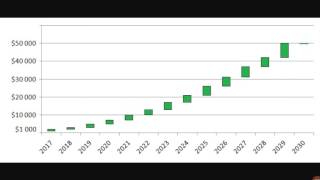
Hey you, welcome back to the channel. And today, talk about something I find very interesting and quite fun. You know, Bitcoins have been very interesting. I love economic models. I love dealing with currencies, and it's been a real treat to look at what Bitcoin is doing. And what I want to talk about today is some predictions that Bitcoins over the course of the next 10 years could be worth millions of dollars. $1 million, $5 million, $12 million. And when you're dealing with something like Bitcoins, something that I kind of term as a very highly speculative device, They're in a situation like this could be potential for almost like limitless upside, yet a maximum loss, right? Because you can come in right now, you see that the bitcoins are $2,000 per bitcoin, and they're divisible, almost really divisible by an undisclosed number. You can just keep dividing them into increments down, down to the decimal and on and on. And that all will have values. It could be like you can get a dollar worth of bitcoins, you can get 50 cents worth of bitcoins, you get 10 cents worth of bitcoins. So you don't have to purchase bitcoins and denominations per coin, one coin. Because it's digital, the system allows you to purchase it any way you like. And that's as well another component why Bitcoin as a digital currency, or as a money if you will, or this trading instrument, is so useful. And as I think it's always going to be valuable to someone. But, you know, as we look at these predictions on this chart here, It's going out to 2030 and you see Bitcoin has hit the $50,000 mark. And that's pretty crazy if you think about in this prediction, if you think about Bitcoin in 2008, 2009, where Bitcoin, you could get like 10,000 Bitcoins for a dollar. And if there's anybody from, you know, who had them back in those days and still have them, multimillionaire. So think about it that way. That's pretty crazy as well. And when you look at the predictions today and even where we're at today, this is what happens when you're dealing with something highly speculative. There is like unlimited upside and a maximum loss. Maximum loss always being, of course, what you put in, but the risk reward ratio is so great in Bitcoin that it's almost the attitude of who cares. And you know, obviously people have been doing quite well. You know, if you took this, you know, the standard of any investment, if you say you went in 5 years ago on Bitcoin and you just held your money in Bitcoin from 5 years ago until now, you know, you probably, you know, you would have tremendous results, uh, outperforming any investment, uh, probably almost in the history of investment. So very interesting stuff. So is this practical? Let's, let's talk about some of the, uh, things that can make this possible, you know, practical reasons. Is this something that could actually happen? So You know, one thing is because of the nature of Bitcoin being decentralized, not being controlled by people, if you think about just what can happen in some countries with their currency and banking system, and we've heard the horror stories, you know, we've always heard stuff like, oh, don't put your money here. If you put your money in this place, I remember my father told me a story about when he was in the military years and years ago, and about how one country he was in, almost overnight, the money changed. The money changed over, you know, the government changed the money over, and they were able to steal wealth from many of its citizens and various things like that. And my, my dad said it was just like chaos on the streets, you know, it was It was, you know, people were fighting for their lives. They were losing their wealth and value. And, you know, we have that happen, you know, in modern times now with many countries, or the potential for it to happen. And so Bitcoin for some countries has become the shelter to prevent the decrease of their money supply, their currency rather, and also basically protected You know, protect them from wealth being stolen from various things like that. And because, you know, Bitcoin is decentralized, there's not much can be done to stop it, you know. And so some people say, well, the government can crack down on exchanges, it can do various things, you know, but at the end of the day, you know, people are very resourceful. And people are very clever with how to get things they want, you know, using various means of trade and barter. So bitcoins could easily just become— go underground and still, you know, people could still hold tremendous amount of value in Bitcoin without losing their wealth. So, you know, that would be nearly impossible to stop, and most experts agree it couldn't be stopped. So that's gonna always make Bitcoin valuable. It's gonna always make Bitcoin useful to someone, and because of that, Bitcoin's gonna always hold value. You know, even if you think about it from the point of view of, you know, putting lots of money into a business, you know, whereas that business can go to zero in value, it becomes very difficult the more people invest in that business and and things like that. So, uh, point being, uh, I think it's pretty safe to say Bitcoin is going to be here to stay. Some people also argue that other cryptocurrencies may kind of dilute Bitcoins, if you will, but my thoughts are Bitcoin is going to always be king because as a new market of people investing in Bitcoins come in, you know, you're always going to want to invest in the more popular currencies, the most well-established, the most tested. And because of that, I think people gonna still always be, you know, putting their money into Bitcoins coming in. And Bitcoins, of course, are, you know, accepted a great deal by merchants now. It's not like it was in 2009 and things like that. And so Bitcoins is gonna, you know, have this market and be very you know, valuable, very useful and practical to use as it's become now. So these are just things that are gonna keep Bitcoin price at a ceiling and at a— or rather at a floor, you know, meaning I think Bitcoin will hit this price where it can no longer go beyond and probably already seen it. And, uh, you know, that's going to be important to maintaining the value of Bitcoin. So can it reach— based on those components, can Bitcoin reach, uh, uh, the value of $1 million around 10 years and go to the moon? Well, there are a lot of things going to be needed for that to happen. Some people said it would pretty much replace gold before it can blast off. Um, and, uh, Some people think that may not be possible, that gold's always gonna kind of hold our attention. But gold is really, if we really think about it, if you compare gold to Bitcoin, gold is at a great disadvantage in a practical sense to Bitcoin because gold is this very, you know, robust thing. You can't move it. Like you need to. Now they do have what they call gold dollars and things like that, but you know, also just the practical use of gold compared to bitcoins. You could do a lot more with bitcoins than gold. Now, uh, you know, bitcoin not only serves the purpose of all those other things I mentioned, but bitcoin serves the purpose of a payment system like Western Union or PayPal. So it could, you know, uh, uh, basically go up against systems like that, adding to its value, whereas it's already being accepted in place of money. So, you know, so it's much easier than gold would be, you know. So there's a lot of things going on with Bitcoin, how you can move it, how you can divide it, that they can basically simulate this rarity in it, which they've done with the 21 million Bitcoins. So there's just a lot of practical things that work with Bitcoins, whereas Bitcoins could definitely start to creep into the gold market and take a lot of the practical value and use of gold. And gold being at about $8 trillion worth of gold being traded, and Bitcoins getting a great percentage of that could definitely boost that price. Uh, and I believe we could see it hit $50,000 quite easily per Bitcoin. Not sure about it hitting a million. Those are— there's a lot of other things that would have to happen. It would pretty much almost have to take the entire GDP of the United States. So it's a lot of things going on with, um, you know, Bitcoin that would have to happen for it to hit a million dollars. But again, go back to this also at the same time just being this highly speculative, uh, vehicle where people are just gonna constantly be dumping money in, probably driving the price up, and it's gonna hit bubbles, it's gonna decrease. But what's interesting about Bitcoin is even when it does that and gets up here to the stratosphere, that it's kind of had this floor where it goes back down and people you know, take profit. Sellers of Bitcoin take profits. Either they reinvest in Bitcoin again to get more money, or they, you know, basically it's going through this kind of a tug and pull thing as it advances forward, because that's seemingly what the charts are showing. And we don't have to guess about this. We don't have to do much speculation about this from 2008 to now that Bitcoin has pretty much continued on this upward trend since 2008-2009. So all very exciting, very interesting stuff. Why bitcoins could hit $1 million. Uh, you know, this is something that, uh, you know, you basically or definitely would want to, at the very least, uh, I think you want to own some bitcoins. Experts are saying you should, the statistics say you should. It's really no reason at this point not to own bitcoins no matter what happens to bitcoins, you know, as well. Again, bitcoins is not like your average standard investment where there may be a certain amount required to even buy bitcoins. You can pretty much buy bitcoins for any price you want and and the value that you invested in will still go up the same, you know, percentage-wise. And these are, these are some of the other cryptocurrencies. We know today that the market overall of cryptocurrencies are $100 billion, so they're rivaling large companies at this point. And it's, it's pretty much for me a certainty at this point that they will surpass some of the biggest industry leaders, companies, you know, probably end up surpassing Google, surpassing, you know, large companies. And, you know, although one thing has been that some people will move in and out of various cryptocurrencies, you know, to try to repeat the past and success of Bitcoin, I think, you know, at the end of the day, Bitcoin is going— because it's the most established, because it has such a history, and has this, this tested type of situation with it, I think people are gonna always get their money back into Bitcoin. I don't think cryptocurrencies are going away, and people are gonna continue to make money like this. I believe it will grab a percentage of the gold markets. And, uh, I, I very much believe that. Will it go to a million? Have no idea. I could see it going to $50,000. But guys, give your opinions of it to me. Um, I have recently just really turned my attention to Bitcoins, although accidentally back in 2013 I did, uh, put some money into it and, uh, got about 4 times my money out. I wasn't smart enough to do like many of you guys and just keep the money in. I said, oh, this thing is gonna be like the tulip markets. You know, the tulip market situation the Dutch had, and I thought it was gonna be this fad, and boy was I wrong. I would have been pushing a millionaire myself at this point with bitcoins, but I sold out. And, uh, you know, took my money and I thought I would be smiling later, but obviously I'm not. And Bitcoin is continuing on its, uh, odyssey, if you will. But, um, you know, anyway guys, that's, that's my thoughts on it. Uh, new to— pretty much new to Bitcoins because, um, I've, you know, pretty much just started studying Bitcoins. They interest me a lot. I've always studied money. But Bitcoin, you know, it's the new digital money, new digital currency, you know, new way of doing things. Uh, Gold 2.0, the new internet monetary system. So learning, I will appreciate you guys, not only your opinions but your advice. You know, you guys who have been on the Bitcoin bandwagon all along, you know, give me your thoughts on it. Let's talk about it. Maybe you can teach me something about it. I'd very much appreciate it. But I'm going to keep learning and bring you guys what I got about bitcoins. Guys, if you like information like this, uh, don't forget to subscribe. Uh, you're free to like or dislike. Uh, I don't care which one you do, but do one. And until next time, guys, take care.