
Bitcoin Won't Mass Adopt - Bitcoin MYK Will
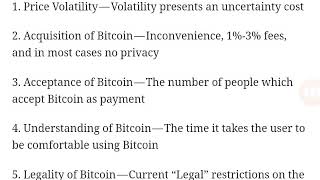
Bitcoin faces six major barriers to mass adoption: volatility, high fees, poor usability, limited merchant acceptance, regulatory uncertainty, and energy-intensive mining. BitcoinMYK addresses these with social-media-style onboarding, free airdrops, low transaction costs, and built-in referral incentives designed for mainstream users.
Chapters
Hey you, welcome back to the channel. And today we want to talk Bitcoin, why it won't mass adopt, why Bitcoin MYK will. So if you're a Bitcoin maximalist, you probably take great deal of offense to this video and the title of this video, and, and that's understandable. Uh, many of us started off as a Bitcoin maximalist, it makes a great deal of sense. Bitcoin being the first of the cryptocurrencies, starting this, this amazing cryptocurrency world, uh, and all of the value and freedom that comes with it. So understandably so, Bitcoin would be very, very close to many of our hearts. But the issue with Bitcoin, um, or should I say, it's not so much about there being, uh, so much the, the issue of Bitcoin itself mass adopting, but more so that blockchain technology will mass adopt, right? That Bitcoin is part of that, right? But it is not all-encompassing of what blockchain technology is. And that's led many to believe that there's a possibility that exists that there will be another cryptocurrency that can perform, uh, uh, much better than Bitcoin. And that kind of, that kind of as well makes sense if we think about the start of the internet. It would be kind of similar to saying that when certain products start out on the internet like eBay or something, or Yahoo, right? That they would become the leading products and websites on the internet, right? Just because maybe when the internet started off, there were only a few of such big, huge mega websites. But as we can see that the internet stayed, and it became this very usable thing that we can't imagine living without now. And there were several other products and websites and technologies, uh, that came about after that. So will this be the course with Bitcoin? Uh, maybe so. We're going to find out. And what kind of cryptocurrencies, if not Bitcoin, will be the type of cryptocurrencies that will be able to solve and fix many problems? So I'm going to get into that a little bit today. And just talk about and see what we can learn. So I have been listening to several Bitcoin critics, economists such as Roubini, and it's several economists that talk about why Bitcoin won't mass adopt and why it won't work. And a lot of us have totally dismissed them as, you know, working for corporate interests or governments and a variety of things. But I found that it's always good to listen to both sides of an argument to have a very full view of the field in order to be able to not only understand your position better, but to be able to understand where, you're going with that position, if you're going anywhere at all. And so all this stuff is very important. So this is an article written by someone by the name of Guy Fawkes, and he's putting together reasons why Bitcoin is going to be very difficult for it to mass adopt or why it won't. And so we're going to go over a few of his points he makes. I thought he did a pretty good job outlining some of these reasons. We'll leave a link in the description. And see what we can come up with and see if it's anything that solves these problems. So the first point he addresses and he makes is that he says, well, price volatility is going to be the reason why Bitcoin doesn't mass adopt, because obviously what are you going to be able to use it for? I'm going to send you money one day and the next day is either going to be tremendously less, right? As we see these large falls even now at the price Bitcoin's at right now, A lot of TA and technical analysis believes that Bitcoin is going to hit $3,200. We've been going over that for about the last week or so, and some people don't think that's going to happen. Some people think it will. One thing we know for sure is that Bitcoin can hit pretty much any price it wants, you know, and it's showing us it can do that, whether it's going in an upward direction or it's going in a downward direction. In any event, it doesn't matter whether it could do that or not. The problem is if it does that in any direction, it creates this great deal of uncertainty and cost, price volatility. And that's going to be bad for any kind of use for Bitcoin at all, with the exception of just, it just sitting somewhere speculating, which then limits the use of Bitcoin, right? The next point he raises here is the acquisition of Bitcoin. Uh, inconvenience fees are 1 to 3%, and in most cases, no privacy, because we know that Bitcoin is not really a privacy coin, right? So we've been led to believe, uh, in many ideas that Bitcoin was this thing we could move for— we can move, and the government wouldn't be able to bother people, or, you know, it would be, uh, totally private. And that was a lot of the reason why people prefer Bitcoin over any other digital money. But we find out that that's not the case, that Bitcoin can be tracked, that it's not private, uh, and that there's just a total inconvenience of fees. You get your Bitcoin, when you try to send it, it can cost a lot. It goes up, the prices get ridiculous, uh, the fees are high. And so it becomes almost impractical to your traditional money, uh, uh, transfer methods, whether it be things like PayPal or Western Union or a variety of things. The next idea is the acceptance of Bitcoin, the number of people which accept Bitcoin as payments, right? So although over the last 10 years Bitcoin, as far as cryptocurrencies, has been the best branded. I remember turning the channel to CNBC just about every day, I see the Bitcoin prices being quoted. They're also being quoted on most major exchanges. And so it's the awareness of Bitcoin is available, but when it comes to vendors and people and markets taking them, you still, you'd be probably in most areas fortunate and lucky to see any Bitcoin acceptance at all. And so because over the last decade, we haven't seen what should be the greatest revolution in money in all human history. We haven't seen that as of yet. The next thing is he makes his understanding of Bitcoin, the time it takes the user to be comfortable using Bitcoin. So we're talking about a, a long adjustment period here. We don't know how long that adjustment period could be, as cash has been used for thousands of years and some paper form of money has been used probably almost since the dawn of time. Uh, and so people have become quite accustomed with that. Uh, you know, of course, with the understanding of Bitcoin, you know, it also brings to mind the technical aptitude it's going to take to use it, right? And so all this stuff could be very, very far off. And over the course of those years, uh, we're not certain what kind of blockchain technology might be available to us. The legality of Bitcoin, current legal restrictions on the use of Bitcoin, and future legal restrictions that will inevitably rise in the event of growing Bitcoin adoption? Uh, yeah, you know, so, you know, as it gets bigger and bigger, more regulations will come in. So then it could be that Bitcoin just does become another type of digital money like the ones we have in existence now, where you still got to know everything about everybody who receives the Bitcoin and a variety of things. So that, that part of it, and in which case then Bitcoin actually becomes even less secure, or rather less private, than cash. Because at least with cash you can still take a, take a, um, a billfold and take it and move it, uh, around an alley someplace. And, and with something being digital this way, that means every transaction would be traceable then, you know, for people who are that concerned about their privacy. So that could create a great deal of issues. As the number of Bitcoin users increase, the cost of barriers 1 through 4 will decrease. Uh, so then that's, uh, I believe pretty good, right? People would accept Bitcoin as payment. Oh, well, I'm sorry, that's actually bad. It says if the cost of barriers— the cost of barriers 1 through 4 will decrease. Okay, so that's— then that's That's good, it'd be less of those things, okay? So let's talk about then what are some solutions to that? What would be, why do we think Bitcoin has a lot of trouble there that maybe other cryptocurrencies won't have? So let's take a look at the BitcoinNYK website in comparison to this. Okay, so here on the BitcoinMYK site, and we're looking at BitcoinMYK and Bitcoin. So I wanna talk about that a little bit. What, what could be some of the hurdles that a project like BitcoinMYK would be able to overcome that perhaps something like Bitcoin wouldn't be able to? So let me look at my other screen here that shows some of those, some of those points that were made. And I think the one of the main points here that was brought out had to do with the understanding of Bitcoin. I want to go there first. So in the understanding of Bitcoin, what happens and what keeps a lot of people out of cryptocurrencies first, um, there isn't an identifiable interface that their brains can relate to, right? It's like, um, if you kind of looked at, uh, Bitcoin as a type of art, right? You would need some type of symbolism, some type of instrument to be able to make people who've never used cryptocurrency, uh, be able to identify with certain symbols, right? And so what BitcoinNYK uses is something that people use all the time, every day, and that is a social media, social network interface, right? That's something that they can identify with. They understand how to use social media. They understand how they have their profiles and accounts, and some of them are linked to, uh, little wallets and, and what have you. And so BitcoinMYK, it does this, it creates this structure in this, this very familiar environment so they can easily adjust the cryptocurrency just by signing up to the, and sign up for an account very easy like they do any other social media site. They don't have to go through the, the task of trying to sync wallets, download wallet clients, control and hold private keys. We use through the Waves platform their online wallet app, which can be downloaded to the desktop, but this makes it a great deal easy for people who are new to crypto to quickly come in and not be burdened by trying to understand all this very difficult technical jargon that is gonna pretty much keep them from being so enthusiastic about getting into cryptocurrency. Um, now as far as acceptance of Bitcoin, that was point number 3 that was raised, and it talks about the number of people who are willing to accept Bitcoin and, and, and a variety of things like that. So the, the less people you have accepting Bitcoin, you know, that's going to make people as well and not want to use Bitcoin. So it's kind of like a catch-22 there. Um, but another problem is these vendors, many of them aren't really incentivized to use, uh, Bitcoin. So you take something like BitcoinMYK where there was a founder's wallet and there was reasons for, um, this move from a kind of centralized point to total decentralization, to which we believe BitcoinNYK has a, um, a, uh, basically a blueprint that moves it to decentralization more so than any other cryptocurrency, even dwarfing Bitcoin itself. We explain that in great detail in the white paper. But I think what's, um, very important to understand is about how BitcoinNYK starts off. It does start off with incentive for groups to market for, right? Because they're rewarded in the cryptocurrency when they market for Bitcoin MYK. There is no incentive to market for Bitcoin, right? There's no reason for me to come go outside right now with a sign to, to go, uh, do a television commercial, to do any of those things, to fly a plane with a Bitcoin banner there's no reason for me to do anything in relation to marketing and getting people to use Bitcoin other than for me to, you know, vaguely say stuff like, oh, it's going to be the future one day and this, that, and the other. But as far as that, there isn't a direct incentive Bitcoin can give me because it's at a point more so of decentralization at this point when it probably needed to as it started off at a centralized point with Satoshi, it needed a plan around it to kind of do those things. Uh, it wasn't able to do that how it was structured. And so because of that, Bitcoin is unable to be incentivized for people to even go out and market for it. And, uh, over a decade now, Bitcoin has about an estimated 50 million users, uh, and to, to kind of put that into context, if we were to compare that to a, a social media site, that would be a fairly well-sized social media, a social network, right? That's all it would be. As far as, um, market capitalization and value, Bitcoin's not even bigger than a, uh, one of our half-decent, half-sized, uh, large, uh, large corporations, right? It's not even the biggest corporations. It's not even, um, there are many corporations in America alone that are more valuable than the entire market capitalization of Bitcoin. That's over a 10-year period. So where some people talk about the growth rate of Bitcoin and, and how far Bitcoin's become, uh, or how far it's come, I think my view is a great deal more, uh, less optimistic than that. I think what I see with Bitcoin is, had it been structured something like how we structure BitcoinNYK with this kind of social media, uh, integration, that in over 10 years, um, BitcoinNYK would have more than 50 million users, would probably have 100 million users, right, or a billion users. 1. Um, let's look at some more of his points. Um, let's see the, uh, privacy of Bitcoin, right? So if privacy was going to be one of the bigger, uh, points to Bitcoin, why a lot of people would want to use it, of course that's been uh, uh, demystified, right? In that, uh, Bitcoin's not really private, right? It can still be tracked, or we can have a record. And in fact, in some cases, like I mentioned earlier, it's probably even worse because now it means they can track every, um, financial transaction you do if you've done it with Bitcoin, because, um, uh, that's all, um, on an immutable ledger now, 00:07:07 Right? Uh, it can't even be erased from a computer. And so those are, those are things that you, you really have to, we have to pay attention to. Um, so how does Bitcoin MYK, uh, uh, you know, go faster to the mass adoption angle than Bitcoin? Well, it's quite simple. First, BitcoinMYK realizes the importance of good distribution of their cryptocurrency itself. Whereas I have to mine Bitcoin or I have to buy Bitcoin, the mining of Bitcoin takes place with, um, mining rigs, the ASIC miners as they call them, which are these very, uh, uh, high energy consuming devices, contraptions, um, at large mining data centers. And this is pretty much the only way you can make money with Bitcoin nowadays. And so, um, you know, it requires a great amount of resources, so that makes it, uh, uh, inaccessible to your average person. Um, so it consumes all this energy. Um, and so with us, um, you know, well, in addition to that, you, you have to— if you don't want to do that, you have to buy it, right? And right now, Bitcoin is very expensive. So if you even want to buy one Bitcoin, which usually one of something is attractive, you'd be spending over $5,000. And so that doesn't feel attractive at all. Um, which moves me next to, uh, how BitcoinNYK solves the problem at the same time addresses the mass adoption of it. There was a, uh, one of these, uh, money-making gurus, right? And I don't really listen to money, money-making gurus. I, I try to study, uh, economics in the traditional sense, but they're out there and they sell programs. And I happened to catch one on television one day and cryptocurrency happened to come up. And he said something I found interesting though, even though I don't listen to money-making gurus, but he said something I found quite interesting. He said, do you know what the problem with cryptocurrency is? He said the problem with cryptocurrency is that you need to give it out first like a sample, right? Get everybody using it, uh, and then once you do that, uh, then people can see what your product's all about and you can get more users that way. So that was his approach, and I found that kind of interesting because oddly enough, I thought that worked, right? To have a well-distributed cryptocurrency in everybody's hands first, then you could you know, go on about the, the what it could be used for and the value and all those things, right? As opposed to trying to get people to buy into it, spend a large amount of money, whether it be on purchasing mining rigs or, or buying something they don't even know if it has a demand to be used or not, uh, just purely for speculation. So I found that kind of interesting, and it helped BitcoinNYK come up with a useful, I think, technique and strategy, and that was to use blockchain technology in one of the best ways I could think of. And that was, uh, to do a similar idea like that where we would go on this mass distribution campaign with the cryptocurrency, but address something that 80% of the globe needs, we found, and that was universal basic income. This would solve a few problems. First, it would get everybody the cryptocurrency in their hands. Next, it was so you would achieve mass adoption kind of by default like that. The next thing it would do is, um, it would create a large network to where everybody has it, and so it's easier to, um, transact business in it, right? It's easier to conduct commerce in it. So if you compare that to what we might be getting in June with the Facebook coin, which is this— what would be this new controversial, if it's a cryptocurrency or if it's just some kind of Facebook dollar, Whatever the case may be, it will be a network, a way to transfer value across a network of about 2 billion people over a very user-friendly social media platform. And those, those components are very important to mass adoption, right? But a lot of people don't like Facebook because it's centralized and it represents the mega corporations that have played us and been our problems up to now. So what's the solution to that? The solution would not be that the idea that Facebook is using doesn't work, because truly it does work, and obviously it's going to work. But the solution would be to create a, uh, a similar version to that that shares those characteristics but is not the mega corporation controlled by Mark Zuckerberg and his his party. And that is what Bitcoin NYK does. It creates a similar feel by going for a large network where you can transfer value that everybody already holds a wallet and holds some of that value. So now it's important to them. They're invested in it. They have value in that network already. The next thing I think is going to stop Bitcoin from mass adopting, uh, besides just the price volatility, is the, the idea that Bitcoin is going to get harder and harder to go up in value. With the idea, or probably the major driving force, I would say, if I'm honest and realistic about Bitcoin's value going up, being speculation as it, excuse me, starts to climb higher and higher. That main driving force starts to get lower and lower, right? As far as people being able to get certain value and get certain returns. Project like BitcoinMYK would represent a way to almost achieve this, lack of a better word, exponential growth by just growing this network ever larger through a very user-friendly social network-like interface. But in addition to that, uh, because at the rate that Bitcoin MYK starts off in relation to Bitcoin, if you look at the price, the price difference between Bitcoin MYK and, um, Bitcoin, and this price is different on different exchanges. On some exchanges Bitcoin MYK is around a few cents, 2 to 3 cents. On here it's at fractions of a penny and it changes, right? But then you look from there, you look at Bitcoin at $5,000. $29, right? So which would be much easier to speculate on as far as value, right? With Bitcoin at around close to a $200 billion market cap, that would mean that Bitcoin— I'm sorry, $80 billion. That would mean that Bitcoin would have to jump from just to have 100% return, it would have to go to about almost another $80 billion, right? right? What would happen if that same $80 billion went into Bitcoin NYK, you know, K, and you're, you're an investor in Bitcoin NYK at that price, and that same amount of money is going to take just to get Bitcoin about $10,000, that same $80 billion went to Bitcoin NYK, right? You would, you would have a great deal more speculative opportunity than Bitcoin, right? Now, a lot of people like to talk about the security and decentralization of Bitcoin, uh, and, and that is true. Bitcoin is the most secure of all cryptocurrencies. It's not 100% secure. A lot of people don't realize that Bitcoin, uh, had an inflation bug that could have caused catastrophic issues for it had it not been caught by a Bitcoin Cash developer, right? So maybe not as secure as we hoped. Just by the skin of our teeth, we were able to avoid that. Skin of our teeth. Almost a disaster. As far as hashing rate, uh, Bitcoin is superior to every other cryptocurrency Bitcoin Cash only has about 6% the hash power of Bitcoin. So Bitcoin's been around 10 years building up its infrastructure, far superior than most of these cryptocurrencies, right? And the decentralization idea of Bitcoin, and I won't get into that. I won't get into why Bitcoin MYK is more decentralized than Bitcoin. That's another, that's another claim we make here at BitcoinNYK that we are far more decentralized than Bitcoin will ever be. And that's, that, that's a whole nother video. Uh, if you're watching this video and if any of this is interesting you, uh, or has interested you, then, uh, subscribe to the channel and you can actually find a video, uh, that tells you exactly why we're more decentralized than Bitcoin. And, uh, we'll try to leave a link in the description. But this is reasons why Bitcoin NYK will be able to achieve mass adoption and Bitcoin won't. Um, and I think it's very important that we sit down and we not just listen to the good parts about cryptocurrency, but we have a very thorough education of cryptocurrency and we as well listen to our critics, right? The economists, the critics, because these people know stuff too. You know, they're not just making this stuff up. You know, there are, there are reasons why they have written papers about problems in Bitcoin, right? And, well, we can't dismiss it all as FUD, but that's something to think about. And I think you really need to take a look at BitcoinMYK. I think it might point more to that future many of you all are looking at. The concept of money in Bitcoin, BitcoinMYK. Obviously a lot faster than Bitcoin because it uses the Waves platform. Um, it uses several other blockchains where it's, uh, faster than Bitcoin because BitcoinNYK, when you think of it, you have to think of it like Bitcoin Lightning Network, right? Which is basically overlaid over a blockchain because Lightning can be used on any blockchain, right? So when people say, well, this cryptocurrency doesn't have a blockchain, well, you're asking the wrong question. Because it is not meant to have its own blockchain. It's meant to work like Bitcoin Lightning, which overlays over blockchains, right? It could be used with Litecoin, uh, Ethereum, and others. But the problem with Lightning is, as far as development goes, uh, we don't really know where we stand with Lightning. A lot of people say Lightning works great, it's no problems. We, we have other, uh, people who say different things. But in addition to that, from a legal perspective, the idea of depositing cryptocurrency in a way it's done makes the hub almost like an exchange that's taking a deposit. So in many jurisdictions, you could possibly face or fall under banking laws, right? So that makes it lightning difficult just from the legal standpoint. But in addition to that, Lightning itself, as far as the, the, the, the development of it, is said to be quite buggy, right, in many respects. And again, I won't go into the details of that either in this particular video because I've done videos on each idea about why Bitcoin is not as decentralized as we think that Bitcoin NYK is more decentralized and why Bitcoin NYK in many respects is better than the concept of Bitcoin Lightning. So there are complete videos to all of these things, but those are a lot of things to think about. And we really need to, I think, take away from this video that the idea that blockchain technology is the answer, it is the future, and it is very valuable to our future. But the problem in the broad idea of blockchain technology, uh, doesn't necessarily, uh, concentrate itself to Bitcoin or Ethereum or Litecoin. And I think that's the huge problem where we're at with this. But, uh, my, uh, invitation to you all is check out BitcoinMYK and see where it falls in line with these other cryptocurrencies, uh, Uh, tell us what you think. Tell us, uh, do you agree with the critics on cryptocurrency? Uh, if you, uh, feel that, uh, or, or, or the points that you do agree with on— because I do feel critics always have something valuable to offer, and it helps to make products better, and it generally helps to make us better in some cases. So if you found anything like that from critics, um, Uh, please leave them in the comment section. Let me know what you've heard critical of these cryptocurrencies, because, uh, the reason I'm doing this video too, guys, is because, you know, sometimes I just feel like cryptocurrency and the entire space has felt like pie in the sky the entire time. And, uh, I've been dealing with money a while, and I haven't found investments and concepts that, uh, were like that. You know, it's always been risk, it's always been it can go the other way, you could lose all your money, and a variety of things. But I seem to be in this space and it just seems to be this, this glory and hope heading one way. And I try to give a very well-balanced review, but in my passion for cryptocurrency, I've tried to create a product that addresses and solves many of the concerns of cryptocurrency, right? So I definitely invite y'all to check that out. Tell me what holes you see in it. Tell me if you'd like to use it. And I think you'll be glad you did if you're a Bitcoin holder, Again, this works more like Bitcoin Lightning. It's not about replacing Bitcoin. It actually works with Bitcoin. If you hold Bitcoin, you get BitcoinNYK for free. If you mine it, you get it free, right? So you just basically verify you hold the Bitcoin, you get the tokens free. They do trade on two exchanges right now. They've been performing quite well. And so we invite you to try it out. Tell us what you think. But that's all I want to say in this video. If you like content like this, Don't forget to like, subscribe, and until next time, take care.
More from Michael







UBI - CIA Agent Explains Why Americans Will Never Get Universal Basic Income?



