
Btcmyk - Accounts Worth $400 Each?
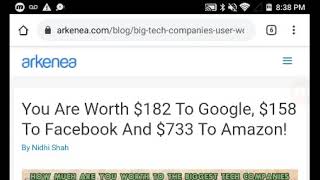
In this video Michael Joseph Presley examines how social media platforms assign monetary value to individual user accounts, drawing on an Arkania article by Nidhi Shah that lists per‑account valuations (e.g., $182 for Google, $158 for Facebook, $733 for Amazon). He explains that these figures stem from the attention economy: user data fuels advertising, which generates billions in revenue for the platforms. Presley critiques the ad‑driven model, noting the rise of decentralized, ad‑free alternatives, and then introduces his own project, BitcoinMYK.com, a cryptocurrency‑based social network that also delivers universal basic income (UBI). He compares the potential worth of a BitcoinMYK account to traditional platforms, estimating that if BitcoinMYK reached Facebook‑scale it could be worth hundreds of billions. The discussion expands to regulatory pressures on crypto, especially KYC requirements, the misconception of anonymity versus privacy, and a brief case study of the Pi Network’s 10 million users and its valuation prospects. Throughout, Presley argues that future social networks should share the economic value they extract from users, linking this to UBI, automation‑driven job displacement, and the broader economic climate.
Chapters
Welcome back to the channel. I hope you're having a great day, a Friday afternoon as we go into the weekend. And, um, I thought this is a very interesting video we're going to do today, and I thought it was very important that we really look at the value of social media, some of the social media sites we're using, your value to social media sites, um, just how valuable you are and how much value you give over, uh, through your attention value. Um, and we're here on a site called Arkania, and there's an article written by Nidhi Shah, and they're, and they're going through this article about the valuation of these companies and just how valuable an account is to them. And so, uh, it was written some time ago, but I thought it was very interesting just to give you an idea of how they value these, um, social media and just how valuable accounts are to people. Um, when you register for these social media sites, how much value you are worth. So here it's saying here that you're worth $182 to Google. $158 to Facebook and $733 to Amazon. So wow. And I guess that makes a lot of sense because a lot of times you come on Amazon, you're going to spend quite a bit of money. Whereas with maybe Google, maybe Facebook, you know, it's, uh, generally these sites are free to us to use and post. And, um, but you know, obviously data, Advertising, finding out what consumers like, ad placement. These things equal beaucoup bucks to these platforms, right? So another thing to keep in mind, because it is dated, this is the figures are quite, I guess you could say, accurate at this point in time because as you can see here it's saying Google is worth $364 billion. I think Google might be worth, uh, you know, a trillion dollars or more now. Now right here it's saying Facebook is worth $227 billion, but the last time I checked, uh, Facebook was worth something like about $700 billion, right? Um, it gained a lot of value in 2020, right? So, um, it says it's worth $158. Um, and when you kind of add that on there, it's probably going to end up being, I think, more close to about $400 an account or something like that. Twitter is worth $81. Again, probably inaccurate unless the value of Twitter went down. Then they got LinkedIn, they're saying they're worth $69 per account. Yahoo's, each, uh, user of $70. Amazon, here's the mega, $733. Uh, and no telling what that is now. That might be like about $2,000 now, you know. Uh, eBay, $474. So really, to kind of get an understanding of like why are your accounts worth so much to social media and why social media is so valuable. But it's really not that difficult. It's really not that hard to understand how this works. You know, if you kind of think about, you look at something like attention value, like where you focus your attention, where you spend your time when you're on social media, you don't go very far before you see advertisements, people trying to sell you something. And these product placements, they, people, companies spend lots of money, millions of dollars. Some businesses per year spend over 50% of their revenues just on marketing and trying to get promotion advertising in front of you. Um, and, uh, you know, with this information, um, uh, uh, this data, um, you know, That equals a lot of money. Now, because of this as well, a lot of people have, uh, started to opt for ideas like decentralized social media, private networks, um, uh, social networks that don't have any advertising at all. And that's understandable, ads can be annoying. Uh, but I think it's important to understand that when you're dealing with, uh, uh, the value of a product and when you're investing in a product or when you're looking to gain value from a product, um, that, that doesn't always have to be a negative thing. Uh, I think one of the biggest issues, uh, with how many social media sites do business and how they make money, because to be fair when you're dealing with something like social media, you know, servers cost money. And so, you know, it's going to be necessary that these businesses, these private companies somehow are able to be able to afford, you know, to keep these things going. That's understandable. But at the same time, I think what's happened, you know, throughout how we've dealt with or how they've dealt with us, many of these social media sites, it would seem that they haven't given us the options to basically be ad-free. And in the case that they have, they haven't offered us part of the revenue, any of the tech checks from our attention value. And so that's ushered into projects that have found a way to basically, you know, create these options for the end user and serve whatever needs they have. I think overall the article is important. It just, if nothing else, helping people to understand the tremendous value that comes from their participation, right, in these networks. And depending on the design of the product, and/or the project. Now this could be quite useful. I, you know, I think with a project like the BitcoinMYK.com, um, you know, which is a universal basic income, um, project. Universal basic income has become a hot topic. Uh, we liken the BitcoinMYK, uh, project to Bitcoin meets universal basic income. We believe, uh, cryptocurrencies are the best way to facilitate, uh, universal basic income. All right, if you don't know what universal basic income is, it's just is basically, uh, um, the ideology that it is a right for citizens to receive enough compensation. It could be either through private networks, government channels, um, to set to, to basically take care of their basic needs, their, their bare-bones basic needs, right? Um, and, um, this isn't a new concept. You know, most advanced civilizations have always had some type of social programs But if we go back all the way back to the Roman Empire, citizens were— there were great public works done for the well-being of citizens. Land was given to citizens. And so many governments throughout the ages have had a variety of these programs, citizens dividends, right? Or to propose ideas. Um, so in these ideas, you know, of course you have to figure out how you're going to pay for them, and there are many ways to do that. Some people have proposed whether it be through some natural resource, it could be oil, whether it be through land, uh, biorenewable resources, and, uh, and in a case like, uh, the BitcoinNYK.com project It's more about data being the oil of the 21st century, right? So, um, that option to receive universal base income through the transference of this value, um, kind of getting away from that a little bit and just looking at this overall through the scope of cryptocurrency. In cryptocurrency, we seem to have a tremendous problem in finding the value of our projects, and it causes many market spikes. It causes bubbles, and it could cause a very unhealthy economy, right, when you're just kind of purely speculating. But when you kind of have an idea what the value of your networks are, the users are, and so on and so forth, it becomes ever so difficult in order for that to occur, right? Um, so I guess what I'm saying is that, and models in cryptocurrency, especially social media sites, I kind of see this as a viable option in helping us to determine the value of these cryptocurrencies in a very healthy sense. Now, where I do side with many concerns in cryptocurrency, especially when it comes to dealing with social media when it comes to dealing with, um, data, right? Um, KYC and so on and so forth. Who has this data? Um, it's a very tough, uh, conversation, and it's a very understandable one, especially that many of us, uh, came to cryptocurrency to, uh, be in a sense of, uh, of anonymity. But I, I, I think we're it's kind of been a false narrative about cryptocurrency is that we are anonymous. There's a big difference between privacy and anonymity. What many in cryptocurrency are looking for is anonymity, um, not privacy. Privacy just means that, you know, we know you're over there, but we're just, you know, you're just kind of, uh, uh, it's a big difference, meaning that, uh, Something like Bitcoin and many other cryptocurrencies, they can still be tracked. They can still be found, right? So there isn't really a true sense of any type of identity protection like many people think, especially from your government. So I believe that's a kind of false narrative and it's an inaccurate way to look at cryptocurrency. Um, What is happening is there seems to be a lot of regulatory, uh, enforcement happening to where whether you're on exchanges or many other projects now are going to be required through many international regulatory bodies to disclose some form of KYC. Mostly every exchange we use is KYC. Uh, we still use uh, centralized exchanges at a rate of about 95%. So that means everybody's doing some form of KYC, right? I don't think KYC is so much the issue, uh, at this point in cryptocurrency unless you're getting some type of privacy coin that's not available on exchanges and so on. It's still some difficulty, uh, and being anonymous. And for the most part most cryptocurrency isn't doing that, right? It's probably only 5-10% of the entire space that's really doing its best to try to really be private. For the most part, you can be found, you can be tracked, um, and so you're not really, uh, doing that with cryptocurrency. That said, I, I think it brings on the more of the notion and more of the idea of of, uh, not so much KYC being the problem, but in these networks, what is your value to them? We understand what your value is, uh, uh, you know, to them, for them, but what about for you? What is the value? What do you get? And, uh, you know, with projects like BitcoinNYK.com through Universal Basic Income we're able to disperse this back to the, uh, community, right? And, and share in the benefits of these networks. And I think that's how it's going to work in the future with many social networks, that the users are going to share in the ownership of these networks and the value of them, uh, and have great benefit of them. But where does BitcoinNYK.com fit into all this? So here's the deal. Uh, Facebook, based on some of the numbers we just gave with Facebook probably being worth about $400 an account per account. Um, looking at a social network like BitcoinNYK.com, take a look at that real quick. All right, so we're here on the BitcoinNYK.com site. This is the Universal Basic Income project. Um, Bitcoin meets Universal Basic Income in a sense. The BitcoinMYK token, um, and you could do a variety of things here. But looking at a cryptocurrency social media site versus, um, what would be a, um, a standard social media site, and I'm just gonna let you all, uh, I'm gonna pose this question to you all. What do you think is more valuable, a Facebook account or cryptocurrency social media account in a financial product where people are buying cryptocurrencies or speculating on cryptocurrencies and so on and so forth? Now, my observation in this and my thoughts on this are financial projects financial products are probably going to yield more, a great deal more value than that's just the standard regular social media site. Um, and I say that because you're probably gonna have, um, products related to these cryptocurrencies that, um, uh, data or offers rather that are going to be of tremendous value. Um, and so we look at this and, you know, people using these sites, promotions, advertising and the like. When we, when we take a look at this, uh, you know, it, it, it makes me feel like at least if I'm just going on pure feelings here, that a cryptocurrency social media site would be more valuable than a Facebook account. If a Facebook account is, let's say, worth $400, right? $700 billion market cap. Um, uh, then, um, you know, if each account is going to be worth that to the Facebook network, then you're looking at about, um, uh, uh, uh, uh, basically, uh, a great deal of money, right? But where's all the spending and buying going and, and the value coming from, rather, right? So in looking at this I'm going to go on a limb here and say these cryptocurrency sites that are trading and trading all this Bitcoin value and variety of things and probably buying cryptocurrency projects and joining exchanges and paying exchange fees and, uh, we're paying advertising for, for ads and offers and so on, that if we were to take our registered 9,225 registered users. And let's just make it equal to Facebook. I'm, I'm in my mind, I'm thinking the accounts will be more valuable than Facebook accounts, but let's just say they're about the same. That would make this project right now, based on the numbers, around about $3.4 million, something like that, right? Or I'm sorry, more like 30, a little bit over $36 million. $3.6 million, right? Over $3.6 million. Um, just now, but if it, if it became like Facebook, so then that's saying if we were to get like 2.5 billion users like Facebook, um, then would we be worth, with all this attention value on the BitcoinNYK.com site, would we be worth $700 billion or something like that? And, uh, uh, you know, these are just, just some rough estimates based on what I'm looking at, but again. I'm thinking if it's a cryptocurrency social media site that can get a lot of people. Now you might say that, yeah, but cryptocurrency right now is still kind of feeling pretty niche. A lot of people not using it, and that is very true. However, when you couple that with universal basic income, probably gonna get a lot of people. And generally what happens in cryptocurrency is people think of universal basic income and they generally go, oh well, you know, that's people coming in, they're gonna get some free cryptocurrency, they're not gonna really buy anything, or something like that or another. But if we really look at what's going on with traditional social media sites, that is what's going on. People are coming in, you know, they're not, uh, paying for accounts or anything like that. They're coming in and they're coming in on a freemium service model, meaning there are no upfront costs to them. And they come in and they're still, uh, value-wise worth a lot of money to these, uh, these social media sites, as you got to see. right? And that's void of, uh, the, the, uh, the, the market speculation trading we do in cryptocurrency and many other things. So, uh, generally when you're dealing with a financial product, the value of it goes up. And that's why my assumption is kind of like an account with them would be a little bit more valuable per account. But it's just something to think about, and I think it's just something that shows just how important it is, it is getting these these accounts, these social media accounts, uh, getting these cryptocurrency wallets and accounts. Uh, I just did a review on the Pi Network, and many of you know about the Pi Network, already 10 million users. And what the Pi Network is doing is, a lot of the, uh, presumption is they're collecting birth certificates, driver's licenses. And, and now to be fair, uh, I know a lot of people tend to think, oh, you know, they don't like KYC, these people shouldn't have your ADA and so on and so forth. But, you know, just keep in mind that there are many regulations out here now and that many projects aren't going to get very far without being in compliance with many of these regulations. And I can pretty much tell you that most are going to require some form of KYC because, uh, you know, people in, in the governments now, the American government, many governments are now basically really pushing that idea that money, uh, terror, um, terrorism, money for terrorists are being laundered through many of these cryptocurrencies. Which, to be honest and to be fair, we pretty much know that's what's happening. And so regulation is coming to cryptocurrency. You're not going to be able to get a lot done without it. And so I think it's the same thing with like the privacy coins on exchanges, you know, they got pulled off exchanges. So a lot of us are living in a fantasy world about hiding from governments, hiding, you know, from, uh, you know, being anonymous and these things. That's just not reality, and that's just not what's going to happen. So, you know, with that going on, many people are going to be, you know, forced to be collecting at least some type of KYC. But, uh, get, you know, with the Pi Network, uh, with the 10 million users already and people trying to determine its value, that's why it's becoming such a very interesting topic about the Pi Network is going to be worth quite a bit of money because with 10 million people. But it also depends on how you promote these products, right? Like, a lot of people don't like ads, and a lot of people have shunned from ads and promotions and offers. And with the BitcoinNYK.com, you know, site project, come on, we're providing universal basic income. We can ill afford not to have promotion ads and, and, you know, our entire thing is about, uh, giving you the option and going, hey, you know, um, you know, is it more valuable to you to share in the value of the network, get that tech check, get that universal basic income payment, you know, or, you know, is your privacy much more important. And that's understandable, whatever choices are being made there. You know, we're just telling you that regulation's coming up and you're not going to be able to really hide much longer from any of these products. Going to be very, very difficult to do that because we don't know if you're a terrorist, we don't know who you are. Um, so you're going to have that problem. And I know a lot of people say, well, the government's, you know, going to say that and do that to try to keep us under control. Completely understand. Um, you know, but there's arguments on both sides here, and, and they're all pretty much valid arguments. Um, you know, so I, I think that the compromise here, or at least the— what's going to probably end up being ideal to a lot of people, is sharing that tech check, sharing that network distribution back to the people if they have to provide some type of data. And if that data is used, you know, it's also like some of the networks, they don't do advertising, they don't do these things. So, um, it's hard to say that they're worth so much per account if they're not doing those things because no way the value is being built up in those projects, right? Um, you know, or, or in the applications on these crypto, on these decentralized cryptocurrencies, as it were. So that's all very interesting stuff. I hope that gives you an idea about some of the value of these projects out here. Um, you know, is BitcoinNYK.com worth that much? Well, I think BitcoinNYK.com is certainly going to grow in accounts. Universal basic income, very hot topic now. A lot of stuff going on in our world. A lot of people still not able to go to work yet. Uh, the economy being under the gun. Still a lot of automation, job displacement. So there's gonna be a lot of reasons, I think, for people to You know, want to keep registering, signing up for our site, and it, uh, certainly wouldn't surprise me if we see millions upon millions of people using BitcoinNYK.com sometime here in the near future. So just want to bring you that information. Tell me all what you think. Uh, how valuable do you think you are to the social media sites you're on? How much money have you spent? How many offers have you done? And what value do you think you've brought to these networks? But that's all I want to say in this video. If you like content like this, don't forget to like, subscribe, and until next time, as always, take care.
More from Michael







UBI - CIA Agent Explains Why Americans Will Never Get Universal Basic Income?



