
BTM Bloggers Pays For Likes - Update - New Feature
In this update video, the host walks viewers through the current state of the BTM Bloggers blockchain‑based social network, which rewards users with tokens for likes, posts, and photo uploads. The speaker explains a potential rebranding from BTM Bloggers/BTM to BTCM to avoid confusion with existing coins, and shares community feedback on the name. He positions the platform against existing blockchain social media like Steemit, noting the challenges of competition and the importance of network effects. A major differentiator highlighted is the project's cross‑chain token interoperability, with planned integrations to Mithril, Empire Avenue, and the Empower network, allowing the BTM token to be traded and valued across multiple ecosystems. The tokenomics are detailed: users earn roughly 1 token per like or post, half of earnings are automatically staked for 30 days, and stake power determines how many posts a user can earn per day. The host argues that this model mitigates risk compared to investing in a single blockchain social platform and supports broader adoption without needing massive user numbers. He concludes by inviting community feedback and encouraging likes and subscriptions.
Chapters
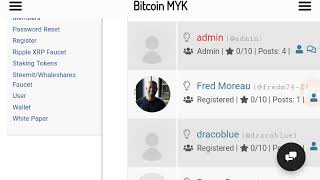
Hey you, welcome back to the channel. And guys, today I want to update you on the launch of our new social media network that pays you for likes. And, um, just want to walk you through some of the features of it today, update you on what's going on, some new features. And, uh, we were calling it BTM Bloggers, but unfortunately we may have to change that, uh, for our token abbreviation. Uh, there are— there may be some confusion with a coin called item at some point in time. And we may drop to something like BTCM, but we'll keep you updated on that. So as we're going through the, some of the members of the site, excuse me for dropping the microphone. I just want to show you some cool features, you know, with our, with our site here and how it, you know, and how it works. So there was someone I was trying, okay, here she is right here. I wanted to upvote her. will basically give her a like. That's what we do, and you get paid for the likes. Of course, we have the most beautiful members on our site, and Smart, don't forget Smart for joining. But down here you will see it shows the likes you receive and different things, and you get ratings, and we're gonna pay you our tokens, our cryptocurrency, for all those different likes you get. And, um, so I received a little feedback today from some people who were saying that they didn't like the title of our project, you know, specifically Bitcoin MYK, because they thought it sounded like one of these scammy, you know, Bitcoin forks. And, you know, I can understand where it was coming from. We've had a lot of drama with Bitcoin forks, a great deal of drama. But as many of you all probably know or will find out is that we have a connection with Bitcoin. So it's very important that there be this connection and relative understanding of our connection with Bitcoin. And so I felt that name was very important, but I did understand where it was coming from. Some other things that he— and of course I love feedback from the community. I look at this as a community project. And that the, you know, the more feedback we get on this, uh, the better it's gonna— it's gonna be for, you know, for everybody. But he thought that the title was what kept people from joining the site. You know, now we've only been going for about 30 days now, and the, the social media part where you can blog and you can like posts and pictures and things like that, that hasn't even been going a week yet. Uh, and really all of this is still being beta testing at this point, uh, and we were gonna— we should be still doing that, but we just decided to open the door so you all can grow and develop along with us as we make, uh, various changes and, um, and different things like that. But, uh, what he basically, you know, was getting at was that, um, um, you know, that he felt that was the reason people weren't— maybe hadn't joined the site, maybe as many as he thought would join. You know, from our perspective, we thought it was a good first week. And I'm gonna— I'm gonna explain to you why we felt it was a good first week, and not even been a week yet, but why we— why we feel that we like the direction it's going. And we're going to talk about the principles of that, um, you know, and why we think this might be better well received than some that exists out there right now. But he— I think what tends to happen with social media networks over the blockchain is that, uh, you know, of course there's this, this, um, you know, this, uh, I, I think the pinnacle— I think a lot of us tend to look to the pinnacle, and I, I think we pretty much all agree that in social media, social networks, probably Steemit is the best. It's still the best. It still has the most, you know, users, and it still has the strongest community. Now, uh, here's something very interesting, uh, came up this week that, um, I was, um, reviewing something or reading something or came across a video, but they were talking about, well, uh, what's going to happen with Steemit when EOS launches their version of Steemit? And then someone went on to say, and what's going to happen to Steemit when Tron launches their own social network, right? Um, and so, um, you know, some people— that would lead some people to believe that either Steemit is going to get a lot of competition or that more people may want to use EOS or, uh, a Tron social network should they launch one, you know, better or whatnot. But I really think it's kind of like, it kind of goes back to that, to that, uh, the idea that I talk about when I talk about how if a person is invested a great deal in a cryptocurrency, let's— and I'll give you an example like this. Let's say you have 1 million tokens and some underlying cryptocurrency that you got. Maybe you got them at a time where you thought this, this project was going to really do something. Then maybe you found out that the people leading it were scumbags, and you found out that it— that dream may not happen. But yet you still have these million tokens. Uh, what do you do with them? You know, uh, is it in your best interest for the project to still work even though it probably won't work? Yes, it's still in your best interest that it works because, uh, you got so much skin in the game, you got so many tokens in that. So even if you probably hear something better, um, it's not going to remove you from that necessarily because you've invested so much already in some project. So you, you've crossed the Rubicon with that. You want to see that through. And I think that is kind of what can happen in certain communities. Also, it could be that some communities are close-knit. You've developed all your friends there. So even if, if Steemit were to get a project like EOS or Tron with other large communities doing a similar thing, it doesn't necessarily mean that they're going to comparably have the value or user base that Steemit has. Because another thing you have to keep in mind is that Steemit was built over, over 2 years now, going on 3 years, with a lot of funding, a lot of marketing, and a lot of people who've grown with that project. So to even have any kind of nearly close comparable data, uh, would be, uh, you know, it's going to be difficult to, to make comparisons like that. The next thing I would, I would say is that next to Steemit, as far as social media sites go, you're probably— the next social media community that's even close to Steemit is probably going to drop down to less than 10,000 member active members. And so a lot of these coins and projects probably only have about 1,000 inactive accounts and people on them. And so, uh, you know, the numbers are quite alarming. That's why a lot of these dApps aren't being used like people think, and you don't really have the numbers, um, as far as the use cases for many of these applications. But let me steer you in another direction— why we created our project and why we think it's going to be significantly different. And we feel that you should think of it a little bit different. Not so much like competition, because I think we found just this right niche that we operate in where we can gain so much value, but we don't have to be so much competitive with other coins. Like some other projects, you know, they have to be kind of competitive because if one coin wins, it kind of destroys their business. But let me, let me show you how you can think about our blogging site and the value of our token in relation to many of these other projects, and it is due to our cross-chain token feature. So if you see like Steemit, WhaleShares, Tribe, which is the EOS social media version, uh, this EasySocial is going to be coming out I think pretty soon. It's not came out yet. Weku came out running on Ethereum, not sure how great that's doing, but we've since joined a a social media site called Mithril as well, and Empire Avenue, which is kind of modeled after our social network. And we're going to be joining that. Well, we're already— we're going to be linking it to the account tomorrow. And so that's going to be big because what Empire Avenue is, is it's kind of based similar on our model except it doesn't deal with cryptocurrency, it deals with social networks. So let me explain real quick how that works, and then in our next video tomorrow we're gonna We're going to go into detail about why this is so important, why this makes us so different with this social media, um, uh, situation across the blockchain, why I think it's going to be— we're going to be very unique in this, and I think it's going to give us a lot of values, uh, over, over the next, um, over the next several months. But, uh, how Empower works is Empower is— it has a token, but it's not a cryptocurrency over a blockchain as of yet. I think they are going to be implementing something like that. But what they do is they're a social network within themselves, but they rate you and you get their tokens and value based on what you do on other social media networks. Are you, are you with me so far on that? You get rated based on what you do on other social networks. Now they have their own social network that, that is linked to all these other social networks. Okay. And you receive their token. Now, what can you do with their token? You can run these interesting things called missions, where it's basically like pays for advertising to whatever you want to advertise. So it's kind of interesting concept, and it greatly inspired us. But we work a little bit different as a cryptocurrency, because as you look at these social media sites that we're connected to, that means that our token can actually be traded for value over their network. So what people value on their network works, whether it be upvotes or, you know, uh, or whatever the case is, um, our token could be converted to their value. So what you, what you would have in that situation is basically as their projects are, uh, becoming more valuable, obviously the trading of our token against their token is going to create more value as well in our token because our stakes over there will increase as well as our token So this is more like an interconnected situation, and you— some people might think of it like interconnected economy, sort of what you might get with like the United States and China. Oh, you know what a lot of people don't understand about the United States and China, you know, as much as we— they try to set up to be these economic wars, is that America, the United States and China is, uh, very much joined at the hip when it comes to economics, you know, um, uh, you know China, probably the world's biggest producer, but who's the world's biggest consumer? The United States. So how we should look at our blogging site, I would caution people about rating the success of our blogging site, of our token, of our social media token, and how it's valued and how the versatility of it and how the value can be moved. I would caution them on rating it just based on the numbers alone, you know, as looking at it like, you know, you might look at a standard social media network. We might go, okay, this one has a million, this has 5 or 10,000. So it's a great deal less. And it's some truth in that as it might be a little less value in the economy, but it's not necessarily less value in the money because the money is moving across all these networks, right? And so because the token value is moving across these networks, it's like it's almost part of these economies, if you will, right? And so that's a, that's a very interesting feature. And that's how come, you know, we think there's going to be a great successful project, and we think people are going to find value in our token as long as they find value in the social media space across blockchains as we um, you know, integrate into, into more of them. Uh, another point I, I want to make that I think is a very important point, and I'll give an example, is that, you know, sometimes in the social media space across the blockchain, many of us are making an investment on a sole platform, and the hope is that this will be a great platform. The problem is with competition. Competition comes in and it creates a situation where Maybe the value becomes less, it may become better, but generally someone might go adverse in value to the, to the next, right? So what happens if I came in with $100,000 or $1 million and I invested it all in one of these social networks? I could potentially be putting myself at a great deal of risk, right? So what, what would be a little bit more wiser, I could say, is if you had a token that could kind of move throughout all these social networks, uh, and if 2 or 3 went down or several, you know, if they unfortunately, if they went down, you wouldn't lose all your stakes specifically because now you'd have some of that value, um, in those social media networks with our token, right? So now you can just move that value, uh, over someplace else. If that makes sense. So last but not least, let's get to the last feature of the, of our blogging site in our network. And that is the, when you receive a like and you pay for that like, or you receive and we're generally paying out one at this point in time. Now it can't, we're generally paying out now 1 token per, per like, per post. And it's, it's a lot of details to it, but I'm going to just try to simplify it real quick. Um, you get, you can get paid, um, you get paid for 1 post per day, but if you're getting likes, you get paid for as many likes as you get, right? Uh, so there's no limit on the likes you get. Now, as your stake expands in the network, that stake, the value of that stake is how much per month that you can get, uh, likes and upvotes, uh, you can on your own post. Like, say, so how it works is half of your, the tokens you earn, half of it goes to stake for 30 days, right? So if you got paid for a blog post, let's say you got paid 1 BTM token, half of that go in your staking rewards, right? Uh, and it would— not only does it go in there, but it does accrue, um, at an increased rate of about 29.9 tokens per 100 tokens you hold, right? So it's an increase of about 29.9%. So you grow more of it, and that, that, um, at the same time gives you the ability, uh, what's in your, your stake held in your stake account to do that many more pulls. The other is it goes into your wallet to be liquefied. You can restake it if you want. So it's real simple. It's very similar to these other tokens, but basically you get everything back within 30 days. You don't have to wait 13 weeks or some 3 months or whatever many others use. You get everything back in, um, you get everything back in, um, 30 days, right? And, uh, for instance, um, 1 token gives you 1 post that you can do per day. Let's say if you have 50 tokens, well, you could do 50 for that. You know, you could do 50 posts. You get paid for 50 posts for that month, plus you get paid for the 30 posts you get paid anyway. So because you get paid for a post a day, again, likes that people give you are unlimited. Um, but it can't be the same person like in your post. It's just like a lot of these other sites, right? And we're going to leave clear instructions to that, but just kind of think of it like, uh, kind of like how Steemit uses Steem Power, Wiltshire uses, um, Well Power. We use Stake Power and, uh, half of what you earn every 30 days goes into that. So real simple. And it, it, it tells you how many, it lets you know how many posts you can do. And get paid for. You can do as many posts as you like, but the system only pays you for one post per day. Okay, so we think that's a— there's going to be a real cool feature going forward, very versatile. Uh, another thing I want to comment on real quick before I get out of here on this update is that, um, I, I think what a lot of people are going to be able to identify with this, uh, social network is that you get paid for likes, you get paid for posts, you get paid for photo uploads. And you know, some of the sites I've— the social media network sites of the blockchain I've used, uh, whereas— and please understand what I'm saying here— whereas how their systems work and how the community values certain contributions they made. I don't think that per se is wrong in any way. Um, however, this is what I would put out there, that if I go on a social network and let's say I'm graded and I'm rated on being a great writer or great, a really great content creator, and I'm getting paid more for that because I'm doing more of that, I, I get that, that that's great. But are the masses of people like that? Like, um, you know, the masses of people that use social networks, the majority of them probably aren't going to be great writers and great content creators. And if they comment on posts, um, and they get paid for that to do some great comments, uh, you know, or they comment and they don't get paid or what have you, What would be their motivation to stay on the site? Because if we say something like, well, community will be the motivation to be on the site, and that community, that community has only like a million people, wouldn't it be easier for me to just find a great community like on a social network that has a billion people or 500 million people? Like, why would I need to go to a small social network to find a community? Is it not possible I could find a great community You know what I'm saying? In a— in a— or a lot more people there. And, and so the point I'm making is that I think some of the standards that I'm starting to see on many of these social networks or the blockchain, which understandably they want to give out with value for a certain amount of what they feel to be production, and I get that. But what I'm— what I see it doing is, is actually— and I, I've actually seen this happen because I brought brought two friends along with me to try some of these social media over the blockchain type sites, and they didn't like it. They left like right away because they didn't like what was being required, what it took to get upvotes and stuff like that. And, uh, when you set a standard like that, you limit the people. And unfortunately, what I found in many of these social media sites is that they want to limit the people who get many of the benefits from these sites. Like, they don't care if it's like a million people or 50,000 people or 20,000 people, and that's fine. But here's what you got to understand with that. A situation like that won't lead to mass adoption, right? Because number one, you don't care if more people come in or not. And I know this to be a fact. I've spoken to big people in certain communities like this. They don't really care. How are you going to get mass adoption like that? You know, if you don't even care if more people come in, so you're never going to mass adopt right now. If you just want to be in this niche market, you know, where, you know, people do things like that, that's, that's one thing, you know, that's, that's fine. But if you want this mass adoption, you know, which many social networks go for, like I've never heard social networks go, well, we don't want that many people. Uh, you know, they're looking to mass adopt, uh, you're probably not going to get that. So, uh, that, that's all the only point I want to make with that. But what we're doing, guys, uh, with the features we have, uh, it really doesn't matter if several dozen social networks rise. We're going to be involved in them and we're going to be moving our token value across them. And so I think that's going to make it safer for our users, going to make it safer for people who invest in these social networks as well, for the ones that don't perform well, and a lot of their stake gets tied up and they lose it. And so it's going to be interesting to watch, uh, with the project we're doing. And I just want to update you guys, and if you have any questions, comments, or concerns, feel free to ask them. We look forward to them, and we love to have more of them. Uh, but guys, that's all I want to say in this video. If you like content like this, don't forget to like, subscribe, and until next time, take care.
More from Michael







UBI - CIA Agent Explains Why Americans Will Never Get Universal Basic Income?



