
California Wildfires Not Insurance Company Fault/UBI Is Needed
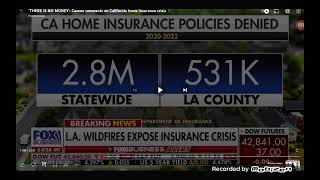
The video opens with a news segment reporting on the Palisades wildfire, which has burned nearly 20,000 acres, is only 6% contained, and has prompted looting arrests. The segment highlights a growing insurance crisis in California, noting that insurers are refusing to write new policies in high‑risk wildfire zones. Data from the California Department of Insurance show that between 2020 and 2022, 2.8 million homeowner policies were not renewed statewide, including 531,000 in fire‑hit Los Angeles County. The reporter, drawing on eight years as an insurance commissioner, warns that insurers are likely to lowball or deny the surge of claims from fire‑destroyed homes. The broader video later connects these issues to a political critique and advocates for universal basic income as a solution, but this excerpt focuses on the factual reporting of fire impact and the insurance market’s response.
Palisades fire, this was the worst. It has scorched nearly 20,000 acres so far. Now the containment there is at 6% for the Palisades fire. At least 20 looters have been arrested for taking advantage of these fire victims who had to abandon their homes. And then on top of that, residents there are facing an insurance crisis. Fox Business's Ashley Webster is live from Palm Coast, Florida this morning. With more on that angle. Ashley.
Yeah, good morning to you, Maria. Look, we know that now thousands of structures have been destroyed by those wildfires, leaving homeowners with nothing but charred remains. There's going to be an extraordinary number of claims being filed, and probably from my experience as 8 years of insurance commissioner, the insurance companies are going to do everything they can to lowball and deny claims. Well, insurers in California have been refusing to write new policies in areas considered high risk for wildfires. According to the California Department of Insurance, between 2020 and 2022, insurance companies declined to renew 2.8 million homeowner policies in the state.
That includes 531,000 in fire-ravaged LA County.
Consumer Welcome back to the channel. I hope you're all having a great Sunday morning. I wanted to, wanted to comment on, um, basically the, um crisis with the wildfires out in California, right? Now, many of you who watch the channel know I'm an advocate for universal basic income, and the tragedy that's happened out in California, you know, we're at a stage now where I don't believe in politicizing what's happened out there in California. California. What the channel is about is trying to discuss with the viewers, uh, solutions and applications to problems. Uh, you know, in the spirit of doing that, we find that Universal Basic Income just simply, uh, provides a solution for a great deal of problems, right? And so our heart goes out to the people who've lost so much in the wildfires out in California. But we want to also make it clear that you have to understand that insurance companies, the way they're set up, are not at fault. They are part of a system that we've decided to partake in, and that system is called capitalism, right? And these insurance companies are set up to be for-profit businesses. In the case where they can't be profitable under capitalism, that's not a good business model. And so these insurance companies, when they're faced with crises like this, like any other operation, uh, where they're pushed to bankruptcy, they're going to just declare that. And the debtors they owe, right, the, the, the policyholders, uh, they just aren't going to be paid right now. It's a crappy, uh, you know, system when you think about it. but it is one that we've accepted as to be a good system. And some, um, even go to the, uh, point of saying the best system that they've— we've ever had, right? Whether you believe that or not, the reality of what happens with the system we've devised is what it is. And, uh, the reality is many of these homeowners aren't going to be paid out. They're going to get nothing, right? They're not going to receive anything. Now we have to, you know, also consider that in LA County, right, these are the fire uh, targeted areas, right? These are the danger zones, right? 531,000 people, uh, could— can possibly be denied, right, uh, in LA County, right? It's a high danger zone. A lot of these people, uh, policies were dropped right before the wildfires because they knew that this was coming, right? Now when you think of home ownership, I want you to understand that when you're dealing with these areas out in the Palisades and Malibu, it is important that you, you understand that a home isn't just, uh, you know, some vanity building, uh, you know, where you, uh, you know, uh, want to show off to people. And, you know, it's this thing where, uh, you know, you just happen to, uh, purchase it like you purchase anything else. No, a home is can literally be your entire nest egg, right? It could be your entire life savings, right? Even many of these people we see as millionaires per se, actors in Hollywood as such, uh, maybe 20 years ago some of these people were, uh, superstars, right? Making large sums of money. But that was 20 years ago. You know, a lot, you know, a lot of times you're now at a stage where these people have put a lot of their money in their homes, right? And that's going to be their retirement. You know, if that home is $20, $30 million, they're going to be able to refinance that home or sell that home, and that's going to be the money they live off, right? Now, what happens in the event they, uh, the insurance companies won't insure them? right? They can't sell the home because there is no home to sell. It's been burned down and all of their life savings has went into this home, right? You know, as to say over the years, um, you know, that's where a lot of their money went. Their careers were popping off 20 years ago. They're not getting as many roles now, right? And so this is a story with a lot of people, right? And so what happens is they go into their retirement depending on those homes to be their retirement, right? Because a lot of your investments, a lot of the, uh, money you have set aside for retirement, it's not just sitting in cash, right? And so what happens, they end up with nothing, right? Now here, you know, what's happening as well is a lot of people who are out there in California for various reasons, whether it's been the wild— losing their home in wildfires or whether it was regulation or whether they didn't like the local politics or whatever the case may be. You hear stories of— or insurance— you see, you hear stories of many of them moving out to Texas, moving to Idaho, moving to Wyoming, moving to Montana, you know, moving to Georgia, moving to North Carolina. Um, and so what you, you have to understand about this is if you're in a situation like this and that were to happen, uh, and you moved out of an expensive place like California and you move— you did move to Iowa or Idaho, you moved into the Midwest, right? If you had an extra $1,000 to $2,000 per month and you faced a crisis like this, that would be very significant because in those places, you know, even if you had nothing, right, in those places, okay, you would, um, that money would go a long way, right? You got to understand that $2,000 a month or $1,000 extra dollars per month in Iowa, in Idaho, is, is vastly different than $2,000 in, or $1,000 in New York, in California, in Miami. right? And so this starts to point to a solution because here's the problem, guys. You know, when the federal government gets involved, wasn't it, I think during the hurricane situations, right? The disasters of, you know, many of the hurricanes that swept through, I believe FEMA was giving these people like $700, uh, FEMA checks, right? It, it just, you know, it was just too disastrous, right? So it's giving like $700, right? So whether it be the federal government, you know, what is $700 going to do if you've lost a million dollar home? So $700, uh, you know, uh, you know, is, uh, the insurance company's not paying, paying out, right? All of those things are going to end up with you having nothing. So it's getting bad now. Uh, a lot of these celebrities, you know, they're doing GoFundMes to help their family members out and such. You know, uh, some of them might still have some liquid cash and such, but you know, when a $20-30 million home burns down, we gotta address the point that that's a lot of these people's net worth. A lot of times when we see how much a celebrity is worth, how much an actor is worth, how much people living out of California are worth, the big bulk of that is coming from their real estate, right? It's coming from their homes, right? And if they're all getting burned up in California and these— and they're in these, uh, counties where people don't, um, you know, uh, where the insurance companies don't want to honor these policies, then that means that they're actually losing $40, $50, $60 million that they've put into. So imagine that, that's like throwing away $50 million. right? Just think about that. Um, so in the cases where maybe you're the guy with the million-dollar home, a half a million-dollar home, it gets burnt up, right? And you just want to pack it up, you know, uh, that was, you know, your savings and such. And now you've, you've moved out of there, you got to try to rebuild, right? Of course, if you try to rebuild in California, Same thing can happen. You don't get insured, you lose all your money, the house burns down again. Because these keep— make no mistake about it, uh, these fires are going to keep happening in California as they've always happened. And I don't want to get into conspiracy theories, but they're even saying things like these people are burning these homes down on purpose, right? They're setting these fires on purpose. I don't know if that's true or not. I don't really do conspiracy theories, but If it is, that's just even more fire to the flames, right? Heat to the flames. And so universal basic income could not only be a solution for this, universal basic income would probably be one of the best solutions for if the insurance companies are gonna just collect your money and willy-nilly decide not to pay. right? Your premiums. Because again, not their fault, it's just the structure we live in. It's the system we live in. We live in a for-profit business situation that doesn't care about general citizens over that, right? That's the system we've chosen. We didn't choose any other, uh, any other system. We said any other system was a bad system. If we put together a government system that put citizens first and said, well, you know, it's not right that this citizen is homeless on the street. He doesn't have— and so our first priority is going to be keeping that from happening. We had a system like that, we wouldn't have that problem. But we chose the other system, right? The system that says, uh, you know, you got to, uh, everything that you gain, you got to blood, sweat, and tears work to get it. right? And, um, you know, uh, if you don't, then you don't deserve it. And if you die on the street, so be it. So that's what we've chose instead, right? So when these things happen and the system can't make up for a for-profit situation, you know, something unfortunate happens to you where you cannot do that, like in the case of these fires burning these, uh, people's homes down in California, and despite them trying to get insurance, they just won't insure them because they're saying that the, you know, the damages that would be far beyond what they're putting into the system, then there's nothing, you know, you can do about that unless you decide to change the system itself from only being a profit-driven model. Right. And there are many reasons why it shouldn't be that. Right. You know, we have examples of systems working without being that, because then what you're saying is you're saying material goods are— you're saying rocks on the ground, you're saying inanimate objects are more important than living human, living human beings. Right. Living, breathing human beings. Um, and so something like universal basic income, if you did have to start over and you had nothing, you've just lost $30 million in your, in your home that was going to be your, uh, retirement, right? You're going to sell that house and you're going to get $20, $30 million that's now gone, burned up in flames because it wasn't insured. That was going to be the money you're going to live off. You're going to refinance your mortgage. You're going to sell your home. You're going to get an apartment or a smaller home and live off the $20, $30 million, you know, the profits. You buy another home for $5 million, you're still profited $25 million. And so you live off that $25 million. Now you don't have that. You don't have anything, right? And so you have a $700 FEMA check. You understand? So if you had that $1,000, $2,000 per month from universal basic income, and then say you move to Idaho, you move to Wyoming, you move to North Dakota, you move to South Dakota, right? You, you move to these, uh, peaceful, less expensive places, uh, now you're able to live off of that, right? So now you've went from having nothing to living off something. And there have been many models conducted that show we can afford universal basic income for all our citizens in that way. Maybe you had a house of 3 or 4 adults, right? So now your household's bringing in $5,000, $10,000 a month from universal basic income. You can afford a home out in Kansas, right? And so those are just some things to think about, but we can't blame the insurance companies for a, structure and a system that we ourselves have decided should be it, that it is the best model we have and that this is what we want. And you especially can't blame insurance companies if you're anti-universal basic income because you're anti any other way of, uh, addressing the issue, right? And so those are some things to think about. Uh, I think that's all I want to say in the video, guys. If you're into universal basic income, if you like content like this, the best thing you could do is subscribe to the channel. If you're a pro-UBI person, subscribe to the channel and hit the like button, right? So we can get that out and we get more people talking about it and more people promoting universal basic income. That's all I want to say in this video. Until next time, take care of yourselves and each other.
More from Michael







UBI - CIA Agent Explains Why Americans Will Never Get Universal Basic Income?



