
Cnbc - Majority Of Bitcoin Trading Hoax Study Finds
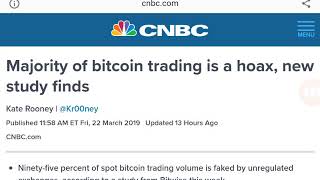
In this video the host reviews a CNBC‑based Bitwise study that claims roughly 95% of spot Bitcoin trading volume is fabricated, with only about $273 million of the reported $6 billion daily volume being genuine. The analysis highlights how wash‑trading and extreme bid‑ask spreads on many centralized exchanges (e.g., a $15–$300+ spread versus a 1‑cent spread on Coinbase Pro) reveal a lack of real liquidity. The host argues that unregulated, offshore‑registered exchanges are incentivized to inflate volume to attract traders, and that this manipulation has contributed to the volatile price swings seen in crypto markets. To mitigate the problem, the video recommends avoiding unregulated centralized exchanges, shifting to decentralized exchanges (DEXs) that reflect true low‑liquidity conditions, and employing reputable market makers to narrow spreads and provide stability. It also suggests evaluating crypto projects based on genuine user adoption, real‑world use cases, and demand rather than speculative volume. The host promotes BitcoinMYK.com, a project that purportedly combines a universal token, DEX trading, and market‑making to create a sustainable, network‑effect‑driven cryptocurrency. The video concludes with a call to action for viewers to support more transparent and sustainable crypto solutions.
Chapters
Hey you, welcome back to the channel and I hope you all are having a great weekend. So yesterday evening I came across this article, the majority of Bitcoin trading is a hoax, new study finds, and this comes from the CNBC.com website. The article goes on to state that 95% of spot Bitcoin trading volume is faked by unregulated exchanges, according to a study from Bitwise this week. The firm analyzed the top 81 crypto exchanges by volume on industry site CoinMarketCap.com. They report an aggregated $6 billion in average daily Bitcoin volume. The study finds that only $273 million of that is legitimate. People looked at cryptocurrency and said this market is a mess. That's because they were looking at data that was manipulated, says Matthew Hogan, global head of research at Bitwise. So, you know, several months ago we did a video that talked about the unprecedented level of wash trading that some studies had showed to go on over these centralized exchanges, over 90%. The Bitwise study finds it to be about 95% with only about $273 million legitimate in Bitcoin trading. Which holds a market cap of over about $70 billion right now, with only $273 million, is legitimate according to this study. So this is a huge, huge problem. And this is a problem many of us have been aware of for quite a bit of time. Now, the dangers of ignoring a problem like this can be catastrophic. As we've seen, it's been catastrophic, and that's why we can't— a lot of us can't make any money, is why a lot of us have lost so much money. Yet we continue to push on. So let's talk about a little bit today what are possibly some of the things we can do to, to prevent this and to and to stop this, right? Or at least protect ourselves from this to a great degree. You know, well, you know, as the article says, and I'll leave a link in the description, I'm not going to read the entire article, but the problem is centralized exchanges are incentivized by us to create more volume, you know, in their exchanges. You know, obviously if we don't see a lot of volume in exchange, we're not going to want to trade on it. And so it becomes so ridiculous that, uh, and let me just read this part of the article here. I think it's very important. The San Francisco-based firm compared that Coinbase Pro, which reports about $27 million in average daily volume in Bitcoin, is its median spread or difference between the price a seller wants and the price a buyer wants. For Bitcoin was about 1 cent. That scenario passed Bitwise's test for having real volume. Okay, right, they're talking about the spreads and I'm gonna get into that in a little bit later about some of the solutions to this, but they're talking about the spreads amongst the exchanges, the difference between the buy and the sell orders. But in another stark comparison, CoinBeanie, the biggest record— reported, rather, exchange on CoinMarketCap.com, has a nearly $15 spread. Hogan said they found other extreme examples of exchanges with a spread of more than $300. It is surprising that an exchange with almost 18 times the volume of Coinbase Pro would have a spread that is 1,500 times larger, Bitwise said in the report. You know, so that goes to show you right there that the rug is being pulled from under our feet, that the volume is not there. These spreads are telling the story that the volume cannot be correct. Otherwise the spreads would close down and you would see the vast liquidity, but you're not getting that because the volume is not there with many of these exchanges. Now I don't know why they get— why we continue to report many of these exchanges as the biggest exchanges and why we continue to allow them to be listed on— you know, my opinion is CoinMarketCap should take them off their services. Um, when, uh, when there's any, there's any type of suspicion of that type of, um, activity. Uh, now with the much larger exchanges, like when you start to get up to like, uh, Coinbase and you start to get up to like Binance and these very large exchanges, uh, this, what has happened with this is even if there were many elements of wash trading and price manipulation, the large amount of liquidity that comes through those exchanges has kind of in a self-correcting way start to close a lot of that down because you still have very highly liquid markets. The problem with these much smaller exchanges that are trying to appear to be large is that the smoke and mirrors cannot address the issue of lack of liquidity, right? So let's talk about some of the possible solutions that we can look at and what might be a good situation for what are the, what is the actual price of some of these cryptocurrencies and how to protect ourselves. So the first part might be, or in my opinion, one of the best ways to protect yourself, which some people may not agree with. I know a lot won't, uh, even if they agree with it, a lot of people won't do it because I think a lot of us are stuck in our ways. And that is centralized, centralized exchanges that are not regulated, right? The, uh, centralized exchanges that flee regulation and go to other countries, uh, these are exchanges that we should probably make a conscious decision not to even trade on if they're running Um, and, uh, I won't just say the United States, you know, even, even though I live in the United States and we have a very high level of regulation with the securities industry, but, uh, I won't say that it should only occur in the United States because there are some, uh, nations out there that as well have, uh, regulation on par with the United States or even agreed to higher. But the problem is once these exchanges start running, uh, that's kind of a bad sign because it means they're trying to avoid regulation to a great degree. And of course, we know a lot of these regulations are in place to protect people from these very things. So centralized exchanges would be the number one problem in my opinion with this unless they are regulated, uh, And that would include the United States and around the world. Some of them don't get regulated in the United States, they run. And the reason they do that is because they could have liquidity issues and they need to be able to pump out a lot of various projects and machinations to get money to stay afloat. And so centralized exchanges that are out of that category, I, in my opinion, would be a bad sign for you being a victim of this, uh, of this, uh, false volume. So something like the solution for me would be, uh, decentralized exchanges. Now, as we, as we know, decentralized exchanges have a great deal less volume than centralized exchanges, but That would be natural to this study. If there's only $273 million actual dollars in the market, then, um, you know, then you would have to— that would have to be reflected in trading. And decentralized exchanges with their low liquidity and their low volume, uh, is representative of the accuracy of that, uh, and that way you won't be burnt Course, if you want to play the casino game, if you want to play the gambling game, then centralized exchanges, you can do that. But then, you know, the market will, uh, kick you in the rear, uh, at some point in time. Another thing I think is, uh, market makers, right? A lot of these cryptocurrencies don't have market makers. You know, what I believe is at this point in time, many of the altcoins top 10 cryptocurrencies, they could have already went out and purchased, or rather, I'm sorry, their partnerships with market makers, right? And to have market makers in place where the spreads are more narrow and the price is a great deal more stable than it's been, but you need market makers, you need firms providing liquidity. And there are firms out there that do that. And, you know, those things should be in place. It should be reported to be in place. So we know that there is a great deal of stability and there is a great deal of liquidity. You know, another thing is just how the cryptocurrency market works in general. With the projects. Are these projects sustainable, right? Do they have a way to funnel money into them due to the demand factors, right? And for me, what makes a lot more, a great deal more sense than what I'm seeing in a lot of cryptocurrencies is use cases and what you could get in the aspect, or one of my, one of the easiest ways for me to evaluate the value of cryptocurrencies through a project like social networks, in some cases gaming applications, because people are actually using these things day to day and you can see the user base. And if there's a large user base there, that means there's attention value there. There's some type of demand or reason to be there. There's some type of need being met. And so, Uh, you know, in that regard, those are good indicators of something that's going to hold value and create that value. Now, of course, the problem with Bitcoin being so decentralized on this network, there's not always a lot of incentive to go into Bitcoin, with the exception of maybe if you're in a country that suffers from a great deal of hyperinflation, you want to shelter some of your money, or you want to illegally take your money out of a nation that has made it illegal for you to do that, right? And so in those cases, you'll find this demand for Bitcoin, but that, that demand wouldn't be large enough to create this sustainable price. And so in order for the exchanges to stay in business, now they are under pressure to make it appear that there is more volume of trade than it is because they need to get you in, they need to get you trading so that their business remains, you know, doesn't become obsolete or you don't use it or whatever the case may be. So market makers, you need market makers, you need a project that grows a lot of user base, that which we can see. Um, and it needs to be a demand there for it, uh, in a branding situation like Bitcoin. However, uh, without the lack of incentive to participate in Bitcoin, because you don't need to use Bitcoin, right? The only people who need to use Bitcoin are people who suffer from hyperinflation and people who need to hide their money. Uh, the rest of the world at at this point may not need to use Bitcoin, or at least not at the demand that it'll take for the market, the true market value to go beyond $273 million if this study is correct. Now I'm more on the side that it is correct. It makes a great deal of sense that it would be correct that 95% of the, uh, uh, volume of trade would be false. Uh, that would pretty much attest to the story we've gotten with cryptocurrency and Bitcoin over the course of the last few years with the big price gains and the big price falls, that those would be great symptoms of what you would get with a lot of fake volume and wash trading. Um, and so, uh, I'm more so side with that. So With looking at true users, true demand, true user base, something you can value easy, like in the idea of a social network, each user, you can pretty much determine what each value of each user is, right? Market makers, does it have market makers where there is a close spread and there is a lot of liquidity between value? And, um, You know, is it on a decentralized exchange where the volume was going to be, uh, not the problem of a centralized exchange wanting to beef up the price so they can make more money, want to wash trade so they can make more money? And one project in mind that does all of those things underlined is BitcoinMYK.com. BitcoinMYK.com, a universal cryptocurrency that allows you to move your represented Bitcoin value across the exchanges that builds a network of people. You can look at the users and start to evaluate what the value actually is in that network effect that trades on a decentralized exchange and that has market makers in it keeping a stable price and moving that coin consistently along. We'll leave a link in the description for that project as well. But I think it's, guys, it's time people out there in cryptocurrency that we get serious about exactly what type of value we're going to get out of cryptocurrency. I think it's time we get serious about, it's probably really only $273 legitimate dollars in cryptocurrency when $270 million goes into the cryptocurrency market. It can have an effect of 50 times, 100 times through the market effect. But there's still only actually $270 million in that market, right? It's not like an actual $70 billion went into that market. So these are all the things we need to be aware of. We need to be serious about it. We need comprehensible plans that solve this problem. That we participate in, not just looking the other way thinking things are going to get better. They're not going to get any better until we address the issue at hand. One way to do that, join our project. Let's create something that really works and that is really sustainable. If you like content like this, don't forget to like and subscribe. And until next time, take care.
More from Michael







UBI - CIA Agent Explains Why Americans Will Never Get Universal Basic Income?



