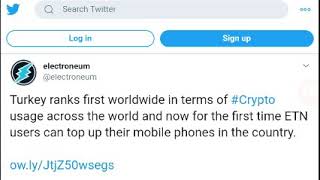
In this solo commentary, the host discusses Electroneum’s recent expansion into Turkey, highlighting the country’s economic instability and the high adoption of cryptocurrency (around 20% of the population). He explains Electroneum’s phone‑top‑up model as a practical, everyday use case for people who cannot rely on the Turkish lira. The speaker then contrasts this utility‑focused approach with the trend of putting games and other non‑essential services on the blockchain, referencing the early virtual‑world token system of Second Life and questioning whether blockchain ownership truly protects users from market manipulation. He criticizes the Western crypto scene as a speculative “casino,” noting that major coins lack clear real‑world use. The host argues that Electroneum’s focus on tangible needs—mobile payments in unstable economies—represents a sustainable path for cryptocurrency. He also promotes his own project, BitcoinMYK, a deflationary Bitcoin fork on the Steem blockchain, and ends with a call for viewer engagement.
Chapters
Welcome back to the channel, and I hope you all are having a great day. So Electronium, it's Turkey. Electronium goes to Turkey, and many of us thought it was Southeast Asia, but no, it's Turkey. And quite fitting that it's Turkey. Turkey had been having many problems with its financial dollar and situations I think it's the Turkish lira, was it? Very early on. Um, and, uh, so they, they became quite, uh, receptive to cryptocurrency, right? Uh, over about 20% of the population uses cryptocurrency, uh, and it's this viable option for them. So with Electroneum now, you can top up, uh, in Turkey on your Electroneum, uh, uh, minutes through your phone plans. And this is, um, you know, I don't really know how else to explain this, guys, other than to say that the success of cryptocurrency is gonna come from actual use. Got into a conversation earlier today and was talking about games to some people, and they were talking about, you know, just all these uses of putting all this different stuff on the blockchain and And I sat back and I was trying to figure out putting games on the blockchain, like, do we need to do that? Why we need to do that? And then my understanding was, okay, well, if you have some type of game and now you can own part of this game and there's a type of property ownership in this game, and maybe that would be why people want games on the blockchain, right? I believe earlier in Electroneum's history, And I'm not very familiar with the early days of Electroneum. This seems to be what a lot of people complained about the earlier white paper days. But if I'm not mistaken, I think gaming was part of it. And so Electroneum went off from that, from that plan, and a lot of people got upset. But I could never get past the game thing because as I was having this conversation with someone earlier today, and that seemed to be what they were into, and a lot of people think that might be the way for cryptocurrency. I remember thinking about this game called Second Life years and years ago that I used to engage in, and since about 2003— so we're talking way back now— they had this situation where they have these virtual goods avatars, and they had their own little token that you would use, and you could own things you built in the game and property and the avatars and the clothes and a variety of things, right? And so it was run by this place called Linden Labs. Linden Labs was basically a company, a regulated company, right? Licensed company. And they had this token and they protected your property. And if there was a problem, it could be enforceable in court. It could be enforceable by law. And you could still own part of the game through their tokens. So that all made sense to me. Now they're trying to do that on the blockchain, but the problem I find somewhat with that, um, is that, uh, you really still wouldn't be protected against market manipulation, uh, who owns these tokens, who's doing what with these tokens. So I'm just not sure if that necessarily would be the best direction for cryptocurrency, but I'm saying all that to say this: the direction Electroneum's taking. It's just focusing on areas and places where people actually need cryptocurrency. It's not worried about games, it's not worried about social media, it's worried about day-to-day living of people who need to actually use a cryptocurrency because their financial system is in disarray, um, and they're just not taking, uh, their local currencies, right? They, they need to use something that is a little bit more reliable. And doing this through their phone plans and Electroneum being there, actually going in there and helping to implement this into their system, it just makes so much sense. And this has to be the way I think that is for cryptocurrency that makes the most sense to where there's a demand where people have to use it. Again, me personally, looking back at the games, looking back at a lot of stuff people trying to put on the blockchain that I'm not even sure if it, it needs to be on the blockchain. Like, I don't know if everything needs to be on the blockchain they're proposing. Uh, the way I see it is there is a necessity and a need right now to upgrade a money system that's over 4,000 years old and hasn't been updated. Uh, and, uh, projects like Electroneum can help to move us in that direction. And, uh, that's how I said, that's why I think it's so important, uh, that, uh, we really present cases and use cases for these cryptocurrencies. I mean, in the West, really honestly, in the West, from what I can see, we treat cryptocurrency like a gambling casino. All it is is we're putting money into these tokens, pumping up the price. We're hoping it keeps going that way. And we got these major cryptocurrencies, uh, top 10 cryptocurrencies kind of leading the pack in that. And I'm not 100% sure why they have the value they hold and why they're able to pull this off when nobody's really using them. What are they used for? I have no idea what they're used for. The only thing I, I hear is the idea of, well, one day we're going to be doing all— putting all this stuff on the blockchain. But we're putting things on the blockchain that work better off the blockchain. It just doesn't make any sense at all to me, everything that we're trying to make a case for and put on the blockchain. You know what makes sense? When a person can't trust their dollar anymore in their home country and they gotta move into something else more efficient, more effective outside of government controls, right? Uh, when it's very user, uh, user-friendly, they don't need a bank account. They can carry it around their back pocket and carry around on a mobile device. And it gives them, uh, value for using it. They're getting airdropped so many of these, uh, this money each month. It just makes so much more sense. So Electroneum, might be slow, might not be moving as fast as some of you all would like, because remember, we're in a casino in cryptocurrency. We want to see fast prices, want to see fast movements. But I can't tell you this, I am definitely convinced that when it comes to, um, a good company going out and trying to evaluate what works in cryptocurrency and what it should be doing Electroneum seems to have that down pat. And just because they're not manipulating their price or interfering in the price or propping up the price from other cryptocurrencies or Bitcoin, or just because it's not one big whale who can move an entire market 20% and maybe keeping our major cryptocurrencies afloat, does not mean Electroneum's not a good product. And it does not mean that the way that these cryptocurrency and the entire cryptocurrency space is carrying on today is going to be sustainable and work tomorrow. So just something was on my mind to think about. What do you all think about the direction of Electroneum moving into Turkey? I thought that was a great move. Would love to hear you guys' thoughts and comments. Don't forget to check out our project BitcoinMYK. That is deflating Bitcoin It is doing a type of Bitcoin, uh, some people call it fork, some people call it airdrop. You can take your pick, but it is, uh, based on the Bitcoin you hold and ever-deflating Bitcoin to make it this viable product as well. It's transaction-free, faster than Bitcoin. We use the Steem blockchain to accomplish that. Check that out. We think that, um, aims to solve many of the cryptocurrency problems as well. But that's all I want to say in this video. If you like content like this, Don't forget to like and subscribe, and until next time, take care.