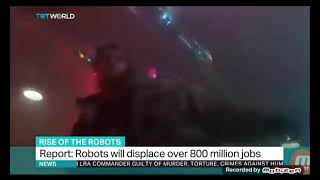
In this video, two speakers discuss the rapid rise of automation and its potential to upend the current economic system. Speaker A cites the McKinsey Global Institute’s projection that up to 800 million jobs could be automated within nine years, framing the issue as an imminent reality. Speaker B expands on this, arguing that such massive displacement signals the end of capitalism and will give rise to a "robot economy" where most labor is performed by machines. The discussion references research by Frey and Osborne (47 % of U.S. jobs at risk in 20 years) and outlines proposed policy responses, including a modest universal basic income funded by a "robot tax" on both physical robots and AI-driven digital transactions. The speakers emphasize that AI software will become cheaper and more pervasive than hardware, making taxation of digital services essential. Finally, they pitch a project called BitcoinMYK, which envisions monetizing attention on social media as a way to adapt to the coming robot economy, inviting viewers to join the effort.
Chapters
When the Terminator hit the big screen almost 3 decades ago, it was just science fiction and too far into the future to even imagine. But in 2021, robots are now widely used. The cost-effectiveness of them means they already have and will replace humans in many jobs. The McKinsey Global Institute report is predicting up to 800 million jobs could be taken by robots within just 9 years.
We can see among our business partners that Welcome back to the channel. I hope you're having a great day. So, um, as you can see by this article, um, or I'm sorry, this, uh, this news story here, um, in 9 years it's predicted that over 800 million jobs will be taken by robots. 800 million jobs. That's That's almost just like saying robots are going to take every job. And, um, you know, this means— does this— this means— I believe it means the end of capitalism, right? Uh, I believe it means the end of capitalism because just through deductive reasoning, it's only so many things it could mean. So if not, uh, If not capitalism, what, what comes next? What type of economy are we looking at here? And what, what are we considering here? And there is a word for this economy that I think is going to emerge over this. I've been predicting 5, 10 years from now. They're saying 9 years. I believe somewhere right around that window was when we're going to have that, the big event happening in that. But the term that we're looking for, and it's a real term, is called robot economy. So what is the robot economy? Let's define it. Define it. The robot economy is a scenario in which most of the labor required to sustain human life is automated. Right. And this is taken from techtarget.com. Okay. According to Carl Benedikt Frey and Michael Osborne, researchers, researchers from Oxford University, 47% of current jobs within the United States should be replaced by automation within the next 20 years. As jobs are displaced by automation, Some people predict that new jobs will be generated to fill the employment gap. Others, however, maintain that the scale of displacement will be of such a magnitude that any new jobs generated could never keep up with the needs of former workers, and that furthermore, jobs that are generated are likely to be candidates for automation as well. right? So all of these numbers and all this data seems to be aligned with many of the figures I'm seeing from my research. All, you know, all the research I can gather, right? And then by the end of the article, I'm not gonna read the whole article. It's a great article. I'll try to leave a link in the description, but by the end of the article, let's see where it's at. We start to get into solutions, right? Uh, let's see here. Here it is right here. Proposed measures to deal with workers displaced by robots include a guaranteed basic income, not a large sum, but adequate to meet the needs of payees. Some IT experts have suggested that a robot tax could be levied to help fund the program, right? So think about that for a minute. This is in line with much of what we've been discussing and talking about, right? What type of economy is this where robots do all the labor, right? The robot economy, right? This is the term that is being coined. Uh, capitalism is gonna be over with, right? It's no way that it's gonna sustain, and there's no way it can exist in the framework of robots doing all the work. Now, of course, the way to control the robots obviously is gonna be through taxation, right? Because the companies are still gonna try to control the robots through, um, uh, you know, controlling it, the intellectual property and so on and so forth. And that's been many of the questions about this on the horizon. But, but the thing about robots, and maybe robot is the wrong term, right? And it's brought out here in this article, uh, that instead of envisioning this like physical robots walking around doing all of the work, uh, so to speak, which is going to be that as well. I believe these robot humanoids are very dexterous, right? So they're going to be doing, or they're going to be designed to do— they may not look like humanoids, but they're going to be designed to fulfill tasks that humans fulfill, and they're going to be, uh, developed just for those tasks, right? But what we're also really— what we're forgetting to focus on is AI software, artificial intelligence, which is going to be a lot cheaper, right? In the beginning, it's kind of expensive to develop, but once it gets going, it's very cost effective and profitable, right? And so this software, when we think about taxing these robots, it's not just taxing these robo— these robotic physical things, but But also, if you look at something like Amazon, taxing every transaction at the point of sale, right? Right off the top. So there is no, no way to get around it, right? When the transaction occurs, the sophistication of our technology will be able to tax those systems, will pay tax on every processed transaction. right? And so this is how many of these programs are gonna be paid for. As the needs of the people increase, this will increase as well. Either way we look at it, how capitalism works, the idea of you go out and you earn and you create something and it's yours, that has no choice but to end because Nobody's gonna hire you, right? Robots are proved, are gonna be proven in software. Uh, AI systems are gonna be provably more effective than you. They aren't gonna get tired. They, um, are gonna be much more reliable. They're gonna make a lot less mistakes. So it's not gonna be any valid reason to have human beings doing any of this work. There is dependency on this capitalistic system, but that's just not how things are going to work out. And so some people want to try to hold on, you know, to it, uh, as they don't know what else to do, and that's understandable. But this is the reality of the situation, and it is always better to be prepared for an issue as big as this than not to be prepared, right? I think we've got to learn some of that firsthand, even in dealing with this pandemic. Um, so that's what it's becoming, a robot economy. That's what we're going to see 9 years from now, 5 years from now. It's going to, it's going to change things dramatically, right? Um, You know, of course, how we, what we term work and what we consider work is going to be vastly different, right? It's going to change. And some of the things we're doing now, some might consider that work, right? You might consider social media work. And that's what a lot of our experimentations are with today. And that is, you know, basically finding solutions to the future. Projects like we're involved in Bitcoin NYK, social media like what you use every day. What if it was monetized? What if it was free but your attention was the currency and the value, right? And so many ideas like this are what we're headed to, and, uh, there's nothing to, to, to change that. Uh, this is just the way it's going to be. And how things are going to go, right? Um, but that's all I want to say in this video. Uh, if you want to be prepared for, uh, looming threats on the horizon like this, why not join BitcoinMYK? We'll leave a link in the description. Uh, we're looking for solutions to deal with this coming threat that is inevitable. Um, and you can be a part of that and benefit from that as well. Um, and we hope to see many other projects addressing issues like this in the future as well. But that's all I want to say in this video. Till next time, as always, take care of yourselves and each other.