
Facebook Global Coin - Mankind's Greatest Invention!
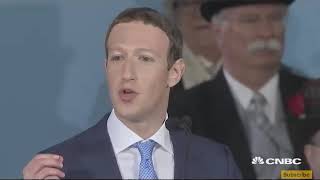
The video is a compilation of speeches, panel discussions, and commentary centered on wealth inequality, universal basic income (UBI), and cryptocurrency-based UBI experiments. It opens with Mark Zuckerberg describing the current wealth gap, the need for a new social contract, and proposing UBI, affordable childcare, and lifelong education as societal pillars. A CNBC‑style panel (Speakers B, C, and Lee Carter) debates the feasibility of UBI, referencing Alaska’s dividend, historical attempts like Upton Sinclair’s EPIC, and critiques that welfare should focus on jobs rather than cash transfers. Former presidential candidate Andrew Yang presents his "Freedom Dividend" plan: $1,000 per adult per month funded by a value‑added tax on automation‑heavy corporations, arguing it would boost the economy, create jobs, and promote social justice. Bitcoin skeptic Craig Wright denounces the proliferation of altcoins and argues for a single, unchanging Bitcoin protocol as the foundation for a stable monetary system. Finally, a YouTuber (Speaker G) reads Investopedia’s analysis of Bitcoin’s need to serve as both a medium of exchange and a store of value, then explains a proprietary Bitcoin fork, BitcoinNYK, which distributes monthly UBI tokens (≈$1,000 worth) to registered users, outlines tokenomics, penalties for unclaimed tokens, and funding mechanisms based on network attention and mining rewards. The content weaves together political, economic, and technical arguments for a crypto‑enabled UBI while showcasing opposing viewpoints.
Chapters
Today, we have a level of wealth inequality that hurts everyone. When you can't— when you don't have the freedom to take your idea and turn it into a historic enterprise, we all lose. And right now, today, our society is way over-indexed on rewarding people when they're successful, and we don't do nearly enough to to make sure that everyone can take lots of different shots. Now let's face it, there is something wrong with our system when I can leave here and make billions of dollars in 10 years while millions of students can't even afford to pay off their loans, let alone start a business. I know a lot of entrepreneurs, and I don't know a single person who gave up on starting a business because they were worried they might not make enough money. But I know too many people who haven't had the chance to pursue their dreams because they didn't have a cushion to fall back on if they failed. We all know you don't get successful just by having a good idea or working hard. You get successful by being lucky too. If I had to support my family growing up instead of having the time to learn how to code, if I didn't know that I was going to be fine if Facebook didn't work out, then I wouldn't be standing up here today. And if we're honest, we all know how much luck we've had to get to this point in our lives. Every generation expands its definition of equality. Previous generations fought for the vote and civil rights. They had the New Deal and Great Society. And now it's time for our generation to define a new social contract. We should have a society that measures progress not just by economic metrics like GDP, but by how many of us have a role we find meaningful. We should explore ideas like universal basic income to make sure that everyone has a cushion to try new ideas. We're all going to change jobs and roles many times, so we need affordable childcare to get to work and healthcare that's not tied to just one employer. And we're all going to make mistakes. So we need a society that's less focused on locking us up and stigmatizing us when we do. And as our technology keeps on evolving, we need a society that is more focused on providing continuous education through our lives.
Hey there, thanks for checking out CNBC on YouTube. Basic income. This time after a trip to Alaska where every resident gets a yearly dividend of about $1,000 or more funded by oil revenue. Zuckerberg said, quote, this is a novel approach to basic income in a few ways. First, it's funded by natural resources rather than raising taxes. Second, it comes from conservative principles of smaller government rather than progressive principles of a larger safety net. This shows how basic income is a bipartisan idea. The tech guru gets to the heart of why universal basic basic income could be a political reality. It's all— it's the only economic principle that people as far apart as socialists and libertarians could perhaps agree on. And it's actually finding some footing in at least one state other than— one other state. Hawaii just became the first state to pass a bill to convene a basic economic security working group, which is a big step toward a universal basic income. So is this a utopian dream or a communist hellhole? The party panel is back. Mickey Conte, Michael Malice, and Lee Carter. This is disaster waiting to happen.
We've seen this actually in 1934. In 1934, Upton Sinclair ran for California governor under a platform called EPIC, End Poverty in California. And at the height of the New Deal, he lost because everyone was like, wait a minute, every broke person from the rest of America is just going to go to California. You got to find a way to pay for them.
It's called welfare. Yeah. And can we— hey, Sean Penn and your buddy Hugo Chavez, has done in Venezuela. How'd that work out for you?
Well, okay, very different and also a typical talking point. Um, the welfare that we have, it's for the billionaires like Mark Zuckerberg. We're going to talk about basic income. It is the millionaire and billionaire class who is living off of the backs of the working people who are making well under what they should be making. It has not kept up with inflation over the past 3, 4, 5 decades, and it's just getting worse and worse. And we have to address this because if we don't have working people surviving, they're going to end up on welfare. But you know what, I've got to say, do you know what makes people feel good? Working, right? So let's not give them money, let's give them jobs, let's give them opportunities. Okay, so I'll see you in like 40 years when that happens. In the meantime, we have a real problem.
We have a real problem.
You can't just create jobs in a second. We've been trying to fix this problem for a long time. You know, the basic income has not kept up with inflation. But the numbers— that's why you get a deficit.
That's why. Don't add up though.
How do you make— tax the rich. That's what you do. Stop, stop subsidizing the wealthy people in America.
So everybody stops working. When people think that there's a net there, they're gonna take advantage of it. And you basically, you create incentives for people to sit on their— at home.
And $1,000 a year in Alaska is a far cry from a universal basic income, which would be something like $12,000 or something.
Yeah, there's a big difference. And I mean, bottom line here is I think Mark Zuckerberg is testing his presidential run, which is hilarious. Reading that, when you just read his perspective on this issue, you just showed how flawed— it was like listening to a— no offense— a freshman in college write their first paper on universal basic income. And I'm like, you're running for president? Why are you in Alaska? Why are you in Kentucky? Why are you going to Iowa?
He's trying to be— you know what? He learned something from Donald Trump's presidential campaign and realized that liberals are wildly out of touch with people.
There were no typos in that message.
He didn't learn anything from President Trump.
Now, now, now. But in terms of who would have thought that a billionaire who was born in Queens, who has a giant, like, smoked glass and brass skyscraper on Fifth Avenue, would be in touch with people who lost their textile jobs in Southern Virginia. Donald Trump was. And so Mark Zuckerberg is like, I better figure out who these people are who, who live between New York City and— well, who live outside of Silicon Valley.
Yeah, he's done a lot though to go out there, communicate with people, get to know people. I mean, I don't agree with this policy at all, but he has reshaped Facebook. I'm And he's talking now about it being one giant community. He's trying to position himself as more than just a robot.
And he's wily. He knows what he's doing. Ask those Winklevoss twins. Thanks, Namiki, Michael, and Lee Carter.
Make it happen in 2021, and it will be the first thing I do as president. Hello, I'm Andrew Yang, and I'm running for president to implement universal basic income in response to this incredible transition we're going through. Universal basic income is a policy where every citizen gets a certain amount of money every month regardless of their work status or anything else going on in their lives. Under my plan, every American adult between 18 and 64 will receive $1,000 a month, free and clear, no questions asked. Doesn't matter if you're working, not, what your income is. $1,000 per adult per month. We're going through the greatest technological and economic shifts in our history, and we need to accelerate our society and government to keep pace with the challenges of 2020. We've already automated away millions of manufacturing jobs, and we're about to do the same thing to workers in retail, truck driving, call centers, fast food restaurants, and on and on throughout the economy. So this plan, the $1,000 per month plan, was studied by the Roosevelt Institute. Institute, which projected that it would grow the economy by $2.5 trillion per year and would create 4.5 million new jobs. $12,000 a year is enough to push an American up to just about the poverty line, which is a little bit more than $12,000 per year. So there's like all of the big, oh, it's going to grow the economy, it's going to create millions of jobs, it's going to create all of these new businesses, which it totally will. But I'm more excited about the fact it's going to help the single mother pay for their children's food and education. It's going to help children grow up to become more conscientious and agreeable and graduate from high school at higher levels. It's going to help balance the scales for women who do so much work that right now is not compensated, for underrepresented minorities who don't have access to the same opportunities and have less savings. The way the Freedom Dividend, which is what I call Universal Basic Income, the way the Freedom Dividend is funded is through a new tax that will fall on the companies that are benefiting most from automation. So we need to shift to a value-added tax that would fall on companies like Amazon and the robot trucking companies, where value-added tax— every other industrialized country in the world except for the US has a value-added tax. And through a value-added tax at half the European level, we could pay for a universal basic income of $1,000 per month for all Americans. A universal basic income will be the greatest catalyst to entrepreneurship and creativity and the arts that we have ever seen. Because when Americans have their heads up and can think about the future, they'll be thinking about the businesses they want to start, the organizations they want to create, and really what they want to see in the world. So right now, many, many Americans have a mindset of scarcity, which is that we don't have enough, there's not enough to go around, we can't afford it. But the truth is, we are the richest and most advanced society in the history of the world. Our economy is up to $19 trillion in size, up $4 trillion in the last 10 years alone. We can easily afford $1,000 per adult per month. This is the great equalizer of our time. Economic justice is social justice. There is no social justice without leveling the playing field in terms of how much money we get as Americans to be able to pay for our basic needs.
I can add snore. Why? What is the reason? When did this start happening? When were the changes? I can tell you, I was there. It's all because of bloody Silk Road. No privacy. Well, actually, there is privacy. There is not anonymity. There's a big difference. People want to make this thing that they say will get around government. You don't do it by walking up to a government official and kicking them in the fucking nuts. I'm sorry, you do not make a system that will change the world by finding the big bad gorilla and kicking them in the fucking nuts. That simple. Really, how do you make something big? You grow it. Imagine If we were here today, not with 50,000 fucking altcoins, but with one Bitcoin that ran all these different protocols, that acted as a universal source of money, that also ran fiat, that allowed exchange, that allowed trade. And then think, if there's no single developer to target because the protocol isn't changing, Try stopping that. When you put a person at the top, then you have a target. I didn't want that. I wanted not to be the target. Because while I'm here, people will go, oh fuck, we can target this guy. The hard bit is not to change. What we're going to do is very simple. We're going to scale Bitcoin. And we're going to have the protocol so that a transaction that was written in 2009 and signed will run in the year 2100 that hasn't been on the blockchain now, that can be sent then, and will still be accepted. Now, you can say that's backwards. I say Silicon Valley's bloody fucking backwards. They're freaking warped. They're freaking warped. They've got this whacked-out idea because of a group of people who've never experienced the real world, thinking code is law, and thinking because they've got huge amounts of money quickly, they've never learnt what it's like to really be in a hard situation. And I've known many people from Silicon Valley, and they are like that. They're all freaking whacked out and up themselves. And very simply, if we want to build a system that'll grow, if we want something that is going to be stable, if we want people to actually take this seriously, then we can't keep changing. You can't flip protocol every second Anyone know when the last TCP/IP change was made in IPv4?
I'm actually going to read a passage here off the Investopedia site. And, uh, as Investopedia, with their expertise, tries to ascertain why Bitcoin has value and what is needed for it to have value. So I'm going to read this passage. It's not in front of your screen, but I'm looking at another computer, and I'll leave a link in the description to what Investopedia says about why Bitcoin needs value, but I'm gonna, I'm gonna, or how it has value and what's, what are necessary components of that. But I'm gonna read what I found to be the most important passage, and you can read it in its entirety. But, uh, Investopedia goes on to say, our first assumption is that Bitcoin will divide will derive its value both from its uses as a medium of exchange and as a store of value. As a footnote to this assumption, it should be stated that Bitcoin's utility as a store of value is dependent on its utility as a medium of exchange. We base this in turn on the assumption that for something to be used As a store of value, it needs to have some intrinsic value. And if Bitcoin does not achieve success as a medium of exchange, it will have no practical utility and thus no intrinsic value and won't be appealing as a store of value. So guys, that's saying a lot in their, in their findings of this, and We have to explore this and determine if this is the case or not. But notice that it says that, you know, in the, in the, in the final, in the final sentence, it says if Bitcoin does not achieve success as a medium of exchange, it will have no practical utility and thus no intrinsic value and won't be appealing as a store of value. So according to their research, so according to their research, it's necessary for Bitcoin to be an efficient medium of exchange. It's necessary for it to be a store of value in order for all this to properly work. So now this takes us back to Bitcoin forks. Hey you, welcome back to the channel, and guys, today I'm going to talk a little bit about— we've opened up now registrations to participate in our Universal Basic Income program every month. So I'm going to read the details to how to get involved with this, where you register at, and when this kicks off exactly, or when you start to receive your Universal Basic Income tokens that are BitcoinNYK tokens. But similar to the approach that's going on with, uh, EOS, Universal Basic Income, uh, we're gonna be, uh, using, uh, portions of our funds to fund this. So, uh, let's go ahead and read how it's gonna work. The last day of every month, registered account holders will receive Universal Basic Income payments. Everyone with an account is eligible. The amount of tokens sent to each account is calculated based on the current rate of Bitcoin. For example, a Bitcoin trading around the rate of $4,000 would be given in comparable value to BitcoinNYK as a monthly stipend payment. Currently, 4 BitcoinNYK equals 1 Bitcoin. So our model calculates the universal basic income per month at a value over $1,000 USD per month. So I'm going to stop right there. This is basically saying that after you register for an account, uh, in our model, we find that somewhere, somewhere around $1,000 US dollars a month is probably what it's going to take, uh, for the, you know, for the average, uh, person to live and, you know, to receive this universal basic income. And 1 Bitcoin right now is around $4,000, but due to our Bitcoin fork, because we had 100 million Bitcoin MYK tokens, that basically meant that a little over 4 Bitcoin or Bitcoin MYK is what it took to equal 1 Bitcoin in our fork ratio, right? So that means that based on a rate at which Bitcoin now trades, the average person would receive about 1 Bitcoin MYK token per month. Now it is important to understand that the tokens are traded on a third-party exchange and the exchange will determine the value. So, so basically, guys, that's what that is saying, is it would be very— it would be great if we could reach values similar to Bitcoin to be able to provide a universal basic income to as many people as possible, but the exchanges would have to determine that. And so basically, you know, what will happen is more value goes into our projects and our token. The hope is we will one day achieve this, and with help from the community. It's also very important to understand that universal basic income at this point in time is a very popular topic, and it's actually being used in some countries around the world. Not only that, but a lot of people want to experiment with universal basic income. They're not going to be able to do that, obviously, in the real world, you know, with the governments at this point in time. But many people fear, and many professionals and very smart people are talking about, one day we may have to go to universal basic income, and that's due to automation, that's due to robotics revolution. And mass unemployment due to circumstances people can't control, and just a plateau of things that are, that are happening. So this may have to happen at some point in time anyway, but now is the time for many of us to experiment with it, and the cryptocurrency space is a great place and way to do that. now penalties. If you fail to claim your tokens every calendar month, they'll return to circulation and you will have to claim it in the following month. You're only allowed to claim one, um, per month, uh, and that one only. So basically the penalty means, guys, if you don't claim your UBI tokens for the month that you're in, you will lose them. And, um, the following month you will be able to claim those, but you'll never be able to get the ones back. They go back to Universal Basic Income circulation. Now funding, let's talk about the most important question. How is this affordable? Well, BitcoinNYK will function in theory like Bitcoin, and the reason this is, is because BitcoinNYK is a fork of Bitcoin. So that means that the tokens that are funding Universal Basic Income, they can't be the tokens that belong to the miners. We also have a different type of fork where as long as miners are mining, they are receiving BitcoinNYK tokens, right, as we're following the Bitcoin ledger. So those tokens are off or can't be touched by this program. In addition to that, miners are also able to claim their universal basic income This isn't some type of socialistic project that just gives to people who are in need or in a welfare-type state. We have observed those projects, we have observed universal basic income tokens just based on that, and we have determined that they are very problematic and they don't work. This is different. This works more like a real-life economy in our model, which basically means that every advanced civilization Every advanced country carries some form of social programs, you know, so it doesn't really matter whether you believe in socialism or not. We are products of a form of capitalism and socialism, and that's what BitcoinNYK is aiming to do. It's not aiming to just be this token that just gives away tokens at no value. We're seeking real value here for our tokens, but what is funding our projects are— and I'll continue reading the paragraph here— the function of Bitcoin MYK will fund the project from attention value and purchase of the tokens, as well as social media and the use of this new value to propel the token forward. So let me stop right there and help you understand this paragraph, guys. Unlike any other business that has existed, social networks are probably the most unique. They collect a lot of money, they're worth a great deal of money, and yet people participate in social media networks and provide the content. Right? But they aren't compensated or paid for it. In our model, the value of what we'll create as a social network, as well as being a hub and having this interoperability into other social networks across the internet, that value, that attention value that comes from that, is what will fund this project. Right, as well as matching up to the Bitcoin ledger, continuing to provide an option for Bitcoin users to, to participate, move their value over, and be able to use Bitcoin as a money across the internet like it was meant to be used, uh, yet gaining value and mass adoption at the same time. In addition to that, penalties and failure to claim tokens will circulate back into the Universal Basic Income program. Failure to claim Bitcoin Fork tokens will incur a 2% penalty within the first month. Penalties will increase over time, rather, and the tokens will fund the Universal Basic Income program. That's basically that saying, if whether in our Bitcoin Fork here, where the people don't claim their Fork tokens for whatever reason, they incur penalties. Whether people don't claim their Universal Basic Income tokens every month, that goes back in the pot. All of these programs, you know, when we think about people like Satoshi who might not ever claim his tokens, that will fund the project. And so we— so this isn't a free program. It's not free money. It will function like many other tokens that gain value and do things and create value. However, a percentage of that value will fund projects not for just a particular group. This is for everyone, so everyone would be eligible, right? So it wouldn't be taking money over here and giving it to there. Everybody is eligible, although the penalties and the value we create, or the penalties are part of the program, And that's because every time you don't use our program, every time you don't use our site, every time you don't use our tokens, every time you don't hold our tokens, we lose value. And so we have to encourage you to participate. That builds up the value of the tokens, that makes the project, uh, us able to fund the project, and it makes us able to give value back to you all. So it's very simple. After you register You will put in your account name, your Waves wallet ID, and you check the box for the month you're claiming in. The last day of every month is when the tokens will be paid out, and last day of every month that follows, uh, the penalties incurred for people not claiming. Uh, so that's how it's going to work. Very easy. It's meant to be very simple to set up a wallet, to claim your wallet, to claim an account, and various things like that. As the idea is mass adoption, which we will cover in later videos. But guys, that's all I got to say today. If you have any questions, comments, or concerns, feel free to contact us, let us know, as many of you have started to do. And guys, until next time, take care.
More from Michael







UBI - CIA Agent Explains Why Americans Will Never Get Universal Basic Income?



