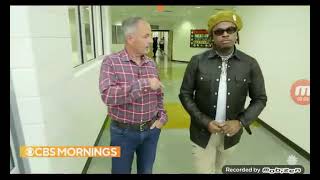
The video combines a short news feature from the series “A More Perfect Union” with a personal commentary. In the feature, reporter Mark Strassmann visits Ronald McNair Middle School in Atlanta, where every student qualifies for free or reduced meals and many families struggle with hunger and clothing needs. Principal John Madden and parent Jasmine King describe the daily challenges faced by the 900+ students. Gunna, a Grammy‑nominated rapper who grew up in the same neighborhood, has funded and stocked a free store called “Gunna’s Drip Closet” next to the gym. The closet provides groceries, snacks, new sneakers, and clothing at no cost; items are restocked weekly and students can take a bag of whatever they need. Gunna explains that the items are things he wanted as a child but couldn’t afford, and he wants the kids to feel proud rather than embarrassed. The commentary segment, delivered by Speaker D, praises Gunna’s initiative, frames it as a concrete example of universal basic income or guaranteed‑income concepts, and links it to the creator’s own BitcoinMYK network that aims to circulate value freely among participants. The speaker urges viewers to support Gunna, subscribe, and join the BitcoinMYK network, positioning the free store as a model for larger economic and social change.
Chapters
Nominated rapper, his name is Gunna, is trying to bridge the divide between the lifestyle he now enjoys and the way he lived growing up. For our series A More Perfect Union on what unites us as Americans, there's a lot of stuff. Mark Strassman shows us how Gunna is bringing the spirit of generosity to a place he knows very well.
Atlanta's Ronald McNair Middle School teaches about struggle. Lots of kids come from single-parent homes. They're old enough to realize what families like theirs live without.
They're mad, and they're not mad at us. They're just mad at the situation that they just left.
Principal John Madden told us every student here qualifies for free or assisted meals.
Hunger is a challenge.
Clothing?
Clothing.
Resources.
You have a number of families barely hanging on.
We have over 900 students, and those are over 900 struggles and challenges. And, you know, we have to deal with that. With that.
Right next to the gym, this space softens the stress. It opened this fall. Gunna's Drip Closet, stocked with groceries, snacks, new sneakers, and clothes, all free. You heard of Gunna?
I have heard of Gunna through my children.
Okay.
Yeah, I did hear of Gunna.
Because kids will keep you connected.
Almost definitely, yes. You have to stay connected in middle school.
Gunna is a Grammy-nominated Atlanta rapper. When his mother told him, "Never forget where you come from," he listened.
I was a cool kid.
Oh, you were.
Right.
That cool kid was born Sergio Kitchens and eventually went to McNair Middle School. Was money tight?
We weren't doing no splurging.
It was a struggle?
For sure.
Do you see yourself in some of these kids?
Most definitely.
Gunna is now 28, but he tricked out this store as though he was 14 again.
Everything that's in here, all of these are like Some of my go-tos.
So you were on top of the Swiss rolls for sure. Everything in here restocked weekly. He pays for all of it. I like Air Jordans.
Air Jordan. Yeah, put them a whole grocery store in there, just fill it up all year. Make sure they got clothes, shoes though.
You got jeans, you got sneakers in there. Why was that important to you?
That stuff I wanted when I was a kid, like that I know, like, I couldn't just go to my mom and ask for.
But McNair's kids and parents can go to Gunna's Closet.
They're provided a bag, and whatever they fit in the bag is theirs.
They go home with?
They go home with.
For free. Like Jasmine King's two girls, Dionisdee, an 8th grader, and Janila, a 6th grader.
Yeah, I got this sweater.
Do the kids see it as a cool thing?
Yes.
They do?
Yeah, it's not like, "Oh, your mom must be poor." What is it? It's a positive thing. And they got the Vans.
It is to their mother. This was her family's second trip to The Closet. Groceries for their table, clothes on her daughters.
That was the first thing that she wanted. Yeah, this is my favorite color. I was shocked. I really was shocked.
And the price is right.
Right, right. It's absolutely right.
What kind of a difference did that make for you?
A huge difference, 'cause it took a load off of my shoulders. When I walked into the store to know that I had that burden lifted, for a couple of weeks.
Welcome back to the channel. I hope you all are having a great Friday afternoon. I want to talk about the Grammy Award-nominated rapper Gunna, who has done something that is just— does my heart so very well. And what, as you can see in this, uh, this clip I want to share with you all Um, he went out to combat an issue all by himself, uh, with his own money, right? Using his own money to create a free store, uh, that is serving these inner city kids, right? And people watch the channel understand a lot about what the channel is about— education, entertainment, television show. Uh, I talk a lot about guaranteed income, universal basic income. Many of the American philosophers and some of the greatest minds of mankind through history have championed this idea and just how, uh, world-changing it would be, I think, to really seriously implement it, right? And this isn't just something that the greatest minds of our time have considered, but it is also something that on both sides of the aisle, whether you're part of conservative economics, um, you know, whether you're a liberal, whether you're Democrat, Republican, this is one of those issues where people on all sides agree on it being a solution, right? And that right there tells me we're moving in the right direction. Um, now Ghana, this 28-year-old rapper uh, you know, became very conscious and just how simple it could be to solve this problem right now. It is true Ghana is funding it with money that he's created. That is very true. But I think Ghana can, from an economic standpoint, understand the tremendous help that it could bring to the economy moving these resources around that people in these areas desperately need to help, to help them keep their bellies fed and clothes on their back so that they can become more educated, educated, and later on be able to participate in the economy and stimulate the economy. And what capitalism has done is become a man all for himself type economy where people don't think in terms like that, right? And so we don't get to see the full effects of what these type systems can create. But bravo for, for, for, for Ghana. Uh, he's actually in my area. Uh, he doesn't live too far from me. I'd love to meet this guy. Uh, I'm not very familiar with his music, and, uh, I'm very select— selective on my hip-hop and rap music. I'm mostly old school, and there are only a few people I, you know, I really listen to at all today. But he is somebody I would want to, uh, you know, listen to his thoughts on a lot of his tracks and, uh, you know, see where his mind's at, because that was a great idea what he did. Uh, what I like so much about it too is oftentimes when you put these stores in schools and programs and things like that, uh, one issue can become that it's not very cool, that it seems to only serve the needy. But Gunna being able to identify with this group of people he came from once upon a time, like most, like many other, uh, successful, uh, especially Black African Americans who come out of poverty and things like that, uh, making tons and tons of money, someone making billions of dollars from coming out of poverty, making billions of dollars. Or close to poverty or something like that. Uh, they don't seem to think of terms like Ghana, you know, uh, in this particular case where he creates this not just a, a giveaway program that the kids are going to be embarrassed to participate in, but, but this really cool program where, you know, kids are going to be running there and say, you're almost dumb not to get these free pair of Jordans and things like that, and making it really cool as the kids expressed in the video. And I think that is so awesome on Gonna— Bravo on you, Gunna. You should be celebrated. Uh, you know, I think community should celebrate Gunna, support his music, support his efforts, uh, more so than many of these other, uh, people out there who, who just kind of seem to only think about themselves. They're not, uh, you know, really— I'm not gonna say they're all like that because some of them probably do a lot and don't talk about it, but the impact is so much greater when they do talk about it. And I know a lot of people look at that like, well, then you're bragging about what you do, and some people don't want to be in the spotlight. But let me tell you why they should be. The reason they should be is because these type things push the idea, uh, of that we need to be doing this more. And the more it gets out in the spotlight and people can understand and identify with these being solutions and just being good ideas, being the right thing to do, and, uh, um, you know, being, um, uh, human-centered, right? Compassionate, and all these things that make advanced civilizations great. Um, identifying with this, making this cool, and this being the thing people look up to, you know, like back, back in the day— I'm older than many of you all, so some of you probably wasn't born during this era, don't remember remember this, but there was a time when conscious rap dominated the airwaves, right? And so you— a lot of the music was just about positive things for Black people and things like that. Um, and so that all went away. Then it became a very selfish, capitalistic model where people just talk about what they got and what it's doing for them. A very egotistical, greedy point of view. And we all bought into it and bought their music, and we give them all our money. But the thing about it is that D— that doesn't really do a whole lot for the community and people within those— your community and the people who support them buying their music. That doesn't do a lot for those people in return. Like, some of those kids probably have to spend their last few bucks to purchase their music or their clothing or so on and so forth. So Gunna is really giving back, and he's setting up what I believe to be a cool model that I really didn't think about, right? It's cool, it's fashionable. A, uh, imagine that, a cool store with actually cool items in it you could get for free, you know, not just some giveaway stuff somebody didn't particularly want, right? And telling you to be thankful for it, right? And I'm not saying you should be entitled to it either, right? What I'm saying is just an easier way to do this and get this done. And I, and I hope that transitions over into outside of that community and just into our, our, our, uh, just our, uh, uh, global awareness, right, of this is how we should move things through our economy right now. Some of us call it freemium services, freemium networks. That's part of what my project Bitcoin NYK does, right, where you just join the network and you start to get things free. You basically get a money free that we can move around from network to network, right? And I founded that idea. I had a background on Wall Street, uh, you know, years ago. And, uh, uh, much like Ghana, I wanted to take that knowledge and be able to do something helpful to people from, uh, communities, uh, that needed it. Um, and be a solution to a lot of global economics we have in the world, right? That affects a lot of our social issues as well. So, uh, Ghana is definitely a person who gets it. And I hope he inspires many others too. He certainly inspires me, uh, in that. And, uh, I'm gonna be listening for his music and I'm gonna be checking them out now because, uh, um, you know, those are the type of people I want to support. Um, I hope some of you all can identify with that and want to as well. But, uh, I just had to bring that to your attention. Also want to say, if you're inspired by messages like these, you want to participate, you want to do something, You could join our network BitcoinMYK absolutely free. You don't need a dime. The value of the network circulates back around to everybody in it, and the bigger it gets, the more valuable it gets. It gets to a billion people, it gets to, uh, 2 billion people, 2.5 billion people, right? All of that value is owned in that network by the participants, which are people like you and myself. So make sure you join if you're interested in things like that. Don't worry about it being a scam. If you think it's a scam, Leave your pocketbook at the door. You don't— you just come, come without the pocketbook. You just show up, right? But that's all I want to say in this video. If you like content like this, don't forget to like the video, share the video to other people, just subscribe to the channel. Let other people see this message so they're aware of what Ghana is doing. And all these things collectively, I think, help to make the world a better place. Till next time, as always, take care of yourselves and each other.