
Hex Coin - Up 23% Today - Performance
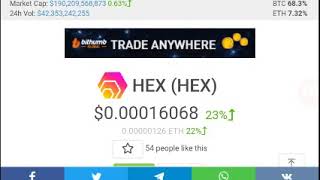
HEX is up 23% today with extreme volatility, swinging 67% intraday. Early minters got 3,700 HEX per ETH, then the rate crashed to 2-3 HEX, causing a 99% loss for speculators. The host warns the project's promises of guaranteed returns and 10,000x gains could draw regulatory trouble.
Chapters
Welcome back to the channel. I hope you all are having a great day. So today, gonna talk a little bit about the price of Hex coin. How is it performing? What's going on? So the Hex coin project said now to be one of the, uh, as far as price is concerned, uh, over the last, uh, 12 days or so one of the most disappointing projects as far as price, uh, in, in, um, in the history of crypto almost, you know, from, um, uh, you know, the launch of all the ICOs and a variety of things. So HEX, uh, going back to that period, uh, specifically day one, has not performed well at all to many. Today it's up 23%. Looks like at the time of this video, uh, the other day it was up something like about 67%. So HEX does these amazing jumps in value, uh, over the course of, uh, of the day. So in that sense, it does seem like it could be a playground for day traders, uh, people like that, people who are swing trading they could really make a goal with this type of, um, coin at this point in time. But getting back or taking a look at the, uh, day 1— now this is the day when, um, a lot of people came in, um, uh, not just of course claiming the Bitcoin, but they were, um, swapping or minting with the Ethereum their HEX coins. Um, and so quite a bit of Ethereum poured into that day one. Now the exchange rate, or rather the amount of Ethereum— I'm sorry, HEX— that they received for the Ethereum, uh, uh, estimates or something like it was at a value about 3,700 stats per HEX, and then it goes all the way down from that to about 2 to 3 Sochis. Now, um, any explanation of Richard Heart, that represented, uh, over a year, almost 2 years of pent-up, uh, anticipation to jump into this project. The, uh, participants didn't follow the rules. They hadn't researched HEX. You know, a lot of times the assumption is just that FOMOing in, getting in without understanding, or doing the necessary research in a project. And Richard Heart had explained that you would gain more value by stretching out the, uh, amount of, um, of HEX that you claimed or minted, you know, over the course of some days and not just go all in on day one because of the, uh, the adoption amplifier, the way it works. There were going to be a variety of different bonuses on day 1 to day 2 to day 3. And just the game theory of his system didn't allow you to get the, the most advantageous situation on day 1. This is kind of similar to what happens in your standard ICOs as well, right? You, you buy in and the price pumps day 1, then after a few days it calms down, and those people that bought in, you know, a few days later or earlier, uh, in some cases they don't reap as many benefits or they take a loss. But nothing, uh, it seems in history took a big— as big of a dump as the Hex coin project, down to something like 99%. So that— ouch, that hurt a lot of people quite a bit, especially those people who were of that very speculative in nature. But then again, HEX is a long-term project, you know, meaning that in the sense of HEX, the idea is to stake it and be in it for the long haul. And so, so for maybe some of those who thought they could get the tokens quick, dump at a profit, didn't work. And that's why a lot of them were disappointed. Also, even through the free Bitcoin claiming feature. Uh, what generally happens with in many forks is people get their fork tokens the same day, then they dump on the project, right? Now this is something Richard Heart doesn't, doesn't like. So, uh, the way his system was structured, you weren't going to really be able to do that. People didn't know that. They thought they could get in, and some thought they could do that. That didn't work out. Now will, uh, HEX go back up to areas like it was, on day one? Have no idea at this point in time. However, if you are dollar-cost averaging with HEX, you're probably doing pretty darn well. Uh, low sat tokens generally, uh, uh, can offer a great deal of potential. They can trade very well, but at the same time, be, um, careful of that downward, uh, those downward ticks. Is what can happen is as you're maybe moving up 30% per tick, remember, it's going to move back about the same value. So not a good situation. Got to be really careful in how you trade this token. If you're not in it for the long haul, you're probably not gonna like what you see. So, um, I'm here on Coin— I'm sorry, guys, CoinGecko, right? I try— it is listed on CoinMarketCap, but I'm not sure uh, why CoinMarketCap isn't reporting all exchanges and accurate data. Like, when I go over to CoinMarketCap, whereas here on CoinGecko, uh, it shows the more, you know, um, the more accurate trading volume for the day. If you go over on CoinMarketCap, it says something ridiculous like $30, $40, $50 a day, which I know is ridiculous because when I go on exchanges, it shows a great deal more volume. But Uh, CoinGecko is only reporting about $3,683. Uh, 87%, a great deal of HEX tokens are staked, um, because that's pretty much the idea of a certificate of deposit. So you're not going to have a lot of, uh, tokens on the market. Circulated supply already showing about 3 billion, uh, tokens out there. That's going to be in relation to the HEX that is minted in the adoption amplifier uh, where they get the, uh, the HEX on the site by minting it from the Ethereum, right? So today I just want to talk a little bit about, uh, you know, this Ethereum that's bothering a lot of people. How, how should we look at that? What is the proper way to look at that? Um, well, I got a few ideas here, and, uh, you know, again, I'm not trying to I'm not trying to defend HEX. I think, uh, what's happened with me is, um, in being, uh, more objective to the, uh, uh, HEX, uh, uh, project, you know, trying to, uh, you know, be as fair in my approach to it as possible and not trying to let emotion get into it and just kind of looking at the project as it is, uh, not totally understanding all the legal ramifications in it, um, you know, or that possibly can come into it. But just looking at it as it is, going upon that it's legitimate as it is based on the information we have, um, you know, I would say that the— what I'm seeing in the cryptocurrency space about the HEX project, um, I don't think it should be happening. I'm going to tell you all why that is. And that's, that's not me even being biased or anything like that. That's just me being how I look at this directly. So we had many, many ICOs, right? Some projects took ICO money and they never built anything, uh, or they took the money before they built something. In the Hexcoin project, what do you think? It's an architectural marvel in design or what it does? Richard Heart says it does something that we've never seen done before in the space, right? CDS, this programmable interest. And he is correct because I've never seen anything quite done like this. I've seen, uh, the staking, various staking, uh, projects. But, uh, what Richard includes is he's saying that the way that HEX is set up, you can see when all the stakes become, uh, unstaked, right? Uh, their maturity dates, if you will. And so now you can gauge that data in the market. You can say, okay, well, this percentage of HEX is coming unstaked, so this is not a good time for me to be, uh, you know, basically, uh, trying to, uh, sell my HEX or something like that. There's gonna be a lot of downward pressure, people dumping. So you could use that data to potentially be a better market trader. That's, that's Richard Hart's idea, um, of what he's saying about it. And then that way it gives you, the trader, the advantage. It gives you advantage over the asset. Um, so the, you know, again, what do you think? It's, uh, uh, you know, uh, value-wise, is it worth the amount of Ethereum that has went into the project, right? You know, although the, the way that Richard Heart frames it, you're not buying the HEX with the Ethereum, you're minting the HEX, right? But people Uh, I don't think they're ever going to really be able to connect with that. I, you know, I think at this point it's going to be, uh, kind of unrealistic for, I think, Richard Hart to believe they're going to connect with that idea. Um, and so they're going to look at it like an ICO or something like that. Now, but let's just kind of go there just for the sake of argument. Let's go there. So that that money goes into the project. Richard Heart has already presented this system, right? He's already built it. He spent, uh, the money on the audits, right? Some of his developers have talked about it, it stretching Ethereum code into the limit to a degree, and it's being a, a, a bit more complicated to program than some people would, would believe. Now that, that comes from one of his, his developers who've been making rounds on a variety of shows, uh, saying that it was quite difficult code to code it in, in the language, right? Whereas I've heard other people come on and just kind of casually say that, oh, anybody can put this up and program this, you know, that, you know, Richard's programmers might not be good or something like that. But then again, you know, a lot of these people, uh, that we've seen on these, uh, these spots on these shows talking about Hex, uh, you know, a lot of them, you can tell emotionally they're very biased to this project. And with me, whenever I hear a person that's really biased, already coming in saying this is a scam, what are you doing with the Ethereum, I automatically shut off from those people. Because what's happening is these people are emotionally invested into this to the point where we're not going to get accurate information from them. We're going to get a lot of emotional arguments and a lot of assumptions about what they think is going on and what they don't know. They're gonna, they're gonna assume this is what's happening, right? And none of that is helpful to any of us, right? You know, that's just them, uh, with an opinion piece reporting on something. The reality of the situation is Richard Hart built something, some system that people are going to find value in or not find value in it. Now it's up to the market to determine what that value is, right? And if people are saying that they believe it's worth their Ethereum to use that staking system, and for that to be this better, uh, put-together system than, uh, some other coins out there with maybe higher value than it has received a lot more money than that, I, I think it's, um I think it's, uh, fair to make the assumption that, uh, you know, that, that at the very least should not be seeing any, seeing any different than what we've gotten with a lot of these cryptocurrency projects we've invested in that are still around, that have dropped 90%, that are, uh, you know, still, uh, people are investing in them and trading them. And, um, you know, they haven't probably done as much as Richard Heart has done. In some cases, some projects have taken money from the investor saying they would do certain things and have not done those things at all, right? Have just kind of totally avoided doing what they took the money for to do. We get many complaints like that in the cryptocurrency space. So, uh, if we're looking at it from a, uh, an area like that, uh, I, you know, I think we have to kind of just see what's going to happen with this project. I don't think we can just kind of jump to the conclusions of that until we have all the information. Now, of course, you should be careful with this. As far as I understand it, people are still claiming their Bitcoin from snapshot on— what was that— December 1st, I believe, right? So there's only 121,000 addresses that have been claimed. It's probably like 50 million Bitcoin wallets. So There are a lot of people out there who could still be claiming HEX, and people are, uh, doing that, it would seem, right? Because that's how you get the HEX free. Now, if you're one of those people who missed out, you just feel like, I gotta try this, I'm willing to sacrifice some Ethereum for it to get in, well, now you know that, um, you have to consider all these factors, and you have to now look at it as, uh, any other investment. Excuse me. Out there. Now, another thing that's come up quite a bit is that they're saying that, you know, when Richard Heart on the site talks about the 10,000x returns and things like that— well, now here's where I do agree with many critics, that that kind of language, even though I understand Richard Heart's saying that he can supply that because it's all going to be paid out in HEX, right? But that kind of language is opening up a situation where investors can claim a type of confusion, you know, in that, in, in that, you know, that language. Because even now I see a lot of people going around talking about, oh, you know, this has to be a security because he's claiming, uh, you can— he's claiming returns and guaranteed returns at that, and, and ideas like that. But really what Richard Hart is saying is he's saying that he can meet those returns because it's all calculated in HEX. Now, uh, that is, uh, you know, uh, I, I understand where he's coming from in that, but the, you know, the, the way it's worded on that site, you know, it could open up an opportunity for the legalities to come in and try to claim that people were confused. And, you know, and maybe then he becomes liable in some sense. Um, you know, hard to say how this will go ultimately, but I can tell you that if you are minting it with the Ethereum, if you know, if you look at it like if you were to go buy a lottery ticket, you know, or something like that, you're going out a night at the casino or something like that, you know, if you're going to lose sleep over it, look at it something like that, right? And if it, if it doesn't sit well with you, just don't go near it in that way. You know, if you can't claim it free, don't go near it in that way. Uh, you know, and, and if you can look at it like something you can lose, which is how you should look at all investments, then you, you know, then, then you're able to take those risks with the, uh, knowledge of knowing what, what you're looking at here, you know, what, what it is, right? Yeah, high risk, you know, it has been the investment mantra for this, as far as I could remember, that people who have an unusual tolerance for risk oftentimes gain much more returns. You know, that's kind of obvious investing 101. So if you're looking at HEX like that, maybe you hit big, maybe you don't, right? But, but, but now you know where you're sitting with this project. But that's all I want to say in this video. If you like content like this, don't forget to like and subscribe. And until next time, as always, Take care.
More from Michael







UBI - CIA Agent Explains Why Americans Will Never Get Universal Basic Income?



