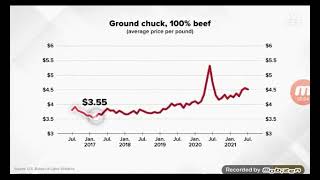
The video opens with a brief data-driven overview of U.S. ground beef prices from 2017 to 2022, highlighting a sharp rise during the COVID‑19 pandemic and forecasting continued food‑price inflation. The host then expands the discussion to the broader "never‑ending pandemic," emphasizing how successive virus variants—especially Omicron—pose ongoing health risks and drive persistent economic strain, including higher food and energy costs. The speaker argues that universal basic income (UBI) is not a charitable idea but an inevitable policy response to the pandemic‑induced economic shock, criticizing the lack of pre‑planned emergency relief and calling for political accountability. An analogy to nuclear‑proliferation underscores the urgency of proactive measures. Finally, the video promotes a private‑sector initiative, BitcoinMYK (also referenced as BitcoinNYK), which leverages blockchain and cryptocurrency to create a decentralized funding mechanism for guaranteed income, inviting viewers to join the project.
Chapters
In February 2017, 1 pound of 100% ground beef cost an average of $3.55. 3 years later, in February 2020, right before serious social distancing measures went into effect, it cost $4.03. It reached a peak of $5.33 in June 2020. But as the pandemic restrictions were lifted, grocery costs stabilized, at least temporarily. They began to creep back up slightly in January 2021, but the prices haven't been increasing nearly as fast as they were at the height of the pandemic. My prediction is that prices of food are going to continue increasing through this year. In 2022, I think prices are not—
Welcome back to the channel, and I hope you all are having a great day. Um, so today we want to talk about the never-ending pandemic, right? And its result economically, right, to the economy, rising prices of food, you know, costs of energy going up, everything seems to be going up. And it seems to be in direct correlation to the pandemic, of course. So I just want to start off by saying, When I talk about universal basic income as many of the solutions for the world's problems, whether they be social or economic, I just want to say that this isn't something that I wish would happen, right? Um, it's something that is probably inevitably going to happen, right? So there's a difference. And some people, uh, I think they approach my view of universal basic income Uh, like I just want to go around giving people free money. No, I think what it's come down to, and these aren't just my, my views expressed but those of many economists, uh, I think it's just kind of coming down to our backs being up against the wall. And many of the people out there, uh, through their daily lives, they're feeling the push of what the never-ending pandemic is seeming to be to do. Of course, when I use the idea of the never-ending pandemic, we're talking about many of these mutations of various strains. We know the latest one they're talking about is the Omicron. And although we don't fully know the effects of it as of yet, there is a lot of concern. People who study infectious diseases, across the globe saying that the, the, um, the proteins, uh, in the virus, the spikes, they could be more spikes. It could be more vaccine resistant. Um, and you know, of all these things, it could be a great concern. Now one of the, the more so concerning, uh, viewpoints that get mentioned, um, from many of these researchers, uh, even in relation to Omicron, is even if Omicron isn't, uh, you know, that dangerous strain that, uh, it's going to be vaccine-resistant, it's going to, you know, going to be something on the level of the, of the plague of the 1500s or the Spanish flu, Researchers seem to agree on the idea that we're always going to be one step away from that, from that mutation that is going to be that. So even if it's not Omicron, it might end up being something else in the near future, right? It does seem to want to stick around, these, this, this pandemic and these strains. A lot longer than we hope, right? And it's, you know, it's obvious this is having a great impact on our economy. We know that. We know it's sped up many of the concerns we had about our economy and universal basic income. Even before the pandemic hit, it was going that direction, right? So I, I guess what I'm getting at here is how much longer and what does it take to make a preparation, uh, in this pandemic economy with the rising prices and cost of food? What does it take for us to have a concrete plan to deal with this all the way until it's over, right? Not to always be scrambling last minute when it hits and trying to figure out what are we going to do for these families, for these people who can't get out to work, not bills being tied up in Congress and people not being able to come to conclusions on this. This is something we've already experienced and this is something there should already be a plan for. Uh, there should be an emergency plan already that just goes, uh, naturally goes into effect. And if our leaders aren't at a place there, what the details of that plan should be, you know, it's time to start holding people accountable in this. It's time for some people to be, you know, basically, you know, taken out of power, right? Taken out of office. Because, uh, you know, that's ridiculous. That it shouldn't be to this point. People are way too smart that we, uh, or at least I like to think that our leaders are smart enough to understand the severity of the situation. Um, so universal basic income, again, again, seeming like one of those solutions to solve that issue, to address that issue, right? Or make us a lot more prepared than we are. Um, and, uh, um, you know, I think it's time that we start to implement something like this when we're dealing with something like nuclear proliferation. I'll just give this analogy. It would be ridiculous from a military strategic point of view to wait to an opposing country, enemy country gets a nuclear weapon to use on you, right? And so that's why many times they scramble around to try to control the production of these nuclear weapons, but they're not doing the same thing with viruses and pandemics and, you know, and things like that. And, uh, we have to hold, uh, our world leaders accountable for that, right? If they're not dealing with that, they're not— they don't have a concrete plan to solve that, you know, we got to let them know that they can no longer continue to represent us, right? And it's got to work just like that. And we have the ability and the power to do that, right? Um, so these never-ending pandemics, like, what do you think about this? Uh, what do you think the solutions would be in this? You know, they've I think the actions of the government have already shown us that their best action is just going to be trying to get, you know, money into people's hands, right? But there are more efficient ways for this to be done. They can set up a system that is already running well, uh, independent of disaster relief, right? Disaster relief is some of the worst relief, you know, you can, you can get. Uh, because it's always going to come, um, one day, one day too late, right? And so that's why you already want to have these things ready to go into action, or already in action, which I think would be more ideal. And UBI just addresses too many issues. It's guaranteed income, is something Martin Luther King was pushing half a century ago. To deal with, um, you know, race relations as well. So it, it just goes across the board. It solves too many problems to, to deny, right? But anyway, I'd like to hear you guys' thoughts on it. What do you think about these— this pandemic? Do you think— how long do you think it's going to go on? Uh, you know, is— are we going to come out and it's going to be a boom in economy? Some people tend to think that. Uh, but a lot of economists don't think that. It seems like people more so on Wall Street think that, but not on Main Street. But anyway, that's all I want to say in this video. I also want to tell you about our project BitcoinMYK, us doing our little part to help solve the issue. Uh, there are many ways to produce— to approach guaranteed basic income, and I don't think the only way is going to be at a government level. I think it's going to have to be a very a vast systems, uh, group of systems that entail both government and private sector approaches. And we're doing our part with blockchain technology through the, the data, or the oil of the 21st century, which is data. Doing that, creating what we call the Tech Check, and trying to get that through cryptocurrency throughout the hands of people around the globe to help alleviate this and to deal with this problem. But if you're interested in projects like that, being part of the solution, be sure and join BitcoinNYK.com today, which I'll leave a link in the description. But that's all I want to say in this video. Until next time, as always, take care of yourselves and each other.