In this video, the speaker discusses recent developments in Polkadot, focusing on the redenomination that reduced the DOT price by a factor of 100, making whole‑unit purchases more attractive. He compares Polkadot’s price trajectory to Ethereum’s and argues that, with this split, DOT could overtake Ethereum. The narrative then shifts to a broader macro view: universal basic income (UBI) combined with digital stablecoins could force mass adoption of deflationary cryptocurrencies, a point drawn from an Anthony Pompliano podcast. Building on that premise, the speaker introduces BitcoinMYK, a Polkadot parachain that implements a burn‑on‑transaction deflationary model, offers a UBI program, and integrates a social‑network layer. He positions BitcoinMYK as a more accessible, Bitcoin‑like store of value that can capture the next wave of users, contrasting it with Bitcoin’s evolution toward a gold‑like asset and highlighting the need for crypto projects that blend monetary policy with social infrastructure. The video concludes with a call for audience feedback and a reminder to subscribe.
Chapters
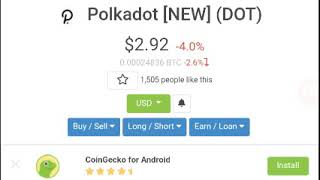
Welcome back to the channel. I hope you all are having a great day. So it's gonna be part 2, Polkadot will overtake Ethereum. So been some updates to Polkadot, the new DOT they're calling it. And if you recall, Polkadot was trading around $300, had broke over $300, had jumped all the way up to I believe about $300 $3,340 range. Um, interesting enough, if you go back a few months ago, um, this cryptocurrency almost went 4 or 5 times its value. Very interesting, very interesting. Not surprising with the type of technology that it, uh, has brought to the cryptocurrency space. But generally what's happened is the value of the Polkadot has been reduced by 100 times. So what that means is if you've— if you had your 1 unit of Polkadot or the DOT coin, it's divided by 100, right? So now you would have you know, $2, $3, right? And so I like this because it's more attractive to buy cryptocurrencies where you can hold an entire cryptocurrency. In the investment business, that's generally why you have things like stock splits and so on and so forth. This doesn't change the value of the underlying asset at all. But what it, what it can do is it can cause more people to buy it because it's more attractive to buy things in units you can hold. People feel they got more, uh, people like round numbers. It just, um, is a lot more attractive. Um, and so, uh, knowing you can hold an entire DOT, uh, for $2 or $3, it's probably going to be a lot more attractive than holding 1 DOT for around $300. Comparably, DOT coins aren't that far behind Ethereum. Ethereum trading around about $400 right now, DOT around the $300 mark. That's catching its highs and lows last 24-hour period. I'm very excited about this project, probably one of my most exciting in cryptocurrency so far because Um, if you miss Bitcoin, uh, I think you pretty much missed all the excitement in cryptocurrency. And I know a lot of people talk about the various altcoins, um, but probably besides Ethereum, um, you know, I think if you miss Bitcoin or Ethereum, you probably missed out a lot, um, and probably missed all the excitement. Some people are saying Ripple and EOS, but those cryptocurrencies just haven't done anything for me. They just haven't grabbed me. Now I like to segue to talking about our project BitcoinMYK, very relative to Polkadot. It is a parachain on the Polkadot network. It is a able to interoperate with Polkadot chains. And so very excited about that, but let's, let's talk about that just a little bit. All right, so recently I caught this video, um, with Anthony Pompliano. Now if you don't know who Anthony Pompleano is. He's a big advocate for Bitcoin, appears regularly on CNBC. I think he's an ex-military guy who started his own investment fund with a high interest in the future of Bitcoin and investing in Bitcoin. And so he has some interesting point of views. And as of late, he started a podcast. He talks to a lot of people in the financial industry and cryptocurrency and in standard economy. I happened to catch this podcast with Preston Psyche, and they talked about how universal basic income and digital currency could protect the global economy. But not only that, how it would— it could lead to mass adoption. It could lead to— what would happen is if these nations started to create these digital currencies on the blockchain and people had to get wallets, then this would usher many to move that value to something more deflationary like Bitcoin. So this is a similar argument to what would people speculate would happen with Facebook Libra coin, and which, uh, you now have potentially like 2.5 billion people using Facebook Libra coin. And what would they do? They would decide that it's probably a better play to move, um, that value now in that cryptocurrency to something more deflationary like Bitcoin. So let's, let's think about that for a moment. If that is relational to what could happen to Bitcoin, is universal basic income really what's gonna do it for Bitcoin and move Bitcoin along? Well, on paper it almost seems like a no-brainer because universal basic income would in a great sense present, um, uh, a great mass adoption vehicle for, for, you know, for one thing, who would turn it down, right? So you're probably gonna have most of the world who are going to accept universal basic income. Um, they're gonna have to be, uh, wallet cryptocurrency, uh, educated on how to use this technology, and they're going to be incentivized to want to be educated on how to learn it based on the incentive of getting the universal basic income. Now, whether the argument of it being sustainable or not is there, what could happen and what came up a lot in this interview was that The people collecting the universal basic income through their standard dollars and so on and so forth, um, would want to get that out of this backed dollar. So in other words, how this universal basic income will work is it will probably be more like, uh, how Facebook Libra coin is going to be, which is going to— you're going to have a stablecoin, uh, it's going to be backed by some fiat currency like the US dollar. right? But due to the inflationary rate, right? You know, meaning that the value of it, you know, can reduce a great deal from inflation. Um, people are going to want to put it into something more deflationary like Bitcoin as the value goes up. That coupled with universal base income is almost a no-brainer to mass adoption. Why is it that the cryptocurrency space um, hasn't connected the dots on universal basic income, mass adoption, and everybody using your cryptocurrency and having wallets. Once everybody has a wallet, the direction that they go in after that doesn't matter. Where they agree with universal basic income, they are now— have become acclimated and part of cryptocurrency environment to the point where they can move to these other altcoins— Bitcoin, Ethereum, Ripple, or so on and so forth. But I think the, the bigger problem with cryptocurrency, and I think where many of us are going wrong, is we're under the assumption that people are going to buy into these cryptocurrencies like Ripple and Ethereum and Bitcoin, right? Now, if we look at the data, let's do this comparably to what happened with the stock market. When many times in this economy, when we speak about the economy doing well, we're speaking about the stock market. Here's the problem. The stock market is representative of very few people in the economy, right? As to say, the average American, the average salary of most people, Americans, people around the world, isn't that high in relation to what they can invest in the stock market, or if they're interested in investing in the stock market at all. This is similar to cryptocurrency as well. What would motivate a lot of the average salary earners would be something like the idea if they can have a great amount of appreciation. That's why a lot of people had Bitcoin mania because they felt they could make a lot of money. Um, the reality of the situation now is Bitcoin, due to its mass, in other words, due to it going from its inception from about 1 cent to up to $20,000, now around $12,000, has appreciated over 1.2 million percent, right? Going from $1 million to over $12,000, that's like 1.2 million percent. Went all the way up to $20,000, that's 2 million percent appreciation over the decade it's run. The problem with it's come so far now, the question is, is it able to keep just going up to $100,000, $200,000 areas I think people like Anthony Pompliano think it's gonna go. My opinion about it is it will not do that. I think that the more invested Bitcoin gets, the more similar it gets like gold. And what's happened to gold? Well, gold isn't something you really invest money in to, to make money. It's more about preserving the money you have, similar to deflationary project or deflationary coin. You want to put money in something deflationary to protect, more so to protect your wealth than to lose money, right? So if if you left your money in, say, the US dollar and your inflation rate, you're going to have less buying power, uh, over the next several years. Whereas if you put it in something like gold, you would, uh, have, uh, either the same buying power or possibly a great deal more, right? Which is what happens when the economy turns against you. Gold prices usually go up, the value of gold goes up. And so I believe Bitcoin is becoming more like that. It's going to become more of just a better gold and an easier way to maintain your value as opposed to make money. The project we're involved with, BitcoinMYK, it is at its genesis, and so it can do these crazy gains. Not financial advice, not saying that it's guaranteed to do it, but just saying that much like how Bitcoin started, it has elements of the deflation. In fact, it's more deflationary than Bitcoin because its deflation rate works against its transactions. The more transactions you do, the more of the currency gets burned, and, and so it becomes less and less, pulling more value back to the participants as the network grows. It is fractions of a penny now, which means it has a great deal place to go. Um, it forks, um, Bitcoin, if not in principle of the technology on the chain, in idea. Meaning if you hold Bitcoin, you're going to be able to get Bitcoin MYK free. Um, it has a universal basic income program which pushes it to, uh, mass adoption, uh, and a social network which makes it more similar to what you might get with Facebook Libra coin potentially a lot of value and a lot of users. And this is a problem with many cryptocurrencies, Bitcoin and Ethereum, whereas they've done good monetary policy-wise, they do not have the infrastructure to really create great growth in the social network area and just to be relatable to the average person. Ethereum, I'm not aware of any huge social networks with Ethereum. Nor Bitcoin, right? And I think this is a mistake. I think social media and cryptocurrency are kind of joined at the hip and they work best in that way. So Bitcoin MYK running on the Polkadot, uh, um, parachain as a Polkadot parachain, um, using the Substrate framework, um, is something I think that's going to be able to interoperate with many of these cryptocurrencies and give back that incentive to join like many people had coming into cryptocurrency earlier. Bitcoin, it just has way too much mass. For Bitcoin to replace gold, the higher the value, you start to get up around $100,000 per Bitcoin, a million per Bitcoin, you're talking trillions upon trillions of dollars. The gold market's only about $8 trillion and most people have come to the conclusion that Bitcoin will never replace gold. So there has to be a limit to this and how much money can be made with Bitcoin. And I think that it's going to need to be more projects that are Bitcoin-like projects that incorporate universal basic income like Bitcoin MYK that's going to be able to do that and be relatable to mass adopting people, pulling in that additional value into the project. But let me know what you all think, guys. Uh, be interested in hearing your opinions. If you like content like this, don't forget to like, subscribe, and until next time, as always, take care.