
Ripple SEC Sued!/Ethereum Can't Scale/ Btcmyk&BBD Safer
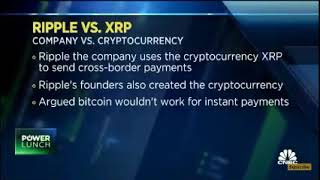
Shepard Smith breaks down why the SEC is likely to sue Ripple over unregistered XRP sales, and warns other altcoins face the same risk. Ethereum may not scale without drastic changes. BitcoinMYK offers a deflationary token and USD-pegged stablecoin as alternatives.
Chapters
in securities. The asset in question here is called XRP. It's a cryptocurrency much like Bitcoin. Ripple uses it for its clients, which are mostly businesses and banks, to send instant payments across borders. 8 years ago, when Ripple was founded, they decided to create their own digital currency to do that. Bitcoin, they say, wouldn't work. They said it was too slow. They began selling the new cryptocurrency over scheduled periods of time, which helped fund the business Ripple still owns the majority of this cryptocurrency. The startup also raised cash from some big-name VCs, including Peter Thiel's Founders Fund and Andreessen Horowitz. It now has a $10 billion valuation. Ripple's founders never registered XRP as a security before selling it to other investors. They argue it's more like a utility and that it's a currency, meaning it wouldn't be— it would be regulated by the CFTC and not the SEC. No comment yet from the SEC, but I'm told their argument is that XRP was an investment contract. People bought it with the expectations that they were getting a piece of Ripple the company. Tyler, back to you.
Shepard Smith here. Thanks for watching. Welcome back to the channel, guys. I hope you're having a great day, and I hope you, uh, a very happy holiday season. So I want to talk about Ripple XRP. The XRP cryptocurrency. And as you got to see that the SEC is now going after Ripple, going after XRP. Ripple being the business, it's being the company, and XRP being the cryptocurrency. And, you know, of course Ripple, the company, is trying to make that distinction between the XRP cryptocurrency and the company Ripple. So there's quite a bit to unpack with that. I think we should just start off from the beginning by first saying that of all cryptocurrencies that are in existence, there have only been two that have been declared not securities. That's Bitcoin and Ethereum. And a lot of that has to do with the, just the scale of Bitcoin and Ethereum and, um, you know, the distribution of it. So what's played out in cryptocurrency and many of the cryptocurrencies we use, there is, um, very poor distribution. There are these pyramid-like structures at the top and they do a very, very poor job of, um, acting as a currency in any capacity. Ripple XRP has been no different. All right, now I know a lot of people in the cryptocurrency space, they like Ripple and they're invested in Ripple, and Ripple has suffered a great deal based on this news. But we also have to keep in mind that this is long overdue news, and I think this opens up a much broader question. As to understanding that when you come into cryptocurrency and your only end goal is to speculate, then you run into a lot of problems, right? What does speculation mean? A lot of— for a lot of us, cryptocurrency, it's come to mean we don't really believe in the projects. We're just hoping they can moon so we can dump them. 1. And in the capacity of them not actually having any, any real use, the majority of them, they are starting to play out like just unregistered securities, right? They don't do anything. 2. They feel like a security, but they're not registered, right? And so this is a part of the problem with XRP, right? And Ripple's involvement in XRP. So the, the big issue, of course, being that how Ripple's treated XRP. What has it done? Well, Ripple's, uh, owns about over 60% of XRP. So I think starting from the idea of XRP in any capacity of decentralization is going to be a problem because with XRP being in such control of it, to the SEC, it appears not only like Ripple is, uh, pretty much determining the direction and the value of the XRP coin because they could control it with such a huge stake. Ripple the company also sells this thing, um, like a— as a profit, right? They're selling it, you know. It would be one thing Ripple the company took the 60% share and they held and it was going to be an indeterminable amount of time when they sold this thing. But it's weird because they own so much of it and then they're kind of in charge of it, but they're not. And so, uh, that's why throughout the history of Ripple XRP, people are confused. The XRP coin with Ripple the company and they've tried to connect where the dots are. But for most of the cryptocurrency space, they haven't used Ripple and they've looked at Ripple as just something to moon and make money off of, right? Speculation advice. Ripple uses an internal system called the X-Current system, and this is how it got started for interbank trading. Now the problem was a lot of what fueled the value of the XRP coin was going to be what they termed the xRapid system, which was going to be this system of where banks would come on board and they would actually use the XRP coin. Unfortunately, that never really happened, right? And so investors continue to kind of, uh, be in this very weird relationship of what Ripple the business is doing to propel the XRP coin forward. The reality of the situation is, my belief is XRP is probably going to be determined to be a security. They might have to do a settlement where they accept no, um, they don't really comment on any wrongdoing or not, right? They just, you know, pay that fine, and they're probably gonna have to do business in other countries and not the United States, right? They're probably gonna be able to be on international exchanges and not the United— not United States-based exchanges. And this is kind of long overdue, you know. We kind of foresaw this coming. We knew if anybody, it was going to be XRP first, right? If they went after any other coin Now this also brings into question, it helps us understand that with the, the, the new agency FATF, this, that's, um, you know, going, um, enforcing a lot of cryptocurrency regulations and laws, you know, where your cryptocurrency fits in, because it's more likely it's an unregistered security. Now why is that a problem? It's a huge problem if you have a lot of money in these projects. You got hundreds of thousands, millions of dollars. And if you got billions of dollars, you're probably not going to want them in many of these projects unless it's something like Bitcoin or Ethereum. And that's unfortunate for many of the altcoins. And I believe that's why the altcoin markets are getting wiped out, right? They're getting wiped out, large part due to, uh, this uncertainty and where are we keeping our money at. You know, nobody wants to be coming home and their families labeling an outlaw and a criminal because you're trading unregistered securities. And so I think these are all things to keep in mind in the cryptocurrency space. I do think XRP is going to suffer behind this. This might very well be close to the end. I don't think it's going to necessarily die, but I don't think it's going to achieve many of the goals that many of the users have set out for it to. And, um, again, I think people, it's Ripple XRP coin was always questionable as a cryptocurrency even from its inception. And a lot of cryptocurrency people who switched over there, I, I wouldn't really think of them as purists in cryptocurrency. I think of them just guys trying to make some money as quickly as possible, any way possible. Um, and a lot of them maybe switched to XRP to try to do that, and they may not be able to do that now. A lot of people who are hard-nosed crypto people, they never touched XRP. They never considered it a cryptocurrency. Whatever your position is with XRP, this is the landscape of it now, and I don't think it's ever going to truly achieve what it might— could have achieved, or what people thought it was, unfortunately. And so this had to come to a head. I think a lot of other projects out there that are unregistered securities that aren't doing KYC compliance, that aren't doing AML laws. This is a warning shot for many of you, and this is unavoidable. You know, this is going to come to fruition that you're keeping your money in these things are going to be risky. If they aren't doing any type of KYC or anything like that, you're going to have a problem with that. But that's all I kind of want to say there. I want to segue to the next part where we're taking a look at Ethereum and, and what's going to happen with the future of Ethereum as well. All right, so this is a very interesting, uh, video that I watched the other day, and it was done by Chico Crypto. Many of you probably know Chico Crypto, a very big influencer in the cryptocurrency space, but he did a video called here Ethereum to Zero if It Can't Scale. And maybe here's why. And it is very, uh, interesting information in this video. A lot of people who are working on the inside of Ethereum trying to get this thing to scale, a lot of information coming out about this is a lot more difficult than they thought, that it may just be that it cannot scale. And, um, it's not looking good for Ethereum. Now, of course, not to be an alarmist, but the reason that this could be a huge problem is if Ethereum can't scale and perform many of the things that people are hoping. That's going to have a big impact on its future and its price. And I don't think Ethereum is going to be able to survive similar to Bitcoin on the speculative nature if it cannot do the things that it needs to do already with these ridiculously high fees, the UI interfacing. You know, Ethereum's just been a very inefficient model for a very long time. Now, what many of these developers on the, uh, on the inside of Ethereum do talk about is that in order for them to get Ethereum to scale, that there's going to have to be a dramatic change to what Ethereum looks like, right? All types of sidechain solutions and, uh, these proof-of-stake solutions that look and feel nothing like the Ethereum of the past. And this is addressed with a great deal of concern, and that, um, you know, it could make Ethereum— not only not make it Ethereum, but, you know, we just don't know if this stuff's going to work at all, and that if it's going to be viable product to the understanding and the great things, parts of Ethereum that at least were instrumental in Ethereum up to now. So now it's going to be this different proof-of-stake model that is going to come with some concerns of its own. So those are just things to be mindful of, you know, cryptocurrencies that are being sued by the SEC, uh, that are top 10 cryptocurrencies like of course XRP, cryptocurrencies like Ethereum that's been a cornerstone of the cryptocurrency space that may never actually achieve its goal of being able to handle a vast congested network and changing into something totally different in look and feel of what we've seen, hopefully for the better and not the worse. So just things to be mindful of where you're putting your investment and what should be— how we should look at this. But before we get out of here, we want to talk about our project BitcoinMYK. Talk about some of the things it gets right in relation to this video, and also talk about the difference between the BitcoinMYK token and the BitcoinMYK Back dollar. Which one should you be using? Which one is better than the other? We're going to check that out in this video. All right, so we're taking a look here at BitcoinMYK Back dollars and We're in this video, we're not going to talk about really the differences between Bitcoin MYK tokens and Bitcoin MYK back dollars. You— we'd, uh, suggest you subscribe to the video and learn a little bit more about that. But for the people who do know about it, we're going to just talk about which one probably is the one that makes more sense to use and understanding the nature of them and what happens. So with the Bitcoin MYK back dollar, here's what I think. we need to look at. The Bitcoin NYK dollars basically is pegged to the US dollar, and its rate of inflation is, um, relational to the growth of the network. Now, think of the Bitcoin NYK project as like, uh, imagine if Bitcoin and Facebook merged together. Just think of a huge social network like Facebook that incorporated Bitcoin. That's kind of what you get with Bitcoin MYK, right? Now, um, it's also, uh, uh, basically, uh, inherits the Bitcoin ledger. I mean, if you got Bitcoin, just get the Bitcoin MYK tokens free. So it kind of has the same deflationary quality as Bitcoin. It follows the value of Bitcoin. Now, Bitcoin MYK back dollars are different. They're actually the currency, the money, right? And they're redeemable for Bitcoin MYK tokens. So people who hold Bitcoin MYK back dollars, they can hold them with the confidence that at any time they can redeem them for Bitcoin MYK tokens, right? Uh, in addition to that, of course, based on that rate, they're going to be more stable and they're pegged to the US dollar. So they're going to be something as a utility-wise you can use, you can trade it, you can actually trade it based on against the growth of the network. And so you can, as a trader, gain value with that, right? So I would say that Bitcoin MYK back dollars is a great trading tool, right? It's a great trading coin. It's a great coin if you're a merchant or vendor and you want to make purchases or sell items, or if you want to do remittance payments globally. That is because a Bitcoin MYK back dollar is always going to be be stable against the rate of the dollar and the issuance rate of the Bitcoin MYK tokens, right? So it's gonna move very little. We estimate it's gonna move, um, so far less than a rate of about 5%, something about like a percent or two. And that makes it, um, a great deal more appealing for remittance payments and many other activities. Not to mention, unlike a stablecoin, a Bitcoin MYK-backed dollar is, uh, able to grow in value. Why is that? Because with the Bitcoin MYK back dollar, inflation is your friend. As, uh, more people come into the network, more of the Bitcoin MYK buying power rate is increased. And it's a formula for that, that, uh, again, you have to watch the videos. We're not going to get into that, but we're just going to let you know that the Bitcoin MYK back dollar, its value grows with the network. So instead of a traditional, something like a stablecoin, that's gonna always stay paired to a dollar no matter what it is. The Bitcoin MYK-backed dollar's gonna stay paired to the inflation rate of the growth of the network and the US dollar. So what you're gonna have is you're gonna have something that can grow, but yet is fairly stable in its growth, right? And you could trade it a little bit more, you know, and rest a little bit easier without having too much downside loss and things like that. So it's a great trader's vehicle. But let's look at the Bitcoin MYK token now, now that you kind of understand how the Bitcoin MYK back dollar moves. And, uh, it was launched— just to give you an idea, the Bitcoin MYK, uh, back dollar was launched not even quite a little over a week ago, maybe about 9, 10 days ago. And, uh, um, the network has grown 10% since just over a period of 10 days. Imagine that, an entire network growing about 10% more in over like, in over a few days, you know, over a little over a week. So Bitcoin and YK Back Dollar start off pegged at around a dollar. They're now well over $1.10. So it grew in the same, uh, value-wise as the network, and that's how they work. So as long as the network's growing the value of them are increasing, right? And that's why, um, uh, they work very well and it's doing it in a very stable way, right? It's doing it because the market, the way it's designed, the margins are tight and the value grows over time. And so it offers a great deal of liquidity and a good case for a potential pop-up appreciation. But let's look at the Bitcoin MYK token, and I understand the BitcoinMYK token, you got to be looking at the BitcoinMYK token more like gold, right? So let's see if I can find it here, here on the list. Oh, it looks like BitcoinMYK backdog is slightly outperforming it. It was doing good somewhere back here. Um, Either that or I pass it, but let me go ahead and talk about it. Oh, there it is way down here. I'm actually shocked it's down there far, but the Bitcoin MYK token, it's, um, moving at about not quite a penny, about 64 sats looks like. Um, it's more like the gold, right? That's, that's what you're going to be redeeming for. And, and because it inherits the Bitcoin ledger and because the Bitcoin MYK token um, is like gold, you know, in that sense. And like Bitcoin, it's quite deflationary, and it simulates the Bitcoin halving as well. So, so many transactions triggers, um, the burning of the supply, and, uh, a lot of the, um, coins go out of circulation, similar to how the Bitcoin halving reduces rewards This reduces supply. And so in that sense, you get a similar outcome with the Bitcoin NYK token. And it's very interesting because as long as you have Bitcoin NYK-backed dollars, you're able to trade them in like gold for this deflationary product. There is a set where the Bitcoin NYK dollar will be— I'm sorry, token will be more deflationary. Than Bitcoin itself. Whereas Bitcoin has about 21 million coins, we can expect something like 5 million coins in Bitcoin MYK once the— its simulation of the halving stops. Now it's part of the Bitcoin Cash network, and if you believe Bitcoin Cash is the real Bitcoin, then you probably more easily accept Bitcoin MYK on a bit as, as a byproduct of Bitcoin. We like to think of it more like an overlay. And a way to transfer, uh, Bitcoin at higher speeds free through these sidechains of that. Uh, the BitcoinNYK token, you don't have to buy it. If you own, you could in retrospect just keep buying Bitcoin and keep claiming that's free, right? That's just how it works. Um, the unclaimed Bitcoin holders' coins go to what we call our Universal Bitcoin Income project. So it goes out to the masses of people as a universal basic income payment, and it allows more to participate in this economy. That's a rough draft of how it works. Now, so which one should you use? Should you use Bitcoin-backed dollars, Bitcoin NYK-backed dollars, or the Bitcoin NYK token? Well, I think it all depends on what your goals are. If your goal is to grow a lot of value with low inflation, you're probably looking at the BitcoinMYK token. If you're like a day trader, or if you're just a person who, uh, is more interested in trading than the product and, uh, being a part of network, or if you're just interested in actually using cryptocurrency every day to send money back and forth and you want to send it across, you want your money to be somewhat the same how it left your pockets, then the BitcoinMYK back dollar is going to be something for you, right? So it all depends on, uh, on your strategy. What we need to understand ultimately is the Bitcoin MYK token and the Bitcoin MYK back dollar pretty much two, two parts of the same coin, you know, two sides of the same coin. You know, one is the currency in a sense that's going to be very useful in day-to-day operations that is inflationary, meaning that you are winning on inflation if you had the Bitcoin MYK-backed dollar. If you had the Bitcoin MYK token, you're winning on deflation, right? It's like gold. If you think of gold in comparison to the US dollar and the British pound or the euro, gold does not trade as much as these markets. And we expect a similar thing with the Bitcoin MYK token and Bitcoin MYK-backed dollars, and that Bitcoin MYK-backed dollars are going to be, you know, basically, you know, the currency that is gonna be trading, moving, gonna change in hands, velocity of money, change of hands fast. The BitcoinNYK token's gonna be like gold, preservation of capital. It's gonna be held. It's not gonna be traded as much 'cause the value, because it's deflationary qualities, probably gonna be going up more and people gonna wanna not get rid of it for fear that they're losing money. Whereas with BitcoinNYK-backed dollars, they'll be spending that in and out of that due to this high liquidity and moving it, doing transfers and such, right? So it all depends on your goals, what you want to do in cryptocurrency, um, and that's how it works. But that's all I want to say in this video. Don't forget to join our project. You get the universal Bitcoin income payments every month from unclaimed Bitcoin holders, uh, coins who don't claim their coins from the Bitcoin Ledger. Um, so you get those, it's absolutely free. And, uh, so you can get— you can earn this, just try it free every day, join our social network, um, get you a wallet and all that good stuff. And I think you'll be glad you tried this project. It's quite unique and it looks very promising as far as we can see. But that's all I want to say in this video. If you like content like this, Don't forget to like and subscribe, and as always, until next time, take care.
More from Michael







UBI - CIA Agent Explains Why Americans Will Never Get Universal Basic Income?



