
Steem - Does Burning Crypto Work?
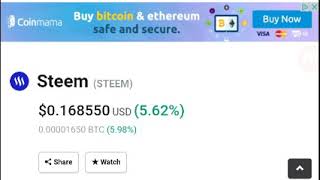
Burning STEEM tokens reduces supply and can drive price up through scarcity, similar to Bitcoin's deflationary model. The presenter argues Steem should focus on token burning as a store of value rather than building on-chain apps, which currently underperform compared to off-chain alternatives.
Chapters
Welcome back to the channel, and today we want to talk about burning STEEM, burning cryptocurrency. Does it work? Why do we do it? Why do we speak about it a lot? And so we're gonna get into that a little bit today. So looking at the price of STEEM here today, up 5%, 5.62%, a little bit over 16 cents. Up from 15 cents. So maybe this is the start of something positive. But it's a question that's kind of come around the Steem blockchain, um, quite often these days. So to understand why we burn cryptocurrency, we're looking at the total supply of a cryptocurrency project, um, The idea of something being scarce seems to create value, right? We see that, of course, in many of our resources throughout the planet. When they get scarce, the price of them goes up. So it's kind of setting out that idea, but with cryptocurrency, it's a little bit more complicated, right? Because these are intangible products. Um, and so if you're just burning, you could be burning. The reverse of that, you could be staking, uh, which kind of works along the same lines. You're, you're, uh, basically generating more of the, uh, the coins, the cryptocurrency, uh, and, uh, as it— as you gain more of them, kind of like, um Basically getting, I guess you could, might think of it like interest or something. You're getting more of these cryptocurrencies the more you keep them off the market. But then the question becomes, are you just burning cryptocurrency to no end? Are you just staking to no end? And you know, what's really making this valuable to begin with? So that's a loaded question. It's a complicated question. But I think to kind of answer it and to go off in the right direction with it, we first got to look at it from a very simple standpoint of what happens in markets, um, that is known as attractive pricing, right? Uh, there is a type of psychological effect you get when you're sold something and you see the sticker price is $1 or $1.99 or $54.99, right? So there's not much really difference. Not much really has changed, uh, in the value of the product of whatever it is that it does or doesn't do. It's not that it's so much that that element of it has changed, but what has changed is just the psychological effect of giving you this, um, very attractive price that you can identify with. Uh, and through looking at the psychological, uh, areas of the market in relation to this, uh, we find that being able to gain more of something despite its value generally is more attractive to people. Uh, we look at something like Bitcoin, for instance, to just purchase one Bitcoin is going to cost you over $10,000, right? So the idea that you spent $10,000 and you only got, um, one, one, one of these Bitcoin for it, right? Psychologically, uh, it, it affects your approach to it. Although the reality of the situation is whether it's one Bitcoin or whether it's a million Bitcoins, if they, if their value is equal to $10,000, it really doesn't matter. Still same value, but it's the psychological effect that can create this type of change in market behavior. And this is data proven and tested. This doesn't just work in cryptocurrency. This works across the board and marketing in general. And we see this. So along those lines, that's kind of why it works. Now on a broader scale, should we be doing it? Uh, I would say yes. I would say the data suggests we should be doing it. Now, um, does it really matter in the idea of the value? Well, let's kind of take it apart. Let's look at it. So what is the demand and what's driving the use of, uh, use in cryptocurrency? Uh, if you had to kind of pick one thing, Uh, and I'm going to kind of overgeneralize here just for the sake of this video to kind of sum up things. But if you look at the data, what's going to probably be the most important functions in cryptocurrency, if you go by value of the cryptocurrency, uh, is going to be something like Bitcoin that acts as a store of value. Um, and that has this very deflationary quality, right? It's not many of them. Um, and so it is what's been dominating the cryptocurrency space. So the data is suggesting that that's where people want to put their money in a store of value. This is really how they want to use cryptocurrency. Now I think a lot of the, uh, the narrative we went on as well is people are going to build all these applications on a variety of these blockchains and we're going to find so many uses with this blockchain technology. And I'm not knocking that, that's whether that's going to be the case or not. I'm just looking at the data and kind of going from there. So let's kind of look at that data and let's look at the reality of that data. So if all these variety of things are going to be built on the blockchain, you talk about video, you think about video hosting, or you think about social media sites or even gaming applications, right? If all these things are going to occur on the blockchain, uh, looking at it from the user experience, right? Uh, are these— do they run efficient on the blockchain? And probably the answer is going to be no. Uh, it's probably going to be easier and still better on the user experience to, uh, run videos off the blockchain. It's going to probably be better on the user to play games off the blockchain, right? He's going to have a better experience and better quality. Uh, you know, as far as, uh, social media, video, same thing. You're probably gonna have a more better experience at this stage off the blockchain, right? And so will there ever be a day that changed? Possibly. But looking at the data right now, uh, that wouldn't be, uh, in my opinion, the most important focus in cryptocurrency right now. Although the idea is to gather that we will one day find some specific uses for blockchain technology. Now, does that mean that then there's no real value in it in the way we think? Of course not. We can find uses and value in these projects. Uh, these— this idea of deflation and being a store of value is a use case if we think in terms of like what we get with gold. Although gold can be used for a variety of things, for the most part, uh, gold acts as a store of value, uh, containing a market about $7.7 trillion. Now the thing is this, uh, some people will say, well, yeah, but we can use gold in semiconductors and you can use gold for, uh, in your cars and engines and a variety of things, right? Um, But the reality is there are other metals you can use in place of gold that work just as good or maybe even better than gold. So gold doesn't, doesn't really, you know, take up the market in this way where it is just the only thing that can be used to help substantiate its value. It can be used for those things, but it does not have to be used for those things. So when we look at it that way, uh, gold's value is kind of locked up in that idea of store value, right? This is where we shelter our money in times of economic distress and, and a variety of things, right? So I think cryptocurrency can occupy a space there because then it takes on some of the traits of gold, but then it takes on other characteristics that are better than gold, like portability, right? And, um, and things like that. It's harder for it to be stolen. Um, and so in, in, in relation to that, it does make a lot of sense that we can just look at cryptocurrency as a store of value. And why is that important? Because store of value ties deep into the idea of, uh, deflation and token burning and a variety of things. These can kind of orbit each other and have value to one another. So in that way, I would say token burning the cryptocurrency, cryptocurrency burning, coin burning, uh, or is the, is the best, um, use of cryptocurrency at this point in time, right? And so in that way, it is important for the STEEM blockchain to burn STEEM in idea that what we're going to get is, at least through a psychological approach, and this is data tested again and data proven that you're more likely going to get, uh, some value there and some appreciation, uh, in that way. Um, but I think that's where we're at now. I, I personally, I think it's a mistake that the STEAM blockchain is kind of focusing on building more applications on it and hope that that's gonna bring more people in. Uh, I at this point in time just don't see it that way. Uh, when, uh, I factor the, um, the uses of, uh, applications of the blockchain so far, how they've worked, the inefficiency of them, and why, uh, they work better off the blockchain. But at the same time, to conclude, some uses of the blockchain that do work, like store value, and of course the idea of being able to kind of use it as a money. There are hyperinflated lands, countries that have problem, uh, with banking and a variety of things. So it's going to be quite quite feasible to see them walk around with mobile devices, send the money back and forth to each other. But as far as playing games on these, uh, blockchains, as far as, uh, video hosting, social media and the like, those type things, whereas I do think it's a place for them, I don't think they're going to be anywhere as significant as the store of value money, uh, situation with cryptocurrency. So, um, I think it's quite important that we kind of prioritize, I think, where our real value is in cryptocurrency. Um, and, uh, um, yeah, just something to think about. Uh, but, but I think that's all I want to say in this video. Um, we do have a proposal going on on the Steem blockchain where we think we solved some, uh, fundamental problems in Steem blockchain. We'd love for you all to take a look at that. If you like it, upvote that proposal. We think that we can do something to help this price esteem value-wise increase. Uh, but that's all I want to say in this video. If you like content like this, don't forget to like and subscribe. And until next time, take care.
More from Michael







UBI - CIA Agent Explains Why Americans Will Never Get Universal Basic Income?



