
Steem Hf21 - (SPS) Steem Proposal System Review BTCMYK PT.1
In this 45‑minute video the creator walks through the aftermath of the Steem hard‑fork (HF21) and explains the newly introduced Steem Proposal System (SPS). He reviews several SPS funding requests, then shifts focus to his own project, BitcoinMYK, a Bitcoin‑backed, deflationary side‑chain token that aims to bring a portion of Bitcoin’s market value onto the Steem blockchain. The presenter details the project’s objectives, token‑omics (monthly burn‑based deflation, forward‑splitting, and a 1‑to‑1 claim mechanism that does not require Bitcoin to be moved), the unique “unique‑account identification” process, and how the token will be used for social‑media‑style voting, music‑artist monetisation, and a universal‑basic‑income (UBI) scheme. He also discusses onboarding hurdles on Steem, the role of influencer and affiliate marketing, the “Bitcoin effect” and network‑effect arguments, and a market analysis contrasting store‑of‑value versus payment use‑cases. Throughout he stresses the potential for massive value capture (up to $1.7 B) if even a small share of Bitcoin users adopt the side‑chain, and outlines a $800 k‑plus funding request to realise the roadmap.
Chapters
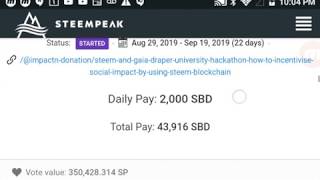
Welcome back to the channel, and I want to talk to you all today about the results of the hard fork on the Steem blockchain when it had been anticipated and what's happening with that, as well as some of the things that came out of it, like the SPS system or the Steem Proposal System and the EIP system. Which I'm still struggling a bit to understand. I've tried to explain it to the best of my ability. It has some moving parts there, and there's a lot of community who can probably do a much better job of explaining it than I can. But anyway, we're going to talk about that today, and we're going to talk about some updates with our project BitcoinMYK, where we're at with that. So as you can see here, on the screen. One of the components that came out of this hard fork was the STEAM proposal system. And what the STEAM proposal system is, it's an on-chain decentralized autonomous organization, or DAO, that allows users to submit proposals for funding and vote on which proposal should be funded. And This had much been anticipated as what would be a powerful tool. This allows the community to invest in great projects that could help grow the network, grow its value. And so they have this system up, and there is, I believe, a committee that decides who gets the funding. So we decided to get involved. Of course, you all know our project wants to bring Bitcoin to the Steam blockchain, uh, as well as create this deflation token, um, and several other features that exist with the project. So we're going to look at that, and we're just going to take a look at some of these other projects out here, uh, that are taking, um, that are applying for this, uh, this new system. So we see something here from Inertia, documentations for developers who work on the Steam blockchain. And it just shows the funding that they're seeking. Looks like they're seeking, um, what is it now, uh, about 3,770 Steenback dollars. And to help you understand that, of course many of y'all probably know how it works, a Steenback dollar is, I believe right now, somewhere in the 80-cent range. So it's all— it's almost close to a dollar. So this is something close around $3,000 for them to create this, uh, looks like a documentation for developers who work on the Steam blockchain. Um, here's a return proposal and not sure how much they're seeking. Uh, I think some of these guys are testing some of the projects. This is seeking— this is a Steam Fest travel reimbursement fund, and there's just, um, for different things, um, there is, um, funding and, and money set aside and available for the community to help grow this network. Um, and, um, that's interesting, a class action lawsuit against Facebook, Google, and their crypto ad ban. I, I thought that they had um, decided to allow cryptocurrency ads to run again. But perhaps there's something else going on. I'm not sure about that. They're seeking 171,000 Steamback dollars. It's probably roughly around $150,000 US dollars, something like that. Um, and just a very interesting, um, project. So again, you know, the hope is What's going to happen is this is going to bring a tremendous amount more value to the Steem blockchain as this reinvestment goes back into the community. It helps to grow that, which I think is a great idea. I think it's probably one of the best moves the Steem blockchain can make at this point. And you just apply to the system to submit your proposal. I think it's only something like about 10 Steem back dollars, non-refundable, and you apply. And if they like what you're saying, then you get the funding, I imagine. But here we arrive at our project, BitcoinMYT, the Bitcoin sidechain deflation token. And you can see that we're asking for a Extreme amount of money, uh, over a million Steambag dollars, uh, with a daily payout of $2,739. Quite a bit, but quite the ambitious project. Um, so let's take a look at that and, uh, see, uh, what exactly it is we're talking about here. So I'm gonna try to click on that, takes me over here to my post. Okay. There we go. All right, so here's the proposal. Going to give you a little bit of details on that. The objective of this proposal is to seek the implementation of over 1% of the Bitcoin market share onto the Steam blockchain at the time of this proposal, representing about $1.7 billion. The focus is to bring over 50 million wallets to the Steam blockchain. So that's kind of estimate of where the Bitcoin wallets are. And although you can see that we're requesting a hefty sum of money, you can see that the value that we wish to bring over to the Steem blockchain is a staggering amount of money, obscene amount of money, $1.7 billion in value. And, you know, we're gonna kind of explain here through the proposal how we plan to do that. So speaking of the benefits to the Steem blockchain, the benefits to the Steem blockchain and Bitcoin holders are numerous. Steem blockchain working alongside Bitcoin solves many issues for Bitcoin holders. This provides a great value to the Steem blockchain as it now will facilitate a large portion of Bitcoin transactions to the end users seemingly free. Thus transferring much of the value to the Steem blockchain. And, you know, that's basically just speaking about Bitcoin holders being able to move their value over the Steem blockchain, transactions being essentially free. And if this can be adopted as the new model for Bitcoin holders to a great degree, you know, there could be many advantageous situations to the Bitcoin holder. Or advantages. And we're going to explain why that is. And I just got some videos put in here that go into detail about, you know, how the structure works, the amount of transactions that are processed per second, which blockchains are the fastest. You kind of see here Steam's ranked number 6. But Bitcoin pair assets on blockchains, I Our research shows Bitcoin pegged assets on other blockchains don't work. This speaks to the issue of trading value into altcoins. The dynamics of trading cryptocurrency assets into altcoins specifies the greater value ratio to the underlying altcoin to Bitcoin. This project solves that problem by allowing Bitcoin holders to claim their Bitcoin value-free thus retaining their Bitcoin in their wallets. A very simple yet effective and non-intrusive means of unique account identification allows this to be possible. So basically what this is saying is it's basically just saying that there are several methods and attempts to where they can peg a Bitcoin asset on another blockchain and back it up by Bitcoin. Um, and, um, there's, you know, that there's nothing wrong with that, but part of, part of the issue is a lot of times these projects don't transfer over well to absorbing a good percentage of the Bitcoin market using it. And, uh, a lot of that has to do with the transference of the value from one asset class to another. And so what we see here is a much more simpler process where we verify that you're a Bitcoin holder and you just get the tokens free. Now what that's done is it hasn't put you in a situation where now you have to actually transfer that value over to another blockchain. You know, this way you get to keep your value in Bitcoin. right? And so that money's safe. Now you have these assets over on the sidechain. Now, this way, you know, instead of having to make those choices in case the market turns against you or something to that degree, you're, you're not in that potential danger. We also talk about the unique account identification, which is a very effective but simple process we use in order to make sure people aren't just coming up claiming a variety of tokens. And that's achieved by several ways without going into KYC issues. And one way to do that is quite simple, is where you upload a photograph and you send it to us. And in this photograph, you have the day of the, the photograph was taken. And you have like your first initial of your first name with all your identification blotted out. So what it does is it allows us to identify unique account holders to that, to that account without requiring them to truly expose their identity, but at the same time stopping people from creating a double spin situation where they can just keep reclaiming and reclaiming. So works very well and seems to solve many of the problems associated with the double spend. Here we talk about social media. Social media does not equal the Steemit blockchain. The confusion has long been that Steemit.com is the Steemit blockchain. This means that the use and full potential of the Steem blockchain goes far beyond just use of social media platforms. Social, social media may, however, equal a great amount of value. The Libra coin project underway will potentially at some stage reach 2.2 billion users. This shows the power of what social media could do over the blockchain. Understanding the reasons why social media grows such value and reaches such heights helps to move to a successful direction. The true value of projects lies in actual use and application. The large use that has been shown on the Steem blockchain, theoretically relating to social media, should translate into a highly ranked coin. The project uses a democratic voting system on posts from members and incorporates a familiar, like, simple approach so end users' adoption of the platform is not overwhelming. The benefits of social media into a Bitcoin-like coin on the Steem blockchain, we believe, presents many advantages as far as expansion and use of the network. Democratic voting also removes many stigmas in association with the balance of value on the network. Our research shows, although these models short-term prove economically sound, long-term they may be quite the contrary. This project has built a social media platform integrated into its Bitcoin sidechain feature. Okay, so, uh, what we're talking about here is the long-reaching effects of social media. And if you take something or concept idea like what was happening with the Libra coin project, which is basically a partnership between Facebook and this blockchain, the value of the social media part of it with potentially 2.2 billion users would make, uh, a project like Facebook get involved in cryptocurrency not only the biggest cryptocurrency project, but it will probably become the biggest money in the history of man, right? Because you would have all these account holders, and that's the power of social media. Because of the onboarding and ability to mass adopt so many people into now what would be your currency and the means to transfer this value, that would be a very powerful network created by social media. So in a, in a very similar way, if we were able to achieve something like that with like a Bitcoin-like project where you have social media integrated into the wallet features, the value feature, then you would have the ability to grow value-wise at a, at a, at a very large rate. So basically it's just saying that we're using a social media layout to help facilitate the transference of that value as people are more familiar with social media functions and sites. It's easy for new people to use it and identify with it, and because of that, they will want to, to use it. It also talks about if you take social media in the sense of something like Facebook that has become one of the largest companies in, um, the world, um, highest and one of the most highest valued as well. If, if you take that information and you kind of apply it to social media over the blockchain, um, we kind of see that it should create a very similar situation in cryptocurrency as in social media. You have a better opportunity of reaching, collecting a lot of wallets and accounts and that the ranking, uh, would be more comparable, comparable to how it is, uh, in, um, in, in the traditional markets where we would have these very dominant social media sites probably ranked in the top 10, maybe ranked even top number 2 or number 3 or something to that effect. So we can see that happening easily with social media being integrated into a type of, you know, token or value system. Um, we also talk about how this social media feature we have uses a voting system that is more on par with a more democratic process of what you would get if you're part of a community, uh, upvoting similar to Reddit. If you kind of think about Reddit, when you cast a vote on Reddit Everybody gets the same amount. Everybody gets one point, one vote, one account, one vote. And this is easy for us to accomplish this, uh, how we explained the identification process where we can identify unique people to unique accounts so that the system is not gamed in that regard. Um, and so, well, this kind of perfect integration, if you kind of think about if Bitcoin were to meet Facebook in a way, in an idea, then you could have this, this ever-expansive network. Um, moving on to the musical artist feature on the site, this is something kind of new we put in development. Uh, social media has been joined at the hip with the music industry. Many are now exploring ways to create a better industry through use of blockchain technology. The industry of old relied on shady record labels and bad deals to promote up-and-coming new artists. Social media has now made it possible to create superstars overnight. Unfortunately, not all situations for musical artists are equal. Steemit has provided an opportunity for musical artists to monetize their intellectual property through a voting system. In keeping with the idea of our platform, um, has feature which allows artists to receive value per play and vote. This concept is a bit different than the proof of brand algorithm, stake-weighted voting. This allows artists to monetize their music more similar to pay-per-play streams, with all vote value being equal. That gives power back to musicians and allows them to promote their brand independent So far, the idea is well received. For speaking with some musicians, we feel this feature on our platform can itself create a tremendous amount of value. We believe the demand for use of this feature will be great. So that's just pretty much saying, you know, um, in short, similar to the social media voting system we have where you post in the community is able to vote on your contributions, uh, and each vote being equal to same at a certain token value. Um, we found that using a very similar system, we'll be able to do something like that for having our musical artists come in and have them where when they their, their songs and music is presented, we're able to listen to it and upvote it. And in upvoting it, we transfer value to them, give them the tokens. And, uh, it's almost like a pay-to-play streaming service at that point, right? You listen at a song and you send over a token when you vote, listen to the artist's song. Now what's happened is the artist is able to monetize his song. You kind of think of if he were to sell your track at a time from your vote. You listen to track, each track you listen to, you pay for the track in a vote. And doing that, uh, what it does is it's given a lot of power to the artist that every time they play a song or every time somebody listens to a song, they're able to pay them for the song. So now the artist is being paid, uh, through the value of the network. And, uh, right, he's in full control of the ownership of his, uh, of his content material. It's not a record label. He doesn't have to pay for promotion or enter into contracts. As long as his song is played, he's paid. So it, it can work out great for artists, and it is getting well received with some artists. And we think as we promote this song, push it forward, get more value in our token, it could, it could be a huge hit. Onboarding new users. New account creation has long been an issue on the Steem blockchain. Some users may have the knowledge and desire to purchase an account, the patience to await an account. However, the problem of the convenience society doesn't work well in those cases. In a world where we receive now things at the touch of a button, This can greatly lower the appeal to the network. Our platform allows for new users not only to create accounts same day, it allows them to earn our SCOT tokens and trade them on the Freedom Exchange. This segregates an account for them until they can either create a Steam account, receive one, or learn how to purchase one. At the same time as they earn our tokens for their participation, they can trade them for Steam and use Steam to obtain their Steam accounts. We find this to be an effective method. It doesn't alienate the end user or make their experience bad. They are able to still purchase in the network. So one big issue has been the way that the structure of the Steam blockchain works and Uh, you have to keep in mind that when you vote something there, that's real money, real value being transferred. So there's a process in how these accounts are dispensed out, who gets the accounts. Um, and that could take, take a little bit of time. Also, because it is real money, uh, that means that it's costing the network money to give these accounts out as they vote for other people. They're actually moving a certain amount of dollar value to those accounts. So one big issue has been not only the learning process that goes with that, setting up accounts, private keys, and all those— Steam is— the Steam blockchain is one of the more easier ways to get into cryptocurrency, deal with wallets and transfers of this value. It still— it requires a certain learning period. And what can happen is a person who's new, who comes in, they're accustomed to registering for an account, getting it the same day, participating in the network. They may get a message, something like, well, you know, check back with us in a week or two or three. And maybe they do, maybe they don't, but it's just probably not the best way to onboard. So a lot of people are coming up with some idea of a guest account. That allows these users to be able to participate in a network until they formally get an account without, you know, basically hurting the structure of the network by just giving out all these free accounts and a variety of things. Of course, the other option is you can just purchase the account, get it the same day, but in the convenience society where people are used to kind of paying on the back end and getting things done. Now it is going to probably be a fraction of people who do that as opposed to the latter. So what we propose in our system is, uh, we trade on two exchanges. One is the Steam Engine Exchange, which many of you are familiar with, um, and, and the other one is the Freedom Exchange. Now the differences are The Freedom Exchange is more like a segregated amount of wallets that can create, send our tokens to a variety of places, where something like the Steam Engine Marketplace is connected to your Steam account. With the Freedom Exchange, there are segregated accounts in their network, but you can send the tokens from there to the Steam Exchange Marketplace. In short, what it basically means is that A new registrant can come onto our network, they can start earning tokens the same day, our cryptocurrency, and they can be sent over to a segregated account on the Freedom Exchange. Now what can happen later on is as they're able to participate, earn, make money, tokens that can be traded against STEAM, they now have the STEAM to pay for an account if they want, or they they've done that for a week or two and they've just been approved by Steam to just get their account free. In any regard, you've solved a big problem of onboarding. Also on the network, while they're on the network earning tokens from day one, they're able to participate, chat in our chat room, instant messenger service, uh, public chat rooms, private chat rooms, uh, all those things where they can reach out to the community, get educated, um, right on site at the same place. They don't have to go anywhere else. Get educated about how to, um, learn more about cryptocurrency and how to have the access to cryptocurrency. Store value. The unfortunate myth of cryptocurrency so far has been a technology we use with many applications and users will find some use of. The statistical reality, uh, the majority of cryptocurrency users only utilize cryptocurrency as a store of value. Assets pose many issues as they generally don't lead to trading and commerce transfer value. Financial products follow. Gold as a store of value accounts for $7.7 trillion. Offshore banking, $15 trillion. Credit cards, payment processors, including Visa, MasterCard, and PayPal, only account for about $770 billion. In comparison to payment systems, you can clearly see the above data. Indicates store of value dwarfs any payment system use of cryptocurrency. Our Bitcoin product would ideally create a significant amount of value to the Steem blockchain as users will see it as a valuable product. The altcoin markets underperform significantly against Bitcoin based, we believe, on the same information. The cryptocurrency market's value of Bitcoin as a store of value much greater than any other product. Based on that information, Bitcoin will continue to be the premier product provided something comes along better and more efficient. Our version of Bitcoin on the Steem blockchain would deflate against trade volume on a 1-to-1 ratio from 100 million tokens to 21 million tokens on par with Bitcoin. It would then deflate down to 5 million tokens. The tokenomics against growth suggests the deflationary model value-wise should act as an appealing store of value for token holders. This will create a Bitcoin product on Steam that adds more to promote it as a store of value than Bitcoin itself. So basically, very interesting information there. Gold as a store of value, $7.7 trillion. You know, basically what that's— what we're discovering is there is quite a bit of maybe looking at things in the wrong direction about how cryptocurrency value works. Uh, many cryptocurrency projects strive to be this money, this utility, uh, token that moves value back and forth. Uh, but we're seeing that when, uh, something acts as a payment system or as a money, the top value is generating, um, is about $770 billion. Um, although that may sound like a lot when you compare it to gold holding value at $7.7 trillion, you can vastly see the difference there. So what is it we're trying to achieve in the cryptocurrency space? Well, the most valuable direction is as a store of value, and the idea being that if Bitcoin is that store of value then it could possibly achieve large numbers like this over being a payment system. And that's why they like Bitcoin as a store of value. But Bitcoin exists in this way because there aren't any other better products that do a better job as acting like a store of value besides Bitcoin, or does it? So our project goes into how not only will it be representative of Bitcoin on the Steem blockchain, meaning Bitcoin holders can get it free, it will deflate, um, against the trade volume on a 1-to-1 ratio, meaning as millions of tokens are traded, millions will be burned. And what's happening is the tokenomics of the supply being reduced against a growing network generally means that the the value increases, right, becomes more valuable. Now, uh, in the last stage, it drops below 21 million coins that are burned. And what happens is those tokens, um, or the Bitcoin holders that are claiming still at that point in time, they're going to be receiving something like 16 of the Bitcoin NYK tokens to, uh, 16 to 1, right? It's 4 to 1 now. So you get right now, you get 4 of these, uh, sidechain tokens for your Bitcoin for free just based on the amount of Bitcoin you hold. But in the last stage, it'll be something like 16 to 1 as the tokens value have decreased. But anyway, you, you kind of get the gist of, of how the deflation works, um, and the importance of store value. So that on the Steem blockchain, uh, can equal a tremendous amount of value as well as an efficient money, as the transactions would be free. But, you know, as we bring out that, uh, when something is an asset it's not going to act very well as a money in the performance of many of the things you want to do. And that's because people are going to want to hold on to it longer. They're not going to want to trade it, uh, as well if it's, uh, quite, uh, you know, gaining, appreciating at a very high rate. You're almost losing money as you trade it because that means people don't want to give it away, uh, so fast. Because if they give it away then if it's worth twice as it was tomorrow, then they will feel like they're losing. And so they're— it's going to make them want to not let go of it so much, making it a bad means of trade. So something interesting to think about, but also could present a very, uh, uh, interesting situation and good situation for Bitcoin holders claiming these BitcoinNYK tokens against the deflation. Against the value of the network and potentially having something that performs, um, on par with Bitcoin, possibly if not better. Um, deflation, and this just gets into the deflation a little bit more. The deflation of our product works as follows: every month the trade volume is calculated. For example, 1 million tokens are traded equals 1 million tokens burned off. Token holders will also be able to take part in a token fork split process. This means based on the tokens they buy, they may claim the same amount of tokens. To illustrate, as the token splits, users who purchase tokens on third-party exchanges may be able to claim those tokens on our platform. For example, 1,000 tokens are purchased they may claim the 1,000 tokens purchased. The network burns 2,000 tokens. The tokens purchased and the tokens the purchaser made on the third-party exchanges. This velocity of deflation against network growth should theoretically create a more valuable product. Although we'd be unable to collect this data until after significant progress in the project, it would seem in comparison to other deflationary projects The data suggests results would be more favorable. Projects like Bomb Token, ETHplode, uh, who have attempted this have seen some considerable results, although these projects seemingly lacked any use case outside of a methodology of deflating tokens as well as perhaps creating unpredictable future results. Our project direction Going through the Bitcoin network, we believe, makes the success rate much greater. So deflation tokens have kind of become, uh, one of the latest things in cryptocurrency, and many of us understand how they, how they work. They burn the supply against the transactions volume trade. and it keeps going until down to a certain point to where the tokenomics is forcing this thing to have value. Um, now whereas many people have kind of become familiar with that concept through, uh, ideas like the Bomb Token Project and ETHFLOW, um, one thing that they've probably aren't familiar with or haven't seen much of is something we call forward token splitting, right? And that's kind of like working deflation in reverse. This is where you basically get more tokens based on the tokens you hold. So if you were to go out, um, in our example in particular, say if you went out and you bought 1 token, you'd be able to claim 2. You would get 2 tokens. And the way this works is on our platform, um, when you show receipt of purchase of cryptocurrency, our token, uh, in the markets, you're able to then basically receive an additional the amount of tokens you receive. Uh, now the trade volume is still burned against the entire amount of transactions, meaning you're still getting deflation in that direction, but now you're also getting deflation on the buy side, um, of the, of the tokens. As what's happening is after you get the tokens, the overall supply is still even being burned against that because it's, it's part of the transaction. We believe both of these mechanisms, uh, working together is going to give the investor and people who participate in our project a tremendous amount of value. Uh, this is a method that has been proven to work, at least, um, initially. We're finding out from these projects, I, I think when you consider something like Bomb Token or EveFlow, you're, you're looking at this project that's quite interesting. But, um, some of them don't really have use cases after that point, where some have kind of evolved to have them. And so it'd be interesting to see how that data works out. But we have seen at least initial success with projects that have really no use case other than just deflating and being a store of value, right? Kind of trying to take that crown from Bitcoin, if you will, as the premier store of value cryptocurrency. And so that's kind of where we're at with that. But of course, with a use case and everything you see going on here with this, project. So it's going to be quite interesting to see how that works. Also keeping in mind that we're asking for almost a million dollars, right? You know, we're talking about well over $800,000 here in Steam Bat dollars. You know, I think any investments made like that, uh, the group making that investment, the community making that investment, they want to see maximum growth from the project. And with something like that that has the tokenomics to make the token value grow up, go up, more likely that's going to attract a lot of investors and speculators and people who are intrigued with, uh, these deflationary-like projects, uh. And so we, we definitely think it's a recipe for success, uh, and that it will be treating the investment, uh, with the best possible situation to get value back to the investors. Content influencers. Marketing and outreach is essential to the survival of this project. It is also going to determine the value of the STEEM blockchain to a great degree. The problem with marketing is that it may become quite expensive. Estimates of over half the revenue of some businesses go to marketing. The key is allowing every dollar to create a great deal more value for your product. So part of our plan is to broker deals with content influencers and create an outreach team that can get results that are cost-effective. The DLive project, once part of the Steem blockchain, Broker the deal with PewDiePie, a content creator with nearly 100 million loyal subscribers. These are very effective methods. However, our approach finds that spending in projected areas of about $20 million to team up with PewDiePie won't be necessary. Similar feat could be accomplished in a well-gathered portfolio of content creators promoting a product with reasonable value spent out to secure similar outreach numbers. Affiliate marketing through the masses of users is, well, greatly underestimated. The community participation and ability to earn through affiliate program marketing allows for viral growth rate. Under our project, we believe we could accomplish such a network and build up a great portfolio content influencers to, to assist us. So many of us at this point are familiar with what happened with DLive and PewDiePie. Of course, PewDiePie being the big social media phenomenon with nearly 100 million subscribers, branding himself and able to pretty much make a network on his own. So Um, DLive got the idea once part of— once part of the blockchain, or the Steem blockchain, I believe, maybe even funded by the Steem blockchain to a great degree as a streaming video service. Um, decided not only leave but to broker deals, uh, these huge mega deals after, you know, pretty much being funded by projects like Steem. Kind of being nurtured and grown up by projects like, like STEAM blockchain. And this has happened over and over again. And that's a, that's a problem. And, you know, to the community funding certain projects, what do you do about that when you fund these projects and you don't get a return on investment back like maybe you should? So we've found a good way to approach this and go about this and have this benefit the Steem blockchain is go out and broker these deals. Broker these deals with these social media influencers based on the subscriber base they have and influence they have and comparable to the amount of outreach they have and network. we're able to structure deals, um, with the value, uh, we're seeking in this proposal, the funding to go out and make these deals with these, uh, uh, content influencers, build this portfolio that allows us to have very cost-effective marketing. So the next problem with marketing is that you can spend all this money and it doesn't yield the results that you like. So we want to be very careful about how we go about this, obtaining this viral growth. I think the, the, the next cool thing would be what I think has been underestimated quite a bit in the product going viral, projects going viral. And not saying that the Steem blockchain hasn't done a great job. I think it's around 3 million users now. There are other projects— 3 million users seems to be the pinnacle hard to break, you know. So it's a lot of projects that kind of break off around about 3 million users. But now we know that in the social media world, 3 million users is kind of like peanuts, right? It's not a lot. You know, you want 10, 20 million users, 100 million users, right, if you can. Uh, and, uh, we would like to see the Steem blockchain build and grow to a size like that. And I think the way to get there would be this very positive, uh, uh, and a very, uh, uh, encompassing participation along with the community social, uh, content influencers, rather. And what I mean by that is having affiliate marketing programs that kind of allow your community to go out and promote people and market to people. Um, you know, as simple as it sounds, I think it's one of the most effective ways to open a social media page and see everybody trying to promote some product, uh, or some that you heard about that you're finally going to try because every time you, you, you get on, you get on this on the net, there's somebody who's talking about it. Uh, and so we feel like that would be a great way to go about that. Uh, you know, as well give the community value, you know, instead of going out and paying a marketing firm or marketing agency, simply give that money back to the community because the best people to promote something is your family, is your friends, tell you about products. That's when you're going to try them. Uh, and they're going to be the people who, some cases, put that demand in you to try them. So that's pretty much where we're headed with that. Um, and content influencers. The Bitcoin Effect. The true value of Bitcoin has been questioned over the years. However, whether the technology and features and usability of Bitcoin can be agreed upon as justification of the value or not, what is clear is the branding of Bitcoin has held it in place as the most traded cryptocurrency and highest value. Similar proposition could be raised about Facebook or Nike. We could determine perhaps there are a number of greater projects in their industries. There may be greater technology. However, despite those details, certain products remain in place and at a high value due to network effect. Our research has shown the Bitcoin network effect transfers over to other altcoins. The majority of Bitcoin coins and/or products have performed quite well over the years. Bitcoin Cash, despite community outcry, managed at one point to gather about 6% the value of Bitcoin. The infamous Craig Wright fork Bitcoin Cash ranking high in cryptocurrency and maintaining a billion-dollar valuation. Dogecoin, Litecoin, Bitcoin Gold— these Bitcoin products have all gained incredibly high value based on their association with Bitcoin. The product aims to do the same, or this product rather. Bitcoin forks and products may on average bring in about 3 million users loan, and as well as knowledgeable cryptocurrency users who move real value. So this is basically speaking to the value of Bitcoin, and not just the value of Bitcoin, but the effect, the Bitcoin effect, if you will. Um, we know that branding network effect, uh, is very important to brands. A lot of times I hear questions like, why are people still using Facebook? Why is Facebook value so high? Why don't people just leave Facebook? The reality is we could all decide to just go, hey, uh, we're gonna pick social media network X, Y, or Z. We're all gonna leave Facebook and we're gonna go over here. But that generally won't happen because of the network effect, because of the the familiar presence of Facebook, the, uh, the amount of network it's built over the years. And because of that, it's very unlikely that a lot of the ideas of taking off and leaving Facebook is going to happen, um, which has kind of plagued a lot of people in cryptocurrency trying to understand this. But it's not going to happen because it has the network effect much like many other products that have the network effect, in some cases over superior products, right? As to say, some people might stick with something familiar before they even go and try something that's better. So looking at the history of Bitcoin-like products, look at something like Bitcoin Cash, Bitcoin Satoshi Vision, community was in uproar about trying to create these new Bitcoins. They seemed scammy, they seemed to dilute Bitcoin to some degree, or whatever the case was. But the reality of what happened was many of them all became billion-dollar projects just like Bitcoin. And so we kind of understand the what the data suggests here, um, as to what can happen with that and why Bitcoin is the premier product. And if we can help that in some way, facilitate that in some way, that's going to be quite valuable to the community, have quite the demand. And I believe that's why these projects have been able to do so, do so well, do so well in this way. Reach these billion-dollar valuations. Even though people may not like the people involved or like them, they still are used greatly. They still have the valuation, and these are undeniable facts. What we like to see is something like this happen on the Steem blockchain, where we have this Bitcoin sidechain moving this tremendous amount of value we estimate something like $1.7 billion. Um, and the reason we feel this is quite easy to achieve is because, uh, when you set up these Bitcoin-like products and forks similar to what we're doing, uh, on average some can gain about 3 million users just from that. So for us, this is a no-brainer to put value in this project and to have a large amount of Bitcoin holder network come over and use this product. And that's what we will be doing with some of this money, going out to promote and get those people participating in, uh, marketing this as a fork so that people can adapt it and use it. Another thing we have to keep in mind, and I think this is very important to help understand what the value of such a project like this is, um, you know, when you look at the valuation of Bitcoin, when it goes from $9,000, $10,000, $15,000, $20,000, whatever the case is, the more it goes up in value, the more difficult it becomes for us to make a profit in it. If you're in at $3,000 and it's at $10,000, you're good. If you get in at $10,000 and it goes to $13,000, well, you're still pretty darn good. But if you get in at $13,000 and it goes to $12,000 or it goes nowhere, then you see it's getting more difficult as it goes up to these very high valuations. A Bitcoin-like product like what we're proposing, uh, with many of the mechanisms that it's part of, it will be much easier for this token to go from $1 to $2, $2 to $4, to $8, $16, $32, $64, and you get the point, right? And so you could have these large jumps and gains, uh, in this product going up with a very small percentage of the Bitcoin market share, only about 1%, going up from, uh, hundreds of millions of dollars to billions of dollars, right? And we can see that quite easily achievable if we structure this right and put it out there correctly. Transfer of value. The project integrates a system to transfer and receive your Bitcoin value on the Steem blockchain. The process of stopping double spending has long been an issue in cryptocurrency. What sets us apart and makes us unique from most projects is the ability to move your Bitcoin value anytime. Most projects coordinate a specific time to snapshot the Bitcoin ledger. Once this is included, there is a one-time transfer of Bitcoin value to another project or Bitcoin-like product. We allow claiming at any time with no coordinated snapshot. There's a very simple process that's discovered during certain coin and token airdrops to claim tokens and have Bitcoin value on the Steem blockchain without moving Bitcoin or creating a double-spend situation. This process only requires the claimer to connect their account and Bitcoin account to our project. Under limited to no KYC, know your customer, users only would need to verify if they hold a Bitcoin account, account either through a wallet signature or small test deposit at the lowest Satoshi holdings, followed by a photograph of themselves holding a note of the date and their driver's license. This is not KYC. The driver license information would all be blotted out except for the first initial or, or their name, so no data connecting the photograph to that person and/or the account would be identifying information. This would allow any suspicious Bitcoin claims to be quickly matched to accounts and photo ID without connecting them to an identifiable account, but only a unique person, right? So that's talking about the actual process of how you get Bitcoin to understand blockchain, how you get this Bitcoin product that we call Bitcoin MYK. So, uh, you know, again, as we mentioned in the pegged assets, pegged Bitcoin assets on other blockchains, It requires you to sell your Bitcoin and then take that money and then you buy this, this pegged asset. What we're suggesting is do none of that. Let your Bitcoin stay where it is. It's safe there. You do what you want to do with it. Now, based on that value you have over there, you're going to get the tokens from us free. How we're going to transfer that value It's going to be through a process of identifying you're a unique person to that account, and that's a lot simpler to do than we once thought. Um, now although it does require identification, it is important to understand that it requires a photograph of identification with unverifiable names on them, right? So in other words, It's allowing us to identify that you're a unique person to that account without knowing who you are, uh, and that's because all the information on your driver's license is blotted out. So if you fold us up a photo of you holding this card with just maybe an initial showing, uh, maybe a first letter initial, right, and a note the data was taken, that way you can't— people can't try to upload, uh, different materials and things like that. Um, and once you— that's done, it's in. Different from a typical Bitcoin-like fork where they can only do it one time because if they don't, people gonna just keep claiming over and over again. So what they do is, uh, they take a snapshot. It's a one-time thing. Boom. Whatever's, uh, in that, uh, account, uh, is going to be relational to what the Bitcoin you get. Well, with us, you just keep doing over and over again. If you keep buying Bitcoin You just come back and claim these tokens. Uh, if you, if you do not want to, uh, even purchase our tokens, you can just go and, uh, purchase more Bitcoin, then claim them. But of course, the, uh, statistics suggest for us in our data that a person who's claiming our tokens free by the Bitcoin holders It won't be long before they realize that the value they're getting from Bitcoin, traditional Bitcoin, and the value that they're growing from a deflationary token and ever-expanding network, that it's going to be a lot easier to get that same value and possibly a lot more by moving some of that value into our token, right? So you can kind of see where we're going with that and why that would make sense. Um, why according to our research it would work out that way. Mass adoption. This project is part of its Phase 2 mass adoption initiative, plans to give out universal basic income. So generally the idea of universal basic income up until recent times have not been well received. The idea of giving away free money is often unsustainable and results generally in failure. However, a few corrections should be included about the concept of universal basic income. First being that it's free money, not yet so free, yet sustainable. So to understand this, projects like EOS had considered creating an offshoot of universal basic income called Universal Resource Inheritance. This, an idea, would give universal basic income based on the annual inflation rate of EOS. Projects considered like this have never come to fruition. However, it does suggest the concept of a sustainable universal basic income. In our version, the average claiming Donna Bitcoin holders on average tops out around 3 million claims. The tokens not claimed as part of the Bitcoin network on Steam, this would allow universal basic income to be paid from the unclaimed value and tokens along with other platforms, uh, projects and initiatives that add value to the network. The biggest question of course would be why would this project need universal basic income? In the first place? The answer is, where it is true that the Bitcoin network could possibly adopt the Steem blockchain to a great degree to facilitate the movement of Bitcoin, the reality is there will probably be somewhere around 3 million claims based on research we've gathered so far. If all Bitcoin holders claim, that will still only account for for about 50 million accounts. This is a great deal shy of mass adoption. We have discovered that not only do most account holders accept ideas like universal basic income, we have found that most would open an account to have access to it. The statistics suggest about 80% of the globe now requires something like universal basic income. In addition to that, it has become one major policy driving the 2020 elections. Candidates like Andrew Yang and the infamous online sensation, the Yang Gang, have pushed the platform forward. Tech experts like Elon Musk have made alarming claims to the necessity of universal basic income and the fourth industrial revolution. A nation like America, which has frowned on such ideas, now are considering it a necessary major policy change. This speaks a great deal to the demand universal basic income is creating. The fallacy of universal basic income is that it can only take money from an economy. This is an economic fallacy and often cited based on limited information. About Universal Basic Income and economics. Through money changing hands and velocity of money, first, this could signify an ever-expanding economy in our example against a deflationary token. In addition to that, Universal Basic Income registrants would also have ways to earn on the site and perform gigs through our working posting site. For services and related tasks that now transfer their value into the token. So along with the Bitcoin network and a demand greater than 80% around the globe, we find this to be a viable approach. The unfortunate lack of demand for Bitcoin. Although Bitcoin has risen to be the dominant cryptocurrency compared to other markets, Bitcoin doesn't even rank as a top business in America size-wise. Several companies, some even private, dwarf Bitcoin in size as far as its market capitalization. So in terms like this, makes Bitcoin not seem so impressive. The issue is the demand for Bitcoin isn't there as much as we'd like to believe. Some economists and crypto enthusiasts place value on Bitcoin at around $800 to $3,000. These numbers are comparably smaller than the value it trades in our markets. Of course, much of this is due to price manipulation as conducted and handed over by the results found through several studies and audits and presented to the SEC. Major demand uses for Bitcoin still rank around moving money out of nations with regimes that put citizens in danger of losing their money. Intact and full-service banking systems also stopped the demand of Bitcoin. Lack of knowledge and education about cryptocurrency also kept down demand. However, 80% of the globe would have a demand for Universal Basic Income. This would not affect the demand and need for the product, nor would it cost the product any new money or value not already existing and lying within it. So speaking about mass adoption and using methods like universal basic income, so what happens when everyone has your wallet, right? Uh, when everybody holds your currency, you know, by default it's going to be more valuable because everybody has it, everybody holds it. Now you can effectively, through a network, transfer value anywhere across the globe. In this case, it would be free using the Steem blockchain. And so again, you have this ever-expanding economy, um, moving against the value of this token. Another thing to keep in mind is that the concept of money itself, remember, is only representing the value that humans put into it. So the— in a very strange way, money is almost fake. Right, and it is our motion, right, our movement, uh, root word current, our energy, root word current.
More from Michael







UBI - CIA Agent Explains Why Americans Will Never Get Universal Basic Income?



