
Steem Proposal System - Progress - What Needs To Happen
A walkthrough of Steem's proposal system, which has $256 daily to fund projects. The host critiques pending proposals and pitches his own: Bitcoin MYK, a deflationary token on Steem that he says could reach $170 million market cap and bring a million new users with just $100k in funding.
Chapters
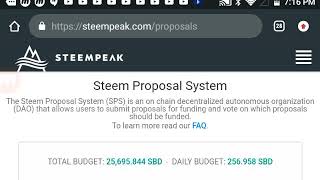
Welcome back to the channel today, and we're going to talk about the Steem proposal system, its progress so far, and, uh, what's probably needed. So let's just take a look at it. Looks like the total budget so far is $25,000 Steem back dollars and a daily budget of $256. So this is, this is a growing fund. And really taking a step back and looking at this, it's showing here some funded proposals. You know, it looks like probably on average, these projects wanna average out about $20,000 per project to get funded. And I think that some projects, even ourselves included, we might have to kind of work more within the confines of the system for it to work more efficient and allow the system to grow over time. So, um, so what we've seen funded so far is projects like documentation for developers who work on the Steem blockchain. You know, obviously that's going to be important to the backend development of the site. There's going to be something usable by the blockchain, and you know, and so this project has been funded, and so it's a demand for that. The return proposal, and it's showing other proposals now that haven't got funded yet. So let's take a look at this one. And this one looks like it's about upgrades for Steam Engine tokens and tribes. Let's take a look at that. That's looking good, like it's about to be funded. And let me look and see what it's saying there. A lot of good jobs been going on with the Tribe tokens. Let's see if I can get over here. Steam Engine tokens and Tribes have quickly become a heavily used feature. So for Steam, Steam Peak, so they're talking about 27 upgrades to Steam Peak for Steam Engine tokens, more wallet operations for Steam Engine tokens, transaction history for Steam Engine tokens, uh, vote value estimation when voting in a Tribe page. Um, and so all this sounds great. And now I do like a project like this because, you know, as we break it down, a lot of the, uh, idea of what Tribes are going to do is going to incentivize, uh, individual product, uh, project creators to go out and reach these variety of markets, where they be niche markets or larger markets. And collectively possibly lead to the value that we need added to the Steam blockchain. So obviously being able to create products that are going to make those things work better is, you know, it's going to be valuable to a lot of people who are on the Steam Engine Marketplace or creating these tribes and a variety of things. So I'm certainly and support of projects like this. Let me see, what's the total funding of the project? Um, so gradually down, uh, yeah, and I'm a fan of this one too. They're getting some good feedback here. Um, yeah, absolutely. You know, what with the tribe tokens, again, you're going to have a large amount of community going out trying to find out what works for the STEEM blockchain. The more of those that are created, the better chance you have. So it's like this collective effort. So I'm with that 100%. Uh, this definitely would get my vote, and I think it's something that makes a lot of, uh, makes a lot of sense. So I want to try to just focus— I'm gonna focus on, you know, I, I know like a lot of people are entrepreneurs, and when you create a product, everybody, you know, a lot of times, oftentimes you think your product is a great product or you wouldn't be doing it, right? And so always want to give kudos for entrepreneurs and people, uh, trying to make positive changes and create something useful, uh, to society. So what I'm going to do, I'm just in this particular video just going to focus on some of the things I think make sense, uh, and that does work. I'm not gonna— and if I don't, you know, cover your particular project. It doesn't mean it doesn't work or it's not a great project. It could just be my limited knowledge of it as well. But I'm going to try to focus on the ones that do make a lot of sense. This obviously does, and they only want 1,500 Steam back dollars. So makes a great deal of sense. I think they need about 3 million more Steam power to get elect— for this to be funded. And I think it's quite reasonable. They only want 100 $15 a day, uh, and, you know, and so the, the money invested in this project, it has to be used, you know, uh, responsibly and cost-effectively. So that's understood. So this one's, um, you know, again, I'm just going to move the ones I think probably going to make some sense. Now, a lot of these are gaming applications, and game— I'm— so I'm not going to just pick any particular game. But I'm just gonna say overall that, you know, if you could have a good breakout game, you know, like what's happened, you know, with some games, uh, yeah, sure, you could have, you know, a good situation there. I would be concerned, however, with some of these games, the amount of money they're asking for. So I, you know, so I think due to the risk of You know, games not catching on or there being a kind of oversaturation of games. You know, I would probably be a bit concerned about with the capital spent. But now what is this? This is Hackathon at Draper University, how to incentivize social impact using Steam now. And it looks like they're doing, they're trying to get that conference thing with Tim Draper now. I'm not gonna go deep into detail about that, but Tim Draper, to me, he has these things, but he seems to be very much fixed on Bitcoin. So I don't really, you know, really put a whole lot of stock in, you know, Tim Draper's activities. But I do know he loves Bitcoin and anything you're doing with Bitcoin, he's probably gonna like that. Let's see what else we got here. Reduce inflation proposal. Now this sounds interesting. They want $1,000 Steamback dollars a day and they want $3 million, uh, $3 million total funding. Now, you know, again, I think this could be a problem because with ask for large sums of money and there's a very limited pool at this size. It looks like it's growing a little bit each day. I don't know exactly how much funding it can handle But, uh, you know, some people propose that maybe about $20,000 on average per project. So once you start to get really high over that number, uh, you know, I'm not sure how likely it is to get funded. But anyway, let's take a look at this proposal because, uh, reducing inflation, you know, uh, you know, obviously helps tokenomics, you know, of things. And so there are some, uh, uh, principles there that can work. So let's, let's see what they're talking about here. This proposal is to burn approximately 1,000 STEAM back dollars per day by sending it to the special null account. Anything that is sent to @null is removed from the STEAM supply as the network protocols ensures that it always has balance of zero and it has no owner. If this proposal is ever about a return proposal, it is a choice by the stakeholders to reduce inflation rather than allow the DAO to save money, which will eventually be released into the market as inflation inflation. It's interesting. It's very simple to, to a degree. They're saying— some people are commenting it might be a good idea later on. At this stage, I want to see how proposals work out. So instead of kind of going after the tokenomics, let's see his response. Steamback does is that we're not burning resources but debt. It's only in the unusual case when Steamback is above a dollar that we're losing out by burning Steam. The post is okay. So, you know, Ah, you know, some people want to see if— I guess my first thought is it would not be better to slow down the print of SteamBack instead of burning. I guess I'm still in the dark about the reason. Okay, so you know, the Steam blockchain has a lot of moving and working parts with the production of SteamBack dollars and a variety of things like that. So okay, they're saying 1,000 is a lot a day. That's like saying we don't want the Steam proposal system. Well, technically it's like saying we don't want half of it because right now it looks like 200 Steem are being added each day. How come you went with instead of 2,000, just 1 million like the refund? I want the project to burn a significant amount without necessarily being overwhelmed. So I'm just going to stop right there. Yeah, see, that's part of the thing. You don't want to overwhelm the network as how the money's— funding's coming in. And, uh, you know, I, you know, I just don't have the numbers on, you know, what, what it would do or what would be appropriate. But I do think it's an interesting proposal from the tokenomics. But it just seems like the Steam community at this point is still more fixed on, uh, creating something that's going to draw people in, a product— products that are going to work and appeal to people, I would imagine. Let's, let's look at some more and see what's happening. More gains to reduce inflation. Is there anything else? Now what is this multi-exchange Steam market maker to improve trading? This is, this actually sounds quite interesting. Where is he? He only has 200, so he's a way off. He wants 100 Steam back dollars per day. Um, but being a Steam market maker, it seems a bit reasonable. Let me, let me see. I don't think it overall might solve the problem, but let's, you know, as far as creating new money, but let's see. The confidence of investors in an asset increases when there's large trade liquidity of the asset across, uh, most channels where it's traded and attempt to enhance trading volume without manipulating the price in either direction is a legit market-making activity. So, hmm, if Jackdaw deploys the code and deploys market maker, the market will operate across multiple exchanges. Okay, so, um, yeah, you could have the creation of a market maker, you know, in this. I would think this naturally would occur anyway though. I, I'm not really sure, but why do you want $100 Steamback dollars daily pay when you only start working when you have all the funds acquired in the account? That means when at least 130 days before you can start, you'll need approximately $13,000. No one guarantees that the funding will last long, and it's $100, okay, for a long period to get funded. However, there are many other projects that will be competing for the funds, and it would be really difficult to get $1,000 or even $5,000. Yeah, I mean Very true. And, you know, again, it's about trying to understand the funding of the network. You know, I think that the system itself, how the funds are being deployed in, maybe need a lot more clarity about what's the idea and what to get funded, as this isn't like a traditional situation where there's X amount of dollars in the pool to fund this particular product. And understanding how you're going to be able to transfer that value to how many projects and a variety of things. So, you know, it's going to have to be projects, I think, that operate within the harmony of a certain amount of funds, but at the same time yet could be effective. So it sounds interesting. I'm just not sure. You know, what's going to happen with that? Again, I think market making in Steam would occur to a great degree naturally. I don't think Steam really needs market makers to that degree, even though it does theoretically would create confidence in the price. But then you just kind of go back to, well, good products do that. Let's see, this is talking about outreach and marketing. Uh, outreach is good. Um, let's see what this is saying. Community in terms of Steam development tools, which leverages community and teams, how they're doing, not too good. Uh, there's our project. We're going to get to that, but let me first check and see, uh, is there anything else happening here that might be interesting? The TRX Finder Developer Tool, and that hasn't got any funding. Steamian versus the Bear Comic project proposal. Um, they want only 92,000 Steam Bat dollars. And, uh, Coinbase Earn style videos for Steam to explain all aspects of blockchain. And this seems like more of an outreach, outreach education type project, and they only want 700 Steam Bat dollars. Uh, Steam proposal reimbursement, upcoming feature, they want $6,000. So some of these, um, I don't know if they really need funding. Looks like some of this could be solved with delegation, right? But I guess now we'll take a look at our project. There are some changes to it. I think we've had to make adjustments, uh, in a more clear understanding of how the Steam blockchain works, right? So the Bitcoin sidechain deflation token, let's talk about some of the problems in our proposal and what are some of the adjustments that was made. So the reason we're excited about this particular project, and I'm not just saying this because I'm biased about it because we're part of the project, uh, it's just, uh, certain data that makes sense to us Uh, excuse me, why we probably need to do something like this. So originally we were asking for $1 million CMBAC dollars. I just don't think that's going to, um, uh, work well in the structure of the funding. We've tried to actually change it, but I think once you do a proposal, you cannot change the funding structure and the amount. You have to do it in the edited information. Like we've done here, and if necessary, we may just have to submit another proposal. You know, but the— we're asking for the Bitcoin sidechain deflation on Steam seeking $100,000 Steam Back dollars, and we've reduced it by about 90% to $237 Steam Back dollars they pay. So let's talk about the reason we've done that and why we think that even though by reducing it to kind of fit within the funding structure of the Steam Proposal System, why it might, um, still work very, very well and, and still be possible to achieve this. And it's more or less just numbers, right? So in the first, um, uh, uh, idea, uh, a million Steambag dollars to potentially bring in about $1.7 billion of the Bitcoin, uh, blockchain value. And of course, to understand that, you look at the market cap of Bitcoin Uh, we look at, uh, basically capturing that 1%, putting us at about $1.7 billion. So now we reduced to $100,000 in hope that we can meet about a tenth of that goal, uh, with these, with limited funds, uh, and, uh, even still be able to capture a very small percentage of the Bitcoin blockchain value, still creating, uh, possibly about $170 million more dollars added to the Steem blockchain, which, which tremendously helped this Steem blockchain's, uh, market cap at this point in time. So also, you know, there are proposals being submitted to kind of make it better for the Steem proposal system. Right now we don't have options of donations or delegations which are other means we can use to perhaps make it possible so other projects can receive alternative funding along with what the Steem proposal system at this point in time can support. And so I'm not going to go over the whole proposal, but I'm just going to try to highlight why we think this is important. So we're using the term Bitcoin MYK token, which is going to be this token on the Steem blockchain that represents Bitcoin value. Now Bitcoin is not trademarked. We know it's decentralized, so it doesn't belong to anybody, but it's great branding in it. But we want to clarify that we're not trying to confuse people that we're Bitcoin. Uh, in fact, in some ways we would say that we implement the best parts of Bitcoin, and in a way we're better than Bitcoin. So we're not trying to be Bitcoin. We actually feel we're better than Bitcoin. I'm gonna explain tell you why. We stumbled upon that what's driving a lot of cryptocurrency factors and market factors are the idea of cryptocurrency being a store of value. That is why the market capitalization of Bitcoin is about $100 and almost $200 billion right now. Oh, um, and the market cap of the other altcoins and cryptocurrencies are far, far below that, although in principle some of them may even be more usable than Bitcoin. And that is because store of value, we're finding out, trumps payment systems. It is just the reality of it. If you look at gold, gold has a, uh, uh, uh, uh, is worth about $7.7 trillion. And then you get to, uh, the biggest payment processors— Mastercard, Visa, PayPal— and combined they don't even equal $1 trillion, right? So just think about that. That means Gold's outperforming them several times over, um, all combined. So how does this work? What do we do with this money? What do— how does this work exactly? So let's think about it. Let's clarify this. Many of you are familiar with the idea of a Bitcoin fork. Now we're not talking a literal fork. Again, the Bitcoin MYK project is not trying to be Bitcoin. It's better than Bitcoin to us. What it is doing is it's using principles of a fork where the tokens are given free to only Bitcoin holders and users. These free tokens now represent their value in Bitcoin, much like a fork. It is all branding in the terminology. Now, why is that important? Because it kind of satisfies the idea of outreach to the Steem blockchain, bringing value over to that. Now, why would someone who's a Bitcoin holder even want to use a Steem product on the Steem blockchain? Well, it is simple. Transactions on the Steem blockchain are free. Uh, not only that, uh, as a Bitcoin-like product, it is much easier to use and process this, um, value-wise, to have it go from, uh, several million dollars and double your money, triple your money, than to have Bitcoin go from $200 billion to $400 billion, right? So from a speculative nature, it makes sense. But if you just really want to get into why it's a better Bitcoin product, it also deflates against the trade volume, right? So meaning that on a 1-to-1 ratio, every time we trade this, uh, token, if you trade, we do a million in trade volume, we're going to reduce that value by the number of tokens. So it's ever deflating, right? Similar to ideas like the BOMB token, ETHplode, these type things. And in the tokenomics of it, in the game theory of it, creates excitement in the cryptocurrency space, something I think we need that we're losing, that helped propel these markets forward, uh, in the past. And it just satisfies as being a better Bitcoin product because Bitcoin cannot deflate. Anymore than it deflates down. Bitcoin cannot move fast and scale. It's not fast transactions. Bitcoin cannot be transacted for free. The higher the value of Bitcoin goes, what happens? It gets ridiculous to move it. You have to sell it for an altcoin and trade your value now off into Bitcoin. Whereas with our product, you never even moved your Bitcoin. You keep it in your wallet and we have a special user identification system that is non-intrusive, that is not KYC, but allows us to know it's a unique user only attached and assigned to that account to stop double spending, to stop people trying to game the system. And it's a very simple process we explain in this proposal, right? What you're looking at is a combination between Bitcoin, Steam, the Steam blockchain, and what would have been Libra coin. By using a very simple user interface people can understand and use, segregating accounts of new users through a method we use where it's kind of like similar to storing accounts on an exchange, which is basically what we're doing. And it allows new users to be able to onboard, uh, and scale, trade STEAM, thus moving the value of the, uh, STEAM blockchain up, at the same time earn our cryptocurrency they can now use to purchase Steam accounts to be able to move throughout the Steam ecosystem. So it's a very simple plan, at the same time complicated plan, that I think makes a lot of sense, and you guys are gonna really love it, right? Imagine the average Bitcoin fork can draw on average about 3 million users from the Bitcoin network. That would dwarf the amount of people who use the Steem blockchain right now. Not only will it dwarf it, but it will bring a percentage of that value over to the Steem blockchain, right, through the speculative nature of it. But at the same time, at the utility measure of it, because it's just going to make more sense to move this token and transact in this value than to move Bitcoin, right? So it's very interesting. And, uh, We've had to reduce to only asking for $100,000. What are we going to really do with this money? Well, um, the money is going back in the volume of the token each month. Now, why would we take, uh, $200 Steambat and circulate it back through the cryptocurrency? Because it adds value to the cryptocurrency. It's going to make Bitcoin holders uh, that community want to transact in it more. It's going to make them want to opt to use it, right? So it's like a big marketing outreach plan in the beginning to get a large amount of people over. Once we do that and we've established a valuable token, now we can attract, uh, new people to the same blockchain because there is a correlation between value of the token and, um, uh, uh, people onboarding, using it more, creating better content, and, and a variety of things. Uh, so, so that's kind of the basic direction of it. The phase 2 direction of it will be going out there and actually getting people to come in. And the reason we need the value of the token to move through the trading of the Steam Engine Market Exchange and a variety of these, uh, decentralized, uh, exchange systems that have created these, uh, SCOT tokens, which is very reminiscent of what you get with Ethereum in an ERC-20 token. It is necessary to use this value to broker deals with these content creators and communities to get the word out and to want to use the value of this token within the interoperability of the Steem blockchain. We think it's a flawless plan. We think it's a plan that statistically has proven to work. We think it's a plan with very little risk, and we have so much confidence in this plan, we can say and believe we will get the value. We believe and we will get the votes and we will get the proposal through. The thing is, We understand how bottlenecking works. We understand that it takes time for people to process and digest information, but once they get it, uh, we're very confident they will understand it and want to support this. Uh, so what happens is, as these $200 Steamback dollars go back into the economy each day for our daily operational costs, for our brokering deals, run our websites and platforms, and a variety of the many projects we do on. We're able to sell about 10% of the daily volume traded throughout the token per day. So let's just say, for instance, uh, 200 Steambat dollars go into the exchange and the daily trade volume for that day is 2,000 Steambat dollars. That would mean we were able to spend 200 Steambat dollars per day. And that can change, and we change kind of with that on a percentage basis. That keeps the token value, that keeps the, the, the investors and holders satisfied with the activity of the token to the point they want to back it and they want to participate in it, and they trust it to be a valuable token to move their represented Bitcoin value throughout the network. So all that's going to be very important. It's a very ambitious project, is a very simple but complicated project with a lot of moving parts, but they all make sense. Um, and, uh, right now to work within the Steam system, $100,000 is what we're asking for to kind of be able to move more harmony with this system without overwhelming it. So only 200 Steam back dollars per day now. Um, now that's not going to be void of delegations coming in, that's not going to be void of donations coming in, that's not going to be void of the money generated from the market, right? So even though we're only asking for $100,000, certain market conditions could still be able to translate for us the values of, you know, hundreds of thousands of dollars, maybe even millions of Steem back dollars still. So this is kind of where we're at with it now. We would love to hear you guys' thoughts on this. What do you think of the Steem proposal system so far and what needs to happen? We'd love to hear about it. Don't forget to support our project. Voted so we can make this happen and we can give the Steem blockchain value. Even with only asking for $100,000 Steem back dollars, we still are looking at this to scale on about an additional $170 million to the Steem blockchain, possibly. In addition to that, with probably Um, just scaling it down, maybe another million people added to the Steem blockchain. So I think it's a great start in the right direction. I think we need something like this, projects that can do this, that can actually add value to the system. But that's all I want to say in this video. If you like content like this, don't forget to like, subscribe, and until next time, take care.
More from Michael







UBI - CIA Agent Explains Why Americans Will Never Get Universal Basic Income?



