
Steem - Reply To Ned Scott (CEO) Steemit
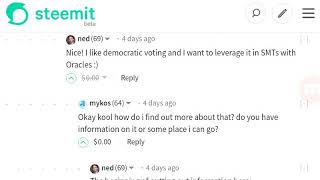
Ned Scott, CEO of Steemit, proposes an Oracle system to move from stake-weighted voting to one-vote-per-account by having trusted accounts verify voter identities and remove fake ones. The creator questions how vote value gets equalized and what happens to large STEEM holders, but sees potential for making the platform more democratic.
Chapters
Hey you, welcome back to the channel. And guys, today I want to talk Steemit, and I want to talk about a conversation thread I was involved with, with Mr. Ned Scott, the CEO of Steemit. And so guys, of course, recently we've come off hard fork 20. It is now stable. We are now able to use it. And So far, things seem to be going quite well. So I want to talk about some, some issues that has existed on Steemit, and many of us have been hoping we can find solutions to it and solve the problem. And after talking with Mr. Ned Scott, I was able to find out some information I thought was very important for the Steemit community to know about a a, a new way forward using something called Oracles. Okay, and so we're going to talk a little bit about what Oracles, uh, is and how it plans to help with, uh, democratic voting, but also help with, uh, people being able to create more accounts to, to, to usher into a, uh, a, a healthy growth market, which is what you need in social media platforms and, and what's the worst team it needs to go. And so I was, I was quite impressed with what I saw with this, with this Oracles. And so let's talk a little bit about what, what Oracles, what Oracles is. And so I think the best way to approach it is first maybe think about what you get when you're involved in a poll. Maybe a candidate is running for a certain type of office and you vote for that person and that data is collected and then someone has to relay to you the winners. And so, and then you may also think of the, the term oracle Uh, you— what generally might come to mind is something like the Oracle of Delphi. Uh, you know, this ancient— these— this ancient, uh, uh, I don't know if there's a sorceress or some type of, uh, person or that knew the answer to everything. So you would seek counsel from these, these oracles, right? Believe in ancient Greece. So what's going on with this is this is collecting data in an effort to flush out— if we were to have democratic voting, this is an effort to flush out what, what we'd have with dummy accounts. Because the, the problem we've had with a more democratic account-based voting system is that it would incentivize people to create dummy accounts, and obviously they just come in and that would be no good for Steemit. And so far, that's why stake-weighted voting has worked the best. Unfortunately, it has created a situation where there is generally a smaller group that's controlling most of the influence on Steemit, right? So it becomes less democratic in that regard. So how could we have account-based voting yet don't run into the problems of dummy accounts, so we can have a more democratic approach to this, which obviously is going to be best in the end. So how this works, guys, or the, the idea behind it, the concept behind it, and it will work with SMT, and Mr. Ned Scott says he's going to release more information as they start to implement this into Smart Media Tokens. But to give you a basic rundown of how it would work, is that kind of think of like witnesses. And on Steemit, we vote for witnesses, uh, and they're democratically elected. And, um, the oracles would be similar. They would be elected, if I understand correctly. So it would be a democratic process where we could elect these oracles, and if they don't do a good job, we, we could vote for someone else. They could be voted out, right? Just like what we get with the witnesses on the Steemit blockchain, right, mining the blocks. So, so what we, how this would work is there would be data that is being relayed back and forth from these accounts, and then there would be a ledger where this data is matched against other data. Like for instance, maybe a person with an account would have some type of identification or data, just, you know, roughly speaking. And then there would be a ledger that's matched up with, by these oracles, and they can kind of determine if these are good or bad accounts, right? So in the event that they discover it's a bad account, these oracles, they would— excuse me— they would then— this person would be kicked out of the system, so they would be unable to vote. Um, and so the video is going to do a greater job, obviously, of explaining this to you, but I'm just giving you a quick rundown of, uh, the, the basic concept of how it's supposed to work. Uh, and I think something like this is going to be a great approach to the problem of having more Democratic voting on Steemit. And so I think that's gonna— I think they are moving in the right direction, and I'm glad that that's happening. Um, now it's going to be more information released exactly on how it's going to work, um, but, um, it will be incorporated with into SMT. So, uh, Where's more information I think I would specifically like to have is where they speak about once these votes are cleared, these are good actors, these are good voters, obviously the value of the votes will still be a factor. I guess the part I'm a little bit unclear, I would be a little bit unclear about in this is as each account would now have a vote, uh, each account, one vote per account, uh, you know, then I'm assuming they would all be equal. I didn't get a whole lot of clarity from that video, so I think I would, would have liked to have some clarity on that. Would they be value-wise equal, right? Because I, I would guess it would, would have to be that. But, uh, some people have a little problem with this. They feel it's just too centralized, and that's been a big topic sticking problem that we've been having, I think, through the course of the entire cryptocurrency space. When we encounter, uh, coins trying to solve issues, trying to solve problems, and they just seemingly fall into this area of, uh, just either being too centralized or too decentralized to the point you can't correct things, you can't change things. Sometimes that might be for the better. And so, uh, we kind of find ourselves in this tug-of-war struggle between these two, these two areas. But what the, the approach to this, the very basic approach to this, that we can have people monitoring these, uh, these bad actors so we can have the growth that's needed on Steemit. You know, you have people, they could come in, they can create accounts without, without all the restrictions we're getting, have it more democratic where everybody's vote is equal to everyone else's vote, if that's the idea. My— the only, the only issue I'm unclear about with that is what happens to the whales? What happens to the, the, the large Steamians? Uh, obviously they keep their Steam, but they would no longer— would they still be incentivized to buy more Steam, right? Or maybe it could be that because the growth rate would be so great, perhaps the overall value of Steemit will grow, and in the end they will still win because they'll have more value with their STEEM, which I think would be the smart, uh, way to think about this. Because I know some whales might have been incentivized to buy STEEM and have influence over the network earlier, but I think if I were a whale, I would consider that If the value of STEEM is decreasing and it's not growing and you have large investments in STEEM, at some point you have to factor and go, well, this isn't very healthy for my investment or my involvement. The fact that we can't grow, the fact that we could possibly have people come in, get discouraged, and leave, which happens quite a bit, and have our STEEM value not go up when it could. If against the growth rate, we could have a more value. So those are some things to determine. Um, and watching the video, the only other thing I could say was, uh, I would have loved to see, or did, or they speak about this algorithm, uh, uh, uh, basically, um, basically, um, uh, giving a comparison of what, what the votes would be worth. Uh, and, and here's the thing, here's what, here's what I think is what they're, what, what, what they were going for, what the video was relaying over. And I, I probably missed it, but now that I think about it, maybe it's more or less like they just take the collective rewards pool and every vote is equally divided in that rewards pool, right? 'Cause they can divide one vote per, they can do that, but it would be very difficult for them to, I think, do that if the votes weren't equal and if it worked how it worked on this present system. So this is gonna be all very interesting to watch. I do like the fact that the think tank here is trying to come up with other ways to do things. And, uh, uh, you know, I, I think it will help going forward, and, and this might be something that really, uh, creates a much better situation for Steemit. Um, and, and so we're gonna have to wait and see, but I was glad to get that reply from Mr. Ned Scott to see that they are working this, working on these things, trying to get, uh, Steemit a lot more fair for people to want to use it and stay involved in it. And, you know, of course with the resource credits now, people are able to set up their accounts and come in and use their resource credits, which seems to be working quite well right now, guys. So I want to talk about that a little bit, guys. Talk about what I found with oracles. I'll leave the link in the description. Make sure you watch it. It's some good, some great things in there. And like I said, from what we heard from Mr. Ned Scott, there'll be more information about it as it, you know, as we get closer to SMT, how it's going to be implemented in, and maybe a little bit more specifics on that. But guys, anyway, that's all I want to say. Guys, if you like content like this, don't forget to like, subscribe, and until next time, take care.
More from Michael







UBI - CIA Agent Explains Why Americans Will Never Get Universal Basic Income?



