
Steem - The $1.7 Billion Project
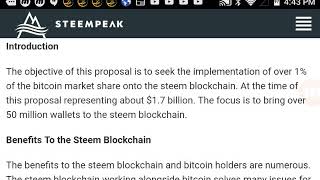
Steem's $1.7 billion blockchain failed to gain users despite free, fast transactions because it offered social currency rewards when people wanted actual money. The presenter proposes creating a Bitcoin-like token on Steem, distributing it free to Bitcoin holders, and using influencer partnerships to attract users where social incentives alone couldn't.
Chapters
Welcome back to the channel, and today we want to talk about the $1.7 billion project on the Steem blockchain. So that's a big number, and when we look at market capitalization of a cryptocurrency, that's going to dictate a lot about what the volume is going to be, the Transference of this value will be reflected in that market cap. And so it's very important. It's not just a, you know, a number that has no meaning or doesn't matter. It is a reflection of what's going on on your blockchain. What's the value of your blockchain? Who's using your blockchain and why? But before we can get to the big numbers like $1.7 billion, introduced to the Steem blockchain, we got to kind of understand why those numbers make it to blockchains in the first place, why they aren't on some blockchains, and what needs to happen in order for that to be the case. So one big narrative I found that's been happening along the Steem blockchain has been more, more along the lines of social media. Now when I'm speaking social media, I'm speaking in very broad terms. That's kind of including not just blogging and posting and uploading videos, but also gaming, gaming communities, and a variety of things. So I'm kind of condensing that down into these, these applications over the blockchain. But why haven't they become like Fortnite and these big gaming communities and Sensations as of yet, with seemingly more to offer as far as, or potentially more to offer as far as value? And why hasn't the social media parts of it been able to grab a hold of people and basically make them join? So we're gonna go over that today. We're gonna try to shed some light on that, give an explanation. In our research, we found probably want to be part of the problem. So I'm going to start with examples like Facebook first and what generally happens in, uh, something like Facebook or, uh, when it's, um, compared against, um, uh, decentralized social media on the blockchains. It goes something like, uh, well, this is decentralized, nobody controls your data, nobody can sell your data. It goes something to the point of we pay you for blogs, we pay you for posts and a variety of things. And the idea is to incentivize people to, you know, leave these mainstream social media sites, these big corporate-controlled social media sites, and use these blockchain sites. And As I've looked around the cryptocurrency space, you know, at the top push of this, we've seen less than, um, maybe, uh, or the height of maybe between 3 to 4 million people. Uh, and this is across the board on most of them. That's like the maximum it can grow. Now, under normal circumstances, one, one would generally use something like, or say something to the effect of, well, it's still new, it's early days. People are learning about it, it's growing gradual over time and a variety of things. But in comparison to other social media sites online, traditional social media sites, we see a great deal more growth than what we see in comparison to many of these social media sites on the blockchain. You know, for instance, over the course of, uh, 2 to 3 years you know, we could see several million people grow in traditional social media, over a million in probably their first year, and getting into their second and third years, tens of millions. And so in comparison, a lot of blockchain social networks can't seem to keep up with that, and we want to understand why that is. So one reason I think it is, is just the models themselves. And so when we're presented with ideas like decentralized social media, when we're presented with ideas like getting paid for blogs and posts and a variety of things like that, whereas one would think this would create a great deal of demand, it doesn't seem to be doing that on the level we'd like to see or what we'd expect. You know, you'd expect if you told someone on Facebook, look, you're up here posting all day, you're doing all this stuff on Facebook, Facebook doesn't pay you one red cent for that. We're willing to pay you for things you do all the time, but that doesn't occur. People hear that message, they still don't leave. And here's why I think that is. So, excuse me, the reason I think that is, is because I think there is a disconnect with the idea of what's— where value is really being transferred. For example, one might think at first glance that Facebook pays you nothing to use it, but that's not exactly true. If you think about what Facebook is really doing, Facebook is give— it's paying, but it's paying in a different type of currency. And this type of currency is social currency. And what do I mean by that? Well, the value gets translated when you use Facebook as far as reach and as far as how many uses you can— you have with that reach. For instance, if you want to sell a bicycle or a t-shirt, you can put a blog about it on your Facebook account and and maybe reach millions of people when 40 days out you got people purchasing items from you in a variety of things. That's a lot of value when you could potentially reach billions of people, uh, as compared to maybe 2 or 3 million people, right? Uh, so that's a lot of the disconnect. A lot of the disconnect is also the relationships, um, that you have on large social media sites like Facebook, where you have these type of valued relationships, where you can engage with so many people and have the option of engaging with so many people. So that is another form of, of social currency, if you will. Remember, the concept of money in itself is kind of a fake concept, right? The money is only a reflection of the value we transfer to one another. So the more people you have able to transfer that value, whether it be a blog post, a picture, or a message, how you doing today, an encouraging message, a poem, or whatever the case may be, the more people you can help with that and the more people you can reach is the more valuable that platform is, and thus its currency, right? So even though, uh, a lot of the Steem blockchain has went on the narrative of, and we're paying you for this, we're paying for this in our token and what have you. And it— you would think that that would encourage people, a lot more people to join. Everybody on Facebook, you think it encouraged— it would encourage them to join if you're just saying every time you write something down here, you're potentially going to be paid for this. Uh, but it doesn't work because they are being paid. It's just that the currency they're being paid in we don't happen to see it. Um, now another issue with the Steam blockchain that's keeping money like $1.7 billion from coming into it, like what we're proposing, is that Steam, it works kind of more like a of money, I guess, right? And that is because of a lot of the activities and the movement of this value. The way STEEM moves, it kind of, it feels more transactional. That's why it does so many trades. That's why the level and the number of transactions are quite a bit, right? It's a lot because it's a lot of transfer of value going on there. But Uh, the thing is, um, the kind of value to come into the Steam blockchain for people to really have that, uh, uh, um, opportunity in that would require it to act more in the concept of an asset, right? And so it's acting more like a money now. Um, and, and so that could also be kind of hindering the, the growth value of it. The catch-22, of course, is the more valuable it becomes, it's going to attract more people. Uh, it's going to be more well branded like Bitcoin. Um, and so these narratives we've told about the Steem blockchain that should in theory work, that I would think would work, uh, doesn't really work because the re— uh, as of yet, because the reality of it is, um, I would think at this point with the a lot of the concept of the Steem blockchain being spread across social media, that it would have this viral effect where people would just tell their friends, hey, I'm getting paid for blogging over here, and it would go something to that degree. The last part I would say is, is just the, the learning curve to Steem and just cryptocurrency in general. And Steem has kind of did a good job as far as wallets is probably going to be on the level one, the easier wallets to use, right? But the process of purchasing STEEM and buying STEEM is another problem because STEEM is generally going to be purchased through Bitcoin, right? And that's going to regulate the, the value and the growth of STEEM a lot, uh, in, in purchasing through Bitcoin, right? Um, so that I just want to kind of point out just some basic ideas in the very beginning what could hinder STEAM, the STEAM blockchain, as far as a lot of the appeal being a lot of the social media applications. And so what we have to do to really understand how we can get $1.7 billion into the STEAM blockchain and get it into it quite easily, uh, I mean pretty much effortlessly, believe it or not, is by, uh, using the STEAM blockchain for something other than a lot of the social media applications. Now they work, but there needs to be something that is more, uh, value-wise going to translate, uh, value and use over to people more so than what's being offered now. Uh, you know, I, I think if we really look at the Steem blockchain, we're for the most part looking at Steemit, steemit.com, the website, right? Uh, and some people say, well, it's more to the Steem blockchain than steemit.com. But the reality right now is, is just Steemit.com. Um, and because of that, people are just kind of looking at Steemit.com as just the entire Steem blockchain. And that makes a lot of sense because Steem has become the flagship project. It created and traded the most value, right? As the Steem blockchain was built to house it, and it's pretty much been, uh, that for Steem and been almost synonymously identifiable with Steem. And now we're making leaps to change that, to show people, hey, we can create great games on the Steam blockchain that can grow, that can grow like a Fortnite product. And we're showing them all that, but we have massive competition already in those markets. And to get $1.7 billion, you have to help a lot of people, but you also have to do something other projects aren't doing. And right now, trying to make the case for we'll pay you for your blogs, we'll pay you for your social media, this is decentralized social media, doesn't rank high right now on the level of the end user's priorities. And the reason being, it's a very simple reason for this. And our researchers found this just to be the case. And that is people for the most part still like someone else to be responsible for him. And let me explain what I mean by that. So when you do your banking, right, and you lose your credit cards and you lose your money, what's the first thing you do? I gotta call somebody, uh, and have them block my accounts, restore my funds, and a variety of things. This is how we're programmed, and this is what we expect. And so it's very difficult for us to transition over to, you gotta suck it up, buddy, you just lost millions of dollars because you weren't responsible with your wallets and your keys and a variety of things. Uh, the part, the list of priorities right now for people in that mindset to go from letting it be somebody else's responsibility to go to, it is now my responsibility. Is not ranked high on their list of priorities, right? So now that you kind of understand that, understand where this is going, and I think got a more fuller picture of where this needs to go, let's talk about how to get $1.7 billion into the Steem blockchain. So here's the thing— excuse me— a lot of people, a lot of people in the cryptocurrency space A lot of people start projects, the first thing they do is they go, well, uh, first thing we gotta do is mass adopt to onboard more users. How we onboard more users? Then they go through a process of trying to get new people in, get new value and get new money in, and the people have to go through generally difficult transitions to learn cryptocurrency, to inconveniently move their money, to wait for transactions and a variety of things. It is not a good experience, and it is an experience that can make people move back into giving it to the responsibility of somebody else. And if you go with the narrative of, well, it's got to get to everybody's responsible for their own money and losing their own money, money in a variety of things like that, if we want to get it to that narrative, then we're probably going to start to pull into a kind of more niche market where where there are people who think like that and are a society of people that believe that is how the money system should work. And that's probably gonna be a long drawn-out process for that. There are gonna be some people who aren't either/or, meaning that they aren't fully for decentralization or fully for centralization. They may fall somewhere in the middle. So even a narrative of a decentralized, totally decentralized platform whereas for many of us that is the ultimate goal, uh, for the rest of society that might be very not very reflective of much of society. So we have to keep all these things in mind, uh, when considering all these things. But in order to, to get $1.7 billion to the Steam blockchain, first we have to look at, uh, the concept of Uh, maybe we're doing it backwards, right? Maybe we're trying to go out to people who aren't ready yet and try to pull them into this thing. And in doing that, trying to hope as they come in, they bring value in. Whereas maybe we should work from inside out, meaning that we should control, uh, the money that's in cryptocurrency in the best way possible. To then pull people in from the outside into a, a well-healthy economy amongst ourselves. Because even amongst ourselves right now, the economy isn't, uh, a very healthy one. But we do that, and then we pull new users into a fine-tuned system. So this is how we do it. It's a very simple way we do this. Looking at the STEEM blockchain It is many advantages to the blockchain outside of the social media applications, the gaming applications, and so on and so forth. And part of that is the ease of use of the wallets and the free transaction system that gives you so many resource credits that you're probably not going to use them all and move the money about anyway. So you— it basically means you pretty much end up with all your transactions free across this blockchain. Now that is true, the speed, not only that, but the speed at which it moves, being one of the fastest blockchains, that offers tremendous value to a lot of projects or a lot of concepts in the cryptocurrency space that are trying to make this work. So I mean, it is almost, uh, you know, as easy, so easy that a 5-year-old could figure this out. That what you need to do is kind of understand where all the value is. That is in Bitcoin. That is true. But even though most all the value, over $170 billion now, is in Bitcoin, um, Bitcoin itself is in its very prehistoric, if you will, design that's meant to stay that way. It doesn't do a good job at onboarding new users. Itself, right? So Bitcoin, the, the, the perfect concept for us would be something like a mix between a type of Bitcoin deflationary type coin, uh, and a social media network, which is something both products don't have. Both Steam nor Bitcoin has the perfect combination of what is needed to onboard users, whereas I think Steam could— will do a better job of onboarding users than Bitcoin. STEEM will not have the value of Bitcoin because of the structure of how it is. So when you combine these two together, these two products, you kind of somewhere in the middle get a solution. And it's very simple how it works. So we've just, we've, um, researched Bitcoin forks, right? And a lot of these Bitcoin forks have went very, very well. Even the worst of the Bitcoin forks that people don't like have managed billions of dollars in, um, valuations, right? And they do nothing really. Nobody uses them. Nobody buys anything with them. They just speculate with them. Now imagine a Bitcoin product like that on Steem blockchain that is actually used by people, right? They have a very valuable cryptocurrency. And why we believe we could bring in numbers like $1.7 billion is that only goes to about, uh, uh, um, 1% of the value of Bitcoin. Now you think about something doing everything Bitcoin can do and allowing Bitcoin holders to maintain their value in Bitcoin and have their value in uh, this Bitcoin product on the Steem blockchain, uh, which is basically what it is. And with, with all that working together, we see no reason why we couldn't get a market share of 1% of Bitcoin in doing that quite easily. Just 1% of the value of Bitcoin is only about $100 a token. Now we would, uh, dream about Steem reaching a price of $100. We believe this is how it would happen, right? And it would happen by getting 1% of Bitcoin holders using the Steem blockchain as a proxy for transferring their Bitcoin. And this will be very simple, work just like a fork, where they receive their Bitcoin tokens on the Steem blockchain absolutely free. Now we do something called pegging, as I've talked about before, where you take various cryptocurrencies and you buy them, um, and but what we could have, and they're backed by, uh, they're backed by the actual coin. But in something like that, we've seen that they don't work quite well. People don't want to sell off their, uh, cryptocurrencies they feel are more valuable for altcoins they feel that are less valuable. And so oftentimes that doesn't work. So in order for us to really solve that problem We have a system that takes the risk from the Bitcoin holders, allows them to transfer that value in a safe way by verifying what they hold in their Bitcoin wallets and giving them that, uh, value, um, in token relational value. Uh, we give off so many tokens for the Bitcoin over on the Steam blockchain. Uh, now we know this works because we've seen this work many, many times. And if you don't believe it works, just look at products like Bitcoin Cash, Bitcoin Satoshi Vision, Bitcoin Gold, right? Uh, even look at projects as we've added a deflationary method to this. Even look at projects like the Bomb Deflation Token that just shot up, right? Um, because it was deflating, which is what this product does on the Steem blockchain. With all these things to couple together, we believe it can produce or take on a market share about 1% of Bitcoin value, which is $1.7 billion. Now that's not the end of it, that's just phase 1. Remember we said we're working from the inside out instead of just saying, hey guys, come over here, buy these tokens, just take a risk with your money, take your money, risk this money on us and lose your money possibly. Uh, we're saying that let's create a valuable product and bring people into a valuable product. And we can do that easy by, uh, creating this Bitcoin sidechain here in the Steam blockchain, credit towards the value of $1.7 billion. Then we can easily, more so easily bring people into the cryptocurrency space with this valuable product, right? It is value to them when they come in. They know the value is there. It's not so much they got to come in and, uh, be constantly, uh, bombarded with buy this token, buy this token, buy this token, right? And so that's— I think that's the first method in establishing not only health economy but bringing in a substantial amount of value to the blockchain. Now, although the $1.7 billion won't completely go all into the STEAM dollar. What it will do as this token is purchased with STEEM and sold in STEEM is bring up the STEEM value in this. So you would potentially still have a great deal of STEEM value there, you know, probably close to a billion dollars itself. I can easily see the valuation of STEEM in a scenario like this being worth $1 billion and the Bitcoin NYK token being worth about $1 billion or just something like under $2 billion. And again, we know this to work and we know this to, uh, have that— we know we have the data to watch this by watching Bitcoin forks, right? And what are Bitcoin forks? Oftentimes just untested products that have used some type of the Bitcoin branding and they have, um, basically awarded these free tokens to the Bitcoin network. Now, in doing that, it's not giving away free tokens necessarily, because how it works is it's not long before speculators figure out that a Bitcoin NYK token that is— that's at 10 cents, 20 cents, a dollar, $2, $3— it's much easier for it to go from $3 to $6 to $6.08. It's also a lot easier to understand the value of being able to transfer this money at a very efficient rate, uh, and transaction-free. I, I don't think that's arguable in the least. Also, to bear in mind that many of these Bitcoin-like products are, uh, basically, uh, inferior, a great deal inferior to Bitcoin itself. Meaning that they're only occupying about 3% of the Bitcoin hash rate, but at the same time, uh, still worth billions of dollars. So that's something we need to think about, uh, and really give us some thought. I think we really have to be realistic about where we want these projects to go and how we're going to get there, because again, if the narrative is to try to present Many of the products understand blockchain like a type of social media application that's going to somehow, uh, be, uh, on par with ideas like Facebook or, uh, or Instagram or something like that. Uh, that's gonna be very hard to do because number one, it's hard for people to break out their habits and move to another blockchain, and it's especially going to be a lot harder— or social media site So it's going to be a lot harder if that particular site is offering less incentive than what they're offering. And I know a lot of people go, oh yeah, well, it's offering a lot more incentive because what we have is we have, we're going to pay for these blogs, whatever that is, whatever that amount is. But again, you miss the real reasons why the Steem blockchain doesn't mass adopt. And that is because these other social networks do pay and they pay a lot, a great deal. You just don't see the upfront money, but the value is self-evident. And we have to not confuse transference of a few dollars here or a few dollars there to the transference of real value that is on a scale much higher than what you might make on a few people getting paid to write a blog. Because even in creating something like that, you've already created a, a, a very niche market. The next thing is, that's fine to create a quite the niche market if you don't expect the value of your cryptocurrency to grow very big. Of course, the problem with that is if you don't expect your cryptocurrency to grow very big, then the issue becomes, how is this advantageous to an investor? He wants it to grow as big as it can grow. And, uh, to keep them happy, to keep them involved in the project, and to keep them invested, you're gonna have to find a way to do that. And the only way I know how to do that is, uh, for your network to be able to grow in size and value, right? But you have to overcome those hurdles that stopped it from adopting in the first place. So that's how we plan to get $1.7 billion to the Steem blockchain. Uh, it is an ambitious project, uh, through the use of partnering with content influencers, uh, media and marketing, and really pushing this thing, making every marketing dollar count. We think we're going to do a great job with this because Bitcoin forks aren't very hard to sell. Uh, everybody jumps in Bitcoin Forks, millions of people, right? Uh, you can easily expect about, if done right and marketed properly and with the type of funding we expect to seek from the Steem blockchain of, uh, over a million Steem back dollars right now, um, with the proper marketing and making all those dollars, uh, uh, count Uh, and with the success of forks we've seen and the knowing that people are going to try them, we would say this is very possible, very doable. And we think one of the best, uh, approaches you could take in cryptocurrency now, uh, seeing that there is no way we can seemingly pull in new money and new value to get the type of valuations we're seeking So we have to, uh, figure out ways that work, that are practical to do this. Uh, and we have to do it in a way we're not wasting money either. You know, I know a lot of people come up with great products and projects and ideas, but in a case like this, I think this would be more the safer bet, uh, we could win on. And I think we certainly should take that opportunity. But that's all I want to say. Uh, if you like content like this, don't forget to like and subscribe. Don't forget to join our program. Our project is absolutely free to join and offers you tremendous value. But until next time, take care.
More from Michael







UBI - CIA Agent Explains Why Americans Will Never Get Universal Basic Income?



