
Steem Tron -Takeover Full Unbiased Story/Bitcoin MYK Ads Release
In this video the host, a founder of the BitcoinMYK project, provides an un‑biased narrative of the controversy surrounding Justin Sun’s acquisition of Steemit and the subsequent clash with Steem’s DPoS (delegated proof‑of‑stake) governance. He explains how Steemit, the flagship dApp on the Steem blockchain, was bought by Sun, who also amassed a large amount of STEEM stake, giving him voting power over the chain’s witnesses (block producers). The speaker outlines the mechanics of DPoS, emphasizing that voting power is directly proportional to token holdings, which creates a plutocratic system vulnerable to takeover. He recounts the disputed sequence of events: witnesses allegedly pre‑emptively froze Sun’s $16 million stake, prompting Sun to mobilize exchange‑based voting to overturn the freeze, while several Steem staff (Andrew Levine, Steve Garbino, Tim Ruhlscape, Michael Vanderburg) resigned. The host critiques both sides, arguing that the core issue is the design of stake‑weighted voting rather than any individual actor. The video then shifts to the host’s own project, BitcoinMYK, a universal‑bridge cryptocurrency that runs on Steem and other chains. He describes BitcoinMYK’s token economics (deflationary token that burns on each transaction), its multi‑chain gateway, and a novel advertising/UBI program where users pay a $1‑equivalent fee in BitcoinMYK to run an ad board for 30 days and earn back tokens based on traffic. He positions this as a practical alternative to DPoS, introducing a “proof‑of‑participation” model: an account‑based voting system that leverages simulated miners and cross‑chain token movement to avoid resource‑intensive mining and to mitigate stake‑based oligarchy. The host argues that this model, combined with the multi‑chain approach, offers a fairer, more democratic governance and economic incentive structure. Finally, he invites viewers to share their opinions on the Steem‑Justin‑Sun conflict, the legitimacy of the witnesses’ actions, and the viability of BitcoinMYK’s solution, while promoting the project’s exchanges and upcoming ad program rollout.
Chapters
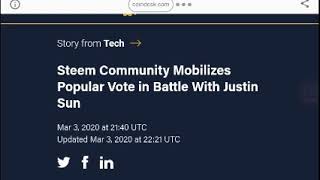
Welcome back to the channel, and today we want to talk about what's been happening on the Steem blockchain during this, what are some calling a hostile takeover by Justin Sun of Tron. So I'm doing this video from my bed, guys. Actually, I'm in the bed. I'm not sick, I'm just really tired. Been a very tiring last couple of days, so if I sound a little bit drowsy or, or something like that, that's why this video may come out that way. So sorry about that, but I was either get that video out this way or I was probably going to sleep without anything, and I want to weigh in, um, and get y'all some information about the story. So this has been an interesting set of events, um, and of course it starts with Justin Soon acquiring the flagship application on the Steam blockchain known as Steemit. Now, Steemit had long been confused. I, I like to say due to the well branding of the Steemit application, uh, it caused many to mistake Steemit for Steam, right? In other words, Steemit is just a social media application that runs on the Steem chain. And, um, it was always confusing to a lot of people outside of Steem because whenever they would have a problem with the Steem blockchain, they would say, oh, they start talking about the upvotes and, uh, generally referring to ideas like Steem. But the big issue with all of this was that, um, that was just one application on the SteamChain, and their whole outlook on the Steam blockchain was based on that one application, Steam. It has to say that if they thought that the upvotes were conducted, uh, unfairly or something to that effect, they were more so pointing in direction to Steemit and not the many other dApps and applications that ran on the Steem blockchain. But we fast forward to where we get this situation where Justin Sun buys Steemit, but he also buys a large amount of Steem, the cryptocurrency itself, large amount of stake. And control, uh, that has influence and voting, right? When the state, uh, and, and of course now referring to delegated proof of stake, you know, this is a consensus model and answer to problems with proof of work, right? And many of us in the crypto space, we understand proof of work and the, you know, and the issues with it from energy consumption to just how it works. And with delegated proof of work, there is a great deal of less nodes being run, but it has a voting mechanism, a more democratic model where people can vote on these, uh, witness validators, these, these witnesses that run the nodes, right? Uh, which would be like, you know, equivalent to what miners do. Um, the, the issue though is through this process where you can, um, vote basically on these witnesses who are going to be the block producers. It's based on your influence and your stake in the Steem blockchain. So it's really based on money. You know, if you have enough stake, you have enough money, you get to put these people that have more voting power, as it were. So because this voting system, as it were, although it does represent certain ideas of democracy in it, because it's money at its core, that in itself creates, you know, uh, many issues, right? And so because it's money, uh, Justin Sun, uh, of course being able to control so much of the stake and influence and stake-weighted voting, he is able to then come in and basically vote in the witnesses he would like to see certain implementations conducted on the steam chain. Now, of course, this all kicks off in a way that's kind of, I guess I could say, to move so fast in what would be a very fearful situation for the Steam chain, uh, basically saying that it kind of loses the idea of decentralization and now you got this kind of centralized figure who controls everything. Uh, whereas I think Justin Sun coming in was trying to, uh, in a way, uh, address that and put people at ease about that direction. It becomes quite odd that then he jumps from that to, uh, putting in these witnesses, uh, of his own and, uh, you know, being now in full control, able to control the chain, implement certain types of actions that he would, you know, now had the power to do. Now here's where the story, you know, and what we try to do on this channel is we try to present all the information available in a very non-biased way. We are part of the STEAM community, but we're a universal bridge cryptocurrency that I'm part of, and so we're part of many communities. And so we don't really have a very biased view on JustAssumes interaction with the STEAM chain in a way that I guess you could say the diehard STEAM community has. But I will say this, uh, what it seemed to transpire off, um, information from, from all, from everywhere, from different things, was that it's kind of like what happened first. And what we're getting is that it was the witnesses who acted first to, in an aggressive way, to freeze Justin Soon's assets, right, in Steam. Now, of course, that's a huge problem because in a very, um, a way that I was allowed by the system that I thought was fair, uh, Justin Soon went in using, uh, the Steam system to acquire his, um, his stake. Now, some are saying those are were publicly staked funds, uh, those publicly used funds from exchanges, because Justin Sun was able to basically get the exchanges to power up and vote on his behalf in order to call the witnesses themselves hackers, but— or the top 20 witnesses. Now, now the issue was that when all this transpired, one message coming out is that the steamed witnesses acted aggressively first, right? So they kind of spun all these events, if that's true and if that's the case, you know, as to say they did a preemptive strike and they basically froze Justin Soon's assets, right? Now he can't— he's just made this huge purchase over about $16 million and he doesn't have access to his, um, to his Steam which would sound ridiculous in any kind of acquisition. If you think about it, imagine if that happened to you. If you purchased something for $16 million, and as soon as you did it, uh, the, the, the community was able to freeze all your money. You can't touch it, you can't move, you can't do anything with it, right? And they did it, uh, in a, in a fear response based on what they think you might do in the future. Now, that in itself creates a million and one problems, of course. But whether it was Justin Soon acted first or then the witnesses acted secondly, uh, that's some of the information came out, which then led to Justin Soon using these exchanges in order to vote in his witnesses so they could undo the actions that the, uh, the Steam top 20 witnesses had done, right? So this is the full story we're getting. And, um, you know, of course the Steam community is going to tell it one way, other people going to tell another way, um, and it's going to be based on agendas and biases and things like that. But like I said, here we don't do that. So if that— if— so if that's what happens, if that's what happened Um, and we know these events occur, we just don't know which in the order. Um, then now you got this situation where is it fair for something like that to happen, right? These are both systems where people are, through a type of gangsterism, controlling the community of, of users to this chain. Now that's a huge problem for me, you know. Um, in looking at this from many events, you know, obviously, and I think I've done many videos in the past, and I think this has spawned many people leaving Steam and many people being in disagreement with the Steam chain. But, you know, my issue was with stake-weighted voting in itself was one of those very problematic ideas where democracy was not available. Right? Uh, because people could, uh, basically buy their— buy the votes, buy their way in, you know, basically collude with the top 20, um, uh, witnesses, block producers, right? And, uh, of course, none of that represents any type of, uh, you know, democracy in that way, or system that is going to play out fair. And it's just so many various problems with that. Um, and so this has led the situation with Justin Soon and what's happening with the, uh, the, the state witnesses. So there's supposed to be a meeting taking place, a public meeting taking place. They're not sure if that's going to still happen. It may happen, right? You know, it seems that there's going to now be a lot of aggression against these two groups, right? And, uh, I don't think it's going to be helpful for the state, blockchain in the end to have now this big schism. You know, Steam had already had pretty bad PR before this. And I understand that fear is what led Steam to do this, right? With this is in, it is kind of this era of this freedom fighting that went on. But I see a lot of concern with people being able to, through the system of Steam, act with the rules of Steam and, you know, then be attacked based on that. You know, you make a big purchase in the Steam chain and then they tell you they don't like the idea, even though the system was designed that way. They don't like the idea of you being able to own that stake and control so much of the network. And instead of saying that there are inherent flaws in the Steam system itself, and that that is what needs to be fixed, they attack the people who are using that system, right? Big problem, big, huge problem. So this is where we're at with this. We don't know really what's gonna happen. You know, a lot of the conversation was that Justin Sun was gonna just then create a Steemit Tron token, which I think makes more sense, right? I would've thought he would just probably did that from the beginning, but create the Steamitron token. And if Justin Soon creates a better product, he then uses that Steamitron token and people use that Steamitron token, right? You know, um, and his app, the applications run on Steam, and that token is the bridge between the two. And then it's up to the Steam community to decide if they want to use Justin Soon's run control applications or not, much like every other, um, application that runs on the Steam Chain. And there's no need for any type of hostile takeovers in, in any sense of the idea. Uh, the same value transfer can still be, uh, established, whether they want to call it atomic swaps or whether there's some direct incentive to use a Steemitron token. Uh, that's where I think that idea would follow. So very interesting turn of events what happened with Steam. Another interesting thing was, as it says in this article from CoinDesk, down the last 24 hours, 4 employees had quit. Andrew Levine, of course we know him as Androarky, head of communications, Steve Garbino, and Tim Ruhlscape, a developer who wrote Pseudonymously, and developer Michael Vanderburg. So, You know, uh, I'm a big fan of Andrew Arki, uh, when I first came into steam, how he described the economics of the steam chain. And at that time, he seemed to be, uh, a very much a stand-up guy, um, interested in the development and the prosperity of the steam chain. But I, I, I must say, I was very glad to see him quit and break from from, uh, working with Steamit and the overall sense of where the Steam chain was going. You know, again, I feel like a lot of what we've seen on Steam is gangsterism. It's a type of, um, corrupt influential system based on money, uh, and it causes people not to act in the best interest of the chain but in the best interest of themselves. And because of how the chain is, is designed, I I think it's poorly designed in that way. And because of that, it's going to continue to have problems way into the future. And, um, whereas I don't say I, I, um, I agree with Justin Soon's approach and some of the things he did in response to the Steam chat, I think everybody should just took a step back and had that meeting first. I think maybe that meeting should have come at the very beginning to, to deal with this. I think Justin Soon should have did a lot more research and how to approach this and set up a, respectful meeting in, in order to make sure everybody was on the same page, as the witnesses as well. Um, again, you know, based on who acted first, them acting, uh, if they acted— if the witnesses acted prior to that, um, and just out of fear of what Justice Soon could do without him doing it, uh, was kind of weird, right? He's forcing him to lock up his stake, you know, and not being able to use that. Out of fear, based on fear. You know, you're not going to get a good response to that. But because so much, um, confusion too with the DPoS model, delegated proof of stake model, you're going to have things happen like that, um, because of the structure of the system. So what's the answer to all this? Like, is this just gonna have to work? Well, first let me finish off what I was saying about, you know, um, Andrarky leaving, which I thought was great, and these people leaving, because to me that's symbolism of them leaving the all of the negative things of what's going on with the Steam chain and what needs to change, right? Not just Justin Soon coming in and trying to attempt this takeover or whatever it was and denouncing that, but hopefully denouncing the whole systemic issues with Steam as to the reason why this happened was due to the structure of Steam. And that's what we need to work on fixing. And if we can't get agreement on how to fix that between ourselves and the witnesses, you know, then it's time to preserve our honor and walk away and say that we're not for this, right? So I hope that's what that was about. Anyway, anyway, after saying that, let me look at some— let's take a look at some, some solutions, what I feel would be great solutions. Because the, the project I'm a founder of, BitcoinMYK, it actually runs on the Steam chain as well. Uh, it's Universal Bridge cryptocurrency. So it runs on several chains, but you can basically through our gateway system move BitcoinNYK from chain to chain. So let's talk a little bit about that. Okay, here on the BitcoinNYK site, and BitcoinNYK, uh, has the BitcoinNYK token that runs on the Steem blockchain. Um, and basically what it is, is this is a hub for Bitcoin MYK. It is a very interesting project. It's a, um, Bitcoin sidechain deflation token that uses other blockchains to facilitate and move value across these chains. The token deflates against transactions, meaning the tokens actually burn, uh, every time a transaction takes place, fighting against inflation. Giving it more value to the token holder. And through this hub, you can access our gateways and chains and a variety of things, and a lot of interesting things that can be done on the hub. While you're on the hub, video hosting can be done on the hub. Musicians, models, photographers, just these very interesting things. Games can be done on the hub. But what we want to show you, you know, in relation to what's happening with Uh, the Steem blockchain, you know, not only is it to us quite dangerous— I'll take you here to our menu and I'm gonna hit social network. I'll show you some things real quick here. But it, you know, it's quite dangerous to us to be in situations where you're going to kind of have these, um, these things happen like this where, um, you know, somebody like Justin Sun could come in, he could, uh, basically implement changes to the chain. And if you're running projects or applications on the chain, then of course you would be affected by that, potentially in a negative way. So that, that makes a very dangerous situation for, uh, dApp runners, you know, on chains that are experiencing situations like that. But Also interesting doing this, this, uh, ordeal was that Vitalik, uh, you know, who's now, uh, seemingly going to be moving Ethereum over to, uh, some type of proof-of-stake model because of the, you know, issues that arise with proof-of-work, uh, you know, of course his response to the incident of everything that was going on and you know, what was happening, I had to make one think, or himself think about, you know, some of the negatives of, uh, something like the DPoS, uh, algorithm. You know, obviously he would have thought about that. And the issue is, uh, the way it's worked, because it could be based on such gangsterism and collusion, and this is what a lot of the steam chain has been about, is what's created a situation where people outside outside the community, uh, having a very negative look on Steem, uh, and that's been a, uh, unfortunately a symptom, uh, or sorry, a side effect of delegated proof of stake. Um, so what's the answer to that, right, when you have those type of situations? Well, what we've done here is we've experimented with something called the proof of participation model, and basically what you get with it is basically, um, uh, um, a type of account-based voting. Now, of course, there are many problems with that, but how we get around it is that because we're able to piggyback off these blockchains and essentially send our tokens back and forth from the chains, then we don't really need miners. But what our miners do facilitate, we call them simulated miners, which is basically this distribution group that uses certain systems, certain algorithms, but that aren't necessarily needed to secure the chain, but fulfills a great idea of the distribution model, right? And the representation of how the value gets distributed across the chain. So it fulfills many of the ideas of what we go through with this situation. But because we don't have the burden of the resources need to run the chains, then we also don't have the burden of allowing people with the most money to control the chain, such as what we got with the Justice Sooners situation. So we think it creates a very, uh, very good opportunity for us to experiment with a more account-based voting model without fear of, you know, any loss of value to the chain and not being able to, to get the necessary resources to run the chain. So because of that, the BitcoinNYK project that trades on the Steam Engine Marketplace, that trades on the Memo.cash exchange, which is a Bitcoin Cash based blockchain and what trades on the Waves exchange, which is yet another proof-of-stake exchange, we can curve the concept of stake-weight voting in that way. And we can make the system in this method probably as fair as we're ever going to get, and it's probably as representative as we're ever going to get. Through blockchain technology because we have elections, uh, every, um, every time the network grows 10 times, uh, we have elections where the community's votes decide how the tokens get distributed back to the miners, the stimulated miners, right? So it's very interesting, it's very interesting, but I think it's one of the closest solutions to having representation, things being conducted fair, and it only works because we piggyback off the chain. You know, if had our own chain, this would not work because then we would need resources to keep the chain running, which means we have to make deals with the devil like many of the other projects have to do by using, uh, proof of stake or stake-weighted voting mechanisms that require a lot of resources. It, it requires compromise, and unfortunately it's going to create collusion and people being bought and, um, all these things in control. Even now, if you look at a situation like the Steem blockchain, there's nothing stopping Justin Sun from cutting deals with the best applications, moving them over to Tron. There's nothing stopping Justin Sun from basically making offers to witnesses. And this is real life here, guys. It's not hard to do that. It's not hard. Justin Sun is still a very, very rich man. Quite the ambitious man. And I, I, in this, uh, display from the community, whereas it did show a great deal of solidarity, I don't think in the end is going to necessarily be an overall solution for the Steam chain. Before I get out of here, just want to talk a little bit more about the BitcoinNYK project, tell you, uh, some stuff about our new ad program that can be used with BitcoinNYK tokens that we think you're going to like. Very, very much. Okay, so we're now here on the front page of BitcoinMYK, and what we want to show you here is we want to show you how we're setting up a new advertising program that we think is gonna work very well for many of you all. So what's happening on BitcoinMYK is kind of reminiscent of what's happening with EOS Voice. Where you acquire for free, uh, the voice tokens every day, and you can use them to push your, your voice to the front, your articles, whatever you're trying to promote. And what we're doing here is we're creating, like, when you come on the site, creating like these apps, these like boards. They're not really— they're a mixture of advertising boards and, uh, photography, art, musicians, video hosting, and whatever you want to do. You're able to use the BitcoinMYK token on our front page to promote, uh, whatever you'd like to do, right? And, um, it could be, it could be anything, right? It can also be marketing for other products. And this is where this project gets so very interesting, because this is a product that's going to pay, pay marketers to market their own products for them, for their own sales, they're going to receive back Bitcoin and YK tokens. That is because we kind of do this almost, I guess you could say, it's like a, uh, for the amount of traffic and attention value we get to the site, we're going to kick back so much in tokens to everybody who has, uh, an ad board promotion on the front page. Right? And so how that works is you run one for 30 days. We're gonna roll this out within, within the week. You run this thing for 30 days and it only costs you $1 to run this ad board for 30 days, right? Now, this dollar is paid in Bitcoin MYK tokens. You pay the equivalent of $1 in Bitcoin MYK tokens. Which you can get for free. You can get them through our Universal Basic Income program. You can get it from completing free offers on the site and a variety of things. So you actually earn them free, very similar to Voicin that way. And, uh, what happens is, uh, right then your ad board goes up, right? So your ad board goes up, and when it goes up, um, you begin to earn more tokens based on the amount of attention and traffic we get to the site. So in other words, a marketeer can buy— it could be for anything. It could be a person promoting a referral link, right, to an exchange, a referral link to, uh, some business, their own business. What happens is they're just going to pay that $1 for the entire month to run that advertising, and while they're getting attention over to their ad, they're actually going to get a kickback of tokens from us each month. So it's a genius project, uh, idea. I've never quite seen it done this way before, and it's just the way that the cryptocurrency works and our project works that we're able to bring this to you and do it in that way. And so, for instance, if someone were to, to do that and take one of our ads, I'll just click here on one of the ad banners here I'm going to attempt to click there and it takes me to— well, in that case took me to Pinterest, but I was trying to go somewhere else. But it should, but it should take us to whatever you're trying to promote. In that case it was Pinterest, but it will be your advertising that actually ends up there, right? Um, and so that's going to be very, very interesting to, um, use and see. If you're a musician, you're going to be able to basically play your music, um, basically get paid for, uh, the amount of traffic we get on the page to your musical tracks. Um, it's going to work the same way for our video— excuse me— for our video hosting. Uh, if you're a videographer, a person who creates videos, Uh, you're basically gonna share in the traffic and value from that as well, right? So very, very cool, interesting project. We think approaches like this is going to be the answer, um, to, uh, what's happening, uh, in cryptocurrency, in situations like delegated proof of stake. Where it's more account-based voting, it's more based on your attention value, and earning your tokens is based on that as well. And because we don't have to expend the type of resources, uh, it does to run a blockchain, because we're essentially needing to be light on our feet in order to facilitate the value and movement of our cryptocurrency across multiple blockchains, because of that, not only is it safer from an investment standpoint because if one chain goes down, then we're on several chains, right? So not only is it safer from that perspective, um, then it's also just more, uh, going to make more sense and into how to transfer value and, uh, basically to operate in a more fair democratic sense, which is what I think a lot of people are looking forward to. So, uh, try BitcoinMYK today. We're trading on 3 exchanges now. We're on Steam Engine. Uh, if you're on the Steam blockchain, you probably already know about Steam Engine. It is our version of the ERC-20 token that runs on the Steam blockchain. Um, and so, um, you know, basically you're able to trade these tokens, receive these tokens. Uh, again, also trades on the Bitcoin Cash blockchain. On the Mimo, uh, platform and trades on Waves Exchange, one time known to be the Ethereum killer, which is a very fast, uh, has a well-done mobile app for our BitcoinNYK token. And, uh, um, yeah, that's all I want to say in this video, guys. Tell me all what you think about what transpired with the Steemit Tron thing, uh, where you stand on it. Do you think Justin, it was right that Justin Sun, um, Steam be frozen after he spent $16 million? Or do you think that Just Assume would have just implemented attacks that would harm the Steam chain in the end? Hearing a lot of different responses from people, and although I don't have a negative feel against Steam Witnesses, you know, I know everybody's just part of community. Trying to do something they believe in. And, uh, you know, STEAM witnesses are incentivized because they're receiving obviously money from the STEAM chain every day of mining the STEAM, the, the, the top 20 or so, or whatever it is. I understand their position, but, you know, I also understand they're incentivized to try to keep their positions. And, uh, you know, sometimes that doesn't necessarily, uh, how they're able to do it, how people are able to prop them up through the state-weighted voting mechanism, uh, people with the most money are kind of able to operate what I would deem to be more of an oligarchy or plutocracy. Uh, because that's able to go on, I think it's going to always be a negative connotation, uh, going with the Steem blockchain. Um, and, and, and so because of that, it's a lot of different opinions out here about this, but I would love to hear from you all directly, your opinions, what you think about the situation, uh, you know, uh, who's right, who's wrong, or neither right, neither wrong. Love to hear from you guys. That's all I want to say in this video. Don't forget to join BitcoinMYK. You'll be glad you did. We'll leave a link in the description. And until next time, take care.
More from Michael







UBI - CIA Agent Explains Why Americans Will Never Get Universal Basic Income?



