
Steem VS Bitcoin - DPOS VS POW
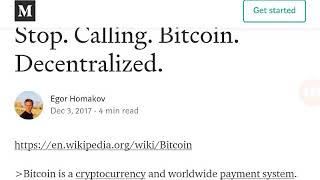
Bitcoin's mining is concentrated in China despite claims of decentralization, while Steem's delegated proof-of-stake uses elected witnesses for fairer governance. The host proposes a Bitcoin-backed token on Steem to combine Bitcoin's value with faster, free transactions.
Chapters
Welcome back to the channel, and today I want to talk about the Steem blockchain versus Bitcoin, or delegated proof of stake versus proof of work. And, uh, you know, it could be that maybe Bitcoin maximalists might not like this video or some of this information presented, um, but, you know, I just want to go on record as to say that I believe right now Bitcoin is the best thing we got towards decentralization. It is the most secure network out there right now. And so there, there is, you know, no suggestion that at this point in time something is better than Bitcoin. However, what I would like to put out there is that there are many, I think, fallacies about Bitcoin that I think we need to consider, and in doing so, uh, try to present that Steem has many advantages over Bitcoin. And to that degree, I don't think that should be overlooked, in which I think it does Bitcoin holders a disservice. We're going to get into that in this video, but But this article we're looking at comes from a gentleman by the name of Igor Homakov. And as you can see, he's probably not a Bitcoin maximalist, but he does speak about some very interesting information in consideration of these two blockchains and what's been a lot of the thought process about them. Now I'll leave a full link to the article in the description. But, um, Igor doesn't believe Bitcoin is decentralized in the way that we do at all. And he goes on to talk about and to kind of show this diagram, variety of diagrams. And when you get to this diagram, this is what Bitcoin decentralization looks like. All of this red represents a lot of the decentralization or a lot of the, uh, the network control belonging to China, right? All this red represents that. Um, you know, also, uh, in addition to that, um, you know, it goes on to speak a great deal about not just the network itself but the value of the network, the wealth of the network, the development of the network, right? So you have several categories. You have a kind of, um, What doesn't appear to be from his data doesn't really look like what you would consider decentralization of mining or decentralization of wealth or decentralization of development. And that is because when we look at these graphs and charts, uh, to have a centralized— a more decentralized, I'm sorry, uh, rather, uh, graph and chart, let's say it would look something more like In his example, it would look something more like this, right? But, and then it'll kind of maybe, you know, get to like how these charts look and maybe in a more perfect looking diagram, you probably have, uh, you know, more of a more even division here, but you don't, you kind of have this situation here. Um, but let's just kind of get into— this is what proof of work looks like with the best network out there in cryptocurrency. But let's just kind of get into what delegated proof of stake would look like. So what would the differences be in that? So, and using the model based on Steam, I want to clarify as well that the delegated proof of stake model, uh, on Steam It's probably not the best example, and it's probably not going to be, uh, it's not probably doing the best job it can with that. But what we are seeing is it has potential, and it has that ability and that option in there, we, we think, to create, uh, at some point, a much more efficient system and a much more decentralized system. And a lot of it has to do with the delegation process itself. Now, to understand the acronym of DPoS, a delegated proof of stake, the D is for delegation. Now, the term delegation occurs a great deal in the definition and understanding of decentralization. And what is delegation? It's generally to move power and authority away from a central authority by the selection of a smaller group to represent a much larger group. And how is this smaller group, uh, able to be selected and, uh, have this ability and responsibility? Well, it's done through elections, right? When we have a delegation, the larger group chose them. And this happens on STEAM with our witnesses, right? So you have this kind of democratic voting system. Now, it's not perfect in that, you know, it can kind of be you know, basically, for lack of a better word, changed, manipulated, stake-weighted voting has a lot to do with it and like, but the core idea of an election process to decentralize a network is, we believe, on the right track. And so that's very important. That's something you don't have with Bitcoin, right? With Bitcoin, how we're looking at this diagram and how this diagram came about was— came about through the absence of an electoral system. So the entire point we're making is that an electoral system in decentralization represents the best chance for true decentralization. So if we want to have the conversation and say that Bitcoin is best at that, then we can have quite a bit of disagreements And as we go on and on in cryptocurrency and we learn new things and more things, we're finding out that there is a great possibility of a better algorithm that can accomplish and achieve these things than, uh, uh, or than, uh, uh, um, Bitcoin, right? And the proof-of-work algorithm. Um, so where Steam comes into this, of course we've covered they're using some kind of delegated proof of stake. But this blockchain also has free transactions and they're fast. They also have a very, um, uh, easy-to-use wallet system, which means it's going to be easier to get new people in using it. Very familiar, very identifiable in a way of a lot of the applications are applications that we're accustomed to using— social media sites, uh, music sites, game sites, and the like. And you just don't see these things, uh, really occurring with the Bitcoin network. It just doesn't work. Bitcoin has kind of, uh, become this base trading pair to buy cryptocurrencies, and it's become a store of value concept, right? So at some point in the future, does the Steam blockchain Is it able to enact on many of these things, right? And we believe yes, it is. We believe with projects like the one we've created, the Bitcoin MYK project, which actually just takes everything that works with Bitcoin and integrates everything that works with the Steam blockchain into it, right? So you have this kind of deflationary Steam-backed token that, uh, you know, basically you're able to move and do free fast transactions on, uh, and able to possibly grow that network at some point in time. We believe on scale things will shift and you will see an explosion in Steem blockchain users as compared to Bitcoin users because of the complexities of the wallets and the private keys and a variety of things. The cost of the, uh, the transactions, the slowness of the transactions, and many of the things that just don't get people very much so interested in using products like this. So something like Steam that can move free transactions, all you need in theory is a type of Bitcoin product that works. Now some people say, oh, well, you just peg Bitcoin. But the problem with pegging Bitcoin is still relying on the idea of I have to now essentially sell something like gold, uh, Bitcoin, which is acting as this very valuable store of value. You're not asking these people to sell it for what is essentially a payment system or a social media type interface, and that doesn't go over well. What you have to do is you have to adopt the network through a means of a similar situation as what we got in like many of the Bitcoin fork projects that gained billions of dollars just by forking Bitcoin. Although a lot of community didn't like them, didn't stop them from becoming billion-dollar networks. And that's just the data, and that's just the facts. You want to talk credit, right? Bitcoin Satoshi Vision, still top 10 cryptocurrency worth like a billion dollars, dwarfing many other cryptocurrency altcoins, no matter how good they say they are, no matter how much respect they may have gained or may have not gained from the community. And this is the facts and this is the data. Now, uh, if we think in terms of something like the Bitcoin, or rather the Steem blockchain, and a similarity to what you might have got with Libra coin, which was going to be this kind of huge, easy-to-use wallet system, 2.2 potential billion users, uh, potentially the biggest currency ever in the creation of, of, of of the world to the point that government's got to try to come in and shut them down. Unlike other cryptocurrencies that are still going, government hasn't come and shut them down because they don't see them as a threat. In relation to those type things, uh, the Steem blockchain could come closer to accomplishing similar goal to that of growing than I think Bitcoin could. So I think we just have to take a step back and really research this a little bit. And like I said, I'm gonna leave this full article in the description, but I think there is a little bit of, uh, uh, um, um, illusionment in, uh, how we see Bitcoin and its uses and what we're actually using it for and how people are actually using it and what's going to become of it. And I think Bitcoin is going to do well into the future, but I'm just saying that, uh, it's always going to be on the horizon a great possibility that something can take a lot of Bitcoin's market share, or something's just going to end up better at some point. And I think this is something we, we have to consider, um, going forward in the cryptocurrency space. But our project, a Bitcoin deflationary token, uh, on the Steem blockchain, so it's a light bomb token. Which the tokenomics have shown to be proven to work. It's like BOMB token, but then it has the scalability and it has the— nothing can dwarf or beat free transactions. I don't care what you say. If I can get your Bitcoin value to move on a Steem blockchain without you selling your Bitcoin, it can get it free by forking it. There is no other blockchain right now that can boast that that has the valuation and success rate of the Steem blockchain where you can do transactions essentially free. This is just a no-brainer, guys, uh, and I feel like fighting something like this is just fighting destiny. We're doing a proposal on the Steem proposal system that puts together a comprehensible plan just how to achieve this and bring such a great value to not only Steem holders but the Bitcoin holders in the cryptocurrency space in general. So, uh, we're going to leave that in the description. I'd love to hear you guys' thoughts on delegated proof of stake versus the proof of work, uh, algorithm, uh, the advantages of it. Are there great advantages of it? Uh, what are the shortcomings of it? And so we'd love to hear you guys' opinions. But that's all I want to say in this video. If you like content like this, don't forget to like, subscribe, and until next time, take care.
More from Michael







UBI - CIA Agent Explains Why Americans Will Never Get Universal Basic Income?



