
Steemit - Community Curators Project
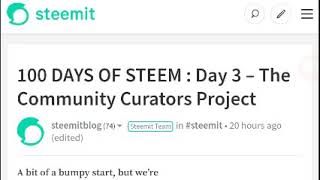
Steemit is allocating 250,000 Steem Power to community curators for one-month terms, plus $1 million to reward effective curation. The project tests two approaches: experts curating their specialties, or a universal basic income model that gives equal rewards to all posts meeting quality thresholds.
Chapters
Welcome back to the channel. I hope you're having a great day. So interesting, uh, information available here today. Steemit is doing their 100 days of Steam communication with the community, and on day 3 here they have the Community Curators Project. So this is quite interesting. We know that it has been quite the eventful situation with the Steam blockchain over the last few months or so. You know, as they say here in this article, a bit of a bumpy start, but we're back for day 3 of the 100 Days of Steam initiative. Quite interesting, 100 days of this. Wow, that's an interesting number. And I Every day, I guess something's going to be happening. Today we are launching the Community Curators Project. Under this project, we are setting up a range of community curation accounts that will be used for rewarding good content across the whole of Steam. These accounts aren't just for the Steam and Inc. team to be going out and curating. They are for the community to use. We are inviting applications from anyone on Steam who would like to be a Community Curator. They are primarily aimed at people involved in running communities, whether through the new Steam Communities feature or more informally through Discord servers, for example. We will also be interested to hear from individuals who are not attached to communities, but would like to curate in a particular subject area that they have an interest or expertise in. For example, education, music, technology. The curation accounts will be allocated for 1 month at a time, right? And then they, they go on here to talk about how to apply and so on and so forth. So this is quite interesting. They're going to be, uh, basically delegating over 250,000 Steem Power, quite a bit of Steem Power. To, uh, these community curators. Um, there will also be another $1 million allocated to what will essentially be a group that monitors the curators, uh, to see how good of a job they do, and they're going to be rewarded for the work they've done. So that's kind of interesting. It sounds pretty good going forward in this 100 days of Steam initiative, it seemed like the Steam team is coming out to make the Steam chain a better place, right? We know that there have been, there has been a lot of controversy about the direction of Steam going forward since it was purchased by Justin Sun. And so it's gonna be interesting to see what happens with this. Now, I Interesting enough, you know, being on Steam now, while being on Steam since June of 2017. So I've been out here a while, been out here a while looking at this very interesting model and, you know, basically interested to see where it goes. You know, what's the story that gets told about the SteamChain? Going forward. And, um, so it got me to thinking, and I would speak with other members of the community, and I would go, well, you know, curation is so very important to the STEAM blockchain, right? But what is the best way to curate? What would be— which area of curation, or what type of curation, would have the more —far-reaching effects, which parts of it would be the most efficient? And of course, we kind of went back and forth. We all came up with these experimental ideas, and I came up with some. Some were a little bit more well received than others. Some were, I think, were a bit extreme. But one thing we did come up with, I think that might have been quite interesting or a good idea. Um, was that curation should be done by individuals in areas that they were, uh, basically specialists in, uh, for lack of a better word, people who would specialize in these areas, um, and they would know to a great effect what curation was. And I actually came up with almost identical idea like this, where these people would then be given over a certain amount of delegated steam to go out for these particular communities that they knew the most about and they could spot, um, the best content on, right? And in doing so, then you would have a community working hand in hand that understood and knew value, right? Amongst their peers. And to me, that made a great deal more sense than just someone kind of going out. And I would always give the example, hey, let's say somebody pours their heart and soul into a scientific research paper and they're an astrophysicist and I'm not. And I come across this great information and what have you, and would I be qualified to curate this post in a way that, you know, that gave it the credit it was due? And I, you know, had to step back and be honest and say, well, no, I wouldn't be able to do that. Now, of course, that would present many challenges. Amongst some of these challenges would be the ideas like, okay, well then what happens to this post that's well done, but maybe nobody has that expertise level to curate it. Would they then have to wait for someone who did to come in and curate it, right? So we'd all kind of, you know, branch off in these groups. This would present problem B. If everybody were to branch off in particular groups on the Steem blockchain, then the allocation of the rewards pool and being able to get value over to these great pieces and works and articles and posts would suffer because these reward pools wouldn't be able to reward posts on a level that is more evenly placed across the chain. And of course, no system is perfect. It's, you You know, we wouldn't be able to get this 100% right, I don't think, no matter what we did. But the basic idea in all of this would be to, you know, make things a lot better for the community, right? And I think an idea like this is moving alongside those lines, right? So I think that's great news. I'm looking forward to more things coming out. If you're interested in something like this, it's giving you instructions here on how to apply. It's on the Steemit blog, and it looks good. You know, it's talking about your community and what you could do with that. So a lot of people know I participate in the Bitcoin MYK Universal Basic Income project. We have a group here on the Steemit blockchain. It's all about universal basic income. And, uh, let's take you over there, have you take a look at it, and we can discuss a little bit more about, um, the Community Curators Project. All right, so here in the Steemit groups, you can see our project. Our project is all about universal basic income. So far, 69 members have joined, uh, and this is basically just— excuse me— of a, um, a community where We have a different view on how curation works, right? And so part of what's happening within our group is that, um, in looking into the idea of curation and how exactly it works, um, how the community values one another's contributions, We have taken more of these stands and experiment of using a more of a universal basic income-based system. Now we know that this is kind of interesting, especially with a lot of what's been going on with Corona, the coronavirus, and it's led a lot of people to now move to ideas like, you know, this might be an option for us until we get out of this. And a lot of people are staying home. Some people are able to kind of work. Some people at home and they have to depend on a government for some type of income to get them through. But when we look at uses for the Steem blockchain, there are some that fall in our group and fall in our camp that believe this is technology of the future that could be very useful, especially in moving value in times like this. And so we believe the work that we do is very important. And, uh, how we look at universal basic income. Although it's not so much specific to the post, it's more specific to the valuing of the post. So, so let's give, let's give you a quick example of what we mean here. So how we look at a post is we basically look at the post being of value and being of substance, but in a way that we don't become experts, so to speak, in those areas. Not only would that be impossible for us to do, but there is a certain type of value we can gauge from a certain amount of activity and participation and making sure it's not spam posts or something like that. Um, part of the— one of the issues that's been happening with curation is not so much that um, the value wasn't there to give it to distribute, but just the means on how it was done, right? And that is because, you know, we formed these communities. And I think the, the, the, the real thing in all of this that we sometimes miss is that what happens on a post isn't just the content itself, it's the people involved with the post, it's the community people, it's what you do on the site and off the site within this community that affects how the community values you. Certain ideas like this is brought up with, uh, the social capital model, uh, composed by Dr. Putnam of Harvard University, where he talks a great deal about, uh, how your social engagement and social interactions can be more important than productivity itself. You know, as to say Hey, you might do a great post, but the thing that might actually end up being more valuable is how you communicate with people on the blockchain, right? And so then it could kind of take out the actual work that went into the poker productivity and put it more into these social dynamics there, right? And I think these are all very, very important things to consider when you put together something sophisticated as a Steem blockchain and the psychology that goes behind how people see value and how they move it and what is value. So what does this all mean in our Universal Basic Income-like approach? And we're going to obviously be applying for this and we're going to, you know, put out some information and posts about this. But basically what it means is that instead of how the stake-weighted voting mechanism works with the Steem blockchain, What you have instead is you would have something more along the lines, um, of, um, uh, of a certain threshold that you surpass in quality, meaning that we know a certain amount of attention went in this, a certain amount of care went into this, a certain amount of text went into this. And once that's determined, instead of going, and now we're going to randomly give you a certain amount of money that in our mindset we feel is appropriate. It's just going to be a certain threshold that you pass. And then at that point, we try to give everybody the same amount that passes threshold. And I want to repeat that when that certain threshold is passed, as far as acceptance of a post, we want to curate to everybody as much as possible the same value, right? In other words, you know, it's not going to be like a one-vote situation where you get $100 on a post. This is where the universal basic income element would come into this idea. So I think that's quite radical. I believe that's quite radical to what we've seen on the Steem blockchain. And where it is, it's true that there has existed a type, another type of universal basic income project I believe several across the Steem blockchain. I don't think they've quite been this radical with it, and I think it's going to take us being this radical with it to really see what this means value-wise for the Steem blockchain, and if through this we end up, um, and with a, a much more efficient curation system. Quite interesting, quite interesting. Let me give one more example to this, to, you know, to kind of get us on the same page with it. This is an event that occurred several years ago, I think almost a decade ago now, where within the town of Paris, France, city of Paris, France, the— there was riots. There were riots in the streets. Now, why were there riots? Well, the reason there was riots was because the retirement age of people in France had been moved up to 60 years old. Now, meanwhile, in the United States, it's about 67 years old. The riots were that the retirement age shouldn't be moved up. Now, this would be quite trivial in the United States seeing that the retirement age was already 67. So in these examples, which one was fair and which one was right? Well, it really doesn't matter which one was fair because it had been accepted it was fair in the United States at 67. and it was accepted to be fair in France prior to the age 60. So what are we saying here? Well, we're saying that in many ways the concept of fairness is derived out of an idea of some type of idea of equality, right? And we know that there is no true idea of equality, but in understanding the curation process and the psychological effect that this can have on a community, we believe that in this particular case, in these particular instances with the curation, what we could possibly have is we can have a very unique situation where, where everybody receives the same amount on a qualified post could change the dynamics of Steam quite a bit. Now, would this make it better? 100%, honestly, I don't know, but But I think these experiments are a good way to find out if that could give us an edge in this space. The riots that started in Paris obviously weren't good, and it obviously wasn't good for the Parisian community. And a similar thing has happened with the way we do things on the Steem blockchain as far as how people perceive value. It's not so much that of the changes in the price as much as the value given to the community and how we see value and how we confuse value with aggregate numbers, right? And in the long term, that can be harmful, I believe, to a community. So in this experiment, we believe we'll find a way not to confuse those things, right? So we're gonna apply for this. And, uh, but just glad to see this happening. I'm glad to see that. I feel like this is finally moving in the direction of kind of how I saw things happening on the Steam chain, where you would have a segregation of communities with a— what do you want to call it— a, you know, voting rewards pool or, uh, or delegation that these communities would all have the same amount of delegation to value, for value to be spread around in their own particular communities of where they're much better at moving value than we are because they know their communities a great deal better, right? And unfortunately, it's always not as simple as saying, well, you know, you could all just segregate, form your own groups either way. But unfortunately, the better part of an ecosystem is a healthy economy, healthy distribution. Excuse me, guys, I apologize for that. Healthy distribution. And, you know, sometimes to have that, it is necessary to facilitate the movement of that value more so than just saying, well, you guys go over here and you form your own communities with your own money. Sometimes for the good of the entire ecosystem, economy, community, these approaches can yield much more beneficial results in the future. And so it's good on Steam to attempt this and try this. I've never quite seen this done quite on this scale before. And hopefully if their findings are acceptable, Um, then, um, they will want to continue this on, delegate a great deal more of the value over to people, right, to do this. And I think this will work out good for, uh, many of the, uh, of the endeavors they have going forward into the future. But anyway, we're going to be, um, doing a post here in a second about applying for this curation. We want to, uh promote universal basic income on the Steem chain and to the community to see if, uh, this works better for them long term. And if you'd like information like this, be sure to upvote the post and, uh, get us out there, get a lot of the community behind it supporting the post. Because, you know, if they choose so to delegate this to us, it's going to be a great deal beneficial to you all because we're going to do our best to approve posts um, on quality, right, and fairness, uh, and in the same value, right? Not, you know, one guy gets a lot, one guy gets little. Um, we're gonna try to create a system that pulls everybody together in the, in the most fair way we can, we can put together with that. But quite interesting, guys. Um, uh, if you like content like this as well, don't forget to like and subscribe and share, share videos with the community. But that's all I want to say, and as always, take care of yourselves and each other.
More from Michael







UBI - CIA Agent Explains Why Americans Will Never Get Universal Basic Income?



