
UBI - Ep.11 - Jack Dorsey
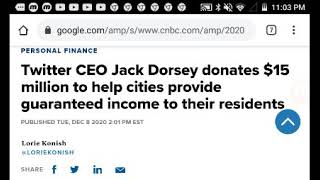
Jack Dorsey donated $15 million to fund guaranteed-income pilots in 30 U.S. cities, offering $500 a month to residents. The host praises the commitment but argues true UBI must be universal and unconditional, not targeted welfare, and explores models like Alaska's Permanent Fund and blockchain-based alternatives.
Chapters
Welcome back to the channel. I hope you're having a great day. So today we're gonna do, um, Universal Basic Income. This is actually episode 11 of our series. I want to get in a playlist so you can be able to watch every episode, uh, as a, as a collection of episodes and, um, uh, get this, um, uh, very important information about Universal Basic Income. But this episode is going to be entitled Jack Dorsey. So this could have been entitled anything. It could have been— the, the idea of the video is to speak about, you know, many famous people who are involved in Universal Basic Income, uh, more so known people. As we know, um, when people who are very influential or famous or trusted advocate for certain topics, there is a great deal more interest in those topics and people tend to pay more attention and understand the seriousness of them and the benefits of them. And so that's, that's began to happen with universal basic income. You know, we have everybody from Elon Musk talking about it will be necessary We have people like Sir Richard Branson of Virgin Records and Virgin Airlines. We have Mark Zuckerberg of Facebook talking about universal basic income. We have world-renowned economists speaking about it. We have celebrities like Donald Glover, David Chappelle advocating for universal basic income. And the list just goes on and on and on. You could do a Google search and you'll find all these universal basic income advocates. And I think it makes a lot of sense because universal basic income has been championed by some of the greatest people in history, from Dr. Martin Luther King to Thomas Paine, There's just been a host of great people throughout the course of human history who have championed this. And although it's not a new concept or a new idea, it is resurfacing as a solution to many of the socioeconomic issues. And that is because As we head into the 21st century, we are facing some of the worst economic challenges and potential possibilities I think we've ever had. Even before the COVID-19 pandemic, we were already facing a looming possible recession. We were already looking at automation taking more jobs and robotics revolutions And, uh, so we were already in trouble. This, uh, hasn't done anything to, uh, help us with that problem. In fact, uh, COVID-19 kind of sped things along. So these advocates, these celebrities, these people besides people like me talking on this video, uh, people that are trusted, great minds, people that are highly intelligent, the richest people in the world, All of these people gather to speak about this, and generally when that happens, that's when it's time to take note and issue of something, especially when you see a lot of billionaires gathering around something. Something's about to go down. And universal basic income is one of those things that our economy more likely is going to shift to, and you're going to see universal basic income probably globally being used, uh, as viable economic system. Um, uh, that's going to be something commonplace, I believe. But there's one thing to advocate for something, there's another thing to, to really put it in motion and put your money where your mouth is. So people like Jack Dorsey, who's recently donated, uh, $15 million to help cities provide guaranteed income to their residents This from CNBC. Twitter CEO Jack Dorsey has donated $15 million to help mayors of certain cities provide guaranteed income to residents in need. The money will go to mayors for a guaranteed income, a group of about 30 cities, and it will provide each city with up to $500,000. I hope they inform federal policy in the future, Dorsey tweeted of the universal basic income. Pilots, right? And so it's very interesting. I had actually been following this story about the, uh, $30 million. And, uh, you know, I can tell you right off, as I've looked at, uh, many different universal basic income experiments, uh, and read their studies and looked at them, I think it's very— it's quite clear And I don't think it takes a lot of, um, I don't think it, I don't think it takes a lot of, uh, uh, analysis to understand that people in need, in this case, are receiving an extra $500 per month. That, that's going to change their life dramatically, uh, to have extra $500 per month to deal with problems they had to deal with before they had the extra $500 a month. Uh, this is a different approach to universal basic income in a way, and what I mean by that is many of these these programs that are tested. And, um, you know, I have to say, like in the case with Jack Dorsey, I would be interested in some of this data, but I wouldn't fully consider all this data. And the reason I'm saying that is because I'm on the spectrum of universal basic income should be universal to everybody, rich, poor. And many times, like in this particular situation. They're going with— I won't say it's not UBI, but it's a version of universal basic income that targets needy people, poor people, you know. And, um, those are the people who need it the most. That is true, but that still negates what universal basic income is, right? When you start to just give the poor people, it feels more like a welfare system. Now, that doesn't mean that people won't have the benefits of universal basic income even if you just give it to poor or, you needy people, people who really need it, as opposed to maybe giving it to richer people who are maybe gonna hold it or something like that. But it still negates what it is. A universal basic income is across the board for everybody, no matter what, no matter what you make. And that's very important, I think, in the overall ideology of universal basic income, that we don't start to blur the lines and confuse it with some type of socialism or welfare system. And I think that could be difficult in dealing with economic stimulus in that way. Poor people are more likely going to spend the money right away, you know, and that does, although that does go back into the economy, you know, obviously a person who's poor and already downtrodden, they're going to have a much tougher time getting the results of a person who's maybe using the Universal Basic Income funds for more market stimulus, uh, into maybe doing other things like creating a business or starting a job or hiring more people or something like that. If you just give it to poor people, the overall effect on the economy might be a little bit different. So I'm not saying this isn't good and a good start in the right direction. I'm just saying that, uh, This wouldn't be the type of universal basic income I would go with. But what I am glad to see is that Jack Dorsey is actually doing something other than advocating for universal basic income, and that is he's put up $15 million. Maybe others who have been as vocal about universal basic income, especially those in the tech industry who in some form or another feel that their advancement in technology and development is, uh, kind of creating, uh, this, uh, result of job displacement in the future. And so they want to be part of the solution. Um, the Elon Musks, the Mark Zuckerbergs, we'd love to see them put up, you know, several hundred million dollars as well, um, in these pilot-type programs or any, uh, program of their choosing dealing with universal basic income that is, according to them, going to be good in addressing the issue. So we'd love to see something like that occur. What I think is going to happen though in the future, in the near future, is we're going to see many approaches and many versions of universal basic income. You have versions like the one in Alaska that I want to do a video on in this series sometime in the near future. But, uh, we're gonna see all types. Uh, the one we're involved with, Bitcoin MYK, is a cryptocurrency. And, um, some people might not quite understand cryptocurrencies yet. They've probably heard about Bitcoin, but they're still in the process of understanding these things. But we believe in the near future that, uh, these universal basic income projects, projects using cryptocurrencies like Bitcoin, Bitcoin NYKR project, that is this fork of Bitcoin that uses, uh, universal basic income in relation to creating what we believe is to be probably one of the core ideas of Bitcoin: economic prosperity, good distribution, healthy distribution. Something unfortunately we aren't even seeing in Bitcoin at this time. Um, and so that is unfortunate, uh, and I don't think that's really in the spirit of what Bitcoin was meant to be about. When we look through history, we've never seen an economy that's not well distributed, meaning that you've got cases like what we have with over half our population, or rather the, the 1% of our population owning all over like half of all the wealth. that we have points to not good distribution, which historically in economics has always equaled a collapsing economy. They've always created the same signs. And, uh, Russell, there's nothing ever good about an economy that's not well distributed. Unfortunately, that happens in our cryptocurrencies. It's happened in our standard economy. And we believe ideas like universal basic income is going to help to correct that. And of course cryptocurrencies, what's so great about them, you know, unfortunately as we push for a lot of government universal basic income projects, which I do believe is going to be necessary, uh, to, um, get this started, I do believe this is going to have to be both government effort, private sector effort, blockchain effort, however you want to look at it. Um, so these things are going to all have to happen together. Unfortunately, this happening through the government, through cash, in a sense also makes it possible for the government to shut it down, government policies to, uh, to change policies in it, or new administrations to come in and get rid of it altogether. Um, and so doing this over the blockchain with projects like we've created for universal basic income, you won't have that problem because these are decentralized ledgers that cannot be shut down by any government or anyone. Um, and so unless you shut the entire internet off, which, you know, we can factor the many issues we'd have with that. Um, you can sign up and register for free today, start earning our valuable traded cryptocurrency. Uh, um, and so I make sure you do that. If you have any questions, feel free to ask them in the comments section. On our website, we have live chat support. Um, but this is the way it's going, and, uh, you know, so we're going to see many different approaches to universal basic income. We're gonna see many people we trust and advocates speaking about it. And so this is here to stay. Uh, we believe it's going to be very interesting to watch. Um, and, um, you know, just going to be one of those things. I believe that we're going to see a lot more, uh, literacy on universal basic income in the middle, in the, in the future through our media, through our, uh, influencers, our content influencers, our, uh, social media influencers, a variety of people. But that's all I want to say in this video. Uh, like and subscribe if you like this video and share this Universal Basic Income series with, uh, people across social media, especially those who are interested in social media— or I'm sorry, interested in universal basic income. I think they'll, uh, find some very interesting information we discuss about it. But that's all I want to say in this video. If you like content like this, don't forget to like, subscribe, and until next time, as always, take care.
More from Michael







UBI - CIA Agent Explains Why Americans Will Never Get Universal Basic Income?



