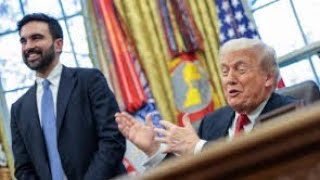
The video opens with a brief interview segment in which a speaker (Speaker B) identifies as a democratic socialist and is asked to clarify whether he calls former President Donald Trump a fascist. The host (Speaker C) then launches into a monologue that weaves together recent political developments in New York City—most notably the election of Zohran Mamdani, a self‑identified democratic socialist, as mayor—with a broader historical narrative about how socialism and communism have been framed in American politics. The host contrasts past demonisation of socialist ideas (e.g., during the Cold War) with the current mainstreaming of policies championed by figures such as Bernie Sanders, Andrew Yang, and Mamdani. He argues that the affordability crisis—rising housing costs, stagnant wages, healthcare burdens, and the displacement of workers by automation and AI—creates a fertile ground for radical policy proposals. The host highlights several of Mamdani’s planned initiatives: state‑run grocery stores to lower food prices, universal childcare, and free or heavily subsidised public transportation. Throughout, he positions universal basic income (UBI) as the most pragmatic bridge between capitalism and socialist‑leaning reforms, suggesting that UBI can be implemented within any economic system with minimal resistance. The video concludes by promoting the creator’s own UBI experiment, BitcoinNYK.com, inviting viewers to try the free platform that distributes a basic income via a social‑economy model.
and the minority leader, Hugh Jeffries, despite his endorsement of you. What's your reaction to that?
I have to be honest with you. I focused very little on resolutions, frankly. I've been focusing— I understand. I think the focus is on the work at hand. I can tell you I am someone who is a democratic socialist. I've been very open about that. And I know there might be differences about ideology, but the place of agreement is the work that needs to be done to make New York City affordable. That's what I look forward to.
And I want to clarify your answer to Stephen Nelson. He asked about your comment calling the president a fascist, and your answer was, both President Trump and I have been clear about our positions and our views. Are you affirming that you think President Trump is a fascist?
I've spoken about— that's okay. You can just say— okay.
Welcome back to the channel, guys. I hope you're having a good evening. Hope you had a rested, well weekend. So today we want to talk about, uh, we'll talk about some different, uh, policies, uh, that have been, um, uh, controversial and, and some may refer to as extreme or concerning, right? Uh, pushed by certain of our political candidates and politicians and such. And what am I talking about here? So We know that recently Zoran and Mom Donny visited the White House, and to much of our surprise, Mom Donny and President Donald Trump had a, what they would term, a very productive meeting. And that just shocked so many people because the question becomes, the policies of the Republican Party, right, are like night and day to that of what would be a Democratic socialist, so to speak. So it could become very difficult to connect the dots on a meeting like this. And you try to figure out what went on. So to kind of go down history a little bit with certain policies, particularly people in America have deemed problematic. We will start at something like socialism. And if you're American, you probably know anytime you heard the word socialism, the first thing that would come to mind would be something like Cuba, you would have something like Russia, you would have something like fascism in Nazi Germany. And interesting enough, the idea of Trump being suggested to be a fascist by so many different people on all sides, it's just a very interesting situation. We got. It would seem that Mamdani didn't roll back his suggestion or his verdict on Trump. And it seems like the idea is they're going to push forward on the things they do agree on, which is interesting. Very, very interesting. I'm glad President Trump did meet with Mamdani. These type of meetings kind of uh, brings us back. It kind of resembles how politics was long ago, uh, and that was where the parties could disagree, but at the end of the day, they were still kind of still one country, and people weren't quite at each other's throats like they, they are now, right? It wasn't like on the verge of civil war, so to speak, but It— when you look at policies like democratic socialism, uh, what's interesting about it, and I'm gonna tie universal basic income into this of course because many of you all watch the channel know I'm a big proponent of universal basic income and I think it presents a huge solution to an ongoing problem, but we'll get into that a little bit as we go. Go. But what was interesting, right, if you look at someone like Bernie Sanders who comes upon the scene and had been pushing the idea of democratic socialism for a long, long time now, right? Bernie Sanders for a long time was deemed or, or pushed in the corner as what would be a destructive policy to America. And then you fast forward Bernie Sanders' policy to, uh, the recent last several years of our political history, and he is the forerunner for the Democratic nomination, right, for president, to the— all the way to the point where a lot of people believe it was stolen from Bernie, that they teamed up on Bernie and concocted this plan that Bernie, as this populist type, should have been the nominee. And Mondani's, in Zoran Mondani's case, he ends up winning, right? And so as the Democratic Socialist of the, what would be the biggest city in the United States. And so basically putting him in charge of next to the president, right? He's running the more complicated city government in the United States outside the president himself, right? right? And he's going to be running it as a democratic socialist. So what that then puts up is it puts up the concept, right? It puts up the model that democratic socialism, if successful in New York City, will not only be a model for New York City, but it'll be a model for the entire United States, right? Because if it can work in New York, right, it's going to be a great case made that it can work pretty much everywhere else. And the good thing about the situation with Momdani in this particular time in history where everything is going on, the leading policy push being affordability, we can't afford afford anything. And why can't we afford anything, right? Um, it— our, you know, our job's not paying us enough. People don't want to pay enough, right? You got all this automation, so you, you, you got people probably being pushed out of jobs. They got to do jobs that, uh, are available, and these jobs don't pay enough, etc. Uh, so there are just so many factors, uh, impacting this, right? We got healthcare issues and such, and that's another part of one of Donnie's policies in New York, to have universal childcare, right? Um, to have transportation costs pretty much eliminated, because if you're living in a place like New York, I would imagine if you can't get around on public transportation, probably most people aren't taking private, you can't drive your cars around New York City probably like you want to. It just makes more sense to take the public transportation. But then if you can't afford metro fare, right, you can't afford train, can't afford those things, then you're stuck. You're literally stuck and you can't do anything, get around as such. And because of the cost of living in New York, Right? Many people can't. So they're, you know, they can't get to key important places they need to be, whether that be work or school or what have you. But anyway, uh, the reason I'm structuring this the way I'm structuring and putting a universal basic income in is to say that isn't it interesting that there was a time where ideas like democratic socialism, like people, candidates like Bernie Sanders were demonized, right? Where even anything with the word socialism, just to say socialism in the United States was, uh, enough to end the conversation, right? All you have to do is say socialist. And the fact that Donald Trump, who has called a politician communist, right? That Mondani is literally a communist and that he wins mayor of New York, the largest city in the United States, is just so interesting to see how far we've come, right? From socialism being completely bad, just the word, to, uh, socialist political leader in the biggest city in the world. And this gets me to beg the question, are we going to see these far pushes into these type of socialistic, communistic systems? And I think the answer to that is yes, right? So the reason I always push universal basic income in there is because universal basic income seems to be the greatest solution with the less friction, right, in these cases. So anytime you roll out ideas like communism and socialism, universal basic income can exist within the scope of capitalism. It can be deemed capitalism that doesn't start at zero. Now, these are quite more interesting dynamics than just city-state government takeovers of businesses. Like, you know, for example, um, Zohran Mamdani wants to do the, uh, the state, uh, you know, uh, what would be, uh, controlled, uh, grocery stores, right? Stores so people can afford to eat, where you can now have the government competing in there hoping to drive down the prices of these private grocery stores, such, right? And so a lot of people think that's a great idea. But then if you've been in the core of America, in the idea that these type of communistic ideas, for lack of a better word, is anything but a good idea, then you're going to still have resistance at the higher levels to that. And maybe even to some of the general American citizens, especially the ones who are competing in that area. Right. And so what universal basic income does is it doesn't necessarily destroy capitalism. I've also had— I've actually had some critics that had a problem with me pushing universal basic income, not because of the idea of getting things free, right? Getting your basic needs, basic income at free, but more so the idea that they didn't feel I was doing enough. In other words, some people do want a more— what would be close to a standard communistic, socialistic system, uh, where the capitalism part diminishes a lot. And I think universal basic income in some way can exist in pretty much every system. And that's why I think it's probably the easiest, less resistant question. But I think the purpose of the video more so is me taking a look at this is just to say that with everything going on with people who would've been unheard of, like Bernie Sanders leading the, as the nominee of the Democratic nomination for president, with people like Zohran Mamdani actually winning the mayoral election and becoming the mayor of New York, right? And having all these policies where people getting a lot of free stuff, right? Under the affordability idea. To have that in there as well. Do you guys now see, and not to forget Andrew Yang, who several years ago led a pretty darn good campaign on universal basic income, giving every citizen $1,000 per month. Now, when you kind of collectively put all these things together, right? You know, are we going into the area now of where all of these what would have been extreme policies, unthinkable policies years ago, are we now moving into places where these things will be— it's not only acceptable but just normal, right? Because like, I remember a time when some of the proposals that Mom Donnie's making and is going to implement, right, as the mayor. I remember a time— or do his very best to. I remember a time when that would have been unheard of, like that wouldn't have worked. People wouldn't have been on board for that. And you got to remember, right, we've been through things like the Great Depression. You know, we've been through the energy crisis of the 1970s. We've been through a great deal of incidents, right? Market crashes, recessions, and so on. When it comes to the idea of affordability, we've been through everything to get to a place where we could go, well, we need to try something else to make the cost of living affordable to Americans and so on. Why at this particular juncture are these type politicians being supported by the people, taken more seriously, and winning elections? Have the people changed? Is it— has it really gotten that bad to where, uh, uh, we're at the precipice where we're gonna accept systems like this? Or is it something else going on? Is it, is it the AI and the automation in the background slowly creeping up and it's the driving force? Because the, the only thing that we have now that we didn't have then are the rises in artificial intelligence, are the rise in automation and jobs being automated away and it having an echo across the economy, right? Uh, it is such, but I'd like to hear you guys' thoughts and ideas about this. And where do you stand? Like, where do you— what type of system would you like to see? And, uh, what do you think is gonna happen? Will Momdani be successful, uh, with his projects in New York? Because I would imagine if he is, uh, he's probably only going to go further with it and make it a model across the United States. So we'd love to hear you guys' thoughts and opinions about that. Uh, guys, we're doing a, uh, universal basic income experiment of our own, BitcoinNYK.com, absolutely free. Uh, we'll leave a link in the description. Try to get over there. I use social media and it uses, uh, social economy to create a universal basic income for all the users. Try it out, see if you like it. Hang with us, uh, try it out. Uh, we think you might like it. We think you might find it interesting. That's all I want to say in this video. Until next time, as always, take care of yourselves and each other.