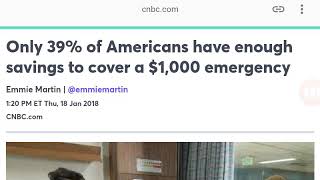
In this video, the host highlights a striking statistic that only about 39% of Americans have at least $1,000 in emergency savings, emphasizing how vulnerable most households are to a single paycheck loss. He connects this savings shortfall to the broader debate over universal basic income (UBI), referencing Andrew Yang’s presidential campaign and the typical proposal of an $800‑$1,000 monthly stipend. The speaker also mentions his own blockchain‑based UBI passion project that aims to allocate network value directly to individuals. He argues that rapid advances in robotics and artificial intelligence could cause economic disruption far beyond the Industrial Revolution, potentially rendering traditional work insufficient. The video critiques the notion that credit cards can substitute for real savings, warning that reliance on debt leads to mounting interest and financial instability. A brief discussion of a Tom Hartman interview illustrates the speaker’s skepticism toward economic models that rely solely on hard work without systemic support. Finally, he asks viewers to consider whether the lack of savings is a personal failure or the result of larger structural factors, inviting comments and engagement.
Chapters
Hey you, welcome back to the channel. And guys, today I want to talk about an interesting statistic that states only 39% of Americans have enough savings to cover a $1,000 emergency. So $1,000 doesn't go, uh, that far these days, um, and, um, if If you watch my channel, you probably are aware that, um, uh, the topic of discussion has been universal basic income over several videos. Uh, a presidential candidate by the name of Andrew Yang has risen up and, uh, his entire platform runs on universal basic income. Um, I have a personal project, a passion project that uses blockchain technology and allocates a portion of the value of the network over to universal basic income. And a lot of what has spawned this is the idea that a robotics revolution and artificial intelligence will be so catastrophic this time around, it will be nothing comparable to what we got with the Industrial Revolution and how we overcame that. but this will be something on a scale much larger that makes it so people, uh, can't compete with this new technology. Um, and so 39%, um, can't— $1,000 would set them back, right? They would be in a disaster. They, they lose a paycheck. We kind of see this kind of happening with the government shutdown and federal employees and how many of them are in dire straits due to missing just a few paychecks. Um, and so is it working? Is that— is then the system working? And what's the answer? Is universal basic income the answer? Well, you know, again, uh, we can kind of debate, or I kind of have a debate going on within my own mind as well about whether universal basic income would work on a government level or whether it'll work better in a more private way. All right. Um, and, but whatever the case is, however you want to look at that, what is clear with this, and I think many will agree because I see these same statistics year after year after year, I think going all the way back like 2015, that the average American didn't have $1,000 in savings in his bank account. right? Now, some have argued against this and they've said things like, well, no, they have credit cards and they have credit and, uh, you know, that's just like, uh, having, uh, the $1,000. But no, I don't think I can agree with that. You know, that using credit for emergencies on that scale to the point you don't have any real physical savings, but you're going, uh, I got the credit card over here, I could borrow against that. Such and such interest rate, and, uh, I gotta pay this back somehow from my— the income I produce. That'll probably be from some job someplace. Um, you know, it doesn't have the same ring to it, right? It just seems like more and more debt and amounting the debt, and that those credit cards and interest rates are building up over and over again. It's not the same as being able to go when you have money not old put aside to fix these problems and solve these problems. And $1,000 is hardly a lot of money for only 39% of the American people to only have that. Uh, and so that might be a problem, you know, as to, you know, maybe, uh, you know, there needs to be certain things put into place to assist these, uh, uh, these, these, uh, citizens. Now, uh, you know, I was watching, I think, the Tom Hartman Show, and back in the day when his show would come on, I was looking at, uh, because I, when I look at models, uh, I really like them to be sustainable. And if I hear things like, you know, ideas, um, where things don't sound sustainable, I immediately start to you know, basically lose interest in that, or my mind clicks off because I just don't think it's gonna be, uh, feasible. But, uh, you know, he had— Tom Hartman had this, this guy come on the show, and he was talking about how hard he had to work. He was talking about how hard he had to work every day Everybody else should do the same and should work as hard as he works, and, and that's what makes this economy sustainable. And, uh, whereas I do wholeheartedly agree that you have to work and produce, uh, you know, that the system isn't designed to take care of, you know, people who just sit around and don't work. However, when I look at these numbers, only 39% of Americans, that shows me that something is wrong because then that's indicating that like, you know, you know, are we then suggesting that, uh, the other percentage of people aren't working hard every day? And, uh, you know, it's, it's a problem, or it's, it's all, uh, directly relational and their fault why they don't have $1,000? You know, I, I just would have to believe it's other factors going against that. Um, and I think in our personal lives, a lot of times if you're right now looking in your bank account and you don't see that $500 or $1,000, I'm sure you can kind of reason this out yourself as to why, you know, why it's not in there. And you might come up with a lot of factors that make sense to you, why it's not in there. And, you know, again, they'll just talk about here emergencies, how one emergency can just significantly wipe these people out. So universal basic income, you know, under some plans— I think one of the average plans for the American people and pretty much across the globe might be like $800 to $1,000 per month to pretty much meet every basic human's needs on average. Uh, and, um, you know, uh, for many people that's not enough to live off, so people, you know, in my opinion, would still work even if they received that. But what it would do in a case like this is they would be working, and it needs— over 60% of the American population wouldn't find themselves in a situation like this. But anyway, guys, tell me what you think. Tell me, that is the— is the over 60% of Americans who don't have this money, is it Is it their fault they don't have it? Is it that many people, uh, that are either lazy or don't work or don't know how to save? Or are there other factors at play here? Anyway, guys, that's all I want to say in this video. Guys, if you like content like this, don't forget to like, subscribe, and until next time, take care.