
Universal Basic Income - Ep.1 What Is It?
Universal Basic Income is regular cash to everyone with no eligibility requirements, not welfare for the poor. The idea traces back to Thomas Paine's 18th-century citizen's dividend and rests on the claim that everyone deserves a share of natural resources. The BitcoinMYK project lets people experiment with UBI using cryptocurrency.
Chapters
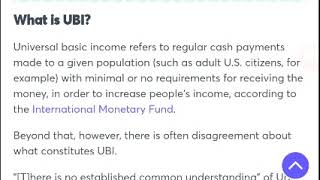
Welcome back to the channel. I hope you're having a great day. And so today we began the series on a segment we're calling Universal Basic Income. Um, it's basically going to speak to what Universal Basic Income is and many of the, uh, questions and concerns that come up with Universal Basic Income. In this first video, we're gonna talk specifically to what universal basic income is and try to contrast differences of what it isn't, right? I think that's very important because oftentimes when we discuss universal basic income, the, source of the material that's defining what it is generally has some specific definition of universal basic income without clarification of their particular, uh, of, or the particular version of universal basic income they're speaking of. So we're gonna try to keep with the most purist idea of universal basic income and contrast what doesn't constitute that. Um, and so, um, uh, as we go down a line in the series, we're gonna, uh, get into many of the moral philosophical concerns with universal basic income. So we hope that, uh, you stay engaged in the series, like and subscribe, and join our subscriber list so you can get the latest videos coming up in the future. So let's first start with the basic definition of universal basic income. Universal basic income refers to regular cash payments made to a given population, examples such as adult US citizens, for example, with minimum or no requirements for receiving the money in order to increase people's income according to the International Monetary Fund, right? So the That definition comes from the IMF. Beyond that, however, there is often disagreement about what constitutes universal basic income. And that's what's gonna be key in this video, not just giving you a basic definition of it, but helping you to understand what it may not be. And I think that's important because we found programs that are being passed off as universal basic income that are not universal basic income, all right? So let's start with why people are now pushing and advocating for universal basic income. What would be some examples of why we might need it? So if we go back to a few hundred years ago, specifically in the United States, people like Thomas Paine championed universal basic income. My understanding of what they were terming the citizen's dividend wasn't so much about looming threats. Obviously it was about welfare of citizens, but it's vastly different from the universal basic income that gets discussed today, which is generally something that's gonna be needed, something that might be due to the global pandemic, something that may be due to a looming automation revolution that can displace many people out of work. So all of these ideas fuel what to be a more modern-day universal basic income. But with keeping with the bare-bones, purest idea of it, it had been championed all throughout the course of our human history, even before getting closer to the nuclear explosion, which would be some of these much crisis-level events we're discussing now. But before that, people were advocating the idea as to say that this wasn't an idea with universal basic income that needed to have these dire consequences, right? It was referenced as a dividend. What is a dividend, right? How does a dividend work? Well, first let me find a definition of dividend. That way we can get a very more accurate description. Okay, so one definition of a dividend I think that might be more relative to the subject at hand is it is a sum of money paid regularly, typically quarterly, by a company to its shareholders out of its profits or reserves. Now, I would also add that sometimes this might not necessarily be money. It could be actually stocks itself. But the idea is there's something that's taken place where people are sharing in profits or reserves right now. I'd also add to that, dividend doesn't necessarily require reserves. There are examples of companies that have issued dividends in order to make their companies appear to look more appealing, right, for people to invest in it. And they would have to, in some cases, have borrowed the dividend, right? And so I think that can also be comparably comparable to some of the ideas of what we're going for here just to get a more complete idea of universal basic income, why people push for, who's supposed to get it or who shouldn't be getting it, and to really clarify that, right? So the next part is if we use the term dividend, then that means that everybody who's a part of that organization If you're a shareholder, some people would term it to mean that you're a shareholder, you're a value holder in the nation you belong to. That could be based on some contribution you've made to that nation over the course of time you've been part of it. So you would be eligible for a dividend similarly to how if you're a shareholder in a company, you would be eligible for a dividend. The next part we would speak about on universal basic income— what it is, who gets it— and the understanding of that is who or what or whom should get it. And universal generally is speaking to everyone included, right? So that's a key term because Typically, what has happened in the understanding of universal basic income is it's been pushed off to include certain groups and not allow other groups to participate. So who receives universal basic income is very important, and the universal means everybody. What isn't universal basic income, or what's been the confusion, is that some would next erroneously conclude that only the needy or the poor would require universal basic income. And this is not what universal basic income is. Um, My apologies, I had to turn off my notifications. But that would defeat the idea of universal basic income. If you give it to just the poor or the needy, then this will qualify more as a social program or welfare program. One big error is a lot of the data collected on universal basic income, as it's really never quite been tried before, at least at the, the more accurate level. But one notable experiment was done in Finland. Now, after gathering research on the event in Finland, we learned that only about 2,500 participants were put in the study, and of the 2,500 people, they were mostly targeted to either be low-income, working poor, or unemployed people. This data, I believe, would create inconclusive, inconclusive results as to how universal basic income will function, uh, properly. And so, um, I would consider that more to be part of a welfare program than, um, a universal basic income program. And universal basic income, you would have all participants receiving universal basic income. And this could in fact create a market stimulus. This is similar to the approaches we've taken with stimulus payments during times of economic crises or pandemics. And so this has an overall different effect on the economy as opposed to just giving it to a certain class of people or groups, right? So I think it's very important that we don't confuse the ideas of universal basic income. I think the next part, besides just the idea of everyone receiving universal basic income, or what essentially would be free cash payments in the eyes of some, is, is it really a free payment? And without going too far into this, as we want to save this for upcoming episodes, like the philosophies and some of the moral ideas around universal basic income, should it be done? When we look at whose resources and whose money we're, we're, um, we're actually dealing with here, and who should have the right to that, and who should decide who gets what. I think we have to start at the very beginning. And so there's this idea, this philosophy as it were, going around right now that every human being on Earth should be, uh, eligible to have equal portions of land on the earth. What are some of the problems if you don't have that? Well, to illustrate, if there was a situation where there was private property to the point people could buy up most of the private property around you, perhaps They could enclose you in buying all the property around you, cutting you off from the rivers and the water and the land and certain resources that you require, which has been the state of human affairs throughout history, which has caused war and, uh, driving people away from lands and so on and so forth. The problem with private property, although it gives many freedoms that we're aware of, where people aren't told where to live, what to do, to a certain degree, as I will use the idea of term limited freedoms, is at the same time we can see some of the abuses that can occur if a person is able to own most of the land around you, making it difficult for you to produce food, making it— and in fact, we have examples of this. In the Middle Ages in Europe where monarchs would own all the deer in all the forests of all the land and they could issue edicts where citizens weren't able to hunt deer to survive. That it was the king's deer and it was illegal to do it. And so what they did was they stopped people from being able to have the right to food, to survive, and to eat. This can create a philosophical problem here, um, a conundrum as it were. But in some ideas of universal basic income, it requires or it makes people eligible to own certain, uh, parcels of land. If not in the logistical idea, of course you can have land or ownership that ends up in Antarctica. It does speak to the concept of through that right, so to speak, you might be eligible to, for so many resources, which translates in terms of ours today as essentially money, right? It is estimated that every human on earth, I believe, can own something like 7 acres of land. You can produce a lot of food with 7 acres. But getting back to the philosophical, or rather the start of the ideas of the issuance of universal basic income and how it impacts others, some going to ideas like it takes money out of their pockets, right? It could very be that universal basic income, or at least any idea of it, is the right for every human citizen to have basic needs and sustenance from the earth. Right? And in that scope, it is a difficult thing to conceive of that people are able to own mountains and rivers and land. The production levels of these things that occur in resources and land is basically you know, something that hasn't been produced by human beings, that they— it was produced through nature and so on and so forth. If you can get around that, um, then of course again we come back to war, which then is kind of stepping away from the moral social contract humans make in order to determine if universal basic income is some type of forced system that's forcing them against their will or taking money from them, and, and, or it plays out some way like this. The other thing I would suggest is that, or, or we could examine really quick, would be the idea that in a system of fairness, an economic system of of where you actually produce, you get what you produce. The labor output ratio is relationally the same, right? That would mean that governments that interfere through our tax systems that allow certain tax breaks and cuts for certain entities and not for others would disrupt that. So even in that idea, there would be no accurate correlation between what you produce and what you should deserve and keep. And so I think this argument is important in the universal basic income idea because it tends to be a conflict between if universal basic income is issued out, then someone has to pay for that. Who maybe deservedly shouldn't pay for that. But I think in stepping back and peering into a wider scope of how our economic systems work, it could cause a more deeper conversation into that idea. We'd like to conclude the video in our first series by saying that Universal basic income has been something championed by many of the greatest minds in history, and it has been a challenge to find the best way to create a universal basic income system. Although many in the world today feel it will be a much-needed system, we don't necessarily believe that this, the solutions will come only in the form of government intervention in our political systems. We also believe it will happen with individuals, communities, and private sectors. And so our project BitcoinMYK is a way you can freely try, uh, universal basic income out. It uses some of the most advanced technology in the world, blockchain technology, creates value through cryptocurrencies like Bitcoin. And the way we accomplish that is by building a large network of value and sharing that value with you all. Make sure you join today if you're interested in subjects like Bitcoin— I'm sorry, Universal Basic Income. If you have any questions, feel free to ask in the comments section or join our Discord chat and our main site at BitcoinMYK.com. If you like content like this, don't forget to like, subscribe to our YouTube channel here, and Take care of yourselves and each other. Goodbye.
More from Michael







UBI - CIA Agent Explains Why Americans Will Never Get Universal Basic Income?



