
Xen Crypto - (BXEN) Binance Up 400%/My Concerns
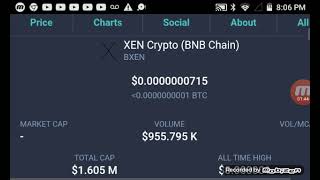
XEN (BXEN) jumped 400% on Binance Chain, but the host warns its massive token supply and reliance on Ethereum gas fees as a price floor threaten long-term value. He contrasts XEN's tokenomics with his own BitcoinMYK platform, which lets people mine through social media activity instead.
Chapters
Welcome back to the channel. I hope you all are having a great evening, great day. So, uh, XIN on the Binance Chain, what we call BXIN, BXIN, whatever you want to call it, it's up well over 400% on over the last 30 days, right? So these, uh, gains that are happening in the Zen ecosystem, as we can see, this means that it's not just happening on Ethereum. That's a good thing, right? So we're going to talk about that today, but it's not going to be all peaches and cream. It's not going to be all good. We're going to actually, uh, talk about some concerns I have for the Zen project. Um, and of course on the entertainment, uh, education entertainment television show, uh, we're not a pump channel. We're not a, um, a rah-rah-rah channel for cryptocurrency. Here we focus on what cryptocurrencies make the most sense, why they make the most sense. We look under the hood, um, and, uh, we make decisions based on that. So we want to have all information available and we want to take a look at these projects, uh, so that, uh, we don't run into many pitfalls some of them seem to have, uh, through their, uh, uh, through their, uh, the routes many of the, the projects take. Uh, so the good, the good news about, uh, this happening on, uh, Binance, you know, uh One huge concern was that, uh, um, Ethereum was starting to kind of lock out, uh, participants, right? You want to have a participatory, uh, economy in these projects, and, uh, Ethereum with the ridiculous fees, right? Um, it causes us to lack that participation for many of us. And that's not a good thing. That's not the idea of why we want projects like this created the way they are. And these are the very same reasons that it drove projects like the Pulse projects, the Richard Heart ecosystem projects to run away from Ethereum. It is why everybody's major goal is to run away from Ethereum, right? So for us to celebrate Ethereum breakthroughs is not a, uh, a good, uh, situation we want to be in. That's not what we want to do. Um, so, uh, the good news again is the fact that these other blockchains, whether it be XAN, uh, or I'm sorry, rather, whether it be Binance or Polygon, whether it be Avalanche, or, you know, many of the other chains that ZEN exists on. You don't hear much about the other ones because the volume is so thin that you don't really, you know, there's not really, you know, much opportunity there. But ZEN might, or Binance ZEN might be now opening up the way for us to see some activity with much lower fees, significantly lower fees. And that might cause a lot more value coming into the XEN ecosystem. And so I'm okay with whether we want to go with the idea of, you know, a rising tide lifts all ships or what have you. That's not so much a problem. But we don't want this to become a situation where we're just dealing with another cryptocurrency with not a lot of participation, not a lot of representation, not a lot of decentralization. And this has been the course of many cryptocurrencies, and this is what we don't want. So whereas great news with Binance, you know, a lot of people are probably moving to Binance because of the, not only the ridiculous fees with Ethereum, but some people felt they missed their move with XEN going up so high, going up 1,000%. That discourages some people from getting in, thinking that they're kind of, they've kind of missed the boat. Whereas we know many of these crypto projects can go a lot, a great deal higher. But anyway, now let me talk about my issues concerning XEN. I want to talk about that. And, uh, so we don't have a one-sided channel. Uh, a good portion of the cryptocurrency channels are typically people who hold considerable amount of cryptocurrency in certain underlying projects, and then they are then incentivized and motivated to push these projects, right? Whether they're good or bad, if they're holding a lot of assets in those cryptocurrencies, they're going to push them. And, uh, I made a pact with myself that we wouldn't do that on the Education Entertainment Television channel. So, um, if you're wondering why you're here, those are the reasons you're here, because you're that small group of people who, uh, don't want to just hype up prices and hype up these concepts and ideas, but really get behind projects that work. And I know that's not for everybody. I know some people just want to make money. Okay, that's, uh, have at it and good luck to you, sir. Uh, but we are more a practical approach, like you do any responsible investment. And, uh, so we're have— we have a different, uh, direction with how we do things, right? Uh, Let's get into my concerns about XIN, and I might even contrast some areas where I think the problems have been solved by other projects like BitcoinMYK that I'm part of. And what you have to understand is when you get to sit back and look at the mistakes that many projects have made over the years, it becomes a lot easier to come in and create plans to correct those mistakes, right? And so we're going to talk about that and get into that a little bit, my concerns about the XIN cryptocurrency project. Okay, I've taken the liberty here of making a few notes here. So let's talk about the first issue I'm having with XIN, or I see with XIN, and that is no layer 1. Now we know that in 2024 is the approximated date, um, that Zen may launch a layer 1, right? Now, uh, all things considered, that sounds good. That makes Zen bullish, and, and those things are good. But as we know in cryptocurrency, the future seldom has been promised to us. And whereas I do think Jack Levin has a much greater chance of executing a layer 1 project, more so than the Pulse ecosystem under Richard Heart, which nobody really knows what's going on. Uh, I think that when we look into the decision of who's making the time frames when these layer 1s are, uh, launched and so on, there is a certain amount of that going into the court of Jack Levin, it would seem. And that is a problem because, uh, it could be that it doesn't launch, right? And what happens is if it doesn't launch, well, we're more so like another, uh, HEX ecosystem, PulseChain ecosystem. And then some might say, oh, but it's Jack Levin, it's certainly gonna launch. Okay, granted, uh, many of us have a great deal more faith in Jack Levin than many other in the cryptocurrency community. But the, the, the, the problems still remains that even if Jack Levin were to release it in 2024 first quarter, and even if he was on time, that still doesn't mean that this period in the interim couldn't be, uh, or XEN couldn't be, uh, overtaken by another similar project that would launch earlier. Similar to— in other words, we could have a situation like what we got with the HEX ecosystem, the Pulse ecosystem, uh, where it takes too long to launch and somebody else does it faster, right? So You know, maybe that doesn't happen, but that is a possibility. Next, the, the next big issue with XIN is the Ethereum is the bulk of transactions. So if we're being honest, the, the entire value of XIN is basically, uh, composed of Ethereum gas fees. Gas fees that create a, uh, a bottom, right, to the XIN price. It kind of creates this threshold where XIN can't— doesn't really— will never really fall below that. That's interesting. That in itself is not a huge problem, but where it becomes an issue, uh, because I actually think that's a great idea, I think that's genius to you know, to preserve the value of the project and the price of minting. But the issue is, um, um, as long as it stays on Ethereum, and if Ethereum really is the only successful chain for Zen right now, which it seems is going to be for a while, uh, then what that means is that there is a special elite group class in Ethereum that seized already a great portion of XEN on Ethereum, and it's probably not going to be likely those people are going to be overcome unless they sell a lot of their stakes. Also, it's kind of elitist in that these people can afford very high Ethereum fees. That's going to eliminate a lot of that participatory economy. It is a huge problem, and what it does is it kind of becomes a situation where the dog's chasing the as tell, and we're not out of the situation we were trying to get out of. Thus, we are not out of adhering to firstly our principles of decentralization across the spectrum, right? Uh, the next problem, uh, that I think is a big issue is the hyperinflated supply, as I call it, and that is much like the Richard Heart model, you know, you're going to trillions of trillions of coins so that people can mine and stake. And that— and whereas that is interesting, uh, typically what's happened with many of these projects is that there aren't a lot of staked stakers, right? They're percentage-wise, you know, uh, there aren't really a lot of that going on. And that's a— and what that tells the market is that A lot of people don't want to be holding these cryptocurrencies with heavy supplies, right? Because they don't want to get caught holding the bag, right? And this is where Bitcoin succeeds because whereas many of the Bitcoin maximalists, Bitcoin developers will tell you, oh, they can pretty much build anything on Bitcoin. Why do we need these other cryptocurrencies? You can do all this stuff on Bitcoin. Whereas they'll tell you that, uh, uh, what is, what is true with Bitcoin is that they believe, uh, and I'm sure it's, it's, uh, technically possible to do all these things on Bitcoin. Uh, the problem is they're doing it with a 21 million supply, a supply, right? Right? That amount of scarcity is going to create such a great deal of value in Bitcoin. And, and because people are going that route, why is it that many of these projects insist on having trillions of coins? Just doesn't make a lot of sense to me. Uh, if everybody's saying they can do everything on Bitcoin that people are doing with these altcoins, uh, why not just follow a more Bitcoin model, a more deflationary model, uh, where, you know, where your, your value is naturally protected. You don't have to protect it in gas, ridiculous gas fees. That's eliminated many participants out of that economy. Uh, the next thing, uh, problem is the, what I call the HEX inherited community. So there's no question that a great amount of the participants came, uh, who are participating in XEN now have come out of HEX or will come out of, come from HEX and the PulseChain ecosystem because the products are so similar, right? The problem with that though is that, uh, I call it in a way a contamination problem. And let me explain what I mean about that. Not so much that I don't think it was a problem that Jack Levin went over there and some people might Richard Heart might look at it like he stole the HEX community. I don't think that's so much a problem. Uh, you know, this is the idea of these markets, having people having options to go with the better products and so, and so on. And that creates, uh, better products for us all, right? So that is not the problem. The problem is, I would look at the HEX community, unfortunately, and I wasn't one of them, but I would look at them as fanatical for the most part, or were. And the problem with that is a lot of that fanaticism came out of the camp of Richard Heart's get-rich-quick ideas, right? And I know people would say, oh, well, Richard Heart talked about denying short-term gratification, right? And certainly he did with the staking and so on to a degree. But even if he meant that, his reverse psychology was all created within HEX as these kind of— even, even the beginning websites look like these get-rich-quick sites, right? So the mentality of the HEX community is always price appreciation, which is different from what you get in successful communities like the Bitcoin community, where it's not necessarily price appreciation, it's price stability and price, uh, uh, uh, or rather, I'm sorry, high volume, right? High liquidity. The fact that you can really use this as a money now and it could absorb so much of that, right? So that's, that's the problem with HEX is HEX is kind of still like the Lambo Dreams community right there. Like we gave the example in the last video of the Miami baller scene where now people are walking into the Miami hot spots I'm a Florida native. I was born and raised in Florida. I spent a lot of time in Miami. And so what's happening in Miami scene is everybody's walking into, walking into these, these hotspots in Miami and they're saying, hey, what happened to the crypto millionaires and billionaires? This guy was buying all the bottles, popping all the bottles every weekend and whatever happened to that guy? And they've all vanished. That's the running joke that's going on now, right? That these guys no longer have that buying power behind them. But the reason they don't have that buying power too has a lot to do, I believe, with the mentality of what the HEX community— not that it's so much their fault, but part of Richard Heart's marketing and tactics JESS was a natural evolution into that. Uh, lastly, and that's a problem obviously because then you're going to have, you know, people, uh, looking at probably XEN not long term, gonna have a lot of great pumps and probably dumps in XEN for a good while longer and so on. Um, the last part I will talk about is the Jack Levin's economic philosophy. Namely saying, number one, we're not quite sure what it is. He doesn't seem to be, uh, I don't think, all the way in the camp of Satoshi, uh, in that, uh, I think Satoshi— let me just put it this way, I kind of see, and I could be wrong about this, Jack Levin could actually be both of these things. Or maybe it's just, uh, uh, just, you know, in certain instances and certain lights, it seems this way. But Jack Levin, um, whereas in Satoshi's idea, I looked at Bitcoin more as not about getting rich with Bitcoin, but setting people free, setting our money free, giving your money back to you under control by you, not control of governments or entities or organizations. Uh, whereas I looked at Richard Hart's view is getting rich and getting rich, and I kind of see now Jack Levin is an amalgam of the two, right? Which could be good. I'm not saying that that won't be successful, uh, in the short term, but in the long term it could be a problem, uh, as I've seen some people making jokes around Twitter about Jack Levin that As Zen gets more successful, he starts to exhibit traits similar to Richard Heart. Remember, Richard Heart didn't start as the Louis Vuitton million-dollar bag totem. He started as the Robin Hood of crypto, right? The whale penalties, the big whale penalties, and take from the rich and give to the poor, right? And so on and so forth. Uh, so there's this kind of debate between the idea of blockchain technology, Bitcoin being capitalist or being something else. And Craig Wright, who supposedly was the real Satoshi, argued this point as well. And whereas he talked about, um, Bitcoin being this capitalist model where just make money, it was never meant for people to mine it at home on their computers, but to have these large data centers the average person couldn't control, right? Uh, and so what has happened to Craig right now? Well, his version of Bitcoin isn't as successful as the, the Bitcoin Core as we know it, and it's not even as successful as Bitcoin Cash, and it's no longer as successful as many other projects, right, due to his philosophy. So my entire point is Is Jack Levin's economic philosophy could be an issue for Zan? Possibly. I think it could be because I'm not totally on board with Jack's view of some economic principles. That's just my thoughts on it, but I think they could come back and be a problem in the end. I think I'll just conclude with BitcoinMYK, how mining works, um, in our, in our platform, right? So first, let me pose this question. Let's say we're talking to the general populace, we're talking to people out there, trying to get them involved in cryptocurrency, waiting for all these people to come in, and they're given a choice. The choice goes something like this: They can download something off GitHub to mine a cryptocurrency, right? They could, uh, so that means they're gonna have to have some technical knowledge, or they could do normal things they do through social media interfaces every day and mine and generate the cryptocurrency that way, right? For becoming a member, right, they were sending Bitcoin MYK tokens. For visiting a site, right? Visiting somebody's profile page, they earn a token, right? For making friends, they earn tokens. And you see what's happening there? If you give people that kind of choice, that the things they do every day in our world and how it's becoming engulfed in this technology, ChatGPT, that's going to take all the jobs from most people. Can you see that this type of future involvement in a type of participatory economy like this would be more appealing to those people? In other words, right? And this is why I keep pushing ideas like Bitcoin MYK as the future. And that's also, that's why I'm not worried because I've been right about Hex, I've been right about XIN. So my track record is good. Am I going to be right about Bitcoin NYK? Probably so. More than likely, yes. Uh, why? Because common sense approach, logic, and reason. But if you give those people that choice, they're not going to say they want to understand how wallets work, how interfacing wallets with Ethereum-like apps works. They're not going to say any of those things, right? I know a lot of people talk about custody admin keys. Listen, that matters, right? But only up to a certain extent. If we look at something like the Pulse community, right? Nobody has admin keys, but that doesn't stop somebody from controlling 90% of that supply. The thing about Bitcoin and YK is its entire model is predicated on distribution, right? Where there's— it's eliminate all the elitist class or the development classes, eliminated all those things. Where everybody can compete and participate. And that's why I know if given the opportunity, how this algorithm works, right? It finds you, it can extrapolate the value of the activity you're doing and anybody can do it. I know that a model like this that we've developed that's working and people are using is undefeated against any other type of applications. And because it's all free, and they're getting the cryptocurrency free, the, the, the idea of a type of control system where people dump on you and do this and that becomes a lot more difficult because it becomes a lot easier for distribution to happen between holders, participants in their wallets, right? So if you like information like this, make sure you subscribe to the channel, watch all our BitcoinMYK videos. Uh, I think Zen's a great project, but not without its problems. Uh, and that's what we do here on the channel. We look in a very objective way. It doesn't matter if it's our own cryptocurrency, it doesn't matter if it's your cryptocurrency, doesn't matter whose cryptocurrency it is. There's going to be no fanboying over here. So we understand that there's— this is going to be for certain people, but we understand a project like this is going to speak to the masses of people. And that's why we don't worry about a slow burn with our project. We don't worry about a slow burn with it. We don't worry about if it takes 5 or 10 years because we know this is going to be the model of the future simply because it's better than the other models. That's all I want to say in this video. If you like content like this, don't forget to like, subscribe. Till next time, as always, take care of yourselves and each other.
More from Michael







UBI - CIA Agent Explains Why Americans Will Never Get Universal Basic Income?



