12 Year Old Reflects on Socratic Mentoring of 9 Year Old
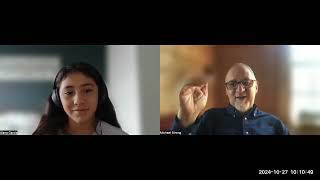
Alana, 12, mentors a 9-year-old using Socratic questions but realized she moved too fast with intellectual content. She's rebuilding trust by talking about his interests: jiu-jitsu, airplanes, and cartoons. The mentor discusses how emotional safety matters more than challenge at this stage.
Chapters
Hello. So, uh, good to see you. Um, first thing I want to touch base on is, have you had a chance to talk to, uh, the, uh, student on history, the 9-year-old?
I did. Uh, we've seemed to have an established time every week, just like I do with you. Um, and it's working greatly for me and him. I think that the process is going well. I think that I might have jumped the gun a little too early and started to like talk about things that we do now a little too early because this past week I introduced a quote like you sometimes do with him. And after the call, I kind of reflected and I thought it was a little too early for me to do that because he— I don't think I got the same output from him as I would have gotten if I spent a few more weeks just kind of hanging out and having fun with him. So next week I'm planning to be a little more open and talk about the things he likes more than being an educator.
Very cool. I love how, um, how thoughtful you are about both what you do and then the distinction between process and content, so to speak. Um, but tell me a little bit more Before we dig into all that a little bit more, uh, tell me about— well, first, have you only met with him once or twice, or how many times?
It's been— I mean, I think 4, it's 4 or 5 times.
Oh wow, wow.
Maybe, maybe 3 or 4, I'm not sure.
Okay. Um, and yeah, tell me about the process going well. In what way? How do you tell? What is the process? Um, is it like— are you doing 10 to 15 minutes like you and I often do, or more or less? Can Give us a detailed description of the process.
Well, I've tried for the time, I've tried to make it 15 to 20 minutes. So far it's been about 20 minutes each time, which is good because I don't really want it to be too short or too long. I mean, the meeting call and then I was, I wasn't really sure where to start. In terms of like the connection between me and him has been made and we're friends and we like to talk with each other. And then now I can like start to introduce some more educational things like you did with me. I don't think I timed it right. I think that over maybe the next 2 or 3 weeks I'm going to spend— I'm not going to really introduce anything like I did this past week, maybe just like I said, spend a bit more time just talking about him and things that he would enjoy talking about. Um, uh, again, to build the rapport. I forget if that's the word or not.
Um, R-A-P-P-O-R-T, rapport. Rapport, it's a great word. Um, so I spoke with him just once, and he was a little bit kind of shy. And, you know, his dad says, with— of course, his dad, he talks all over the place. But I think with new people— was he at all shy with you, or not? With— not at all shy?
Um, well, I think definitely less so than the first time, so there's, there's improvement, but not as much as maybe I would have thought there was. Um, he, um, like, I, I think if it were me and you versus him and me, obviously there would be a big difference. Um, he was kind of shy, like not as engaged or motivated as I thought he would be. So that's why I was planning to take, um, take my time a little slower.
Makes sense. And of course I'm an adult and probably more intimidating. Do you think that he perceives you as, uh, just an older kid or kind of a peer? Or to what extent are you the— do you think, and maybe you don't know, but to what extent do you think you're kind of the, the intimidating big kid versus just a peer to him?
I'm probably more of the intimidating big kid than the peer to him, um, because again, he didn't really know me that well. We've only talked to each other a couple times, um, and also I don't think I— again, I didn't— I haven't spent enough time like talking about common interests with him, so he might seem to think that I'm a lot older than him or something when I'm really not.
What kinds of things do you guys talk about?
Uh, we have a lot of common interests, actually. He trains jiu-jitsu too, um, and he has competed a couple times. So the first time I really spent a lot of time on that because we're both competing next month. Um, we have read the same book series, um, a couple— not like big hard books, just like really enjoyable long series books that have a lot of content to grab from. I haven't read him in a long time, but yeah, he has a couple of interests that I haven't pursued yet much in my life. For example, planes. I'm on his dad's Substack and it's really interesting. And he talks about planes all the time, apparently. Like, he's really into them. He's really into making them. He wants to engineer them and stuff. So that's something I could learn about from him too. And the first and second time we talked, I asked him a little bit about that, but I couldn't really find the questions to ask because I would ask a question. He wouldn't really give a very detailed answer, which again made it a little difficult to keep going.
Yeah. Now, this is tricky, and I appreciate that you're aware of how tricky it is. I'm going to kind of drill down into what's worked. Often I try to look at what's working and what's not working. And then of course crank up what's working because jiu-jitsu is something you, the two of you so clearly share in common. Would you say he opens up a bit more on the jiu-jitsu side?
Yes.
Yeah. And I would expect so. And, you know, again, you know jiu-jitsu better than I as an outsider. I kind of, when I'm asking you questions about jiu-jitsu, I'm kind of making it up because, you know, I've, when I was in high school, you know, I did a little bit of wrestling, I've done tai chi, I've done sort of— I've had a few martial arts lessons, so I'm not a complete stranger. But, you know, it's your, you know, life, so you know way more than I do. Um, so when you talk to him about jiu-jitsu, do you talk about training? Do you talk about style? Do you talk about, uh, competition? Where do you go when you talk about jiu-jitsu with him?
Um, I think the time I talked about jiu-jitsu with him, I was heading more into the direction of competing because he's competing sometime in November and so am I. So I asked him his thoughts, if he's competed before, how he did, the feelings that he feels when he competes. Does he like it or not? Does he like ginrō no gi better? And I think, now that I think about it, with those questions he was a little bit more elaborate. Than with others, maybe just because, like, I don't think he's as into it as he is with planes, but maybe he knows that I do it too, but I'm not sure.
When you say a little bit more elaborate and so forth, you know, in some ways I'm optimizing for intellectual engagement. So when I see a person, and this is adult or a child, anyone really, you know, when the light comes in their eyes and they're enthusiastic, when they're like, you know, not all, not all of them will get, but, um, because he is, at least for me, he was really shy. I'm, I I'm pretty good at opening people up in questions, but he was— he wasn't completely resistant, but, you know, he was, uh, I would say kind of a hard case compared to most people. Um, and that's okay, you know, I'm a stranger, you know, much older than him and so forth. But, um, yeah, I think your awareness as to when you're getting more engagement from him, um, and then especially in this early phase when, you know, he's not ready to say a be more intellectual, not ready to discuss quick questions. Yeah, I would say be aware of when you're getting more engagement and, you know, just build on that. Makes sense?
Yes.
Totally cool. Just as a relevant aside, because, you know, I'm thinking of this Socratic questioning, we actually have a Socratic parenting course going on for parents when I ask questions to their kids. And sees dad as part of that course. But I'm realizing that part of what we do is intellectual, you know, asking about ideas, asking about, you know, philosophy and Kant and whatever. But part of what we do is also being emotionally sensitive to— and, you know, at the extreme, you can imagine somebody who's just like a machine asking questions and pays no attention at all to the emotional state of the other person or the group of people. But I would say a lot of what we try to do is both lean in and go towards intellectuality while also being, I would hope, fairly emotionally sensitive to the other person. Does that make sense?
Yes.
And then what I was going to say is I'm actually looking at technologies. I'll give you one example. There's something called Immersion Neuro that would measure both of our psychological safety and emotional engagement. And I'm thinking that this could be cool because it's wonderful that you're developing the perception of where he is. But imagine if you had kind of a gadget where you say, oh, you know, his emotional engagement way up, psychological safety, whoops, went way down when I asked that question. Can you see how that might be a cool tool for helping to learn how to do this?
That would be amazing.
Yeah. Well, maybe you can help us develop it. That would be cool. So yeah, I think everything you said makes total sense. You know, he is a little bit reluctant and so forth. And, um, yeah, the jiu-jitsu makes total sense. Probably slowing down on the intellectual side. Uh, just quick question, I'd mentioned the Cartoon History of the Universe. Did you guys talk about that at all?
We do. Um, every time we meet up, I ask him about where he's at and what he's thinking about it. Um, I mean, the last couple times, I think he just got back from a vacation, so he mentioned that he hadn't been reading it, um, and forgot where he was. So next couple of sessions, I'm going to keep asking him about that. You know, I'm kind of curious too about where he's at and how far he's going and if he's a fast reader or not and if he remembers things.
Totally makes sense. So given that maybe jiu-jitsu and airplanes— and by the way, people don't know, he's— he and his dad are building an airplane together. So jiu-jitsu and airplanes are at the really engaged side. Where would the history be? Is it as difficult as the quotation you mentioned, or is he more open than kind of being on the spot intellectually?
Do you mean when you were talking specifically about something like Planets?
No, no, when you're talking specifically about Cartoon History of the Universe.
Oh, got it. I don't think he's been specifically open about like just that. The first or second times when he was still reading it before his vacation, I asked him where he was and how he was doing and if he liked it and what he was learning. And he remembered, I think he was learning about the Ice Age or something, that period. And he didn't really show super big interest in it, like if he had been talking about planes or something or some other like if, if I were him, some other book series that I really, really, really liked.
Got it.
Um, so that's why I kind of moved over to Plains the first couple sessions.
Totally makes sense. So it sounds like, um, that's kind of on the slow path. Totally okay. Uh, but good to know, and thanks again for recognizing that. Um, say a little bit more about— well, first, I'm delighted that you're reading his dad's blog, um, because that gives you a lot of context. Did the dad recommend you read his blog, or you just decided to go ahead and read it?
No, I'm not actually— I'm actually not sure who put me on it. Actually, no, I was, um, scrolling through our thread of emails and I clicked on his, um, on his email because there was a link to it. Um, I think I just got on, so I haven't read a lot of it, but I'm excited. I wanted— I definitely want to read more.
No, very cool. And again, I always like, you know, if I have the time, I like to do as much kind of background research and context about any situation, basically. Uh, because the more you know, the more, uh, you know, nuanced you'll be able to be. Um, and so, yeah, you said, talked about the engagement with the jiu-jitsu. Say a little bit about how the airplane worked, what he talks about, what he's excited about on the airplane. Is it about the project or airplanes per se, or a little bit of both?
So when I asked him about, um, airplanes and how he's interested in it, even on that subject, he didn't elaborate to the point where he told me what he was working on. And what he was interested in, I had to kind of ask him if he wanted to be a pilot or be an engineer in the future. Like, if you asked me about jiu-jitsu at this point, I would have— I think I would have gone to the point about where I'm competing next and how excited I am. And then when I asked about planes with C, I had to— like, it wasn't— maybe we weren't at the point where he would have told me everything. Who would have been super excited to talk about it with me, maybe specifically with me.
Got it. Would you say you think— so I, I think your strategy, totally right, let's back off on the intellectual side. Uh, do you think at this point he kind of looks forward to talking with you, or do you think he's afraid? Or, um, where are you just in terms of the relationship?
Um, at this point I don't think he's particularly excited to talk to meet with me. I hope, I mean, honestly, if I were him, I might be a little nervous before each time just because I'm meeting with this older person and she's asking me a lot of questions that I might find uncomfortable or difficult to explain or to answer to, just like kind of back in the day I was with meeting with you. And then now it's kind of a little more relaxed, um, and I can speak more freely without tension.
Got it. Oh, you're so aware. It's wonderful. So yeah, I would say let's build rapport. Um, ideally he gets to the point where, you know, it's, yeah, really easy to talk with you, and then you can kind of incrementally build up on the intellectual side. Uh, but again, I think it's so cool that you're playing the role. Are you enjoying it, or is it, uh, stressful for you?
It's kind of nerve-wracking each time I hop on, but I am enjoying it and I'm trying to get better.
Well, thank you for that acknowledgement. You know, there's a whole theory that a certain kind of stress is actually healthy and good. I mean, I, I'm sure jiu-jitsu competitions are, you know, stressful, but it sounds like in a good stressful way. Is that right?
Yes.
Yeah. Cool. And obviously this is not nearly as stressful and high stakes as a jiu-jitsu competition, but I think it's an appropriate challenge for you. And just hearing the way you talk about it, I think you're kind of ready for this sort of, yeah, leadership role, so to speak. Does that sound accurate?
I hope so. I think so.
I'm sure it is. I'm sure it is. Well, we've probably gone long enough for today because I like to keep these short enough to be watchable. But real quick, how's the Iliad going?
It's going good. I'd say I'm about halfway maybe right now. I'm going a little slow because schoolwork and everything, but I'm enjoying it.
No problem. Well, I look forward to catching up on The Iliad and Harvard CS50 and schoolwork and all the other things in the fullness of time. But for now, big, big congrats on your progress in leading a Socratic discussion of a 9-year-old. Go Alana! So have fun with it, okay?
I will, thank you.
You're welcome, bye-bye.
Bye.






