Alana and I begin The Odyssey
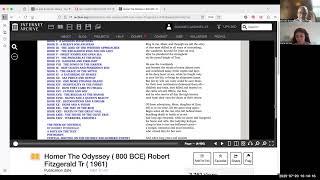
Alana and a tutor start reading Homer's Odyssey in the Fitzgerald translation. They compare it to the Iliad, examine the opening verses to spot key characters and themes like perseverance and divine intervention, and plan to read Book 1 independently before diving deeper into character psychology.
Chapters
Uh, so yeah, we are going to just begin looking at the Odyssey today, Fitzgerald translation, um, and I thought it would be interesting because you tried the Iliad on your own and got through most of the Wilson translation of the Iliad, might be fun to, you know, part of me was thinking, oh, we should finish the Iliad rather than go to the Odyssey, but partly I thought You know, if you were kind of— well, first talk to me a little bit about what happened with the Iliad. Did you kind of get bored or you got busy or you might go back to it or what? Why did you not finish the Iliad?
Combination of a couple of things. I did get busy and I don't think bored is the right way to describe it. It's just that I had heard so many retellings of it. I already knew what happened. So that attributed to part of it. But one of these days, I'm for sure going to finish the translated version so I can read the poetic sense of it.
Got it. Totally fine. And then is you feeling similar with The Odyssey? You've heard so many retellings, you already know what happened and maybe it's not worth reading?
No, it's— I think it's worth reading. I actually don't think I've heard as many retellings of The Odyssey as I have The Iliad. And it's a completely different story. So I think you should totally give it a try.
Okay. Again, if it bogs down, no problem. But I think it's also different if you talk to somebody about it. Did you have anybody to—
Yeah, that's true.
—relied with or not so much? Not so much, no. So, yeah, let's— I want to start with kind of Homer. What do you know about Homer? What do you think about Homer? What is Homer stand for in your mind, so to speak?
I don't really know a lot about Homer himself, but when I think about Homer, my mind obviously goes right to the Iliad and Odyssey because that's what I know he's known for. I guess, to be honest, I guess that's it. I haven't learned much about his personal life, if we know about anything.
Oh, thank you. And as far as I know, we don't actually— some people think that there may not even have been a Homer. That these may just be poems that have, that were passed on generation after generation for hundreds of years in ancient Greece. Other people do think there must have been a bard called Homer. And, but then still, certainly by the time they were written down, it was hundreds, literally hundreds of years of Homer being in existence or the Iliad and the Odyssey being in existence in Greek culture. Also, the Iliad and Odyssey have somewhat different styles. And so, you know, it's exactly appropriate not to know much about the person Homer, because nobody knows much about the person Homer. Then going a layer down, what's your general sense? Do you have any sense of the Iliad versus the Odyssey? Do you know about any differences? Anything at all about similarities and differences between the Iliad and the Odyssey?
Do you mean in the story or the writing style?
Either way, anything, you know, I'm just, just kind of surveying to see what you— what's already in your head, so it gives me a sense for where to begin.
Yeah. Um, well, I've never read the translated version of The Odyssey, but as I know that the stories are connected but still completely different, um, so like Odysseus is in both The Iliad and The Odyssey, and he's memorable characters in both. And then obviously the fact that the Odyssey isn't about a war, it's about his journey home. So different subject. Got it.
Thank you. That's, that's enough. Maybe let's just look at the opening of the Odyssey then. So I'm going to bring it up on my screen. Can you see it?
Wait, it's still— no, no, I can't.
Great. It took a minute to load. So yeah, 24 books. And my thinking for procedure is today we'll just start the first few verses of Book 1, and then you can— we'll each read Book 1 on our own, and then next time we reconvene, we can discuss Book 1 as a whole. So yeah, a goddess intervenes. Do you know anything about the goddess who might be intervening?
Yes, I believe that's Athena because she has— or she favors Odysseus. She helps him throughout the war and throughout his time home. I forget exactly why, but I know that they have a connection somehow.
Yeah, Athena is a major character in this book for sure. Um, yeah, what do you know about Athena?
Um, I know that she's the goddess of wisdom and war strategy and crafting or something, among other things. Um, oh, and I think that's particularly why she favors Odysseus, because he's super smart and like a strategist and stuff. Um, but yeah, she's a really big character. Okay.
Um, Let's start. I'll read the first verse and just, then we'll get a sense of the flavor of how this opens. Sing in me, Muse, and through me tell the story of that man skilled in all ways of contending, the wanderer harried for years on end after he plundered the stronghold on the proud height of Troy. Any thoughts on how it opens?
Not really. I mean, I know it's talking about Odysseus because— or just because it's about Odysseus, but it also mentions the war with Troy and how he was— I don't really know what harried means, but he was away for years on end.
Harried kind of means like hassled. Oh, many problems, many problems put in his way. And we'll see he runs into lots of challenges. Note that the Iliad, we talked about this last time, was about anger, or, you know, in many ways, sing to me, goddess, the rage of Achilles. Given that this one is not talking about rage, and by the way, is it fair to say that rage played a pretty significant role in, or Achilles' rage played a significant role in the Iliad?
In the Iliad, yeah, for sure.
So given that this does not talk about rage, do we have any idea of what themes might be, um, coming up in this one?
Um, well, since it doesn't mention rage, maybe not a bunch of rage, but I know there might be at the end. Um, but I think the thing I would focus on to try and foreshadow the story would be, um, that it says "harried for years on end," because I know that's basically or that's a big chunk of the story, how Odysseus was like, or encountered all these problems of, um, when he was trying to get home.
So maybe look to that. Okay, okay, certainly a worthy hypothesis. I'm going to go ahead and read the second one. He saw the townlands and learned the minds of many distant men, and weathered many bitter nights and days in his deep heart at sea. Well, he fought only to save his life, to bring his shipmates home, but not by will nor valor could he save them, for their own recklessness destroyed them all. Children and fools, they killed and feasted on the cattle of Lord Helios, the sun, and he who moves all day through heaven, and took from their eyes the dawn of their return. Anything interesting or engaging in that one?
Yeah, I think that paints Odysseus in a good light because it mentions how he was just trying to bring him, save his life, bring his shipmates home. And then it mentions that— or at least what I'm getting at is that it's not his fault they died, it was their fault. They did something, they insulted Apollo or Helios or something. Um, also, and that, that also foreshadows one of the problems that they encounter where they kill some of the cattle of Fort Helios. So I think that's interesting.
Okay. And again, on your own, we'll be reading the whole chapter, so I don't want to kind of go too slowly, but I want to get one more stanza this time. Of these adventures, Muse, daughter of Zeus, tell us in our time, lift the great song again. Begin when all the rest who left behind them headlong death in battle or at sea had long returned while he alone still hungered for home and wife. 'Her Ladyship Calypso clung to him in her sea-hallowed caves, a nymph immortal and most beautiful, who craved him for her own.' What's going on there?
It foreshadows the very beginning of the story where we start with Odysseus, who's being kept with Calypso because she wants him for her own, but he wants to leave. Oh, and it also mentions that he's alone because at this point all of his shipmates have already died. So this is— yeah, so that's the actual start of the story.
Got it. And I guess wondering about themes and speculating about themes, you know, you mentioned the kind of problems, harried friend. He also, you know, is clever. I forget what you said, strategist, wise, goddess of wisdom. Athena, his relationship with Athena. I'm here heading home for home and wife, and then Calypso craves him and so forth. You know, again, with Iliad, boom, rage, it opens with. You were mentioning Herod. Do we have any more sense of what this might be about, or it really is just different challenges coming home? And how could— is it just sort of like a random story about a guy who had a hard time getting home? Is that kind of what it is?
No, I don't think so, because I know that maybe not now, but later in the story, you know that this is Odysseus from the Odyssey, or no, from the Iliad. So that means it's not just about some random guy, it's about Odysseus. And he has, I feel like the book has the sole purpose, or at least she does, he's trying to get home. And it's not really— his problems aren't really random. Actually, some of them are, but most of them I know, I remember, had something to do with different gods who were angry with him, like, or Helios, or Poseidon I know had a problem with him. And then I know at the very end when he gets to Ithaca and then the suitors are there, that's a whole different problem. That's not quite random. So, but obviously we don't— if you were new, you wouldn't know that yet. Um, but if you were new and reading the beginning, I don't think— I would assume it was some random guy dealing with random problems, um, especially since it's so specific. Uh, but you still don't know who he is, so got it. You just have to keep reading.
No, that sounds good. And of course we'll read Book 1 for next time. Again, we're already heading along, I guess You know, there are different ways to read things. Since you're already somewhat familiar with the plot, does it make sense when I ask about what are the themes and what are the key themes that we might see? Does that language make sense to you?
I think so. Themes meaning maybe like the whole plot or different characters or points of views that the characters bring, maybe? That's what I was thinking of.
A little bit. I guess I'm thinking, you know, going back to the Iliad, if rage is a theme, Achilles' rage is a theme, um, you know, there are a lot of plot details, but the ways in which his anger drives— is it fair to say that his anger drives, um, a good part of the story in the Iliad? Yeah.
And then in the Odyssey, I remember I think the theme would be— I guess if we're talking about emotions, because maybe like the point of it would be for Odysseus to get home, but maybe the emotion part of the theme, like rage, could be, I don't know, something like Odysseus's longing or something to go back home, or— actually, I'm not sure which specific emotion because it doesn't mention it in the very beginning, like the Iliad, and there's lots of different ones. But the way you're talking about theme makes sense now.
Yeah, yeah. And what I'm suggesting is that, well, of course, you know, you'll be, you'll be reminded of plot details. Sounds like you're fairly familiar with plot. But what I'm thinking of is beyond the plot, I'm interested in getting a sense for who this Odysseus guy is. Why does he do what he does, what his relationship with Athena is, you know, in kind of more, more the human, call it almost the human psychological side or the human spirit side, kind of beyond plot details. Does that make sense? Yeah, I think so. So I would say, you know, as you read Book 1, of course, get the plot and let's try to figure out who this Odysseus guy is. And maybe why, you know, the Iliad and the Odyssey were both tremendously important in Greek culture. They were, you know, Christian culture has the Bible. It's not exactly right to say the Iliad and the Odyssey were the equivalent of the Bible in Greek culture, but they were super important to their culture. And so insofar as we might want to understand Greek culture, and you know, there's a case to be made that contemporary Western civilization is on the one hand based on the roots of the Judeo-Christian culture and then the Greco-Roman culture. Have you heard that at all, that modern Western civilization is largely the combination of Judeo-Christian and Greco-Roman culture? Is that at all familiar to you?
I remember hearing something about that, but I'm not sure if it was those specific cultures. Yeah, but I can kind of see.
Yeah, not, not a big deal. But I, in some ways, I'm thinking that, again, going beyond plot detail, we want to begin thinking about, by way of understanding who Odysseus was and why he was important, and who Athena was and why she was important, and so forth. If, say, the Iliad and the Odyssey are foundational to Greek culture, and if Greco-Roman culture is foundational to Western civilization, maybe it's worth kind of understanding, uh, Odysseus, the Odyssey, and Odysseus and Athena a bit more deeply. Makes sense? Yeah. Okay. Uh, in which case, I just want to kind of frame that way of thinking about Book 1 of the Odyssey. And, um, you know, sometimes one or the other of us is busy, but next time we're able to convene, I very much look forward to discussing Book 1 of the Odyssey with you. Okay. Yes, for sure. All right, have a great trip. Bye-bye. Bye.






