Alana visits The Socratic Experience to discuss Varo's "Dead Leaves"
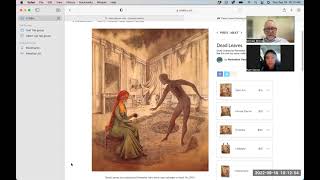
Alana and Michael analyze Remedios Varo's painting "Dead Leaves" through Socratic dialogue, uncovering references to Greek myth: a woman unwinding thread (Ariadne), a labyrinth-bodied man (the Minotaur), and birds escaping. They explore what the thread, labyrinth, and dead leaves might symbolize before consulting outside sources.
Chapters
Good morning, Lana. How are you?
Good morning, Michael Strauss.
How are you?
I'm very good. How are you? I'm well.
I think you were in a tournament yesterday?
Thursday.
How did it go?
It went pretty well. I got second.
Very cool. Good job. Did you enjoy it?
I enjoyed it.
So I also know that you visited Francisco's class at the Socratic Experience.
I did.
Tell me about it.
It was really good. I really enjoyed listening in. I talked a little bit, but I mostly listened because I like hearing how things go. Especially because I've never been to that class before.
Got it. Um, so was it, was it what you expected? Was it different? Was it surprising? Was it— what did you expect, and now was it similar or different?
Um, I guess it was what I expected. It seemed shorter than it was. Yeah, that happens a lot.
Yeah.
I really liked how they talked about poems and paintings, two in one. Yeah, because I always enjoyed those.
So some of the kids were a little bit older than you. Was, was it okay? Were you intimidated or not at all?
Not really.
Okay. Um, and is it different? Would you say that the way the kids talk about things is similar to the way you and I talk about things, or what's similar and what's different there?
I think it's very similar. It wasn't very different. They had the same conversation structure, and they were talking about pretty much the same things.
I hope and expect so, but I'm glad that it seems like that from your perspective. You know, I do this, and this is how all my schools are, and I like to think about ideas. And so when we're trying to figure out what a poem's about or what a painting is about, You know, I would say we're trying to use our minds to understand things. And, you know, there are lots of different things in the world to understand. Would you say that you made sense of that painting or the class made sense of the painting, or was it still pretty confusing?
I say it was pretty confusing, and I didn't really get it fully. I didn't understand it very fully.
Do you remember the name of the painting?
Um, it's Dead Leaves. I think it was called Dead Leaves.
Dead Leaves.
Dead Leaves.
Okay, um, I'm gonna see if I can find it. I know they were referring to, um, The woman had, uh, the woman was, you know, unwinding a thread. Do you know what that was about?
I didn't understand why, but I do remember she was unwinding a thread.
I think that's a reference to a Greek myth. Do you— are you familiar with those myths at all?
Yes, the Theseus and the Minotaur, when A-A-Adrienne? I don't know how to pronounce her name.
Ariadne. Ariadne.
Can you say that again?
Ariadne.
Ariadne.
Mm-hmm.
Okay. Um, well, she gave the thread to Theseus to go in and find the Minotaur and kill him. So that does refer to that Greek myth.
Yeah, and then I guess I'm trying to figure out how that could relate to what was going on in the painting. Any ideas?
Well, we did discuss that the thread that was leading into the man, the other man's chest, his chest kind of looked like a labyrinth. So that also kind of went with the myth too. I noticed that the man whose chest was a labyrinth, he kind of looked like Peter Pan's shadow. And I said that, I don't know, I just kind of felt it looked similar, so I thought it might have some meaning.
Mm-hmm. I found the painting, so let me see if I can bring it up. You were right, good memory, it was dead leaves. And so yeah, I'm— what's confusing to me, a bunch of things are confusing to me, is that, you know, it's in a modern house Here, I'm going to share the painting. Do you remember the painting pretty well?
I do.
Okay, I'm going to go ahead and share it just so I've got it in front of me. So, do you think the myth is an important part of understanding the painting? Can you see it?
I do. I think so. Well, because it's in front, it's front and center pretty much. I, I would assume that it would be very important.
And so now I see that I had originally thought the birds were flying out of the tunnel in the, the shadow's body, but you're saying that really it's maybe flying out of a labyrinth and the thread is going back into the labyrinth that she's winding? Is that what you're saying?
Possibly, yes.
Why do you think the birds would be flying out of the labyrinth?
Um, I don't— to be honest, I don't really know, but birds are, are used as a sign of freedom sometimes, so maybe it could be freedom, escaping. The labyrinth.
I know some students were saying the shadow might be her shadow. What do you make of that hypothesis?
Um, to be honest, I'm not really sure because I didn't— I don't really think that that's her shadow. Like maybe it could be, but I don't, I don't see why or how.
Yeah, I, I guess in the case against— do you want to make the case for why it does not seem like her shadow? What's an argument for why it's not her shadow?
Well, why would her shadow— I'm just talking here, but why would her shadow have birds flying out of it? Like, is she losing her freedom?
Mm-hmm. Although usually birds flying out, you would think, are gaining their freedom.
Um, that's true.
Although I guess my sense is that the shadow looks maybe more male than female. Do you think that?
Um, wait, the shadow looks more male.
Can you say that again?
I think, yes. That's another thing.
Yeah. That, that was, that was one of the things when those kids were arguing that. And then the other thing is the shadow is moving. I don't know. Would you describe the shadow as lively or not?
As lively? Mm-hmm. Well, it's certainly in a different position than she is in.
Yeah.
So that could mean that it is or was moving and this is just a photo or a picture of or a timeframe. Mm-hmm. I could say so, I guess.
Yeah. I mean, she's— and the students— I listened to the video, by the way. I watched the video of your class. So although I was not there at the time, I kind of followed what you guys were talking about. And she does sort of seem, you know, sad or withdrawn. It is— she and the shadow seem very— shadow seems somehow, yeah, almost like it's dancing or something or posing or something, whereas she is kind of, you know, down and out of it, not very happy.
Yeah, the pose is what reminded me of Peter Pan shadow.
Ah, that was a great— Actually, remind me about Peter Pan's shadow. What's the story of Peter Pan's shadow?
All I really know about Peter Pan's shadow is from the movie. I guess I never really paid attention to it.
But can he—
Go ahead. Thank you. But I always imagined it in this pose. Because I think it strikes this pose somewhere in the movie.
Can he or Tinker Bell either make the shadow disappear? Isn't there something that they do with the shadow in Peter Pan?
I haven't read the— I have not read the original book yet, but in the Disney movie, the shadow somehow escapes from Peter Pan. And they have to find him, and it ends up in Wendy's house, and that's where they find it.
Interesting. I wonder if Peter Pan can be a reference. Part of it would be— I would want to know, was this made— was this painting painted before or after Peter Pan? I don't know. I don't know anything about it. Painter.
Well, because if it was painted, or after— yeah, before Peter Pan, the Peter Pan shadow could be based on this.
Yeah. Yes, but I, I do remember the Peter Pan shadow being different. Um, yeah, there's a lot of information in here. It feels like there should be a puzzle we can solve. And that the painter wants us to solve the puzzle. But I know that in class you guys are struggling, and I, you know, I could cheat and research it on the internet because I'm sure there are people on the internet that know exactly what's going on there. But I'm realizing I'm struggling just as much as you guys are struggling. There are also the leaves blowing through the curtains. What do you do with that?
That's probably why it's called Dead Leaves, because they look pretty dead. They're not very green.
Yeah, of course. So yeah, but then we would want to connect those dead leaves with the, the figures in the foreground.
So I'm not really sure what I would make the dead leaves. I don't, I, I don't know.
Well, is it unsatisfying to you when you can't figure one of these things out?
Yes, it is very unsatisfying.
Um, should we cheat and see if we can look it up? Oh, or do you want to keep working on it?
Let's keep working on it for a few more minutes, and if we can't find out, then let's, then let's Google it.
Okay. So, you know, definitely the dead leaves and the glowing light in the back. And then I guess I just get stuck. I get stuck. She is striking, he is striking. How about the carpet? What do you make of the carpet?
Well, the carpet does look like grass, and I know one of the students mentioned that because it's very uneven and some places the grass-like things are tall, like in the middle there I can see a kind of tall one, or it looks tall. It's one fern, blade of grass, I don't know what it is. Um, it starts out as kind of a right angle and then it goes into this weird wacky kind of cloud-like shape. Manta.
So, do we, can that help us? Does that help us connect the figures in the foreground with the title and what's going on in the background?
Um, even the, to be honest, I don't, I don't know how it would connect, but it might, so I don't know.
Okay, I'm actually looking You know, it's possible. It doesn't entirely make sense. Um, ah, okay. So I'm, I'm, I'm reading to see what somebody says. Is it okay if I read a little bit?
Yes.
Okay. Um, so, and who knows, this is just something on the, on the internet. So, um, let's see. I lost, I lost it actually. No, it's one of these things where there are all sorts of— okay, I'm on a website that wants me to basically pay for things or something. Yeah, have you ever got into websites like that when they They try to get you to— oh yeah, trying to get me to pay for things. Um, so we'll have to— but it said something like the myth of the male hero. Um, that's what I started to read. How would that help us if we thought this had something to do with the myth of the male hero?
Well, the male hero is Theseus.
Ah, so tell me more. Okay, tell me more.
Well, I would assume that it would be Theseus because there's the string that leads into the tunnel/labyrinth, um, and that's what happens with Theseus. He ties the rope at the entrance and then he brings the thread in so he can find his way out, and then he finds the Minotaur and he kills it. So that would be the male hero.
Okay, so here's what the— here's what it says. In Dead Leaves, Varo— Varo is the name of the painting painter— Varo seated a woman on a bench on a carpet of grass in a room in which leaves blow in through an open window. The woman wears a flowing green gown. That gracefully covers her shoulders but is scooped low at the neckline. Red hair cascades down her back. With her right hand, the woman gathers to herself a ball of blue yarn, thread that emerges— wait, I can't see these colors. Can you see all these colors?
Yes, I can.
Okay, I'm actually a little bit colorblind, so that slows me down on things like this. Okay. Woman gathers to herself a ball of blue yarn, thread that emerges from within a faceless black figure. Nearby whose torso is a series of vaulted stone passageways that recede and get increasingly smaller the further one travels into the figure's interior spaces. Two birds, one red, one white, fly toward the woman from the labyrinth leading into the body cavity of the faceless black figure. Okay, so that was just a description. Dead Leaves, like all of Varo's paintings, tells a story. In this painting, Varo's symbolic narrative invites us to imagine the journey women make into the sacred spaces of the archetypical feminine. So I'm going to pause there. What do you think of that? Does that make any sense?
Kind of, because the thread that the woman is holding is going into the labyrinth. I didn't catch that last part of the description, the last description of the painting.
It says Varo's symbolic narrative Imagin— invites us to imagine the journey women make into the sacred spaces of the archetypical feminine. Um, do you know what an archetype is?
Wait, say that again, please.
An archetype. A-R-C-H-T-Y-P-E. No, I don't know what that is. So it's a term in mythology. I think you and I have talked about the hero as an archetype. That is lots of different cultures have hero myths. I'm sure, you know, I don't even know Hawaiian mythology, but I'm sure Hawaiian mythology has heroes. Is that true?
Yes.
Yeah, so every culture— one of the interesting things is different cultures have different myths, but there are certain things that seem to be consistent across all cultures. So every culture has some kind of a hero myth, for instance. And so we call the hero an archetype because it is kind of a generalized type. Arc is like an arch at the top of a column, you know, that's sort of like the top type. And so the idea is there's certain things that are so deeply embedded into the human psyche that they go across cultures. Does that make sense?
Yes.
So hero is one of them. And here when it says the archetypical feminine, It sounds like they're claiming that, um, there's something kind of deeply feminine that goes across cultures. Does that seem plausible?
Yes.
Okay, then it says, the Labyrinth is a story that takes us back tens of thousands of years to a time when the great goddess reigned, when the feminine was revered and honored, and the mysteries of birth, death, and rebirth were ritualized and regarded with awe. As a symbol for the womb of the Great Mother, the labyrinth offers us a contained space to re-experience movement and struggle that growth, birth, and rebirth entail. So it sounds like it's claiming, um, that somehow the labyrinth shadow relates to the feminine experience of birth and so forth, growth, birth, and so forth. What do you make of that?
That, that makes sense, um, because she's holding a friend and it's going into the labyrinth. The labyrinth could represent the challenge of what— of the— of birth and regrowth, um, because there's— well, the labyrinth is basically just a big maze. With lots of dead ends with monsters in them. Um, does it say what the birds are for?
Um, let's see. I'm, I'm looking at more stuff. It does look like Varro's painted labyrinths a lot. Let me see if we get to the birds. It's long, so we don't have time to read all of it. Let's see. Let's see. In painting a woman, a ball of yarn, and a labyrinth, Varo evoked one of the earliest myths in Greek culture, the Minoan story of the Minotaur. The thing so monstrous and shameful it had to be withdrawn forever from human sight. So that's a piece of the myth that I had forgotten, that the Minotaur was so monstrous and shameful that it had to be withdrawn forever from human sight. Did you ever hear that about the Minotaur?
I did.
Okay, so I think that's interesting and important. Um, mythologically, here too is the threat of Ariadne, who gave to the hero Theseus a sword to kill the monster, and a ball of yarn with which to find his way out of the labyrinth of the unconscious when the deed was done. With her imagery, we find Varo pulling on a thread of the patriarchy. Do you know what the patriarchy is?
No, I don't.
That's the notion. So patriarch is father or father figure, and so the idea is that culture could be very male-oriented. And so pulling on the thread of the patriarchy, for the Minotaur hidden within the mythical labyrinth has the body of a man but the head and tail of a bull. Somebody is bullheaded, aren't they stubborn? I don't know, it sounds pretty strange and hard to— I'm not getting to the birds to answer your question. So it does, it's definitely, they're pushing hard on the Minotaur myth for sure. And the notion that the Minotaur can't be seen and is shameful. So that sort of makes sense to me. It goes on and on and on. But it sounds like we'd have to reread the Minotaur myth to kind of get more.
Let's see. About the Minotaur being shameless and you can't like be because it's so ugly and shameless, you can't see it. What if the man with no face represents that because you can't see his features? He doesn't have the head of a bull, obviously. Or— yeah.
Got it. And so the reason he's faceless is because it's shameful? The Minotaur is shameful?
It's a theory, I guess.
Okay.
Because I don't know what else it would be.
Yeah.
Or it could be representing the labyrinth, but it's on his chest.
That seems plausible. Boy, this goes on and on. It's like a long, long essay on this. Um, but it's mostly about the Minotaur and the labyrinth. That's clearly what they think the painting is about. But I was trying to get to the birds because you're right, they're mostly just talking about the myth of the Minotaur and how— I guess what I don't get is why she doesn't look happy. Do you get it why she doesn't look happy?
Well—
Not that she's supposed to be happy or anything. But, you know, it seems— I guess what I'm thinking is the whole thing with the Minotaur seems very dramatic. Like, whoa, there's this horrific monster and she's helping Theseus come out. And I can't see any emotion in her. Is she angry at Theseus? Is she happy with Theseus? Is she angry at the Minotaur? Is she happy with the Minotaur? You know what I mean? There's this whole— if the Minotaur is the whole thing, and Theseus's battle with the Minotaur and, and her role in kind of pulling him out, um, I don't get any engagement, you know what I mean?
Well, there's— I think— I'm not sure if I'm mixing this up with another myth, but I think that at the end of the myth, when Theseus and Adriane, or Ariadne. Ariadne. Okay, so they go off and sail together because they're gonna marry and be happily ever after. But then, if I'm not getting this wrong, I've heard that Theseus dumps her somewhere, I forget where. And so this could be representing Ariadne, or Ariadne, and she looks so unhappy because of that.
Wow, if you're right about that, that makes total sense. That makes total sense. I did not know that part of the myth. Um, in which case, you can imagine, here she is kind of helping him do all this, and then he comes out and he's completely— he's going to betray her and be ungrateful and all that. Is that kind of how you're getting it?
Yes.
Okay, that would make sense. That would make sense. Yeah. And then why the birds different color? Any idea why the birds are different colors?
No, I don't have any ideas.
One of them is red, right?
Yes. And then one of them is white.
I can't help but think the red is blood somehow, if Theseus is going to kill the Minotaur. But that doesn't help us much more. I don't know. So these— so what we've got is we've got a really ancient myth that is profound and deep with lots of different dimensions. And we've got a painter who is sharing— I don't even know— I don't know anything about Varo, but Varo has Varo's interpretation of this myth. And then we're trying to figure out what Varo is doing here. And even with the description, um, the description sort of makes sense, but it doesn't help me with all the parts, at least the part I read. So does it help you a little bit?
Um, well, it reminded me of that last part of the myth, so partly.
That's true, that's true, actually. Yeah, actually, that's really true. That, and insofar as the, the interpretation is talking about the dynamic between the archetype of the feminine and the archetype of presumably the male or the hero. If Theseus, the so-called hero, but Ariadne gets him out and then betrays her or dumps her, then you can see why Ariadne would be pretty unhappy. So that does seem like you solved that piece of the puzzle. We have to figure out to make sure that that myth is correct. Are you like 80% sure you're correct on that?
I think so. I'll, I'll look, I'll look it up right now.
Okay. Do you have a phone with you?
I do.
Okay. I'll let you look it up.
Um, so, um, does Benezias, um, betray It says that the most popular version told by many writers is that Theseus was willingly disloyal to Ariadne, and he secretly abandoned her, abandoned her of his own abolition.
Wow, good, good call, good memory. Sounds like you got it spot on. Um, you know your myths, so that makes a lot of sense. So yeah, if you had figured that out in class, you would have helped everybody. Uh, did you get that far thinking about it in class, or you didn't get that far?
I didn't think of it, so I didn't get that far.
Okay. Um, but that totally explains for me why she would have the expression on her face. Totally explains that Um, cool. Well, um, where are you going today?
I am heading to, um, basically the adult version of the competition that I competed in on Thursday because that was just a mini event. This, um, this tournament, like, all the best people in the world are competing in. And I got to watch them yesterday, and I'm gonna get to watch them today.
Very cool, very cool. Well, enjoy it, and, um, you know, hopefully you'll be able to come to our classes regularly, regularly at some point. Does that sound good?
Yes.
All right, all right. Well, I hope to see you there soon. I'll be in touch with your parents, okay?
Okay. Thank you. Bye-bye. Bye, I'll see you next week.
Yep.






