Alana's Writing Process
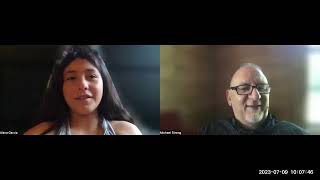
Alana is working on her third book, seven chapters and 23 pages so far, writing without an outline and letting plot develop as she goes. She alternates between thinking and writing days, chasing a flow state, and writes for readers like herself, aiming for stories accessible beyond America.
Chapters
Good. How are you?
I'm well. So my memory of what you're doing this summer— and tell me if I'm right or wrong or if I missed anything— is playing with friends, writing your third book, jujutsu tournaments, and Harvard CS50, and then also creating a new game. I'm getting all 5 of my fingers on the screen. Did I get everything?
Those were the basic things that we had planned, yes.
Good. And how are they going?
They're going great. Um, we're going to the beach today. We're gonna go surf, um, even though it's a bit chilly and gray out. We weren't expecting that. Um, my brother and I competed a lot the past few weekends. Um, and then there's one in about 2 weeks that we're going to go to. Um, yeah, it's been great.
Very cool. And then surfing, do you surf with friends or family, or who do you surf with?
I think right now it's just gonna be my dad, my brother, and I. Um, usually it's just us, but sometimes we go with friends.
Cool.
We haven't gone in a little while.
Well, my sense is surfing makes you incredibly strong because paddling out is so much work. Would you say that your arms get pretty strong when you paddle out?
I think so.
Yeah, I, I've only done it a little bit and wow, it is so much work. Uh, but good, good work. So how about, well, first the card game, any progress in the card game or is the card game still on the back burner, so to speak?
No, no progress made yet, but I'm starting to visualize some of the cards.
Excellent. And your book, any progress on the book?
Yes.
Tell me about it.
Uh, started a new chapter, plot twist.
Excellent. How long, how many chapters do you have so far?
7, I think. 23 pages. Say that again.
So you— 7 chapters on the new book already?
Yes.
And 23 pages total in the book?
Something like that. I do have them double-spaced, um, because I did that for my first book because it was a bit shorter than the latest one, and I'm just following the line, I guess.
Double-spaced TypeScript or handwritten?
It's— yeah, it's typed.
Okay. And then, uh, so 23 pages, 7 chapters, so a little over 3 pages per chapter?
Yes.
Okay. Uh, and how do you— do you have— bless you— do you have any idea how long the whole book is going to be? Is it— are you like halfway through A quarter of the way through? Three-quarters the way through?
Um, to be honest, I'm not sure. Um, I want to make it over 10 because, um, I think my other books were over 10. Um, but I'm not entirely sure on how long it's going to be.
Got it. Um, how is the process of writing the book this time different from the process of writing the earlier books?
Um, it's not that different. I just have different characters and different motives.
Mm-hmm.
Um, yeah.
Tell me about the different motives.
Well, obviously I can't say too much, but, um, you know, there's new characters and some of them want different things than in the other or previous two books.
Mm-hmm.
Um, and that sort of erupts a challenge for the main characters.
Got it. And do you have an overall story arc at this point, or is it kind of exploratory and evolving?
It's exploratory. It's, it's definitely evolving. Um, I like to change parts of my story a lot so that it makes more sense overall. When I just have it planned out, I feel like when I get stuck and stop, or when I get stuck and I have to like think over it again, the story doesn't seem so great as it did when I first came up with it. And so that's kind of why I love just making it up as I go, because it always seems pretty awesome.
Got it. Um, would you say you kind of sit down with like with an idea in your head of where it's going to go? And then you start going and it sometimes follows that idea and sometimes goes in a different direction?
Yes.
Got it. And can you tell, are you looking for like excitement in the plot? Are you looking to surprise the reader? Are you looking for where, what your characters should be doing? How do you decide what's the right direction to go as you go forward?
Um, well, I think about what would make most sense, um, for either the villain or the main character, or what, what I would expect to happen.
And were you done?
Yes.
Most sense for you, or do you think of external readers other than you?
I, I don't know. I feel like it's sort of both. Um, but I guess I don't know if people think the same way as me, but sometimes, I mean, I go outside.
Do you have, uh, an ideal reader? I'm like, is your reader a 10-year-old girl just like you, or is your ideal reader I don't know, a younger kid, an older kid, an adult, somebody completely different, somebody very similar?
I've never actually thought about an ideal reader, so I'm not so sure. I mean, I guess I always expect— I expected my book to be read by kids like me, so.
Yeah. I do think that's usual. I think that's— I think most people kind of write with the implicit expectation that they're writing for somebody like themselves. But, you know, obviously if you're writing, if an adult is writing a children's book, sometimes they think of writing for children. And it also, I could imagine sometimes writing, you know, girls wanting to write for girls or maybe for boys or, you know, things like that. You might have a particular— would you say your book is for boys or girls or it could be either? You have no idea.
Um, I don't think it's explicitly for one. I think it's for both.
Do you think that, uh, it makes— is it, you know, you're an American. Is it more for Americans, or do you think non-Americans could understand it just as well?
I mean, I think non-Americans could understand it just as well. I mean, I didn't want to make it so complicated that others are not— others than the people I had in mind couldn't read it. I mean, it's— yeah, my— I don't think my writing's that complicated.
Got it. And how will you know when you're done? How will you know when this is the last chapter?
Um, I think that usually when I come up with a story Um, I'm— once I get to a point where it could possibly be like the stopping point, I realize that and then come up with an ending part. I don't— I, I haven't had any issues in the past with coming up or with, um, the ending.
Got it. How often do you write? Uh, tend to write every day, or is it maybe once a week when you're feeling like it? What are your writing habits like?
Um, to be honest, it's kind of, um, not— or one day I will for a little while, and one day I'll just think, and one day I'll write. It's not really in a pattern.
Although what's interesting about what you said is it sounds like, um, thinking is sort of an entirely separate stage from writing. You said one day you'll think and another day you write. Would you say that it's useful to you to kind of have thinking time separate from writing time?
I think that sometimes it helps, but thinking while writing does get it done much faster.
Uh-huh. Do you find that often you're thinking about your story when you're not working on it?
I'm not sure. I think it's both. But I think there might be more of it happening when I'm writing, just because I'm in the zone.
Of course, of course. And you would say you get into a zone when you're writing where you're just like totally focused and the rest of the world disappears?
Sometimes.
Okay.
Um, not gonna say all, but yeah, that's—
sometimes people call that a flow state. Um, have you heard that expression, going into flow, before?
I think so. I'm not sure if that accounts to reading, but if it does, it happens to me a lot.
Yeah, yeah, for sure. You know, you get it going. I think it's exactly what you mean by in the zone. Where did you get the expression in the zone? Is that something you heard from your family or somewhere else?
To be honest, I have no idea. I've had that for a little while. I'm not sure if people just used to describe me when reading in the zone, but I don't know.
Well, and we all, we all absorb lots of language and linguistic patterns, but yeah, it sounds like it's definitely something you're used to using, and you're aware that when you're in writing, you're sometimes in the zone. Well, marvelous. I am glad to hear about the book going onward. And glad to hear about the jujitsu and surfing and play. Any work on Harvard CS50, or did you take a break?
I am taking a long time with it. I'm still— I'm almost done with the Week 0 Scratch. It's just some details I have to work out, and then Um, I'm gonna start next week.
Yeah, no rush. Can I think of summer as sort of take it easy? That's why I'm really glad you're playing. I think play is— play is always important, but play is especially important in the summer. So, uh, good for you, and have a wonderful time surfing. Um, I will think about how much stronger you're becoming, and, um, we'll talk next week.
Okay, awesome.
Okay, thank you.
Bye.






