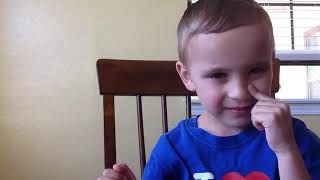
An adult asks Ethan, a child, what fear is. Ethan says it's feeling really scared, like when he saw huge footprints in a cave and thought a big creature might eat him. They explore whether fear always needs a good reason, and whether happiness does too.
Chapters
Ethan, how are you? Can you hear me?
Yeah.
Okay, good. How are you?
Good. How are you?
I'm very well, thank you. So I was thinking about what fear and where does it come from. So do you know what fear is?
Yeah.
What is fear?
It's when, like, you're really scared.
Okay, and why do we sometimes become really scared?
Like, if you see something scary, you might become really scared.
What kinds of things are scary?
I don't know.
Have you ever been scared in your whole life?
Yeah.
Can you remember a time that you were afraid?
Yeah.
What caused it?
One time we walked through We were at this place and we walked through a scary cave that had footprints and they were huge and I was really scared.
Wow, was it a real cave?
Not like a real one, just a really short one.
Okay, so a short cave and then when did the fear stop? When did you quit being afraid?
When we got out.
Okay, so why do you think you were afraid in the cave?
Because those footprints.
Did you think the footprints might hurt you?
No, I just thought something big walked through and might eat me.
Oh, that sounds really scary. So do you think that animals are afraid sometimes? Everybody's afraid. Okay, why do you think everybody's afraid sometimes? What are we afraid of when we're afraid?
Well, it depends on different people. Like, I'm afraid of Big footprints. I'm afraid snakes.
Got it.
Afraid of everything that basically can harm you.
Okay, so maybe we're afraid of things that could harm us. Do you think— yeah, do you think that sometimes we're afraid of things that cannot harm us, or we're strictly Afraid only of things that can harm us?
Sometimes we're afraid of stuff that can not harm us.
Why do you think that is?
Um, I do not know very much.
Okay, so, um, I'm tempted to say that if something is to harm us then that makes sense that there's a reason for us to be afraid. But if something can't harm us, it seems like there's not a reason for us to be afraid. Does that sound right?
Yeah, yeah, sounds right.
Okay, do you think that we should only be afraid of things where we have reasons to be afraid?
No, I don't.
Okay, so we— maybe we should also be afraid where there's no reason to be afraid at all?
Uh, that's what you mean. Uh, no, you shouldn't be afraid.
Okay, so how can you tell in any given situation if there's a good reason to be afraid or not?
Hmm, I don't want to know that question.
Okay. Do you think that most people have good reasons when they're afraid?
Yeah, probably.
Okay. Can you think of any examples of anyone anywhere who is afraid without a good reason?
No, not too much.
Okay. Do you think we usually have good reasons when we're happy, or we can be happy without a good reason?
I don't really know what you mean.
Well, we were— you were— it seemed like you knew that, um, usually when we're afraid, we have a good reason, but sometimes not, right?
Yeah.
So I was thinking, if we usually have a good reason to be afraid I was wondering if when we're happy we also have a good reason to be happy, or if sometimes we're happy without a good reason.
Oh, I— well, I have to write that one down because I don't know.
Okay, no problem. Would you say that human beings are complicated to figure out?
Yeah, mostly.
Mostly. Okay, well, we're human beings and we can be pretty complicated. So with that, I will let you think about when we have good reasons to be afraid or not, when we have good reasons to be happy or not. And I'll let you think about it until next time we talk. Sounds good?