Loving your child's mind
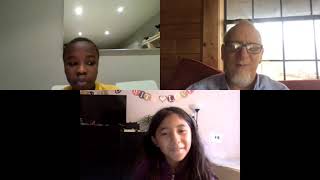
Eight-year-olds Alana and Sankara talk about reading and writing. Alana loves fantasy and Greek mythology but doesn't feel inside the characters; Sankara gets fully immersed, especially in Wonder. Both are writing their own stories: Sankara's a space adventure, Alana's a magical mythology tale.
Chapters
Hello, Alana, how are you? Can you hear us, Alana? Hello, can you hear us, Alana? I can't hear you. I think you're muted. Can you unmute?
Yeah, I was muted.
Whoops.
Okay. All right, I'd like to introduce you to Sankara. Sankara, how can you introduce yourself?
My name's Sankara and I'm 8.
Yeah, terrific.
Cool, I'm 8 too.
All right, so maybe because you guys know almost nothing about each other, maybe you could say where you live and what kind of school you go to, and maybe some things you love to do. So, um, Alana, do you want to start? Where do you live? What kind of school do you go to? And what do you love to do?
Sure.
Um, I live in San Diego downtown, and I think I go to a charter school. And most of my favorite things to do is read, um, do jiu-jitsu, and Probably hang out with some of my friends.
All right, thank you, Alana. How about you, Sankara? Where do you live? What kind of school do you go to? And what kinds of things do you like to do?
I live, um, in London, and I like reading and seeing my friends and, um, yeah.
Terrific. Actually, one thing that I knew about both of you is that both of you love reading, and I love reading too. I think reading is so wonderful. So maybe, maybe let's talk a little bit about what we like about reading. Um, so Alana, do you want to start by saying what you like about reading? Maybe what kinds of things do you like to read? And then what do you like about reading those kinds of things?
Okay, um, I usually like to read fantasy fiction or mostly Greek mythology. Um, I really like it because I think I really like the stories and what happens.
Terrific. How about you, Sankara? What do you like to read and why do you like to read it?
Um, I like to read, um, Fiction books, and because I like the story, and when I read it, it's like I'm actually there.
I missed the last part of what you said. You like to read it so you can actually what?
Because when I read it, I feel like I'm actually there.
Ah, I love that. And so I want to hear more about that. What is it like to be actually there? Try to explain a little bit more. What is it that— maybe a place to start is do all stories make you feel like you're actually there, or do some better than others? And what does it feel like to be actually there when a story does that for you?
Some books don't do as good as others. And when I feel like I'm actually that side, when somebody talks, it's like I'm the person who's talking or something.
So what I'm tempted to say is, do you feel as if with a really well-written book, you almost get inside the head of the characters, that is, you experience life sort of like the characters are experiencing life? Is that a good description?
Yeah.
Mm-hmm. Okay. Alana, why do you— what makes a book— why— actually, let's start with Sankara's perspective. Do you feel as if with some books you feel as if you're actually there?
Mm-hmm. Yeah.
Um, for me, not really. I just really imagine them.
Okay, so you would say you've never had the experience of feeling like you're inside a character's head when you read a book? Are you frozen, Alana? Is she frozen for you, Sankara?
Mm-hmm, yeah.
Okay, with the internet I never know, sometimes one person can hear and another person can't hear and I don't know what's going on, so if she's frozen, I want to think a little bit more with you about— so she says for her it's more imagining what their kid's life, the, you know, the character's life is like rather than being inside their head. Does that make sense to you too, that sometimes it's more for you about imagining the kid's life rather than being inside their head?
Yeah.
And looks like her internet was weak, so she bopped off. So what can— I want to figure out why is it sometimes, because I've certainly had your experience, Sankara, where sometimes I feel like it's almost like I'm experiencing the things that the characters are experiencing. And I'm trying to think, maybe sometimes it's more like what Alana is saying, it's more like you can kind of imagine what it's like for them, and I'm trying to think about the difference. So Alana, it looks like you froze and fell off and came back.
Yeah, I guess so, it's because my internet's really, really bad.
That happens, no problem, no problem. And so as I was kind of summarizing, Sankara was saying that he sometimes feels— and Sankara, tell me if I'm wrong, OK? But I think Sankara sometimes feels as if he is experiencing the world as the character does, whereas it sounds like, Alana, you're mostly kind of imagining the characters but not really putting yourself in the place of those characters. Did I summarize each of your perspectives correctly?
Yeah, for me, yeah, I think that's good.
Okay, so what I guess I'm wondering is, I think I've had both, I think I've had both experiences, that is sometimes reading for me is like what Sankara is saying where, you know, I feel like I'm the character pretty much, you know, and I kind of feel the same emotions the character is excited that he or she is going to do something and then, you know, maybe sad or disappointed that a bad thing happened and I'm like emotionally having the same experiences as the character, and then other times I feel as if I'm sort of like an observer and I'm imagining what their life is like, but it doesn't really feel like me. Have both of you had both kinds of experiences or strictly only one?
I think mostly just, I'm just imagining it.
Mm-hmm. But would occasionally, would you say you almost identify with a character and almost experience the emotions that the character is having?
Like sometimes when someone dies in some of my books, like I kind of feel bad for them or I feel sorry for them, but I never really think of myself as like the character.
You know, actually, you're— I would say that's true. I guess I've never ever felt like I was dying when a character dies in a book, so for sure I'm with you on that one. Sankara, how about you? Would you say that you always feel like you're the character, or am I exaggerating? Or say more about you know, is it sometimes like imagining you're the character or sometimes like being the character?
Sometimes I imagine the character, like if someone dies, I wouldn't feel like I die.
Sounds like all three of us are right there with that one. So Sankara, can you say more about a time when you felt like you were the character? Like, do you have a very specific case in mind of a character where it almost felt like you were that character?
Um, in Wonder, um, this boy gets, um, is going to a new school, and I also feel like I'm going to a new school when he goes to a new school.
I see. So were you joining a new school in real life at that point, or had you joined a new school in real life?
Yeah.
I see. And so let me see if this makes sense to you. What I'm imagining when you say that is that if we have a particular experience, like maybe joining a new school, that if a book— if a character in a book has an experience like that, sometimes a really well-written book gives us a very vivid, compelling version of that experience that maybe almost helps us understand our experience better. Do you think that's true, or am I exaggerating when I describe it that way, Sankara?
I think, I think that's true.
What do you think, Alana? Are Sankara and I making sense, or do we sound crazy?
Um, I think you guys are making sense.
Have you ever had that experience where maybe a character in a book was doing something like you had done in real life, and when you read about the character's experience, it sort of almost made your own experience, uh, come alive somehow more?
Um, I don't think that's ever happened to me.
Okay, um, but this is a— that was a helpful example, Sankara. Do you have another example of a time when you kind of felt like the character? I mean, that was just, I think personally I found that example helpful. Do you have another example? We can see if Alana has had a similar thing.
No, I can't remember anymore.
Okay, it's hard in what I call real time on the spot. So Alana, what can you think of the time when you felt most like a character? Maybe we can start, you know, has there ever been a time when something happened to a character and it really did, you kind of, you're emotionally connected? Obviously not died, but something else. Has it ever felt like you were right there inside the character?
No, other, like, Just, I'm using this as an example, but yeah, if someone dies in a book, I kind of feel bad for them, but not, I don't feel, but like I said, I don't really feel like I'm the character.
Mm-hmm. So Sankara, maybe let's go in the Ilana direction. Are there times when you definitely do not identify with a character where you're kind of imagining them, but it just feels so different that they're like a different person? Can you give us any— does that sound right to you that sometimes you're just imagining them and you're not kind of going through the experience with them?
Yeah.
And then do you think it's— so you mentioned that a character going to a new school, which was an experience you had. Would you say if the characters are having experiences more like experiences you've had, then you identify more with them? But if the characters are having experiences that are more different, then maybe you don't? More different than your own experiences, then maybe you don't identify with them. Does that make sense?
Yeah.
So Alana, does that make sense to you that if we, if we have, if we're like a character, if we have experiences more like a character, we're more like to, more likely to feel something like what they felt, whereas if the character is doing something very different from our experience, Maybe we don't feel what the character felt?
Yeah, like kind of like maybe like sometimes when I'm doing something other than reading, like if I see something and then I tell my parents that I've seen him or her at a different place, like sometimes I see my friend, my old friend from jiu-jitsu at the beach sometimes if I go, like sometimes that makes me a little excited, so I'm kind of a little excited.
Mm-hmm.
So sometimes like that, a little bit of emotion.
Yeah, no, I think it's sort of magic. We talked about how some books do these things better than others, and it is sort of magical when books do them well. So personally, I'm very interested in how writers sometimes can get us to feel what the characters feel, even a little bit. And I know Alana, you've written some books. Saankara, I forget, have you written any books? Or written a story or anything?
Yeah.
So tell us what kind of stories you've written.
The only one I've written is about a boy named Max, and, and it's just an adventure.
It's an adventure? Is that what you said? So say more. What is the adventure? Is it like, um, is it in a city? Is it in the country? Is it, um, kind of action? Is it, uh, I don't know, space? What kind of an adventure?
So this, this person is supposed to go to space, and then, but then his, his, um, spaceship crashed. And then he ended up in a place he didn't know. And then, yeah, that's basically, yeah.
So if it's space, I would describe it as full-on science fiction. Does that sound right to you, that it's science fiction?
Yeah.
And just so, uh, Sankara knows, Alana, can you say a little bit about the story you wrote and what kind of a story it is?
Okay, um, my story is basically magical Greek mythology, or I tried to base it off Greek mythology, but then I didn't want to like do it full, so I added some magic items in there.
Very cool. So maybe more like fantasy. I would say Sankara's is more like science fiction and maybe yours is more like fantasy. Does that sound right?
Um, yeah.
Okay, or maybe mythology, either way. Um, I, I sometimes after having a little conversation, I like to kind of check in and see how things worked, and so I would describe us as mostly talking about reading and writing, and so I want to check in with you, Sankara, as we're going to wind down. What, what did you enjoy most about this conversation about reading and writing, and what was maybe most challenging for you in this conversation about reading and writing?
I'll deny.
Was there anything good about it at all?
Um, yeah, I like thinking about, um, about the story I wrote because my story was a bit funny.
Terrific, I'm delighted to hear that. And what was maybe challenging about talking about reading and writing in this conversation?
I don't know.
Okay, if you think of something, we can go back to you, but I want to go to Alana. So Alana, what did you enjoy most in this conversation about reading and writing?
Probably that I could also kind of also, uh, I kind of got to talk about my book a bit, like, um, What's his name again?
Sankara.
Sankara. Um, but yeah, I like to talk my book about my book again, um, just like Sankara, because I'm, I'm always doing something else. So right now I'm not working on that book. I haven't worked on that book for in a while because I'm also doing other books and doing other stuff.
Terrific. Was, what was, was there anything challenging about this conversation? And if so, what, what What was it?
Nothing other than you guys kept freezing for me and then I kept getting kicked out. Other than that, it was fine.
And of course, from our perspective, you kept freezing on us. It's like, Alana, why are you freezing? But that's technology, obviously. It has nothing to do with any of us. Um, cool. Uh, in which case, um, Sankara, I know I want to check— touch— talk to your mom, or actually my wife and I are going to talk to your mom a little bit. Um, but I thought it was really great to talk to both of you about reading and writing. I love reading so much. I'm so glad to find two super intense young readers. So let's— here's to creating a global club of cool reading readers, okay? All right, in which case, um, bye, Alana, and Sankara, let your mom take over, okay? Okay, bye-bye.






