Loving your child's mind: Alana on good guys and bad guys
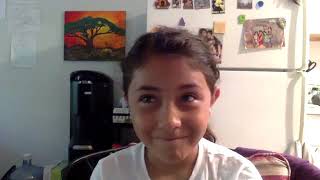
Alana talks about survival stories like Robinson Crusoe and Percy Jackson, what makes her like or dislike characters, and her plan to write a four or five book fantasy series with a surprise villain she'll reveal later. She writes in Google Docs for 10 minutes to an hour most days.
Chapters
Can I hear you? Can you hear me?
Yes, I can hear you.
Wonderful, wonderful. I can hear you as well. Good. How are you doing this morning?
I'm good.
Good. What are you reading? I'm well, thank you. Well, and what are you reading these days?
Um, right, so I'm reading Robinson Crusoe, and I'm also starting a new series I think it's called The Heroes of Olympus or something like that. I'm on the first book, which is called The Lost Hero.
Excellent. What's happening in Robinson Crusoe right now?
So I'm in the part when he first got shipwrecked.
Oh wow, and you're very cheery about that. Isn't it scary that he's shipwrecked?
Not really, it's kind of interesting. The music.
Why is it interesting?
Because he actually has to fend for himself. He has to like, like just survive from the things he has. I think he has a knife, a little tobacco, and yes, he has to survive off of that.
And you like stories where people have to survive with almost nothing?
I like stories like that, maybe people are on the verge of maybe dying but survive in the end.
I see, and so would you say what you like about it is there's kind of some thrill or fear that they're going to die, but if you know they're going to survive, then the exciting part is seeing how they figure out how to survive?
Yeah.
Okay, so Island of Blue Dolphins, I forget what was her name? The protagonist's name in that?
Karana or Wanapali.
Karana?
I think it was Karana.
Karana? Karana, okay. So would you say that Robinson Crusoe and Karana are pretty similar, or do they have very different approaches to survival?
Um, I think they have very different approaches because since Robinson Crusoe is on a different island that he doesn't actually know what it's called or if there's anything anything on it, but Karana is on her own island that she's lived on for all of her life, so she probably knows where some spots are, good spots.
So would you say it's much easier for her to survive than it is for Robinson Crusoe?
I think so, because all he has is a knife and a little tobacco too, and she has like all the different kinds of fish she can— I mean, maybe he can catch some fish, but that but those waters were really, really, really, really, really rough.
And how do you know that he's going to survive? Maybe he's not going to survive.
I assume that he's going to survive because in every book that has a character, the good character almost always wins. Well, except in Infinity War.
What's the exception?
I said except in Infinity War because when I watched the movie with my mom, Thanos won in the end or something like that. He got all the gems. Got it.
Okay, so usually you're saying the protagonist survives, so you're assuming that just because of that framing that Robinson Crusoe is going to survive, and then you're enjoying how he figures things out. Is— yeah, do you have a sense of him as a person? Is he— does he have a personality at all or no personality really?
What do you mean by personality?
Like, some people are kind, some people are mean, some people are optimistic, some people are pessimistic. You know, people are different in how they are.
I think he's kind.
Okay, um, is his personality similar to Karuna's, or is hers very different?
Between Karuna and Robson Kershaw?
Yeah.
Um, I think theirs is actually basically the same.
Okay. Can you tell when you read a book if you would like that person? You're the person in the book. Can you tell when you read a book if you would like that person?
Yeah.
Would you say that you like most of the people you read about in books, or are there some characters you're not— you don't think you would like?
Some characters in a book, like bad guys or something like that, I wouldn't like, but maybe the good guys, well, not especially just like good guys who do the right thing, but also if they're kind and honest and do the right things.
So how about in Harry Potter? Are there any characters you don't like in Harry Potter?
Voldemort.
Okay.
Or, you know who?
And why do you not like them?
Um, Hufflepuff.
Why do you not like them?
Hufflepuff.
Okay.
Me neither. Bellatrix.
A whole bunch. So can you explain why you dislike them?
Um, because they are basically trying to destroy the whole world.
Okay.
Well, not the whole world. They just want to eliminate a lot of people.
So anybody who's trying to destroy things or do bad things and you don't like them, is that a fair assessment?
Well, oh, well, yeah, and but sometimes in books, um, maybe the bad guys can turn into good guys or maybe they just stay bad, but yeah, that's when I hate them.
Um, can you think of an example of a bad guy turning, turning good in a book?
Um, in Percy Jackson, There was a boy, there was a demigod named Luke who helped Lord Kronos arise, and then Annabeth turned him good.
So when you say she turned him good, was it magic or persuasion, or how did she turn him good?
I think it was persuasion because they used to be basically family because Luke and another girl named Thalia found her in like an alley when she was only like 7 or something like that. And they became really, really close. So she always tried to persuade him to not be on the dark side or something like that.
So why doesn't somebody in Harry Potter persuade Voldemort not to be on the dark side?
If or did?
Well, why don't they? Do you think they could persuade him not to be on the dark side?
I don't think, well, from my thinking, I don't think they would be able to.
Why not?
Because he is head on. He is head on onto whatever he's doing, even if he gets killed.
How about the other bad characters in Harry Potter? Do you think any of them might be persuadable to join the good?
Maybe. I don't think— well, most of them I don't think so. I can't really think of one of his Death Eaters that would really turn to the good side.
I know, why not? How can you tell if somebody is persuadable or not, or somebody can be turnable to the good side? How can you figure that out?
Sometimes how I do it is if like maybe if someone had a really, really, really strong relationship like maybe just being really, really, really good friends with another one and they're on the good side or something like that. Like since you got— since they're both connected, maybe the person on the good side could still persuade the person on the dark side to come back.
I see. So it's kind of strength of relationship across the good/bad boundary. And what you're saying is that nobody, nobody, none of the people on the bad side in Harry Potter have a very strong relationship with people on the good side?
Not really.
So suppose, um, you know who the author of Harry Potter is, right? What's her name?
I think it's J.K. Rowling or Rowling or something like that.
Yep, that's exactly right. What if she wrote another book, and then the next Harry Potter book, another Harry Potter book, and in the next Harry Potter book, they were able to persuade one of the people on the bad side to join the good side. Do you think that would be kind of weird and out of character, or do you think that she could write a book in which that happened?
I think she could write a book in which that happened, because some— I mean, some of them they might be able to persuade, but you would have to try really, really, really, really, really hard.
Okay, so you, you're still writing fantasy stories yourself, right?
Yeah, I'm trying to write a book in Google Docs right now.
Okay, um, do you have characters that are both good characters and bad characters, or all your characters good?
Most of them are good right now, but I'm gonna do bad ones in the end, so I'm keeping it as I'm doing— I'm keeping the, the, like, the lead bad guy as a surprise.
Got it.
Until the end of the book and then books that lead on from that.
Got it. Oh, so this is the first of several books you're writing?
Mm-hmm.
Okay. And so, well, this is interesting. So the bad guy will be a surprise, and then I would say a lot of books kind of have a conflict between good and bad, and that's what makes them exciting. Does that sound right to you?
Yeah.
So you as an author, you're already thinking about, you know, it's the thing with just books with good characters, sometimes they can be boring. And I would say something like Island of Blue Dolphins and Robinson Crusoe, it's kind of the human against nature. That is, I don't know if there's necessarily a bad person, but there's a struggle, you know, some kind of a fight or struggle. So in books like Harry Potter, kind of a struggle against good and evil, in books like Robinson Crusoe and Island of the Blue Dolphins struggle against nature, and so in your book right now, no bad characters. How do you make it interesting if there are no bad characters yet?
Like, first I add some in, and then first I add like just like picturing them in your mind, and then they get away, and then like there's going to be like maybe something interesting with the bad guys and the good guys. That's what I'm doing.
Got it, and so how far would you say you're? Halfway through your story, your first book, or a quarter of the way, or a tenth of the way? Do you know roughly what percentage you are done?
I actually don't know. I don't really know how much I'm going to be writing.
Okay, okay, well I'll be very interested to see how you, how you introduce the bad guy. First, I'll look forward to reading it, but I look forward to how you introduce the bad guy and then Um, you know, kind of this— you said a surprise. Do you know how the surprise is going to work or not yet? Okay. Okay. Well, I look forward to seeing how you do that and then how, um, how the bad guy, good guy dynamic plays out over— you know how many books you want to write?
I'm thinking maybe 4, something like that. 4 to 5.
Excellent. How often do you write in your book?
Right now I'm trying to do at least 10 minutes or an hour every day, but I'm really doing every couple of days because maybe I'm doing a comic book because I'm making them so I can sell them, something like that.
Yep, well, excellent.
Or maybe—
Okay, yeah, well, I look forward to reading it. Are you having fun writing it when you do write it? Yeah. Okay, good, good, good. All right, um, are you gonna go out and do something fun outside today?
I hope so.
Okay.
I don't really know.
Great thinking on reading and good and evil and, uh, how I'm very fascinated in how these stories work out. So, um, hopefully you have a good day and a good week, and we'll talk to you next week probably.
Okay, bye-bye.






