Loving your child's mind: Alana reads Invictus
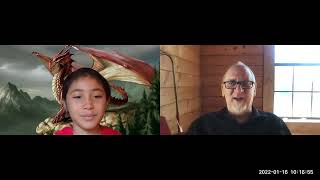
An adult guides Alana through William Ernest Henley's "Invictus," unpacking difficult words and the poem's central claim: "I am the master of my fate, I am the captain of my soul." They discuss how Henley wrote this defiant piece while recovering from amputation, and what it means to have freedom of mind even when the body is conquered.
Chapters
Sankara is a swimming tournament, Marawa is in Australia, and Magat has the day off. So I thought we'd do a poem because we haven't done a poem for a while. It's called Invictus. And maybe we're going to start by reading it. Have you ever heard of this poem before?
No, I haven't.
Okay, do you want to read it and then we can talk about it?
Okay. Out of the night that covers me, black as the pit from pole to pole, I thank whatever gods may be for my unconquerable soul. In the fell clutch of circumstance I have not winced nor cried aloud. Under the blood-giong-i— under the blood—
bludgeoning—
bludgeoning of chance, my head is bloody but unbowed. Beyond this place of wrath and tears looms but the horror of the shade, and yet the menace of the years find and shall find me unafraid. It matters not how strait the gate, How charged with punishments this scroll! I'm the master of my fate, and I'm the captain of my soul.
All right, thank you. A few difficult words, but what do you think as a whole? What do you think that this poem is talking about?
I don't know.
Okay, no problem. Do you think it's supposed to be funny, or is it supposed to be serious?
It doesn't seem very funny, so probably serious.
Okay, I like to, in something that we may not know, I like to start with things where we can be somewhat confident. Also, I'll help you on the word Invictus. The title of the poem means unconquerable. So when it says in line 4, "my unconquerable soul," Invictus is Latin. Do you know what Latin is? Have you ever heard of Latin?
Yes, I have.
What's Latin?
Um, it's a language, um, that I think the Romans used.
Brilliant, absolutely. And, um, both— many modern languages, uh, are descended from Latin. So both Spanish and French, as well as Portuguese and Romanian, are all descended from Latin. And Italian as well. They're all Latin languages. So, um, yeah, invictus means unconquerable. What do you think it means to be unconquerable?
Maybe that like no one can really like be in charge of you.
Would you say that you are unconquerable?
I think I am unconquerable, or I can I can help myself be unconquerable.
Excellent, excellent. So, you know, not knowing the Latin term, not knowing what Invictus meant, that would make it more difficult. So now that we know that it's about unconquerable, let's just try the first stanza, and I'll read it this time. Out of the night that covers me, black as the pit from pole to pole, I thank whatever gods may be for my unconquerable soul. What do you think that means?
I don't know.
Okay, let's take piece by piece. So, "out of the night that covers me," are there any words that you don't understand there?
Not really.
One of the things I think is really interesting about poetry is sometimes poetry can be made of totally words we understand, and yet it's a little bit hard to figure out what it's saying. So let's go on. Black as the pit from pole to pole. Anything, any words you don't understand there?
Well, I understand what the words mean, but I've never heard all those words together like in this part.
Fair enough, fair enough. So, "Out of the night that covers me, black as the pit from pole to pole." Is it fair to say that we're not clear, that all the words make sense, but we're not exactly clear what they're referring to?
Yes.
Okay. When you hear "pole to pole," what does that make you think of?
It makes me think walking from one pole to the other.
And what are the poles that you're thinking of?
Just poles, like, that are, um, in the ground.
Okay. One other possibility that comes to mind for me, and I'm not yet sure if you're right or not, is the poles on the planet Earth. So there's the North Pole and the South Pole. Um, so that's one other set of poles. You've heard of the North Pole and the South Pole, right? Yes, that's another possibility. So, out of the night that covers me, um, black as the pit from pole to pole— and we're still not sure what all of that refers to, but let's go on— I thank whatever gods may be for my unconquerable soul. How about just those last two lines? Do those make sense?
A little, I think, a little more. Than the first two.
So what are the last two lines, what are they saying to you?
Well, how I understand them is that the author, because there's many different religions and so there's many different gods that people have believed in, so he might be like whoever is actually maybe real, or at least to him, he's thanking them for his unconquerable soul.
And does the concept of an unconquerable soul make sense?
I think so.
So when you say you are unconquerable, would you say your body is unconquerable, or your soul is unconquerable, or both your body and soul are unconquerable?
Maybe both.
Okay. What would it— so let's see, let's— one way I like to understand things is to try to understand the opposite. So what would be a— what would it mean to be conquered physically in one's body? How could, how could one's body be conquered?
Maybe like if, like maybe if they're tied up, or maybe if they know that they can escape, so they just do whatever you tell them to.
Okay, um, so you mean— let me get— see if I understand the last part. So tied up, I understand. Tell me the other piece again. I didn't quite understand what you meant there.
Like maybe if like someone's telling you what to do, like, like maybe hard labor, and you don't really have control over it, and you know that you can't get out of it.
I see. Then, then you might be conquered if people can control you physically. Yeah, got it. And how about a conquered soul? If you're conquered physically, does that mean your soul is conquered, or not necessarily?
I mean, not necessarily, because you can, like, maybe you can, like, inside you can probably still, like, not be, like, totally in control of that person. Like, they can't make you think about something. Okay, in control of your own mind and soul.
Okay, I mean, what would it mean to have a conquered soul then?
Like maybe they've— or maybe you've just maybe given up entirely, or they've conquered you entirely.
Do you, do you think that sometimes people do give up entirely?
Probably. Yes.
Have you ever known anybody or read a character in a book where they had given up?
No. Especially like maybe fiction characters, you never really see them give up because in the end they always win.
Yep. Yep, certainly the protagonist does. OK, let's try the second stanza. In the fell clutch of circumstance, I have not winced nor cried aloud. So let's just pause there. Are there any words you don't understand?
I don't really understand the word circumstance in that, like, in that position.
But the rest are okay?
Excuse me?
The rest of the words are okay?
Yes.
Okay. Um, yeah, in the fell clutch of circumstance, um, I have not winced nor cried aloud. What I'm getting there is, um, there could be circumstances that are difficult. Um, so there are easy circumstances and hard circumstances. So, um, you know, maybe if you're climbing a mountain and the rain is coming down and the rocks are starting to fall on you, and, um, you know, you could imagine hard circumstances like that, whereas maybe sitting having breakfast with your family in the morning is an easy circumstance. So there are different kinds of circumstances. Some of them are hard ones and some are easy. Does that make sense?
Yes.
Okay, so in the fell clutch of circumstance I have not winced nor cried aloud. Um, are you okay with those two lines now?
I think so.
Okay, under the bludgeonings of chance my head is bloody but unbowed. Any words you need help with there?
I've never heard the word bludgeoning, and I don't know what it means.
Okay, it's an old-fashioned word to kind of beat somebody up. Uh, people would be bludgeoned with a stick, and so it's the metaphor is of chance kind of beating us up. And presumably it's hard to know if it's real or or metaphorical, but under the kind of beating, the way chance beats us up, things in life beat us up. His head is bloody but unbowed. Does that make sense now?
What does unbowed mean?
I never really heard that word. To bow in front of somebody is like to bend over and bow. To bow your head is to put your head down. And what I get the sense of here is unbowed is, you know, instead of head down, he's like very confident and head up and strong. Does it make sense?
Yes.
So under the bludgeonings of chance, my head is bloody but unbowed. Is that starting to make sense?
Yes.
Okay. Beyond this place of wrath and tears looms but the horror of the shade. Okay, any words there you need help with?
Mm-hmm. Um, well, I know the word shade. I just don't know what it means in the context that they're putting it in.
I love the fact that you're so aware of, um, being unfamiliar about context, because that is part of what poems often do, and books in general, I think. You're exactly right. This author, this poet, is using words in slightly unfamiliar ways, even very familiar words. The way I'm interpreting it is way back in ancient mythology, and you, you read some Greek and Roman mythology, right?
Yes.
Sometimes they would talk about the underworld as the shadow world. So Hades, do you ever remember reading about Hades as the shadow world?
Yes.
So that's how I'm interpreting it, is the horror of the shade. Again, I could be wrong, but I think they're talking about the horror of the shadow world or the afterlife. Does that help make sense of the word shade there?
Yes, it does. Thank you.
You're welcome. Um, so beyond this place of wrath and tears looms but the horror of the shade, and yet the menace of the years finds and shall find me unafraid. How are you doing on that stanza now?
Um, I think it makes enough sense because basically it— um, the author's tell— or the author's writing down that, um, he's maybe been strong so long and he's still unafraid.
Okay. And then the final two: "It matters not how straight the gate, how charged with punishments the scroll." Do you need any help with words there?
I don't really, or I know the word charged, but like how are they using that in that context?
Okay, so what I'm thinking of is if you're reading a scroll you could imagine it being, you know, you could be charged with a crime, or you could be charged with, you know, in the military you could be charged with going into the battle. You know, people, people in this sense charged is giving other people orders, I think. So you can be charged, or telling them what, what they should do. So that's the sense I'm getting from it, is that there's some scroll. And even if he's told he has to go into battle or he's told that he's been charged with bad things, then the last two lines— does that make sense?
Yes.
The last two lines are the most important ones. These last two lines are super duper famous, super famous. I am the master of my fate. I am the captain of my soul. What do you think that means?
Well, he's in charge of what he does, and he's in charge of everything that's his, and no, he doesn't take orders from anyone.
Okay, does that make sense?
Yes, it does.
Would you say the whole poem now makes some sense?
A little bit, yes.
Okay, how would you describe— what would you say it's about if somebody asked you what it's about?
Um, I think that it's telling the person that's reading it, like maybe the things that he's been going through, or she's been going through, and how he or she has been— is not afraid. And, um, he, he or she's been basically controlling who he or she is.
Got it. And does that seem like a message that might be valuable or interesting to some people?
I think so, yes.
Do you think that sometimes people get discouraged in life, or discouraged by events?
Yes.
Have you ever been discouraged when you lose tournaments, or you're never discouraged?
Well, not— I'm not really discouraged. It's, it's more like a thing, but it's never really a big deal.
Excellent. Um, well, one of— just to let you know more about this poem, um, it was written in the 19th century. Do you know in the 19th century was?
Um, well, I don't know much about it, but I know when it was.
Okay, so it was written in the 19th century, um, you know, over 100 years ago. And the person who wrote it, uh, a man named William Ernest Henley, had a disease which had resulted in having one of his legs cut off because of the disease. And so after he was in the hospital with one of his legs cut off, it was his foot below his knee, um, he was recovering, but he wrote this, um, while he was in the hospital recovering after he had lost a leg. Why do you think he might write something like this while recovering from losing a leg in the hospital?
Well, for many possible reasons, possibly to cheer him up. Maybe he could like give this, or maybe he could even sell it, or he could just give it out to people to help them, to cheer them up, or to give confidence.
Okay, would you say, uh, cheering somebody up is the same as giving confidence, or are those different?
They are a little similar, so maybe they're the same.
Would you say this poem cheers you up?
Well, a little bit.
Okay. It's— cheerful seems light to me, whereas this poem feels heavy in the sense that he's talking about a lot of, you know, bad things. Bludgeoning of chance, my head is bloody but unbowed. It seems strange to talk about being bludgeoned, that is beat up, and being bloody if you want to cheer somebody up. Do you see what I mean?
Yeah, but in the end he says that he is still like, he is still in charge of him and he's not going to give up.
Absolutely, absolutely. So the message at the end is you're absolutely right. And but just, I think personally, I think your description of it as something that gives confidence is more accurate than something that cheers people up. Do you see how I would make a difference there? I'm, you know, usually I cheer people up by getting them to laugh or by showing them positive things. I don't talk about, you know, my head being bloody from being beaten up. Does that make sense?
Yes.
Okay, but yeah, it's actually a very famous poem in terms of giving people confidence, especially when people are suffering. And I think, you know, obviously it would be a horrible thing to lose your leg. And I think while he was suffering— well, instead of suffering, you could have— I could imagine some people feeling sorry for themselves if they had to lose a leg. Would you say he feels sorry for himself?
Hmm, I don't really think so.
Yeah. I don't think so either. And so I think it's kind of the opposite. And that's why maybe give confidence is maybe better. And I like what you said early on about your mind can't be conquered, even if you are physically conquered, not just you personally, but anybody, that your mind— would you say our mind is always free or our mind could always be free?
I'd say that, um, our minds are always free because you're in control of them.
Is everyone's mind equally free, or do some people have minds that are more free than others?
Well, people might have minds that are more free than others because they can choose to have their minds— like, they can choose to give like take orders or to like be conquered.
What do you think leads some people to have minds that are more free than other people?
Maybe if they have a positive attitude, or if they believe in themselves, or like— and if maybe if they don't give up.
Is it fair to say that if they believe they are masters of their fate and captains of their soul, then if they believe that, they're more likely to be free?
I think so.
Okay. Well, I wanted to see what you thought of this poem because it's so famous, and I'm always interested to hear how you understand the world. So that was fun for me. Did you enjoy that? Yes. Okay, anything else you want to touch base on?
I'm good.
Did you have a fabulous time in Hawaii?
I did.
I saw photos of your trip to Hawaii and it seemed just absolutely amazing. So it was good for you. Good for you. All right, good to see you, Alana. Till next time. Yep, bye-bye.






