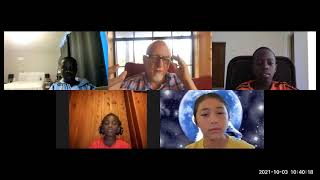
In this recorded classroom session, an instructor (Speaker A) guides a small group of students (Alana, Sankara, Magat, Marwa) through a close reading of Naomi Shihab Nye’s poem “Kindness.” The lesson begins with a volunteer reading the poem aloud, after which the instructor asks each student to self‑rate their comprehension on a 0‑10 scale. Using these self‑assessments, the instructor scaffolds the discussion by breaking the poem into clauses and prompting the students to interpret each line. The conversation repeatedly returns to the opening stanza, exploring the metaphor of “losing things” as a prerequisite for understanding kindness, the image of “future dissolve[ing] like salt in a weakened broth,” and the “desolate landscape” between “regions of kindness.” Students propose varied meanings—loss leading to empathy, future disappearance, financial loss, and the endless bus as a symbol of life’s unceasing journey—while also expressing confusion and “freezing” when they cannot articulate thoughts. The instructor repeatedly validates honesty, encourages collaborative hypothesis‑testing, and models a reflective reading strategy: propose an interpretation, then test it against subsequent lines. The session concludes with the instructor summarizing a consensus interpretation that loss and the awareness of desolation foster empathy and motivate kindness, acknowledging the poem’s difficulty and thanking the students. Key moments include: - Use of a numeric self‑assessment to surface comprehension gaps. - Systematic clause‑by‑clause analysis, prompting metaphor unpacking (salt in broth, desolate landscape, endless bus). - Student‑generated analogies (financial loss, future disappearing, bus as life’s unending ride). - Instructor’s pedagogical tactics: honesty praise, hypothesis‑testing, collaborative meaning‑making, and meta‑commentary on the difficulty of articulation. - Final synthesis linking loss, empathy, and kindness.
Chapters
Okay, so we have a poem today by a poet named Naomi Shihab Nye, and it is on kindness. Actually, the title is Kindness. So, um, do we have a volunteer to read it for us? Go, Lana, go ahead and read it.
The whole thing?
Yep.
Okay.
Before you know what kindness really is, you must lose things. Feel the future dissolve in a moment like salt in a weakened broth. What you held in your hand, what you counted and carefully saved, all this must go so you know how desolate the landscape can be.
Before the—
between the regions of kindness and how you ride and ride, thinking the bus will never stop. The passengers—
He's frozen.
Yeah, I know. The passengers eating maize and chicken will stare out the window forever. So I finished it off for her. While we're waiting for her to get back, I want to see you— Are you back, Alana? I want to see how well you understand this. So again, 10 is perfect understanding. You understand every word, every sentence, every piece. 0 is you have no idea what language which it's in. Sankara, on a scale of 0 to 10, how well do you understand this poem?
Um, 5 and a half.
5 and a half?
Yeah.
Okay, excellent. How about you, Marwa?
2. 2?
Okay, I love honesty. You know, one of the tricks I play is if you claim to understand it and you don't, then I ask you to explain explain it, and if you don't know it, it will become obvious. Alana, how well do you understand the poem? She's frozen again. Magat, how well do you understand the poem?
1%.
1%? Okay. Alana's back. How well do you understand the poem on a scale of 0 to 10, Alana?
Like a 5, maybe.
Okay, great. So this is good. We're all still figuring it out. Again, my number one technique for figuring things out that are hard is to break it into pieces. So let's just start with the first clause that is up to the comma. Before you know what kindness really is, you must lose things. What do you think that means? What's sankara?
I think it means like, um, um, I only understand the end part.
You only understand or you don't understand the end part?
I only understand.
So explain the end part then.
Um, it means like you have to lose something to know To know how to be kind.
You would say you have to lose something to know how to be kind?
Yeah.
Why would you have to lose something to know how to be kind?
Because if you lose something that's important to you, then you'll start appreciating the things that you see every day, I think, maybe.
Okay. Do the rest of you agree that it's saying that if you lose something, that will motivate you to become kinder?
Sometimes.
Do you think that that's what this poem is saying?
Yeah.
What do you think, Marwa?
Yes.
Okay, Maga, what do you think? Do you think if you lose things you will become kinder? You're muted. You are muted.
Go ahead. Not possible.
Not possible. Are you, are you saying it's not possible to become kinder? Many say Possible to do many things. Okay, let's go ahead and get the next clause. So, before you know what kindness really is, you must lose things. Feel the future dissolve in a moment like salt in a weakened broth. What on earth does that mean? Maybe like everything you've hoped for, and then you make one simple mistake, and then it's all Okay, that's, that's how you're interpreting the notion of feeling the future dissolve in a moment. Is that right, Alana? Go ahead, Sankara.
Maybe it means like, like if you do things and you can like shape your future, if you've done something bad before, Okay, if you lose things, you can shape your future.
If you've done something bad before, um, is that the same as what you said, Alana, or different? Okay, um, and I want to go back to how it's different, but Magat has something first. Go ahead, Magat.
Me, I think it is when you think something bad in your, in your future.
You think it's when you think something bad in your future. Okay, what nobody has touched on is the 'like salt in weakened broth.' So it's comparing feeling the future dissolve in a moment is like salt in weakened broth. Can anybody explain why this might be like salt in a weakened broth?
Maybe it's like somebody—
she's frozen. What happens when you put salt in a broth? Does anybody know what happens when you put— what happens when you put salt in a broth? Do you know, Sankara?
It dissolves.
Okay, so the salt dissolves. So how could your future dissolve like salt in a weakened broth? Go ahead, Sankara.
Maybe, like, it could all disappear.
Okay, your future all disappears. Alana, can you remind us what you thought it meant to say or feel the future dissolve in a moment? And I see you, Magat, I'll go after we've been to Alana.
So what I meant was like everything you've ever hoped for or wished for, you just make one mistake and then it goes poof, it just disappears.
Would you say that is like salt, how salt dissolves in a weakened broth? Does that analogy make sense? Okay, go ahead, Magat. What were you going to say?
I would say that if it is like salt in a vegan broth, it is— I think it maybe it means that you, you don't feel your future. You think your future is bad and you, you, you don't hope.
Okay, you don't hope, you feel your future is bad. And that— I want to go back to Sankara's interpretation as well, but Alana, it sounds you would say— are you saying, Alana, your future, you don't see it anymore, it disappears? Is that what you're saying?
Yeah.
Is that the same as Magat saying your future is bad, you don't see it, or is it different?
Oh, it's kind of different because it's not She keeps freezing.
Um, while she's frozen, Sankara, can you remind us what you said about—
I've changed my mind. My idea is—
so you've changed your mind. What's your new idea?
Maybe it means like, um, you should, uh, like I can't explain it.
Okay, I'm going to check in with Marwa. Marwa, do you have any ideas as to what this means?
Not really.
Okay, would you say it's a pretty hard poem?
Yeah.
Okay, no problem, that's why we're figuring it out. So Alana, you froze again when I was asking how your interpretation is different from Magat's. And so you were saying it dissolves, you can't see your future. He was saying your future looks bad. How would you say those two are different?
Well, it's not that it just looks bad. Like, in my interpretation, it's like you don't like see it like anymore. Just, it's just gone. Like, you don't see it and you don't think, oh, my future is bad. Like, you don't— like, it literally disappears.
Okay. So we have a couple of interpretations of this. One way that I like to read difficult material is I have a kind of a hypothesis, an interpretation, what I think it means, and then when I read going forward, I see if my understanding still seems to make sense. So I'm going to read the next sentence and we'll see what that seems to say. So what you held in your hand, what you counted and carefully saved, All this must go so you know how desolate the landscape can be between the regions of kindness. Anyone have any idea what that sentence is saying? Go, Alana.
I was thinking that if you saved up and then it just all was gone, and then you'd think, wow, this is how other people feel. And then you're just, you're just in amaze of how shocking it could be, maybe.
How shocking what could be? Well, Alana, go ahead.
Um, me, I was gonna say Alana's frozen. And also me.
Maybe what?
Maybe this could mean that, like, if you saved up your cash and then you have to, like, use it to— I still can't explain it.
Okay, does it feel as if you understand it better than you can explain it, that it's kind of hard to get your ideas out?
Yeah.
That happens, no problem. That's again one of the reasons I like to think out loud together is we have to think, have to figure out how to put things in words. So Alana, you froze again while you were explaining. Are you frozen, Alana? You there?
She's frozen.
She is frozen again. Okay, so what you held in your hand, what you counted and carefully saved, All this must go so you know how desolate the landscape can be between the regions of kindness. So you keep freezing, Alana. We missed the last part of your explanation. So can you give us your explanation of this again?
Yeah. So I was just saying, kind of like Sankara was saying, like, so if you saved up like everything, it could— it doesn't really have to be money. Like if you lived in a world where you didn't really have money and you just traded things, like you traded your best rocks or best cows or pigs or whatever, and then you have to spend it on something that you don't want to, or like it just goes away and, or maybe not like literally, but like your hopes get smushed down. So you don't really know what to do with it. And then you're like, wow, this is how other people feel.
So the wow, this is how other people feel. How does that relate to the regions of kindness?
Because it says, "Oh, so you can get how desolate the landscape can be." Kind of like that?
I sort of have it, but I want to check. Marwa, is Alana making sense to you or not yet?
Not yet.
Okay. Sankara, do you think you can explain what Alana is saying or not yet?
Not yet.
Okay, does anybody know what desolate means? Go, go, Sankara.
A barren landscape.
There you go. Yeah, and so Alana, so far we can't— nobody can explain quite what you're saying, so we need to get it more clearly. I was asking about desolate. So I think what I think, Alana, is I think you have an interpretation of this part So you know how desolate the landscape can be between the regions of kindness. So there's an analogy or a metaphor between a landscape and regions of kindness. Can you explain a little bit more how you're interpreting that?
Well, basically what I'm saying is that, so if like Sankara, if you were saving up just a lot of things and then something happens and then poof, like it's all gone. And then, so you then, well, so then it goes, and then like the point is then you know how difficult it can be for other people if that happened, or since it's happening to you, how bad it is.
So if I'm going to try to, well, maybe before I try to re-explain what you just said, um, can anybody else explain what Alana said? Go ahead, Sankara.
Maybe you're walking, then you go to buy some groceries, and then your money— and then, um, your bank card falls out of your pocket, and then you lose it all. And then, um, yeah, that's about all I understand.
Okay, um, I think that might be part of it, but I get what I think I'm getting from you, Alana, is that if we experience something that is, you know, our future dissolving, or we lose what we thought we had, that that helps us empathize with other people, that helps us want to feel kindness because we know maybe how much we need somebody to be kind to us. Did I— do you think— am I getting it mostly correct?
Yeah.
Yes.
Did I get anything wrong?
Not really.
Okay, let's get the last sentence and see if this fits in there as well. How you ride and ride thinking the bus will never stop, the passengers eating maize and chicken will stare out the window forever. Go, Sankara!
Maybe means alive. Um, maybe it means like you think your life will never stop except, except it will. Okay, I guess you only have one chance to do what you wanted.
Okay, um, how does that— if that's the right interpretation, how does that interpretation relate back to the theme of kindness?
Maybe you should be kind, kind in the chance you have, then wait till the last minute and never be able to change it. Okay.
Um, Marwa, is this making any sense?
Yes.
Can you explain it in your own words?
Like I can't really explain it that much.
Okay, no problem. This is actually really, really hard. I like to give you guys big challenges. Magat, is this poem making sense to you at all?
I—
yes, I think it makes sense.
Okay, um, what is it saying about kindness?
I can explain this.
No problem. Alana, do you want to explain the last sentence, or is it not making sense to you yet?
Um, I could try, but I don't think you— or I don't think it's gonna make that much sense. Um, so if like you did, or like you got yourself on this thing, maybe you're like going somewhere and traveling, and then you— something bad happens and it just keeps happening and happening.
She is frozen again. So what do you guys think of her notion that this— the writing and writing on the bus is like something bad keeps happening and happening, and thinking the bus will never stop is like thinking, um, the bad thing will never stop? Go ahead, Sankara.
I kind of agree with Alana and kind of not.
Okay, tell us what you do not agree with.
I don't even agree that it's like it's happening over and over again. I think maybe it's your trip to something chaotic or something.
It's a trip to something chaotic?
Yeah.
You froze at the end again, Alana. So you want to finish your explanation?
Sure.
So if you, if you got like, if you traveled and then something bad, something really bad happened, and then it kept on happening and you thought it would stop but it never did.
Okay. And how would that relate to kindness?
Well, maybe you weren't kind and then it teaches you to be kind.
Okay, would that be consistent with your interpretation of how desolate the landscape can be between the regions of kindness?
Maybe.
Okay, um, so what I'm getting— because we're kind of going long, I'm going to see if I can tie up what I think is Alana's interpretation and see if the rest of you think— so Alana, I think what you're saying is that if we lose things, if we see our future dissolve, if we are in this kind of lonely place where we need kindness, then we might be more likely to realize that other people need kindness. Does that— am I partly right? Am I sort of getting it?
Yeah.
Okay. Does anybody have a different interpretation? Okay, so this is hard. I want to acknowledge this poem is really hard, and I think you all have done a great job, and I want to call it a day so that we can let you all go on with your lives. So thanks for working with me on such a difficult poem, and I will see you next Sunday again. Have a wonderful week, everyone.