Loving your child's mind: Reflections on how experiences change us
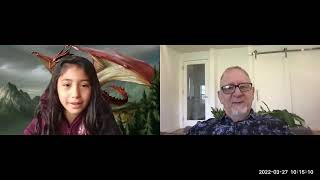
Fourth-grader Alana wrote a self-published three-book series about Abigail Williams and watched her own writing improve across the volumes. She thinks experience changes how people think and decide things, and notices how kids shift from playing to sitting and talking as they get older.
Chapters
So yeah, let me— I want to think, so Abigail Williams number 1, Abigail Williams number 2, and now is the third one— does each one have their own title?
The first one is just Abigail Williams: Tales of a Relentless Warrior Kid Who Takes Souls Everywhere She Goes. But the second one has a subtitle, and it's called Medusa Returns for Revenge. And I think that kind of separates the two books just by names.
And do you know what the title of the third one will be?
Nope.
Okay. So tell us about Abigail Williams. Who is this Abigail Williams character?
She's— or I think I kind of based it off of me, and then I just put different names. She is this girl who finds out Oh, I'm a demigod. And then she has to rescue all these others. And she kind of has to make her own village camp just by herself and her friends. And then she has to worry about Medusa and if she's going to come back and when she's going to come back.
Mm-hmm.
Yeah.
So this is very interesting. Which parts are you and which parts are not you in Abigail Williams?
I don't know. I didn't really put that into thought when I was writing them. I just based the character like first off me.
Do you think the personality is mostly you, but the situations are obviously not yours?
Yes.
Got it. And does— you're writing the third Abigail Williams book. Does she develop over time or is she the same person in all 3 books?
Um, I think she develops a little bit, her skills and probably her thought process.
And you wrote these books, would you say they're each roughly a year apart?
Yeah.
So the Alana who wrote Abigailium's 'Abigail Williams Number One' is probably a little bit different from the Ilana who wrote 'Abigail Williams Number Two,' which is still a little bit different from the Ilana that wrote 'Abigail Williams Number Three,' right?
Yes.
So do you think that the thought process in each of the three Abigail Williams reflects the development of Ilana's thought processes?
Yes, I think so. Like, I imagine in the first book there's probably a few typos and maybe, like, maybe you couldn't understand, but maybe, like, but maybe it might be better in the second one and the third one, and then all the develop— and then all the characters could kind of change.
Got it. And so how do you think your own thought processes have changed over these 3 years?
I think they've changed at least a little bit because I've noticed that there was, or in the second one, I didn't have, let's just say, as much misspelled words or places where it didn't really make sense. And it was also a few chapters longer.
So what I hear you saying is that your spelling improved from book 1 to book 2. It made more sense so that you were better able to kind of write a kind of clear story, and that you also wrote more in number 2 over number 1. Is that correct?
Yes.
And will there— do you think number 3 is any different, or books 2 and 3 going to be pretty much the same?
I hope that number 3 is going to be different. So my skills can develop and change over time. That's what I hope.
Are you aware of your skills developing and changing over time or not too much?
To me, whenever I just kind of feel the same, but then when I hear it from other people, I'm like, oh, Okay.
Can you give me an example of that?
Um, well, a few days ago, I was going over the second book with my neighbor downstairs. She's the one who edited my first one. And she found just like overused commas and stuff. But she said that She thinks that my writing improved, and I don't think I thought of that before. Or maybe I just thought it was the same.
Do you ever go back and read Abigail Williams Number One and Number Two and compare them yourself?
Not really, but whenever the books are out, someone else is reading them and I'm right there, I step toward them and just read a little bit.
Got it. Do you think that older people have different thought processes than you do, or do you have exactly the same thought processes as older people?
I think that it's not the same because one, they're probably going to have more experience than me, and two, they might see it from a different angle than a more younger person like me.
Do you have any idea how having more experience could change the person's thought process?
You would know more. And maybe if I thought maybe we should put this there, and then they said no, or maybe they said— or they argued against that.
And, um, it's tricky because what I'm getting is that you have a sense that an older person might see things differently, but it's hard to know how they would see things differently. Is that accurate?
I mean, sometimes, sometimes it could be hard. Like maybe if you've been doing that thing that, like, you're putting something there and you've been doing that all throughout your life, or writing, and maybe it could be hard to understand why not Do you have a sense—
going back to experiences— do you have a sense for how experiences change you? You're having more experiences now than you did 2 years ago or last year. How do you think experiences are changing you?
Um, I think experience— the more I work on it, maybe the more I would see and make mistakes and then correct them.
What kind of mistakes?
Um, maybe I did something totally wrong and I didn't notice it, or even maybe just I put the wrong words in the— in different places, or anything, anything like that, that then I could have experience fixing that, correcting that, and also making mistakes.
So you had just said two things originally. You had said on the one hand that with more experience, older people might see the world somewhat differently. Then you said they had a different perspective. Can you say more about ways in which older people might have a different perspective?
What do you mean? I think that— I mean, perspective could go into experience because maybe— yeah.
So they might be more or less the same thing.
Um, I don't think they're the same thing, but if maybe you have a lot of experience in paragliding or parachuting, then maybe your perspective of seeing paragliding is different from a beginner.
That makes sense. Um, do you think that in general adults see the world differently from children at all?
Um, I think they do because one, like older people compared to younger people, adults are still older than children or kids and might have more experience in that thing.
But can you make any generalizations about how in general adults would see the world in such and such way whereas kids would see the world in a different way?
Um, wait, should I give— wait, are you asking me to give an example?
If you can, that would be really great if you could give an example.
Um, this is just the first thing that comes to mind, but maybe when kids are struggling in math and maybe the adults totally understand it and the kids don't. Maybe the adults could have years and years of experience doing that Got it.
Do you think that if you saw a written paragraph, you could tell if it was written by an adult or by a child, or not necessarily?
Um, I don't know. I think I'd have to try that before.
Okay. And then, um, in your school, I assume there's some kids that are younger than you and some kids that are older than you?
Yes.
Would you say that in general younger kids are are in some ways different than older kids?
Different in what, writing or just speaking or?
I don't know, that's the question. But do they behave differently?
I think so. Maybe not. I mean, maybe some of the older kids do different things than the younger kids. I think that would be obvious. Maybe the younger kids like to play with the blocks that can connect together, while the older kids might just like to hang out in the lunch court or something.
So there's a change in the patterns of play, it sounds like.
Yes.
Would you say older kids in general like to talk more with each other than younger kids?
Um, I don't know. I mean, I usually play instead of just talking.
Got it.
But I don't think I'm as old as like 8th graders or something, so I don't know.
Does your school include 8th graders?
Yes.
And you said you gave the example of some of the older kids like to talk in the lunchroom together. Are those like just the 8th graders?
I don't know, because I've seen, I've seen a few grades do it. I'm just not sure which grades. I know they're all, I know they're above 4th grade because I'm in 4th grade.
Got it. And so you're kind of with the, there you go, you've given me 2 groups. Group 1 likes to sit and talk together. Group, maybe I should do it the other way. Group 1 likes to play and Group 2 likes to sit and talk together. Would you say those are pretty clearly defined groups, that either you're a younger kid who loves to play or you're an older kid that loves to talk to each other, or are there more than those two groups?
Um, I mean, sometimes there might be more because sometimes I see like second graders maybe just kind of walking and talking, but I, I don't know if that counts as sitting down and sitting down and talking because they're Maybe not playing, but they're moving.
So would you say the two— so it sounds like we're talking about things kids do when they're free to do whatever they want to do. So, you know, this is different from math or whatever, but it sounds like when kids are free to do whatever they want to do, either they play or they talk, or maybe some combination of play and talk. Is that accurate?
Yes, but I also— some of my classmates read during lunch or draw, or they don't have to play all the other games as maybe I do, because I have a few— my friends and I have a few games that we play like every single day. We really like that.
What kind of games do you guys play every day?
Um, we love playing Infection or Tag, and then we learned this new game called— we call it Lions and Zebras. It's basically a mixture of Tag capture the flag, and yeah, it's really fun. Basically, it starts out as one person, one person is the lion, and he starts off at the middle left side of the court, and then all the other people have to run across, and they'll have either a flag or a paper towel tucked in their pants, and if the lion pulls that out, then you're lying with that line.
It sounds really fun. Um, are there some kids that sometimes play and sometimes talk, or do kids— and then you've also got the kids who read and draw, but are there kids that go back and forth, or generally when you're younger you play and then at some point older kids almost exclusively talk?
Um, there are a few people that kind of cycle into a game, but sometimes they'll talk or play somewhere else or play with us. But there's a few people that I know who just read like every single day.
Yeah.
And I love reading. So sometimes—
do you sometimes read instead of play?
Um, no, I never really bring a book down. I'm always focused on—
it sounds like you read enough at home that when you're in school you want to play. Is that accurate?
Yes, and plus we have a designated time at school to read.
Got it. And then, um, you know, those kids who sometimes who cycle— you said cycle in and out of the plane— would you say they're just a little bit older than you? Do you have a sense if those are 5th graders or 6th graders, or do sometimes 8th graders come and play with the 4th graders?
Um, actually, so during lunch it's from 1st grade to 4th 5th grade outside in the court so that the 5th graders up to 8th graders can go next. So usually if it's not from our class, it's really— it's either 2nd graders or 3rd graders.
Got it. So you guys are playing together. Does anybody in your, in your level, grades 1 through 4, do they ever sit and talk, or most of— most everybody plays at that level?
Um, some people sit and talk and do other stuff. They might not just sit and talk. I, um, some of my friends sometimes sit and talk, but sometimes they're also active and maybe they're playing with us or doing something on their own.
Got it. And with the 5th through 8th graders, do you know if some of them are still playing or they're mostly at a sitting and talking stage?
I'm, I think most of them are, so are playing. I mean, I don't I don't know when you kind of start to just sit down and talk, but I've noticed— but just the reason why I said that is because most of the time I see older kids, I see them sitting down and talking.
I think it's an interesting transition. Do you think it's an interesting transition?
I think so, because I don't really see the point in sitting— or I mean, I guess I do, but I think, I think just playing is funner.
Do you think in 4 years you'll just want to play, or do you think in 4 years you might want to sit and talk?
I think in 4 years I might want to sit and talk because I don't know when my wants will change, and maybe I will, I don't know, want to do that instead of play.
Yeah, it's interesting. And I think, I expect you're probably correct that it's about what you want changes. And so right now what you want is playing, and at some point what you want could change. And that, do we have, do you have any idea why what we want changes as we get older?
Not really. Maybe it could be, maybe it could be interests, or maybe depending on how you act.
Mm-hmm. Well, I think human beings are interesting to study. You know, zoologists study animals, like there are people that study dolphins and people that study dogs and monkeys and everything. Do you think that we could study human beings just like we study monkeys or dolphins or dogs?
I think we could. There's humans all over the world.
Yeah. Um, do you think that there are general patterns to human development, just like there are, you know, a puppy. Would you, would you say a puppy dog acts differently than a grown-up dog?
Um, I think that, I think yes, because maybe a puppy dog could be more excited and maybe smaller than a grown-up dog would. I think most, not most, but most of the grown-up dogs I've seen are not jumpy, and they're kind of calm.
Yeah, so just like we can make generalizations about puppy dogs versus adult dogs, we can probably make generalizations about kids versus adults. Fair enough?
Yes.
Okay, well, I think it's really fun to explore these things. So again, I don't want to go too long, um, but I'm glad to have you exploring these things with me, and I will read more Abigail Williams soon. Okay?
Okay.
Okay, have a great week, Alana.
Thank you.






